![[NFT GIVEAWAY] The milestone of element 50: tin - The Periodic Elements NFT](https://www.publish0x.com/img/566717.webp?action=resize&ar=1&enc=webp&inv=0&ori=1&st=1&up=1&w=1140&signature=0d9319722c4c2a6022711015466fa7fc64a62444548eac67580c54b71686c6fc)
Introduction
Round numbers are always seen as a goal and for us too, reaching element 50 of the Periodic Table means a lot.
We started in October 2020 a bit for fun and thanks to you we got passionate about this project, seeing it as a great opportunity for many to support study/curiosity with the world of NFT.
Thanks to all and good element 50 to all.
Tin
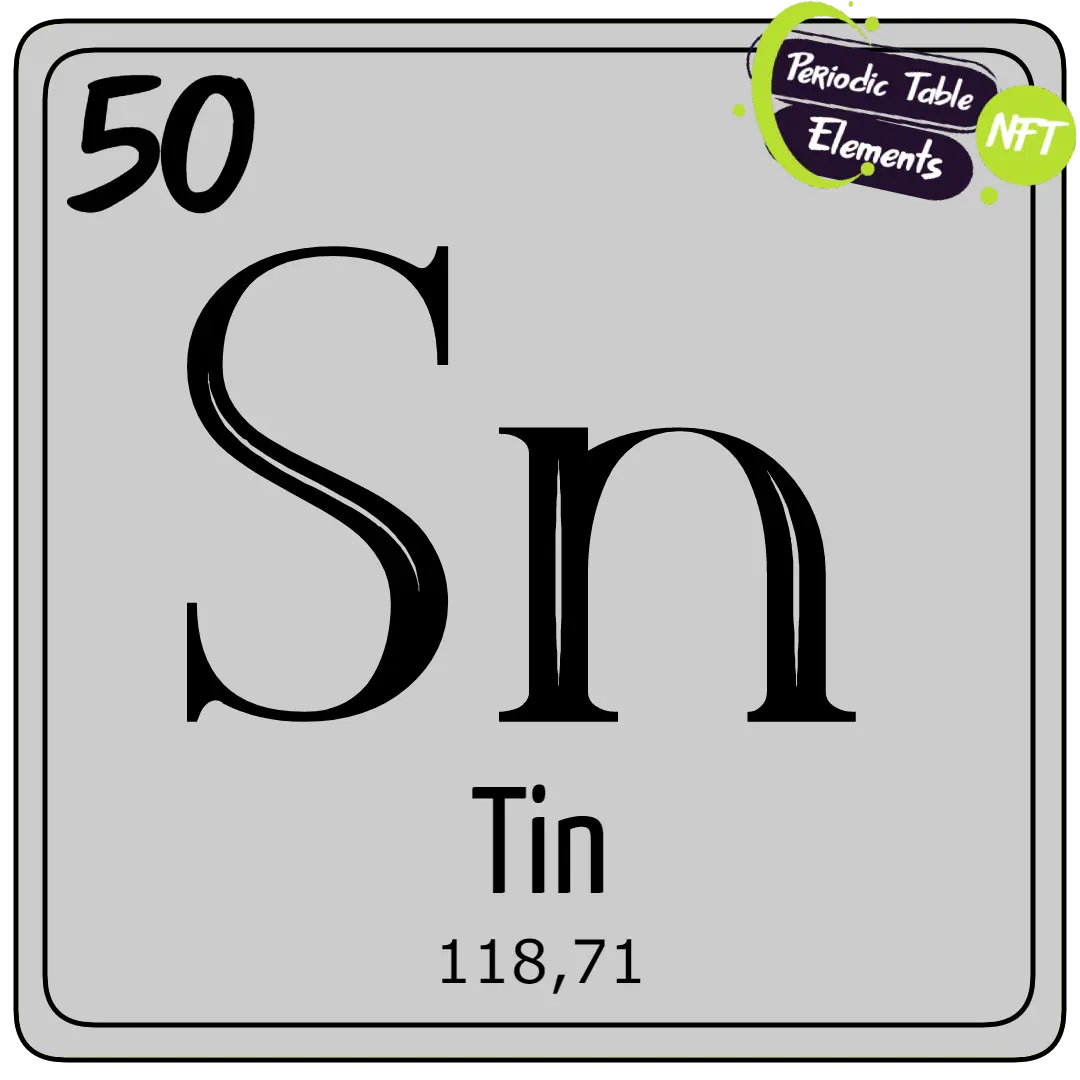
Tin is a chemical element on the periodic table that has symbol Sn and atomic number 50.
Tin is a malleable and very ductile silvery white metal, with a particular crystalline structure that causes a characteristic screech when a tin rod is bent (the noise is caused by the breaking of the crystals): when heated, it loses its ductility and becomes brittle .
Tin (from the Latin stannum) was one of the first metals to be discovered, and since ancient times it was intensively used for its effect as a binder of copper, of which it greatly increases the hardness and mechanical qualities forming the alloy known as bronze, in use until 3500 BC. The tin mining activity presumably began in Cornwall and Dartmoor in the classical age: thanks to it these regions developed a dense trade with the civilized areas of the Mediterranean Sea. Pure tin was not used in metallurgy until 600 BC.
About 35 countries in the world have active tin mines and virtually every continent has a major tin producer. Metallic tin is produced by reducing the ore with coal in a reverberatory furnace. Most of the world's tin deposits are alluvial in nature and half of them are in Southeast Asia.
Tin binds easily to iron and was used in the past to coat lead, zinc and steel to prevent corrosion. Tinplate containers, cans and tins (tin-plated steel sheet) are still widely used to preserve food, a use that covers a large part of the world market for tin metal.
Other Uses:
- Some important tin alloys are: bronze in its various formulations (such as bell alloy, phosphor bronze and statuary bronze), Babbitt metal, die casting alloys, pewter, soldering iron, princisbecco and White metal.
- The most important tin salt is tin chloride which is used as a reducing agent and as a mordant in calico printing. When tin salts are sprayed on the glass, an electrically conductive coating is formed: this phenomenon is exploited in the manufacture of light panels and for anti-ice windbreaks.
- Window glass is most often made by cooling molten glass by floating it over a mass of molten tin to obtain a flat surface (this is the famous Pilkington process).
- Tin is also used in soldering to join copper and lead pipes and is included in the composition of the most popular solder alloys used for electronic components and circuits, in brass alloys, in glass manufacturing and in a wide range of chemical processes.
- Tin sheets (tinfoil) were a packaging for food and medicines. They have now been supplanted by very thin laminated aluminum sheets.
- Organic compounds of the pond are used in the antifouling paints with which the living work of the ships is painted to prevent the proliferation of algae, crustaceans and molluscs on it (for example the Tributil Tin Oxide - TBTO).
Tin becomes superconducting below 3.72 K: it was one of the first superconductors discovered.
The giveaway
We had already announced it to you: this will be a special giveaway, where you can relax on the sofa, with your drink protected by a tin foil and call your friends. This is a good opportunity to get your best friend an NFT.
The max supply of the element is 299 NFT and 280 are dedicated to this giveaway. A very high number when compared to other giveaways.
To participate in the giveaway just comment this article with your wax address, no other action is necessary. The comment must be entered by June 6 at 16:00 CEST (the timing is also longer than usual). [1 wallet - 1 user].
If the number of valid comments exceeds 280, an extraction will be made.
However, this does not mean that the element 50 will have little value, because we immediately anticipate that the next molecule will contain the tin element. The new contest will be launched simultaneously with the assignment of the NFTs to the winners.
Elements released
- The first 30 elements
- #31 Gallium (max supply 200)
- #32 Germanium (max supply 149)
- #33 Arsenic (max supply 200)
- #34 Selenium (max supply 99)
- #35 Bromine (max supply 200)
- #36 Krypton (max supply 200)
- #37 Rubidium (max supply 249)
- #38 Strontium (max supply 200)
- #39 Yttrium (max supply 149)
- #40 Zirconium (max supply 99)
- #41 Niobium (max supply 200)
- #42 Molybdenum (max supply 200)
- #43 Technetium (max supply 200)
- #44 Ruthenium (max supply 299)
- #45 Rhodium (max supply 99)
- #46 Palladium (max supply 200)
- #47 Silver (max supply 200)
- #48 Cadmium (max supply 149)
- #49 Indium (max supply 200)
- #50 Tin (max supply 299)
Molecule released
- H2O - Water (max supply 37)
- NaCl - Salt (max supply 64)
- CaC2 - Calcium carbide (max supply 46)
- KMnO4 - Potassium permanganate (max supply 57)
- HCN - Hydrogen cyanide (max supply 59)
- CH2N2 - Diazomethane (max supply 46)
- LiCoO2 - Lithium cobalt oxide (max supply 53)
- LiBH4 - Lithium borohydride (max supply 51)
- PSYCO - Strychnine (max supply 62)
Celebrity released
- Lavoisier (max supply 149)
- Glauber (max supply 149)
- Marggraf (max supply 149)
- Curie (max supply 149)
Link to save
- Market on atomichub for the purchase of NFTs
- Blog on publish0x to be updated
- Telegram channel
- Discord: in the "all-projects" channel
- The Periodic Table of Elements WAX Book
(Photo by Nathan Dumlao on Unsplash)






