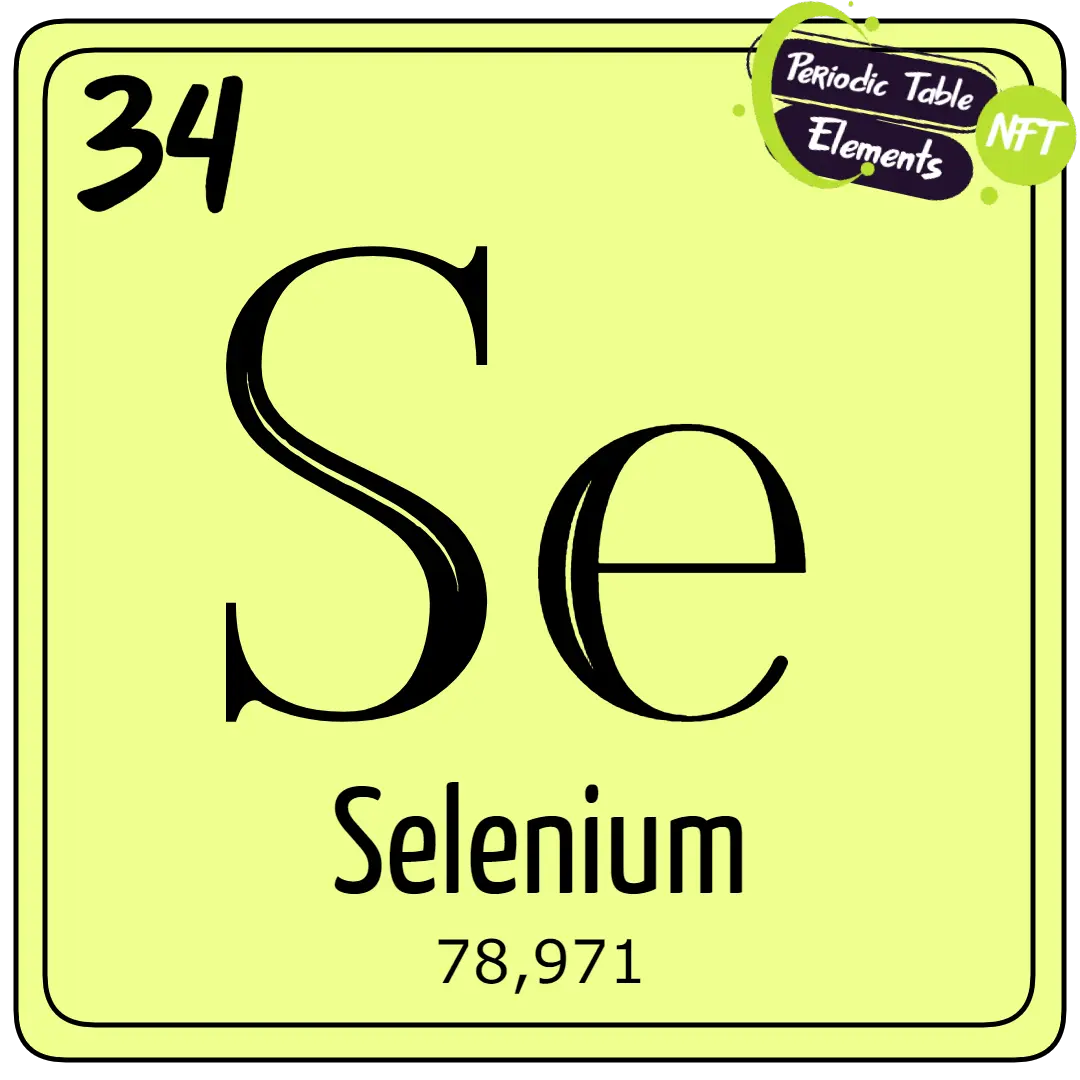
Selenium is the chemical element with atomic number 34 and its symbol is Se.
It is a non-metal chemically related to sulfur and tellurium. The element is toxic in high doses but in 1957 Schwarz and Foltz established that it is an essential element in the diet, useful in the prevention of some diseases.
Selenium exists in various allotropic forms. As a powder it is amorphous selenium red, while the glassy form is black. The hexagonal crystalline shape is metallic gray, while the monoclinic crystal has a saturated red color.
It also has photovoltaic properties, that is, it converts light into electricity, and exhibits a photoconductive effect, that is, the electrical conductance increases if selenium is exposed to light.
Another use of selenium is in photography. In artistic photography it is used to extend the tonal range of black and white prints and to increase the intensity of tones; it can also be used to increase the permanence of images.
In the late 1990s it became increasingly common to use selenium, together with bismuth, as an additive to soldering brass instead of lead, to comply with anti-pollution regulations.
Natural sources of selenium are fish, meat, offal, milk and derivatives, brewer's yeast, cereals, nuts, mushrooms, fruits and vegetables. To take an adequate daily amount of Selenium, except for specific cases, a healthy and balanced diet is sufficient, in particular rich in milk, yoghurt, eggs, cereals and, in particular, nuts and peas.
The giveaway
Selenium is one of the rare elements from the Periodic Table Collection. Its max supply is only 99 pieces. We have decided to dedicate 60% of the supply to the giveaway. However, as anticipated in a couple of articles, the time to participate is short, only 24 hours.
All those who comment on this article with their WAX address by 09:00 CEST on 10 February will participate in the 60 NFT Selenium draw.
Warn friends that time is running out
The Periodic Table NFT project
The Periodic Table NFT project aims to raise awareness of chemical elements in a modern key, basing the approach on blockchain and Non Fungible Token.
Day after day it will be possible to know the single elements that make up the table, to collect curiosities about each of them and about the table in general.
We are working to be able to learn, in a playful way, also what happens by combining the various elements.
The whole project is based on the collection of NFTs that can be bought on the site https://wax.atomichub.io/market?collection_name=periodicelem&order=desc&sort=created&symbol=WAX or by participating in simple giveaways published on publish0x.
Elements released
- The first 30 elements
- #31 Gallium (max supply 200)
- #32 Germanium (max supply 149)
- #33 Arsenic (max supply 200)
- #34 Selenium (max supply 99)
Molecule released
- H2O - Water (max supply 37)
- NaCl - Salt (max supply 64)
- CaC2 - Calcium carbide (max supply 46)
- KMnO4 - Potassium permanganate (max supply 57)
- HCN - Hydrogen cyanide (max supply 59)
- CH2N2 - Diazomethane (max supply 46)
Celebrity released
Link to save
- Market on atomichub for the purchase of NFTs
- Blog on publish0x to be updated
- Telegram channel
- Discord: in the "all-projects" channel
Resources:






