![[NFT GIVEAWAY] A laser light from Samarium - The Periodic Elements NFT](https://www.publish0x.com/img/876270.webp?action=resize&ar=1&enc=webp&inv=0&ori=1&st=1&up=1&w=1140&signature=c46cb0c1b77946c1316a0ca04e516bac5554e9ca88ec3904e895704429ece756)
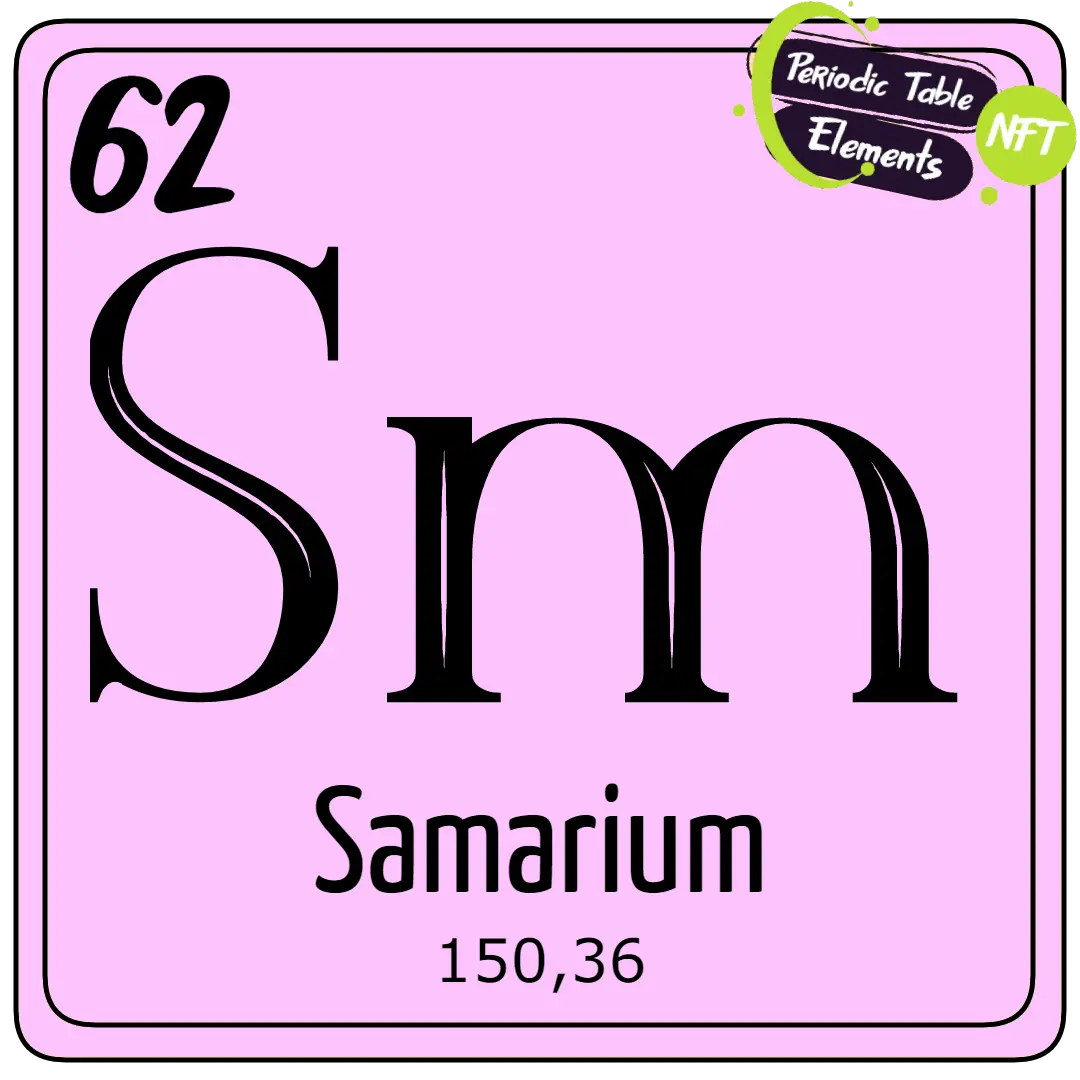
Samarium is the chemical element with atomic number 62 and its symbol is Sm.
Samarium is a silvery-looking lanthanide metal, fairly stable in air at temperatures below 150°C; above this limit it ignites spontaneously.
It exists in three different crystalline forms depending on the temperature; the conversion temperatures between them are 734°C and 922°C.
Samarium was identified for the first time in 1853 spectroscopically by the Swiss chemist Jean Charles Galissard de Marignac. It was then the Frenchman Paul Émile Lecoq de Boisbaudran who isolated it in 1879 from samarskite. Both the latter mineral and the element are named after the Russian engineer Samarsky.
Samarium is not found in nature in its native state; like other rare earth elements it is contained in several minerals, including monazite, bastnasite and samarskite. Monazite, which contains up to 2.8%, and bastnasite are the main industrial sources of this element.
The uses of samarium include:
- the production of arc lamps for cinematography, along with other rare earth elements
- the doping of CaF2 crystals for the realization of lasers and masers
- the construction of neutron absorbers in nuclear reactors
- some special alloys
- the production of permanent magnets with high resistance to demagnetization
- production of glasses capable of absorbing infrared light by adding samarium oxide
- the dehydration and dehydrogenation of ethanol, reactions for which samarium oxide is a catalyst nuclear medicine: isotope 153 is used in medicine for the treatment of bone metastases.
The giveaway
The ways to participate in the giveaway and receive an NFT of this element remain very simple: enter a comment in this article with your WAX address by Tuesday, December 13 at 16:00pm CST.
Among all valid comments 69 winners will be drawn who will receive this NFT for free with a max supply of 149. (1 user - 1 wallet - 1 NFT).
The Periodic Table of Elements NFT project
The Periodic Table NFT project aims to raise awareness of chemical elements in a modern key, basing the approach on blockchain and Non Fungible Token.
Day after day it will be possible to know the single elements that make up the table, to collect curiosities about each of them and about the table in general.
We are working to be able to learn, in a playful way, also what happens by combining the various elements.
The whole project is based on the collection of NFTs that can be bought on the site https://wax.atomichub.io/market?collection_name=periodicelem&order=desc&sort=created&symbol=WAX or by participating in simple giveaways published on publish0x.
Elements released
- The first 30 elements
- Elements from number 31 to 50
- #51 Antimony (max supply 200)
- #52 Tellurium (max supply 199)
- #53 Iodine (max supply 200)
- #54 Xenon (max supply 149)
- #55 Cesium (max supply 200)
- #56 Barium (max supply 200)
- #57 Lanthanum (max supply 299)
- #58 Cerium (max supply 200)
- #59 Praseodymium (max supply 200)
- #60 Neodymium (max supply 200)
- #61 Promethium (max supply 99)
- #62 Samarium (max supply 149)
Molecule released
- H2O - Water (max supply 37)
- NaCl - Salt (max supply 64)
- CaC2 - Calcium carbide (max supply 46)
- KMnO4 - Potassium permanganate (max supply 57)
- HCN - Hydrogen cyanide (max supply 59)
- CH2N2 - Diazomethane (max supply 46)
- LiCoO2 - Lithium cobalt oxide (max supply 53)
- LiBH4 - Lithium borohydride (max supply 51)
- PSYCO - Strychnine (max supply 62)
- CuSn - Bronze (max supply 64)
- Sn4P3 - Tin Phosphide (max supply 44)
Celebrity released
- Lavoisier (max supply 149)
- Glauber (max supply 149)
- Marggraf (max supply 149)
- Curie (max supply 149)
Link to save
- Market on atomichub for the purchase of NFTs
- Blog on publish0x to be updated
- Telegram channel
- Discord: in the "all-projects" channel
- The Periodic Table of Elements WAX Book
(Photo by Erfan Afshari on Unsplash)





