![[NFT GIVEAWAY] Xenon headlights for our sports cars - The Periodic Elements NFT](https://www.publish0x.com/img/650330.webp?action=resize&ar=1&enc=webp&inv=0&ori=1&st=1&up=1&w=1140&signature=4f6a20939d5a359531f9b51198f4b731a812df279257e3b50df48b772325e6b4)
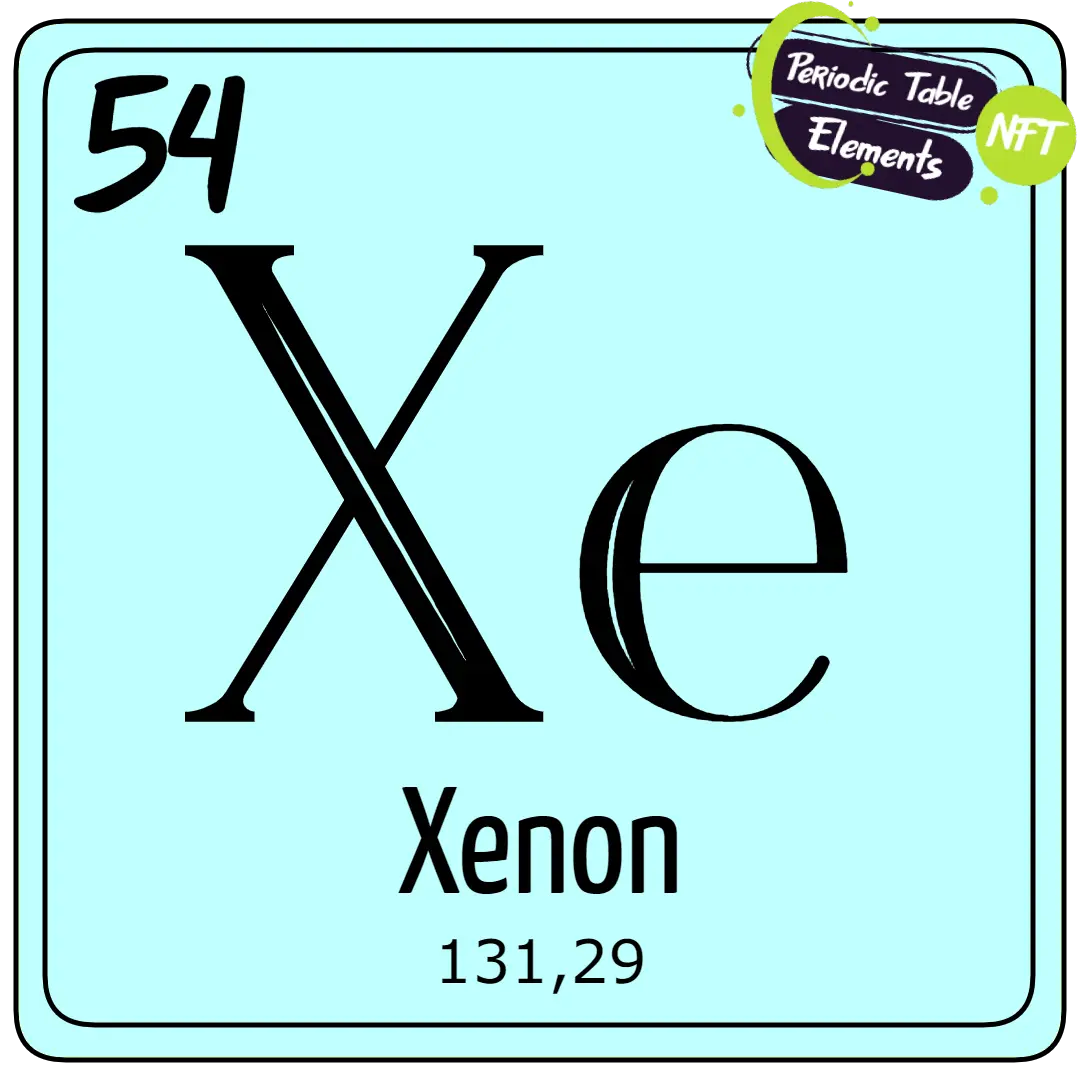
Xenon is the chemical element with atomic number 54 and its symbol is Xe.
It is a colorless, odorless and very heavy noble gas; it is found in trace amounts in the Earth's atmosphere and was the first noble gas of which compounds have ever been synthesized.
Excited by an electric discharge, the xenon produces a blue light; this phenomenon is exploited in the production of lamps.
This gas is famous and mainly used for the production of lamps and light devices: xenon flash lamps for photography, stroboscopic lights, excitation sources for lasers, bactericidal and dermatological lamps, lamps for automotive lighting; now all the lamps used for film projections use this gas.
Xenon was identified in 1898 in England by William Ramsay and Morris Travers in the residue obtained by partial evaporation of liquid air. Its name was given because its presence in atmospheric air had a concentration of 8 × 10⁻⁸ (0.0000008%) by volume, hence for its "rarity".
Until 1962, xenon and other noble gases were considered chemically inert and unable to form any chemical compound. This belief has been disproved and some stable compounds of noble gases have been synthesized.
The giveaway
It is the last element of period 5 and as we have now learned, the last box of each period is occupied by a noble gas. This definition has always fascinated me and given its characteristics, we have decided that this element will have a max supply of only 149 units.
Like every element of the periodic table so far distributed in this collection, part of the supply is destined for a giveaway in which 70 users will be awarded.
To participate is very simple: just comment this article with your wax address. You can optionally indicate a use of the xenon element.
The 70 winners (1 user - 1 wallet - 1 possible NFT) will be extracted from all those who enter their comments by 22 September at 16:00 CEST in the following ways:
- 1 ticket for the comment
- 1 additional ticket for the indication of use of the xenon element
Notes on the artist
Next week we will present the artist who will accompany us with the realization of the NFT molecule. On that occasion the NFTs of the last molecule contest will be shown and sent to the winners. We apologize and thank you for waiting, but we have tried to do things as well as possible with the inclusion of a new partner.
The Periodic Table NFT project
The Periodic Table NFT project aims to raise awareness of chemical elements in a modern key, basing the approach on blockchain and Non Fungible Token.
Day after day it will be possible to know the single elements that make up the table, to collect curiosities about each of them and about the table in general.
We are working to be able to learn, in a playful way, also what happens by combining the various elements.
The whole project is based on the collection of NFTs that can be bought on the site https://wax.atomichub.io/market?collection_name=periodicelem&order=desc&sort=created&symbol=WAX or by participating in simple giveaways published on publish0x.
Elements released
- The first 30 elements
- Elements from number 31 to 50
- #51 Antimony (max supply 200)
- #52 Tellurium (max supply 199)
- #53 Iodine (max supply 200)
- #54 Xenon (max supply 149)
Molecule released
- H2O - Water (max supply 37)
- NaCl - Salt (max supply 64)
- CaC2 - Calcium carbide (max supply 46)
- KMnO4 - Potassium permanganate (max supply 57)
- HCN - Hydrogen cyanide (max supply 59)
- CH2N2 - Diazomethane (max supply 46)
- LiCoO2 - Lithium cobalt oxide (max supply 53)
- LiBH4 - Lithium borohydride (max supply 51)
- PSYCO - Strychnine (max supply 62)
- CuSn - Bronze (max supply 64)
- Sn4P3 - Tin Phosphide (max supply 44)
Celebrity released
- Lavoisier (max supply 149)
- Glauber (max supply 149)
- Marggraf (max supply 149)
- Curie (max supply 149)
Link to save
- Market on atomichub for the purchase of NFTs
- Blog on publish0x to be updated
- Telegram channel
- Discord: in the "all-projects" channel
- The Periodic Table of Elements WAX Book
(Photo by Vincent Péré on Unsplash)






