![[NFT GIVEAWAY] Cerium to be cut with a knife - The Periodic Elements NFT](https://www.publish0x.com/img/836508.webp?action=resize&ar=1&enc=webp&inv=0&ori=1&st=1&up=1&w=1140&signature=4641e2505e211a034898b2ee84bb861ac751cbbea27302039dc8ea2df42133d5)
To participate in this giveaway it is very simple and free: just enter a WAX address in the comments of the article by Wednesday 7 September at 16:00 CEST.
Among all those who enter their WAX address correctly, 100 wallets will be extracted to which a free NFT will be sent (1 wallet - 1 user - 1 NFT).
Have you entered your WAX address? Done?
It is time to understand a little better what you are participating in if you do not know the collection on the Periodic Table of Elements. It is a project started in October 2020 to combine the spread of NFT with the spread of a hostile topic like chemistry.
It was decided to use the Publish0x platform as an archive of all documentation and the WAX blockchain for the management of NFTs.
An element of the Periodic Table is explained at periodic intervals by pairing a free NFT giveaway on that element. To make everything more lively, we try to vary the distribution method: extraction, the fastest, with small activities, mixed, ...
Little by little, a small community has been created that is waiting to brush up on their school memories on this topic.
From time to time we integrate with some NFTs beyond the Periodic Table such as famous people in chemistry or everyday events.
Finally, there is the possibility of playing with small chemists by forming molecules with their own elements in the portfolio in contests that occasionally involve the community.
In recent months we have been a bit stuck due to various everyday reasons but we have made the commitment to go through the entire Periodic Table togheter with you and therefore the project is not going to die.
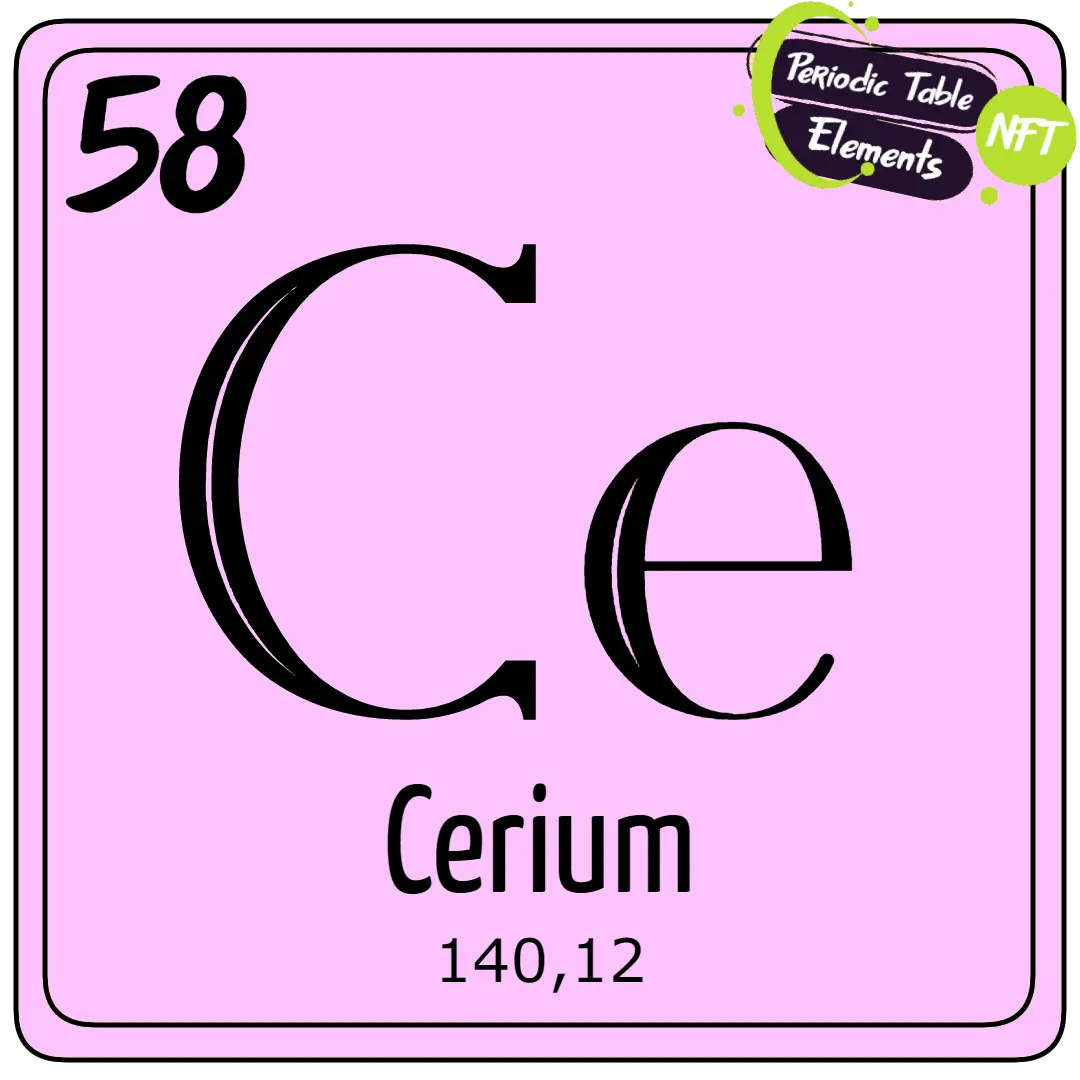
We had arrived at element 57 and now it is the turn of Cerium, element number 58 with the symbol Ce.
It is a ductile, silvery-white metal. It oxidizes quickly when exposed to air and is soft enough to be cut with a knife. Cerium is the second element of the lanthanide series.
It is also traditionally considered to be one of the rare earth elements. Although it is always found in combination with other rare earth elements, in minerals such as monazite and bastnäsite, cerium is easy to extract. It is the most common of the lanthanides and is the 26th most abundant element.
Cerium was the first of the lanthanides to be discovered in 1803. The name cerium was given by Berzelius from the name of the dwarf planet Ceres, discovered two years earlier.
Pure metal can easily catch fire if scratched with a blade.
Some of the most common uses:
- cerium is used in the production of aluminum alloys and some steels.
- the addition of cerium to cast iron castings avoids graphitization and allows the production of malleable cast iron.
- it is used in the production of stainless steels as a precipitation hardening agent.
- it is used in alloys for permanent magnets.
- it is a component of Mischmetal, widely used in the production of highly pyrophoric alloys for cigarette lighters.
- Cerium is also used in voltaic arc lamps, particularly in the film industry.
- Ceric sulfate is widely used as a volumetric oxidizing agent in quantitative analysis.
- compounds of cerium are used in the production of glass, both as components and as bleaches.
- compounds of cerium are also used to produce colored glazes.
Cerium, like all rare earths, is moderately toxic. It is a strong reducing agent and ignites spontaneously in air when heated to 65–80 ° C. Cerium can react explosively with zinc and its reaction with bismuth and antimony is very exothermic. The fumes from cerium fires are toxic. Water should not be used to extinguish cerium fires, because the chemical reaction between cerium and water releases hydrogen, which is highly flammable. Workers exposed to cerium complained of itching, heat sensitivity and skin lesions; animals injected with large doses of cerium died of cardiovascular collapse.
The Periodic Table NFT project
The Periodic Table NFT project aims to raise awareness of chemical elements in a modern key, basing the approach on blockchain and Non Fungible Token.
Day after day it will be possible to know the single elements that make up the table, to collect curiosities about each of them and about the table in general.
We are working to be able to learn, in a playful way, also what happens by combining the various elements.
The whole project is based on the collection of NFTs that can be bought on the site https://wax.atomichub.io/market?collection_name=periodicelem&order=desc&sort=created&symbol=WAX or by participating in simple giveaways published on publish0x.
Elements released
- The first 30 elements
- Elements from number 31 to 50
- #51 Antimony (max supply 200)
- #52 Tellurium (max supply 199)
- #53 Iodine (max supply 200)
- #54 Xenon (max supply 149)
- #55 Cesium (max supply 200)
- #56 Barium (max supply 200)
- #57 Lanthanum (max supply 299)
- #58 Cerium (max supply 200)
Molecule released
- H2O - Water (max supply 37)
- NaCl - Salt (max supply 64)
- CaC2 - Calcium carbide (max supply 46)
- KMnO4 - Potassium permanganate (max supply 57)
- HCN - Hydrogen cyanide (max supply 59)
- CH2N2 - Diazomethane (max supply 46)
- LiCoO2 - Lithium cobalt oxide (max supply 53)
- LiBH4 - Lithium borohydride (max supply 51)
- PSYCO - Strychnine (max supply 62)
- CuSn - Bronze (max supply 64)
- Sn4P3 - Tin Phosphide (max supply 44)
Celebrity released
- Lavoisier (max supply 149)
- Glauber (max supply 149)
- Marggraf (max supply 149)
- Curie (max supply 149)
Link to save
- Market on atomichub for the purchase of NFTs
- Blog on publish0x to be updated
- Telegram channel
- Discord: in the "all-projects" channel
- The Periodic Table of Elements WAX Book
(Photo by Jimmy Chang)






