
Amidst the turmoil of the Peloponnesian War, both warring sides - Athens’ Delian League and Sparta’s Peloponnesian League - would eventually come to an agreement of sorts in the form of the Peace of Nicias. Due to character, however, the two sides would continue to be at each other’s throats in one form or another, turning this planned fifty years of peace into one that would last but a few. Amidst desperations to gain a stronger footing in the war, and in Greece as a whole, Alcibiades, perhaps history’s most charismatic and interesting political figure, would rise to great prominence and greater influence, helping to plunge Athens into its greatest ever mistake: a full-scale invasion of Sicily.
Check out my previous post on The Battle of Mantinea, 418 BC
EARLIER LIFE
In this man, Nature seems to have tried to see what She could accomplish; for it is agreed by all who have written his biography that he was never excelled either in faults or in virtues.
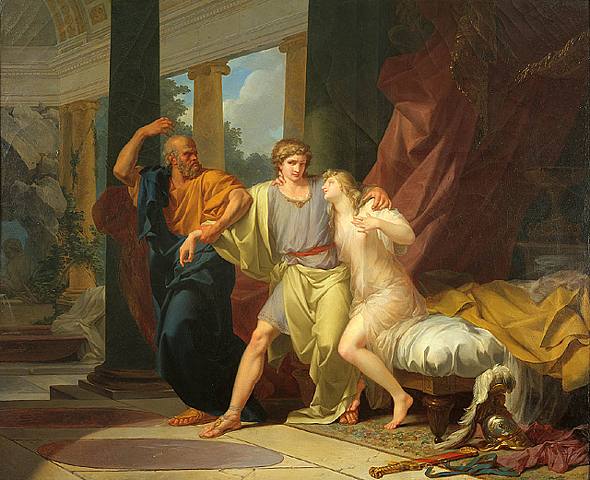
[ABOVE: "Socrates Dragging Alcibiades from the Embrace of Sensual Pleasure", by Jean-Baptiste Regnault, 1791, now in the Louvre]
So says the Roman historian, Cassius Dio. Born in Athens to a noble family around 450 BC, Alcibiades was the son of Cleinias, a renowned politician and veteran commander who won notoriety and praise for his personal skill during the Battle of Artemisium, 480 BC, later dying in the battle of Coronea during the First Peloponnesian War. His mother, Deinomache, could supposedly trace her lineage back to Eurysaces, the son of the Greek hero Ajax from the Trojan War, meaning his family was also the Alcmaeonidae, the powerful and controversial family that ruled as Athens’ last tyrants, but also included Pericles himself.

[ABOVE: Modern 1911 bust of Pericles, now held in the British Museum]
Alcibiades was raised in Pericles’ home, being his stepson. One of Alcibiades’ most noteworthy features were his looks; he was described as easily being the most handsome man of his day, and skilled in many aspects of life. Plutarch states that he had a lisp, but that it gave his speech further persuasiveness. The historian further describes Alcibiades' son's mannerisms being alike to his fathers:
That people may believe him like his father,
He walks like one dissolved in luxury,
Lets his robes trail behind him on the ground,
Carelessly leans his head, and in his talk,
Affects his lisp.
CHARACTERISTICS
Growing up and entering politics, he eloquently stood out as one of his day’s best orators, having a style of speech delivery that was hard to resist. Described further as energetic, enduring, generous, publicly and privately magnificent, agreeable, gracious, adaptable, he was also described as extravagant, indifferent and licentious - his varied states of being baffled many!
PERSONAL LIFE
In around 424 BC, Alcibiades married Hipparete, the daughter of Hipponicus III, described as the richest Greek of his time. His lifestyle of courting with courtesans made Hipparete decide to move out of her husband's house to live with her brother, which did not seem to phase Alcibiades. When she later legally sued for a divorce, he marched up to her, carried her off himself through the streets and markets of Athens and forced her back into his home, where she would remain for the rest of her life.
He was tutored by none other than Socrates himself, who is said to have shared a bed with Alcibiades on several occasions. It was their close personal alliance that made the young Alcibiades so popular even in youth, to the point where even the name of Alcibiades’ wet nurse is known: Amycla of Lacedaimon. Plato, in his “Alcibiades” passages, quotes Socrates:
I was the first man to fall in love with you, son of Clinias, and now that the others have stopped pursuing you I suppose you’re wondering why I haven’t given up - and also why, when the others pestered you with conversation, I never even spoke to you all these years. Human causes didn’t enter into it; I was prevented by some divine being, the effect of which you’ll hear about later on. But now it no longer prevents me, so here I am. I’m confident it won’t prevent me in future either.
It is said that Socrates’ words and philosophy moved Alcibiades to tears, disturbing his soul. On occasion, however, Alcibiades would revert to type when offered physical pleasures by other people, causing Socrates to constantly chase after him to bring him back to philosophy, only having a hold on him via his words. Any who sought to corrupt Alcibiades would prey on his ambitious, vain side, egging him on to undertake affairs no one else would dream of and claiming he could outshine even Pericles.

[ABOVE: "Socrates Seeking Alcibiades in the House of Aspasia", by Jean-Léon Gérôme, 1861]
RECOGNITION
Perhaps his most noteworthy feature, however, was his drive for superiority, notable since youth; thrown into wrestling at a young age, when grabbed by a superior opponent, Alcibiades grabbed his hand and bit into it. When told,
You bite, Alcibiades, like a woman!
he simply replied,
No, like a lion.
He was also honoured throughout Greece for his great successes in the Olympic Games, using his vast collection of horses to win several races. While he himself did not participate personally in the games, the lavish horses he owned won him first and second prizes, and possibly a third or fourth as well. In short, with the finest tutors, heritage and city at his helm, he was gifted since birth, blessed with great circumstances and loved by all in spite of his shortcomings. Going into a grammar-school, he requested the works of Homer. When the tutor said he didn't have any copies of the Iliad or Odyssey, Alcibiades punched him in the face. When he was studying under a second tutor who stated he had Homer corrected by himself, Alcibiades asked the tutor,
How, and do you employ your time in teaching children to read? You, who are able to amend Homer, may well undertake to instruct men.
MILITARY CAREER

[ABOVE: 18th century engraving of Socrates saving Alcibiades at the Battle of Potidaea, 432 BC]
Both Alcibiades and Socrates took part in the Battle of Potidaea in 432 BC, the catalyst which started the Peloponnesian War. Both men shared sleeping quarters outside of battle and stood shoulder-to-shoulder in formation. Alcibiades received a wound during a skirmish in the battle, causing Socrates to throw himself at Alcibiades to protect him. The two also fought at the Battle of Delium, 424 BC, in which Alcibiades, on horseback, rescued Socrates while the rest of the Athenian army retreated from the pursuing Boeotians. After the Battle of Mantinea, 418 BC, Alcibiades was key in persuading the city, under threat of losing their democracy via the Argives and Spartans, to take up arms and repel the invaders, reinstating their democracy and fortifying their city walls and better connecting and protecting their port to better connect it with Athens.

[ABOVE: "Socrates at the Battle of Delium", by Thomas Couture, 1843]
Come 416 BC, Alcibiades had made a well-established name for himself, encircling himself with several prominent and wealthy persons in Athens. It's here that the young prodigy enters into the spotlight midway through the Peloponnesian War, as the war-hungry city-state began to set its eyes elsewhere; while Sparta regathered their strength, conflict stirred far to the west - Sicily, Athens thought, could be ripe for glory.
SICILIAN HISTORY
Sicily’s Greek history is almost as ancient as the rest of the Greek world’s at the time; Thucydides recounts that the cyclops once inhabited the island, but with no further details provided, followed by the Sicanians, displaced from their homeland in the Iberian Peninsula, and providing the island with its Greek-given name of Sicania. Sicanians continued to inhabit the island’s western half. Following the capture of Troy, many Trojans apparently made their way by boat to Sicily for refuge, as did many Greek arrivals from Libya and nearby Italy, going on to found several cities. One group from Italy were called the Sicels, who were forced out of their homeland in Italy by the Opicians, and their king Italus, who gave the mainland peninsula its name. Upon arriving on the Mediterranean island, the newly arrived Sicels fought the Sicanians, displacing them in the west of the island, and paving the way for the island to be renamed after them as Sicily.
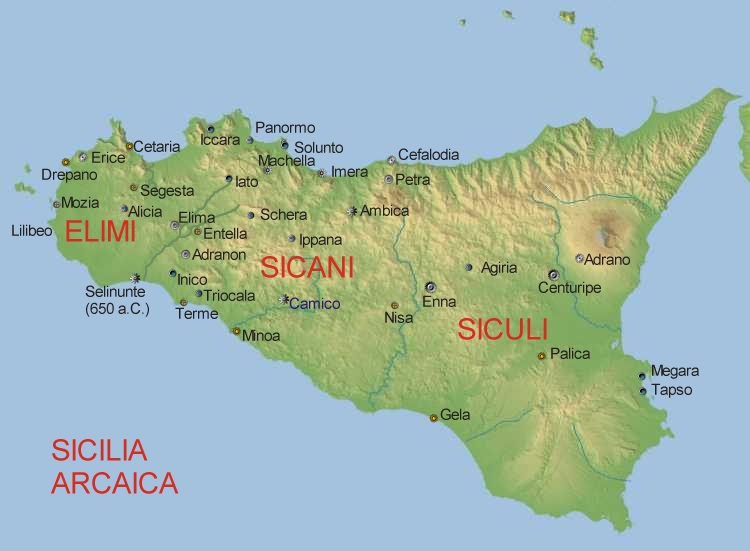
[ABOVE: Regions and cities of ancient Sicily]
Another major group inhabiting the island were the Phoenicians. Originally from modern-day Lebanon, the Phoenicians were, alongside the Greeks, the other major colonising, sea-faring peoples of the Mediterranean. Coming to found the “New City” - “Qart Hadasht”, or “Carthage” - in 814 BC, in what is now Tunis, Tunisia, the city soon grew to be a hub of Phoenician settlers and refugees, bolstering the city’s population following the Babylonian conquest of the Phoenician mother-city of Tyre, and its eventual capture by the Persians during the reign of Cyrus the Great. Carthaginian settlers would come to colonise and inhabit the Sicilian coastline over the next few centuries, founding trading settlements that came to dominate the region such as Lilybaeum. Most of these cities were largely abandoned once Greek colonists from the mainland began arriving to the island, forcing the Carthaginians to other cities such as Panormus, modern Palermo.

[ABOVE: The Republic of Carthage, 4th century BC]
Major Greek cities founded in this time were Naxos, Syracuse, Leontini, Catana, Trotilum, Thapsus, Megara Hyblaea, Gela, Akragas and Zancle. The city of Himera was founded by further colonists from Zancle. Ever since the 500’s BC, the Greeks on Sicily and Carthage had been at odds with each other for dominance of the island, until in 480 BC, around the same time as the Battle of Salamis over in Greece, the city-states of Syracuse and Akragas would fight the Carthaginian general Hamilcar at the Battle of Himera, resulting in Syracusan hegemony over the island for the next decades to come.
THE PLAN FOR SICILY
By the winter of 416 BC, Athens began to receive embassies from their allies in Sicily at Egesta. The Egestans had recently embroiled themselves in a dispute with Selinus over intermarriage disputes, who in turn had called upon the island’s dominant power, Syracuse, for aid. Convincing the Athenians to join over fears that Syracuse could come to dominate the entire island and attack Athens someday, as both Syracuse and Sparta were Doric Greeks and allies as such, and perhaps guilting Athens over their failed expedition there in the previous decade, Athens took the call to aid their Sicilian comrades.
PREPARATIONS
A Spartan campaign into the Argolid ensued during the winter of 416 BC, carrying on into early the following year. Come Spring 415 BC, Athenian embassies arrived back from Sicily, who were accompanied by their Egestan representative. They brought with them to Athens sixty talents of silver, offering it in the form of one month’s salary for the sailors and marines they asked Athens to man atop sixty ships to set sail for Sicily. After a meeting, the Athenian council chose Nicias, Lamachus and Alcibiades to lead the expedition. Their goal was to aid Egesta against Selinus and Syracuse, and take all measures they deemed plausible and necessary in Sicily to bring as much of the island under Athenian rule as possible.

[ABOVE: Bust of Nicias, from "The World's Famous Orations, Vol. 1", pg. 105]
Four days after, further meetings were held to discuss what provisions should be brought to Sicily and how the ships should be outfitted. Reluctant among the three commanders was Nicias, who thought Athens was biting off more than they could chew. He spoke to the assembly:
We should not decide matters of major importance on such superficial consideration and allow foreigners to sway us into entering a war which is none of our concern. For myself I have nothing against war. It has made my reputation, and I have less fear than most for my own life, although I believe that the man who does take some thought for his life and property is no less a good citizen, as such men have the greatest personal interest in the success of their city. But I have never before let reputation dictate a view which I did not hold, and now too I shall tell you only what I think best. I realise that my words would have little force against your characteristic temperament if I were to simply advise you to preserve what you have and not risk present advantage for an uncertain future: but I shall argue that your enthusiasm is misplaced and your aims will be hard to achieve.
He argued further that the Peace of Nicias was only temporary, and the subsequent battles within like Mantinea had proven it to hardly be peace they could trust. Sparta only came to terms given mounting pressure facing them, and the prisoners on Sphacteria they wished to recover. With peace, they could recuperate their losses and reform, and should Athens fail in Sicily, Sparta would have the edge. Nicias also noted the assembly he spoke to was packed with young faces, forcing him to urge them and the elder statesmen among them to not fall prey to the peer pressure of being called cowards for not undertaking the expedition; war, plague, military losses and financial setbacks had done enough to the Athenian state in the past fifteen years.
Unsurprisingly, the expedition’s most ardent supporter was Alcibiades. The two statesman always had opposing political views, and now insulted by his speech, Alcibiades came to crave the command position offered to him. Supposedly, he wished to lead Athens to conquer not just Syracuse, but all Sicily, even Carthage itself, bringing his family countless masses of wealth, glory and fame. His excessive, lavish lifestyle was known to the Athenian people, given his frequent banqueting, hedonist pursuits and racehorse gambling. Thus, public scepticism and fear of him potentially wishing to make himself a tyrant rose, and the public quickly turned against him.
Alcibiades too spoke before the Athenians, claiming that his past pursuits had benefitted the state inasmuch as they benefitted his family. He argued that Sicily’s cities, while large, were disunited and rife with internal quarrelling Athens could capitalise on, and that their hoplite numbers were far smaller than what Athens could muster. Atop of this, many other non-Greek inhabitants of the island would likely gladly join Athens in their undertakings.
The people had already voted to support their Sicilian allies - what kind of friends, Alcibiades argued, would Athens be should they accept the funds from Egesta and not use it for a Sicilian expedition? The Delian League had grown to the superpower it now was because it undertook requests for aid from across the sea, and this was just another one, with greater riches than ever before available with victory. At the very least, he argued, a weakened Syracuse would send a message to all Sicilian enemies, including the Peloponnesian League, that Athens, even weakened, was no enemy to look down on.
With his speech and the requests from the Egestans heard, the people were riled more than before to send troops and ships to Sicily. Nicias gave a further speech; knowing he could not dissuade Athens from launching the expedition outright, he set to convince them that the expedition was too large in scale, and that Athens could not currently afford it. He argued that cities like Syracuse had secret vaults of vast wealth in their temples and treasuries, allowing them to quickly call upon thousands of well-equipped soldiers should the need arise. An expedition would require over fifty ships and a couple thousand soldiers, atop slingers, archers, merchant ships and more, to win even just against Syracuse.
In giving this speech, Nicias hoped either to sway Athens from undertaking the expedition, or, if need be, be thrust with full command of the expedition and succeed in it. To his dismay, his speech emboldened the Athenians, bolstering them to acquire further funds to increase the size of the expeditionary force; at least one-hundred triremes and five-thousand hoplites would be called upon from Athens and her allies, including archers and slingers from across the Delian League. With this, preparations were underway. Requests began being sent to Athens’ allies and recruitment lists were made in the city. Recovery since the plague and the Peace of Nicias had produced a generation of young men eager for combat, and the recruitment list was quickly answered.
RELIGIOUS SCANDAL IN ATHENS
During the preparations for Sicily, a religious scandal unfolded in Athens; the city was full of statues honouring the deity Hermes, the emissary and messenger of the Gods. These statues, known as Herms, consisted of a sculpted head and torso atop a plain, square section, affront of which would be a sculpted a set of male genitalia. They were commonly found outside the homes of wealthy citizens and outside of temples. One night during the Sicilian preparations, someone had taken it upon themselves to remove the genitalia from the Herms. It was taken as a sign that there was mass, silent uproar against the Sicilian expedition. With the perpetrator unknown, bounties were put out to find who the culprit was, with rewards put out for anyone - foreigner or slave - who presented knowledge of any further desecration of the Herms.

[ABOVE: Roman copy of a 5th century BC Athenian herma]
It didn’t take long for men to come forward with information, regarding instead however about other statues that had recently been desecrated during a drunken folly. Accused immediately was Alcibiades, who had amassed many public enemies since his rapid rise to prominence had blocked many others from obtaining high political status. Alcibiades was ready to stand trial against his accusers, claiming he would pay his dues in full - execution if need-be - if found guilty, and retain his command against Sicily if not. His accusers began fearing his potential mass support within the army should a trial be held immediately. They thus set about delaying the trial for when Alcibiades and the fleet were near or in Sicily.
THE VOYAGE TO SICILY
On a given day, midway through the summer of 415 BC, the Athenian army marched to Port Piraeus, mounted their ships and began the voyage to Sicily. The expedition was met with practically the entire population of Athens, coming to wave them farewell on their voyage amidst a flurry of mixed emotions of fear, sad farewells, hope and the seeking of glory. To the rest of the Greeks, this whole expedition - one of the largest ever assembled in Greek history - seemed more like a display of power rather than a plausible expedition set for success. It was vast in numbers and the furthest of its scale in destination, rivalling even Cimon’s expedition to Egypt and Cyprus half a century prior. Nonetheless, the Athenians set sail for Sicily.

[ABOVE: The route taken by the Athenian fleet to Sicily, 415 BC]
It didn’t take long for Syracuse themselves to get word of the oncoming armada. Giving a speech in the centre of the city was Hermocrates. Reliably informed of the Athenian expedition, he told the Syracusan people about what was approaching them, asking them not to panic and assuring them that many in Sicily would gladly join in repelling the invasion. He asked for calls to be sent to not just the rest of Sicily, but Italy and Carthage. Even Sparta and Corinth, he argued, should be called upon for aid, hoping they could fully reopen the Peloponnesian War, further weakening Athens.
Hermocrates put forward the plan to land a large Sicilian coalition force in Taras, a Spartan colony in southern Italy, to demonstrate to Athens the far-flung alliances Sicilians had and to put up a fight against them before they even reached Sicily. Should Athens run forward and attack with their faster, lighter ships, many supplies would be left behind, and should they attack altogether after the engagement at Taras, a defence could be better organised in Sicily. With this, the Sicilians were as roused towards war as Nicias and Alcibiades’ armada were, setting forth to defend the island from Athens at once.
THE FORCE
The Athenian fleet met at Korkyra (Corfu) for final inspections. There, it was divided into three squadrons, with commanders chosen by lot, to ease the burden of command across such a vast armada. In total, the fleet consisted of 134 triremes - sixty of which were Athenian - and two vast ships known as Penteconters from Rhodes. (“Triremes” were named so for having three banks of oars, and “Penteconters” had fifty oars in total, along one bank.) Aboard the fleet were 5,100 hoplites, 480 archers, seven-hundred Rhodian slingers, 120 light troops and one horse transport ship carrying cavalry. So vast was the expedition that thirty vessels alone were needed to carry grain and supplies, amongst other merchant and trade ships.

[ABOVE: Illustration of a Penteconter from "Illustrerad utgifven av E. Wallis, volume I", 1929]
ITALY
From Korkyra, the fleet crossed the Ionian Sea, westward towards Italy. Reaching the Spartan colony of Taras (modern Taranto), the fleet sailed close to the coastline, travelling south along the Italian toe. Local Italic cities granted only access to their waters and safe anchorage for a night, but did not allow access to the cities themselves or the supplies or people within. The armada reunited at Rhegium, at the very tip of Italy looking out towards Sicily a mere few miles away. Rhegium denied the Greeks entry to the city, forcing the fleet to camp outside the city, nearby to a sanctuary to Artemis, where the citizens of Rhegium had established a market-like meeting point for them to stay. Rhegium stated that they would not pick sides in this external conflict, but would join at the behest of the rest of the Italo-Greeks. For the meantime, Athens would wait, conducting their final specifics in their Sicilian plan whilst waiting for promised Egestan funds.
SICILY RESPONDS
So close to Sicily were the Athenians, it didn’t take long for Syracuse to finally be united in knowledge of Athenian intentions. Funds and garrisons were installed in several of their towns, and equipment inspections were carried out for the army in Syracuse itself.
Meanwhile, Egestan envoys reached Nicias’s fleet, bringing news of a mere thirty talents to fund the fleet, a fraction of what was promised. Denied Egestan funds and Rhegian aid, the Athenian general's morale shrunk. Allegedly, the Egestans had fooled the Athenians by showcasing lavish amounts of gold they owned in their cities by simply borrowing this money from their nearby Greek and Phoenician allies, essentially showing them the same items in different cities to fool the Athenians into thinking they had more to give, that largely wasn’t even their own.
NICIAS, LAMACHUS AND ALCIBIADES
Nicias now laid out a plan that the fleet should simply stick to its original plan and attack the Sicilian city of Selinus, demanding maintenance funds from Egesta for the sixty ships they provided in the meantime. Following up, Nicias said the fleet should sail around Sicily to display the might of Athenian power, and to show they could and would be of service to their allies in an attempt to keep them loyal. Then, unless presented with an opportunity, they should sail home.
Alcibiades, however, proposed that heralds should be sent to every Sicilian city, aside from Selinus and Syracuse. His plan was to attempt to make as many alliances and incite as many revolts as possible, starting with Messana, the Sicilian city closest to Rhegium and mainland Italy. Unless terms between Egesta and Syracuse were settled, Alcibiades proposed that Syracuse itself should be besieged immediately.
Lamachus, meanwhile, proposed directly assaulting Sicily - they had the huge fleet and army, and Syracuse was likely still making preparations, so why wait? Some back-and-forth opinions however moved Lamachus to join Alcibiades’ plan. Alcibiades immediately set for Messana to negotiate an alliance. They refused, only offering to set up a market for them outside their city like what had been done for them at Rhegium. Back outside Rhegium, Alcibiades took a larger fleet of sixty ships south to Naxos, where they were welcomed to stay. After being denied a welcome in the next city at Catana, Alcibiades instead made camp north of the River Terias. Camping for the night, the fleet sailed in column formation towards Syracuse, with ten of the sixty ships aiming for the city’s Great Harbour to check for any prepared enemy vessels. Surveying what they could of the harbour and city, the detachment returned to Catana.
Still denying them entry into the city, the Cataneans held a public meeting, inviting only the commanders of Nicias’s fleet inside the city. While Alcibiades was speaking, several Athenian soldiers managed to disassemble a poorly made gate into the city and forced their way in, surrounding the public meeting space and forcing the city’s few pro-Syracusan elements to flee, leaving the rest of the city to agree to an Athenian alliance. They were now allowed to settle their entire force in Catana as they pleased.
Word soon reached Nicias from Camarina, stating that should they march any further, Camarina and a large prepared Syracusan force would come out to meet them. A small attempt was made anyway by Athens, but this was quickly beaten back by a Syracusan cavalry charge, forcing the Athenians back to Catana.
ALCIBIADES'S DEFECTION
The Athenian people thought the ruination of the Herms was part of a tyrannical conspiracy. Arrests were made in the streets against anyone thought to be a conspirator. Men were even forced to give false evidence and admit guilt to save their own skin, even if it meant imprisonment and the continuing of the crimes. Hundreds were being put to death, and bounties were put on the heads of those who fled Athens as a result.
Meanwhile, a Spartan force crossed the Isthmus of Corinth and arrived near Athens. Reportedly, they were there due to a dispute in Boeotia, but the paranoid Athenians thought it a part of the conspiracy, planned in part at least by Alcibiades, who was now on his way back to Athens. It is said that the people thought of how the overthrow of Pisistratus by Hippias before the rise of democracy nearly a century prior had been aided by a Spartan force. Concerned, the people thus planned to have Alcibiades trialled and killed upon his return. The ship returning him, however, wished for him not to be arrested, hoping not to stir more trouble than needed for the Sicilian Expedition.
With all this in mind, Alcibiades took a drastic turn. Literally: upon his transport ship reaching the Italian city of Thurii, southern Italy, Alcibiades ordered his ship to turn away from the main party and head for Thurii, later seeking audience and safety from Sparta. Searches for him stopped when he couldn’t be found after a number of days. In his absence, the Athenian turncoat was condemned to death, alongside his close followers and colleagues. From Thurii, being guaranteed safety by King Agis, Alcibiades made his way to the home of Athens's great rival.
Alcibiades had defected to Sparta.
THE EXPEDITION BEGINS
With this, the remaining two Athenian commanders in Italy - Nicias and Lamachus - split their commands between them, setting sail for Selinus and Egesta first before heading for Syracuse itself. The goal was the submission of Syracuse and its allies, their capture, and potentially the capture of the entire island. It was thus far the most ambitious expedition made away from Greek soil by Athens, and presented the opportunity for loot, glory and victory for the Athenians. Victory would result in a titanic revival of Athenian prestige and wealth so lost throughout the Peloponnesian war so far, and Athens could from there go on to dominate the Greek world.

[ABOVE: Greece at the time of the invasion of Sicily, 415 BC]
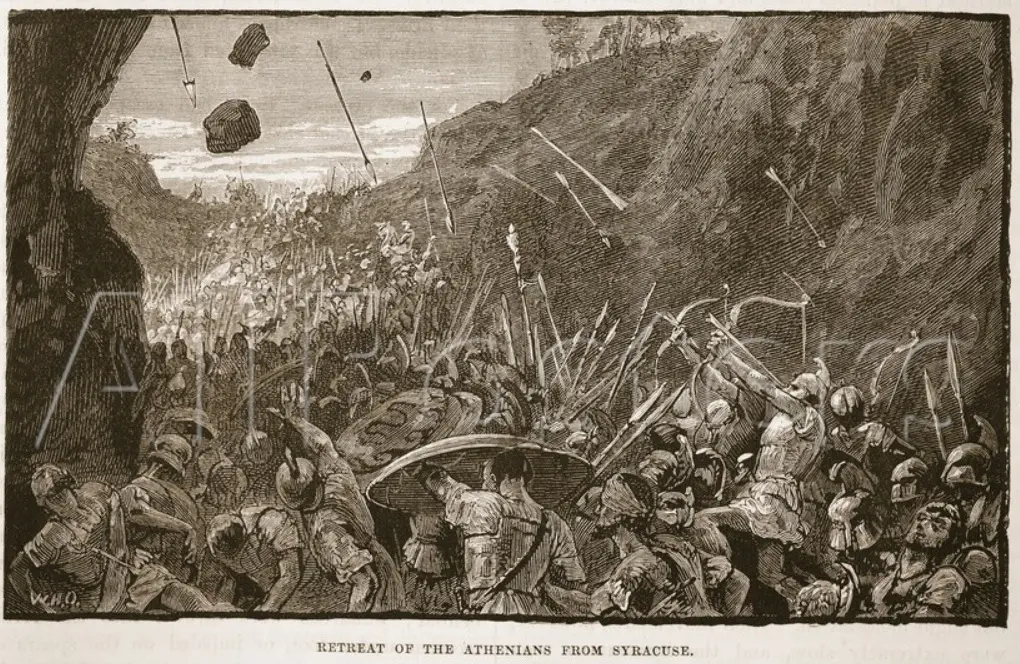
What would unfold would prove to be ancient Greece’s greatest ever military disaster.
NEXT POST: THE SICILIAN EXPEDITION, 415 - 413 BC: Athens' Greatest Disaster
SOURCES
- Thucydides, "The Peloponnesian War", Book 6.1 - 62
- Herodotus, Book 8.17
- Plato,
- "Alcibiades", 103a + 121a
- "Symposium", 215a - 222b
- Cornelius Nepos VII, "Alcibiades", passages 1 - 4
- Plutarch, "Lives: Alcibiades", pg's 218 - 227
YOUTUBE LINKS
(I do NOT own these videos)
"History Summarized: Alcibiades" by "Overly Sarcastic Productions"
"Ancient Athens' Colourful Warlord and Deserter - Alcibiades (Animated History Documentary" by "House of History"
"Absolute Mad Lads - Alcibiades" by "Count Dankula"
MY ANCIENT GREEK HISTORY BLOG PAGE
MY ANCIENT PERSIAN HISTORY BLOG PAGE
All feedback - positive and/or critical - is appreciated!
All images used are copyright-free
Don't forget to rate this post, share it and leave a tip if you enjoyed it
Follow my FACEBOOK
Follow my INSTAGRAM
Follow my REDDIT
Follow my TRUTH SOCIAL
Follow my TUMBLR
Thanks for reading :)
EDIT
I'd like to thank Tumblr user "kebriones" for his recent analysis and critique of my work here, which allowed me to re-read my sources and correct some mistakes.
Like I say: All feedback - positive and/or critical - is appreciated!
I don't have every source it is possible to get for all the posts I do at the time I do them, but I will include all vital information that I can with what I have.






