
The iconic Acropolis of Athens and the Parthenon as its crowning piece, and the Western ideals of democracy, philosophy and architecture - these things were allowed to reach their zenith in Athens essentially under the rule of one man, who has gone down as one of the greatest leaders of men in world history. A proven ability to lead soldiers and command armies, a powerful mind and voice to give the greatest of speeches, and a level of popularity unrivalled, all define the rulership of Pericles. At the height of his power, Athens would become known as the cultural and educational capital of the Greek world.
Check out my previous post on the First Peloponnesian War, 460 - 445 BC
PERICLES'S BUILDING PROJECTS
Above his military campaigns, Pericles’s greatest achievement in winning over the people and awing the world around him was his construction projects. These projects would receive scorn from his contemporaries:
The fame and reputation of the Athenian people are suffering, because of the transference of the common Greek funds from Delos to our own keeping. Moreover, Pericles has undermined the most plausible excuse we had to offer our critics, namely that the removal of the treasury from there had been prompted by fear of the Persians, in the sense that we wanted to have it in a safe place where we could guard it. The Greeks regard it as outrageously arrogant treatment, as blatant tyranny, when they can see that we are using the funds they were forced to contribute for the military defence of Greece to gild and embellish our city, as if she were a vain woman adorning herself with costly marble, statues and temples at 1,000 talents a time.
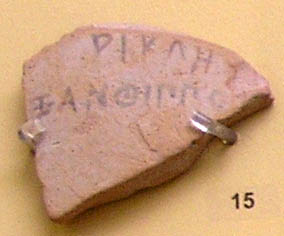
[ABOVE: An ostrakon with Pericles's name on it, from 444/3 BC, now held in the Museum of the Ancient Agora, Athens]
Pericles justified his lavish spendings by stating that Athens, being the leader of the Delian League, was exempt from League payments, and that all payments of coin, men and ships went to Athens anyway; as long as Athens carried out its duties of putting these valuable resources to use against the common enemy, then said-resources belonged to Athens. Moreover, Pericles argued that an excess of resources could occur, so these extra resources should go towards projects that would bring the Greeks eternal glory, while giving more of the citizen population great works, arts and crafts to work on. Athens’s foreign wars had enabled the young and fit to receive great payments out of the common purse, yet Pericles, not wishing for the skilled but idle artisans to miss out on payments, introduced further schemes for construction that would keep those at home busy providing something for their nation. Stone, bronze, gold, ivory, cypress and ebony - all bought and redistributed by sailors, merchants, helmsmen, wagon-makers, ox keepers, rope-makers, weavers, leather tanners, road builders and quarriers - all put to use by modellers, joiners, masons, guilders, metal smiths, ivory softeners, embroiders, painters and embossers… Pericles employed thousands, of all ages and backgrounds, to work on the great projects he had in mind.
Most astonishing of all with the progress made in these projects was the speed. It was expected that generations would pass in the time, yet only a single administration had passed by the time these works were finished. This is truly what makes the works of Pericles a thing to behold: not just their sheer scale and beauty, but the short timeframe that they were finished in. Managing the works was an architect named Phidias, and other known craftsmen and builders included Coroebus, Metagenes and Xenocles, who worked on the Sanctuary of Mysteries at Eleusis. Callicrates also worked hard on the Long Wall that joined Athens to Port Piraeus, which were first constructed by Themistocles after the Persian Wars. The comic poet Cratinus ridiculed the comparatively slow progress made on the Long Walls here, stating,
For a long time now, it’s been coming along fine
In Pericles’ speeches, but there’s no change at all in fact.
THE ODEON
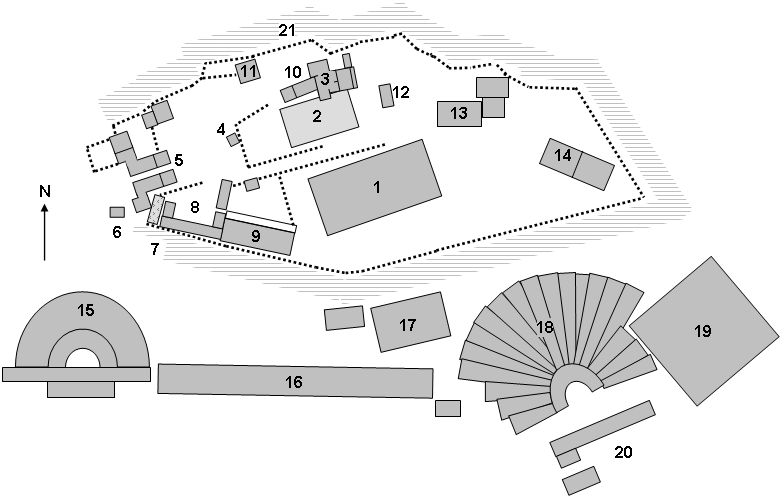
[ABOVE: Site plans of Athens's Acropolis, showing the Odeon (15)]
Amongst the construction was the Odeon, the main Athenian theatre. Filled with numerous banks of seats, pillars, and its sloping, steep roof that rose to a singular peak, it was said to have been somewhat of a copy of the Persian king’s tent. So ambitious was Pericles for the Odeon to be built that he passed decrees for musical competitions to be held at the Panathenaia festival, arranged for himself to be a part of the Committee of Competition Supervisors, just so that he could decide how competitors would sing or play the various instruments. This building once again received biting criticism from Cratinus:
Here comes our squill-headed Zeus,
Wearing the Odeum on his head,
Now that the ostracism is past.
THE PROPYLAEA

[ABOVE: The Propylaea's east façade]
Athens’s Propylaea was also finished in this time, taking only five years. Overseen by Mnesicles, this Doric-style complex served as the gateway into the Acropolis itself. Its construction was seen as being guided by Athena herself, since some workers fell from atop the rocky cliffs of the Acropolis itself, plummeting down to the ground at such a height that doctors gave up trying to rescue them. It is said that Pericles dreamt that the gods came to him in a dream, instructing him how these men could be saved. These men were thus rescued from near-death, and a bronze statue to Athena the Healer was built by Phidias here, dedicated beside an altar.
THUCYDIDES' OSTRACISM, 442 BC
Accused of spending too lavishly by Thucydides and the aristocrats, Pericles spoke before the people to ask them if they held the same view of him. To his dismay, they agreed, and Pericles humbly stated that it should be he who incurred the costs of the building projects, not the people. Possibly impressed by his humility, the crowd thus shouted and demanded that Pericles withdraw money from the funds and spend it freely. With public backing, he engaged Thucydides in a contest over who should be ostracised, and Thucydides was exiled, thus overthrowing his opposition faction. Pericles thus essentially became the most powerful Athenian.
With his new-found power, Pericles was able to control the city’s revenues, fleets and military expeditions. Unchecked, Pericles became less and less of a subordinator to the whims of the masses, turning his mode of leadership towards a more autocratic and king-like state of being, more and more reigning in the masses whenever they fell out of favour with him and persuading them over to his line of thinking and governance. With a mix of instilling fear and hope into his citizens, Pericles had turned Athens from a powerful regional state into the most powerful and lavish Greek nation to have ever been witnessed - a true Golden Age. This was not a short phase; Pericles held great influence over Athens for over forty years, and unchallenged power for fifteen years until his death.
When Sparta responded aggressively to Athens’s growing power, Pericles encouraged the people to pursue further grand building designs, and to expect even more highly of themselves. He introduced a decree, demanding that every League member across the Aegean should send delegates to a meeting in Athens itself, in order to discuss what should be done about all of the buildings in Greece destroyed by the Persians during their invasion, as well as discussing how to keep the Aegean safer for travellers. This plan, however, did not take form due to Sparta’s opposition of it.
THE SAMIAN WAR, 440 - 439 BC
Six years following the end of the First Peloponnesian War, war broke out between Samos and Miletus. This dispute arose over the two states’ disagreements over the ownership of Priene, and Samos, early into this conflict, gained an upper hand, forcing Miletus to call Athens for aid. Athens aided with forty warships under Pericles. He passed a decree, allegedly on his wife’s request, sanctioning the expedition to Samos. Pericles swiftly ended the conflict and, against a Samian peace offer of gold, installed a democracy in Samos, extracting eighty talents of silver from the city. He also took a hundred hostages - fifty men and fifty boys - and deposited them on the isle of Lemnos before returning to Athens.
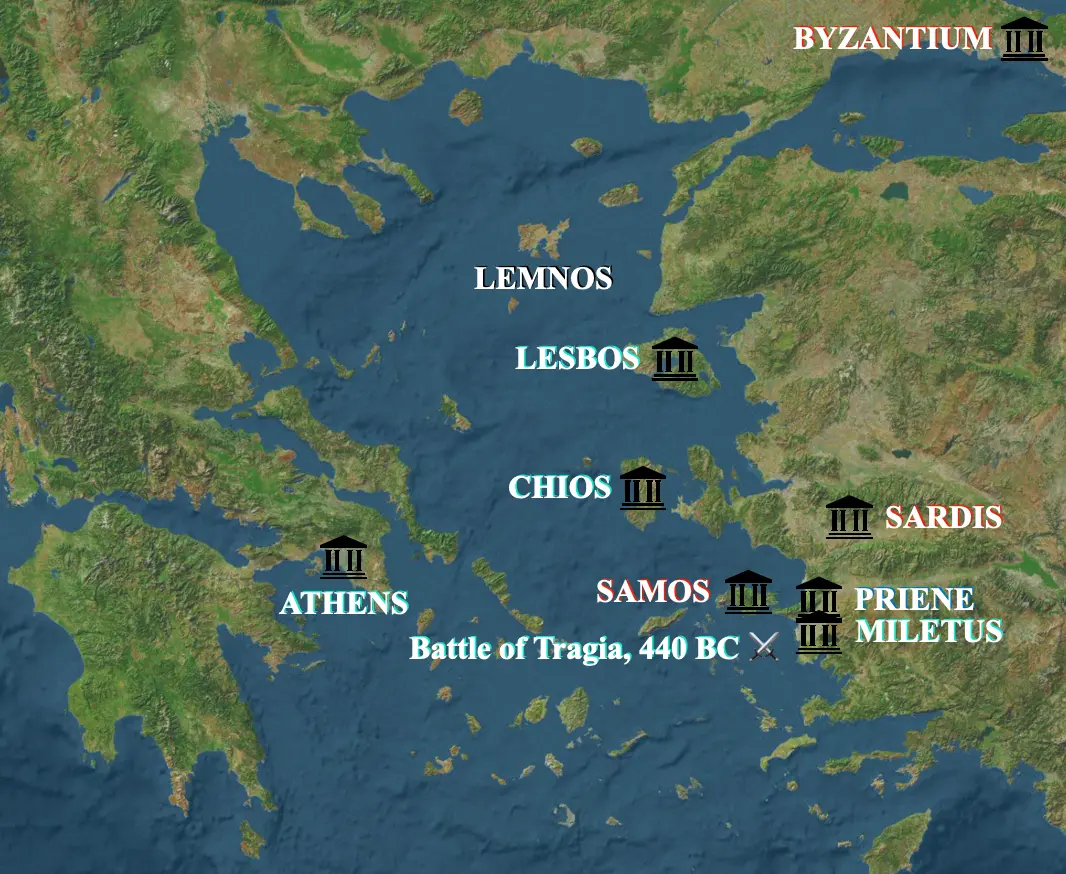
[ABOVE: Map of the key cities and locations involved in the Samian War]
AID FROM PERSIA
Some Samians, though, did not wish to remain a democracy, as the city's people still held overall preference for their old aristocratic governance. One night, some anti-democrat Samians left their city to liaise with the Persian governor of Sardis, Pissouthenes, who was keen on expanding his influence by gaining Samos for the Persian Empire, or at least its alliance. Pissouthenes had even previously attempted a bribe of ten-thousand gold staters to try and stop Pericles’ assault on Samos. Together, they sailed with around seven-hundred mercenaries to Samos in the middle of the night, leading an insurrection against the newly-implemented city democrats, capturing most of them before making for Lemnos and rescuing the hostages. Athens's local garrison at Samos was handed over to Pissouthenes in Persia, and the Samian rebels declared their revolt against Athens itself, joined at some point by the city of Byzantium.

[ABOVE: An anonymous coinage portrait of Pissouthenes from Phokaia, Ionia]
THE SAMIAN REVOLT
Eventually receiving word of this revolt, Athens sent sixty warships. One detachment would be sent to the Asian region of Caria to keep an eye out for any Persian fleets that may have come to aid Samos, while others would be sent to the allied states of Chios and Lesbos to gather reinforcements, while Pericles took command of the remaining forty-four ships. Pericles’s detachment came across the Samian fleet, fifty warships and twenty transport ships strong, while they sailed back from Miletus, and the two navies engaged off the isle of Tragia, resulting in an Athenian victory. Better still for Pericles, forty reinforcing ships from Athens, and twenty-five from Chios and Lesbos, arrived at Samos. The allies began constructing a circumvallating wall around the city and blockading its port-side with the fleet, while Pericles commanded a silty-strong contingent to meet an upcoming Phoenician fleet, who had come to aid the Samians. While this fleet was away from Samos, the Samians launched a surprise naval attack against the blockading Athenian navy, winning the day and restoring naval dominance of their own waters, at least until Pericles returned after defeating the Phoenicians and resuming the blockade.

[ABOVE: A statue of a Greek warrior found in the temple of Hera at Samos, c.530 BC]
Gaining control of Samos’s harbour, Pericles' army constructed siege equipment and put Samos under siege before the inhabitants exited their city and prepared for an open-field battle. At this point, Pericles either wished to re-engage in Cyprus, or he received word of a Phoenician fleet sailing to aid the Samians from the east. Either way, he assembled sixty triremes to head east, leaving a smaller contingent to keep up the siege. This would prove to be a mistake; the Samian commander, Melissus, noticed that Pericles’ remaining commanders and fleet at Samos were too weak to continue the siege without Pericles and the rest of his forces. Rallying his Samian rebels together, the Athenian army was crushed, and the defeated Athenian forces had an owl (the symbol of Athena, Athens’s patron deity) tattooed onto their foreheads.
Hearing of this, Pericles sailed back to Samos, overcoming what remained of the resistance and ordering for a wall to be constructed around the city to starve out the Samians. The siege, however, would last months, driving much of his army to impatience and anger. Pericles thus had the army divided into eight sections, allowing each to draw lots in the form of beans; whoever picked the white bean could stand down and enjoy themselves, allegedly birthing the phrase, “white day”, used when someone is enjoying a treat.
SAMOS SURRENDERS
After eight months, Samos surrendered in 439 BC. The city walls were ordered to be destroyed, fines were imposed and much of Samos's fleet was disbanded or given to Athens. Its rebellion quelled, Byzantium too was forced to return to it former subject status under Athens. Returning home, Pericles ordered for honourable burials for those Athenians who died fighting at Samos. Pericles was met in Athens with great cheers, adorations and a showering of gifts, however Elpinice, the half-sister of Cimon, stood alone to scorn Pericles’s victory, for it had been against fellow Greeks instead of Persians. Whispering, Pericles was quick to respond:
An old woman like you should not anoint herself with perfume.
Pericles would boast of his victory over Samos, declaring that it had taken Agamemnon and Menelaus ten years to take one city, while it had only taken him eight months to conquer the most powerful of the Ionians. Thucydides states that Samos came very close to robbing Athens of their control of the Aegean, highlighting how decisive this war over Samos really was.
RESTORATION OF ATHENS

[ABOVE: A view of the Athenian acropolis as taken from the Hill of the Muses]
In the latter half of 449 BC, a motion was passed in the Athenian assembly; in months prior, Sparta refused to send envoys to Athens in regards to sending aid for the destruction of Athens caused during the Persian Wars, and now Athens was taking matters into her own hands; the Acropolis would be reborn, and splendorous new architecture would crown it. Pericles had already proven himself one for funding splendid artworks when he sponsored Aeschylus’s play, “The Persians”, and was the son of Xanthippus, who led Athens at the Battle of Mycale and who himself funded great works atop the Acropolis. Upon employing his dream team of every great architect Athens had to offer, including Phidias, Pericles made his intentions with the Acropolis clear:
[I intend to raise] marks and monuments of our city’s empire [so perfect that] future ages will wonder at us, as the present age wonders at us now.
THE PARTHENON
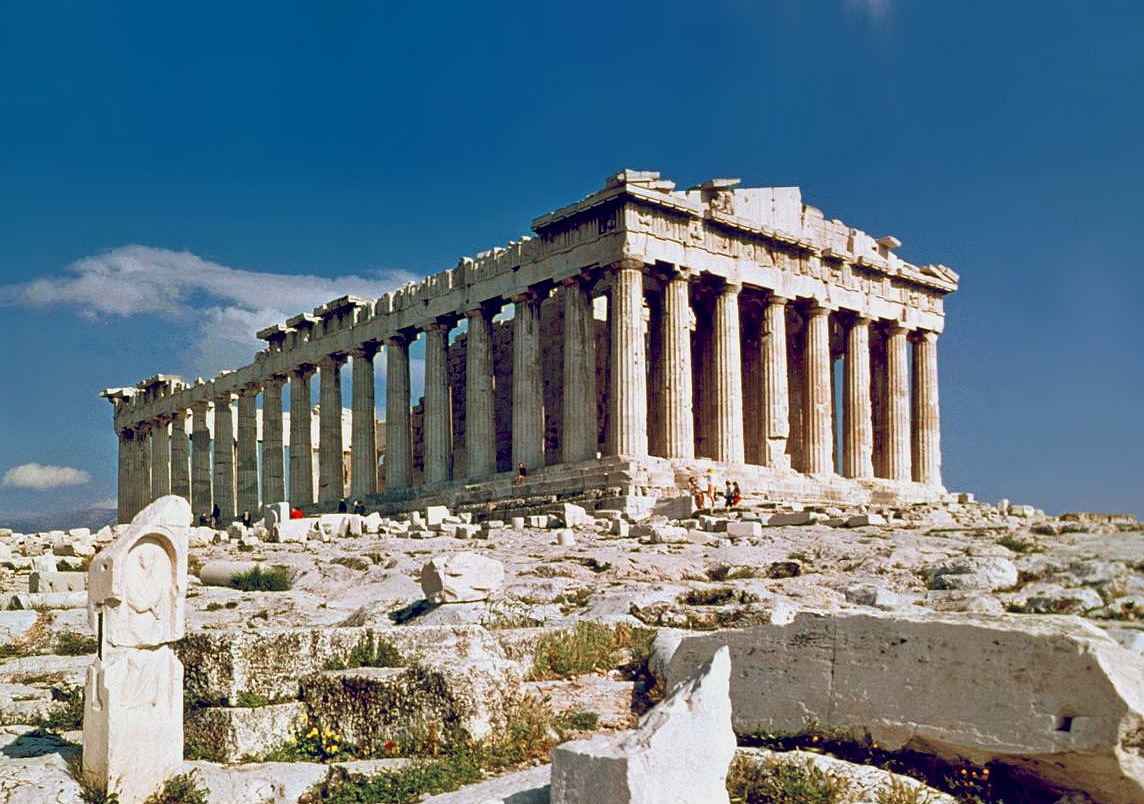
[ABOVE: Photo taken in 1978 of the Parthenon]
Two years later, in 447 BC, work began on a splendid monument to outshine them all - a home to a gold and ivory statue of Athens’ patron Goddess, Athena herself; finished in 438 BC, with ornate decorations being added until 432 BC, generations of the future would call it the Parthenon. Like many of Pericles’ construction works, the Parthenon (what it was called at the time is unknown) was built atop the ruins of older buildings; the Parthenon’s predecessor, originally under construction in the 480’s BC to celebrate Athens’ victory at the battle of Marathon, was destroyed by Xerxes’ army. Now, Pericles wished to revive and enshrine the memory of Athens’ greatest glory and fallen soldiers for all eternity as images of the battle were engraved into the structure, from the ground plans up to the friezes. Together, the burial mound at Athens honouring the fallen Athenians, and the Parthenon depicting them in their last glorious moments, would serve to honour them and their city.

[ABOVE: "Phidias showing the frieze of the Parthenon to his friends", by Lawrence Alma-Tadema, 1868]
The Parthenon was magnificent; fourteen metres high, 34 metres wide and 73 metres long, it was the unrivalled crown of Athens. More so, it was clever; despite appearances, there is not actually one single straight line in the entire building, for it was so large that, when viewed close up, the building's curvature could be seen clearly. Those working on the building thus had to curve every part of the Parthenon in order to give off an optical illusion of its straightness. Even the columns are waisted at the centre, so that when viewed from afar they appear straight.
Most wondrous of all though was what the Parthenon housed inside: the building's interior was designed specifically to house a gold and ivory statue of Athena. Twelve metres high, it took six whole years to complete. All who saw the Parthenon from afar, and any who ached their necks gazing up at the statue of Athena, would certainly feel the raw power of the Athenian Empire.

[ABOVE: Painting depicting Pericles and Aspasia observing the statue of Athena Parthenos in Phidias' studio, by Hector Leroux, 18th century]
In the span of half a century, Athens had gone from a small settlement revolting and deposing its last tyrant to the leader of a Greek alliance that defeated the greatest empire of the day, and to the centre of its own lavish empire. Unsurprisingly, such a rapid rise to power had not gone unnoticed; The cold war of the First Peloponnesian War was over, yet tensions were still high between Athens and Sparta. While they were almost certainly going to clash again anyway, unforeseen circumstances would soon plunge the two old rivals deep into a much greater and more terrifying war, one that would ruin Greece for generations and change the face of the Greek world forever…
NEXT POST: THE BATTLE OF SYBOTA, 433: Catalyst 1 of the Peloponnesian War

SOURCES
- Thucydides, "History of the Peloponnesian War", Book I.115-118
- Diodorus Siculus, "Library of History", Book XII.27-28
- Plutarch, "Greek Lives", Pericles
- Oswyn Murray, "Early Greece", pg 23
- Tom Holland, "Persian Fire", pg's 362-368
- National Geographic, "The Most Influential Figures of Ancient History", pg 78-81
YOUTUBE LINKS
(I do NOT own these videos)
"Pericles: The First Citizen of Athens" by "Biographics"
"Ancient Greek History - Pericles and the Golden Age of Athens - 15" by "Historyden"
"History Summarized: The Acropolis" by "Overly Sarcastic Productions"
"History Summarized: The Athenian Temple at Sounio" by "Overly Sarcastic Productions"
MY ANCIENT GREEK HISTORY BLOG PAGE
MY ANCIENT PERSIAN HISTORY BLOG PAGE
All feedback - positive and/or critical - is appreciated!
All images used are copyright-free
Don't forget to rate this post, share it and leave a tip if you enjoyed it
Thanks for reading :)






