
With the fall of Plataea and the putdown of the revolt on Lesbos, Sparta and Athens respectively were showcasing the lengths they were willing to go to win this war. Now, the new rising stars in Athens, Nicias and Demosthenes, would have to showcase their military excellence if they were to defeat Sparta's own rising commander: Brasidas.
Check out my previous posts on the Siege of Plataea and the Mytilenean Revolt, and the comic plays of Aristophanes
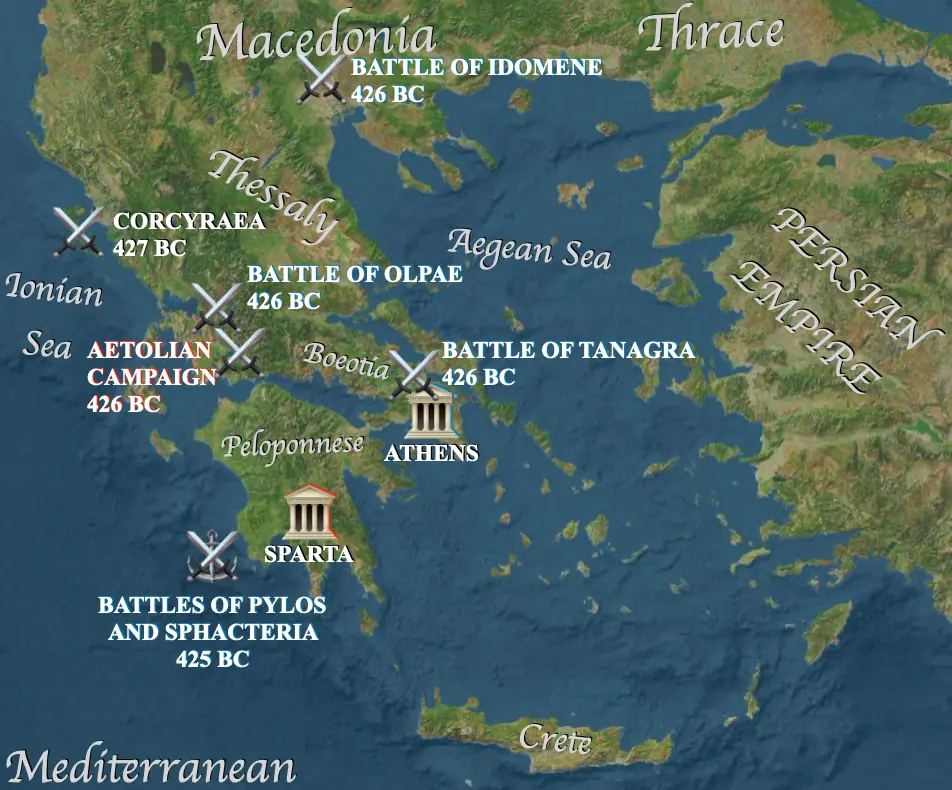
[ABOVE: The coming battles of this phase of the war. Delian League victories are highlighted in blue, and Peloponnesian League victories in Red]
CORCYRAEAN CIVIL WAR
Following the Mytilene revolt after failing diplomatically with the people of Lesbos, the Spartans planned to grow their fleet and sail to Corcyra (modern Corfu), where civil war had engulfed the island. Athenian garrisons at Naupactus, while minimal for the time being, were expecting reinforcements, and Sparta wished to take action before this happened. Following the Epidamnian Affair which led to the battle of Sybota - now some six years ago - captured Corcyraeans returned to safety to Corinth then attempted to sever the city's ties with Athens. When Athenian delegates arrived, the Corcyraeans pledged their alliance with Athens, but also renew their alliance with Sparta. What followed was a series of failed diplomatic missions involving Corcyra and Athens, resulting in civil war and skirmishes on the island by the time Sparta arrived with their twenty ships. In total, fifty-three ships were commanded by Alcidas. Brasidas joined him as an advisor.

[ABOVE: A Gorgon (a mythical creature) depicted on a piece found in Corcyra, now held in the Archaeological Museum of Corfu]
Sparta’s ships anchored at Sybota’s harbour on the mainland, sailing for Corcyra at dawn. The Corcyraeans in turn sent sixty of their own ships against Athenian advice to wait for them to attack so they could fight together. Upon rowing towards the Spartan fleet, two Corcyraean ships defected and several crew members aboard other ships began fighting amongst each other. Seeing this confusion, Sparta lined twenty of their ships up to attack the Corcyraeans, leaving the rest free to take on Athens’s twelve vessels.
Wary of how outnumbered they were and cautioning against a head-on attack, the Athenian ships attacked the flank of the Spartan navy, destroying a ship. Much like at the battle of Naupactus, the Spartans formed into an outward-facing circle and the Athenians circled them looking for weak spots. Noticing this, the Spartan ships, successful in attacking the Corcyraeans, sailed back to assist their comrades, forcing the Athenians to withdraw, and the remaining Corcyraeans retreated back to their city. The Spartans did not dare make a direct assault against the city, however, so withdrew to their base on the mainland.
Come the next day, Alcidas received word of sixty allied Athenian ships heading his way, lead by Eurymedon, forcing Alcidas to withdraw back home. Now safe, the Corcyraeans had their Peloponnesian prisoners executed. Seeing no-one to now assist, Eurymedon too sailed away, leaving the Corcyraeans to their own affairs.
THE PLAGUE
Meanwhile in Athens, come the end of the summer of 427 BC, another strong bout of the plague struck again, killing a further four-thousand hoplites and three-hundred upper-class citizens who would have provided the army’s cavalry - the Hippeis - and a further amount of civilians “beyond computation” as Thucydides described. Very little would have been more demoralising to Athens than a strong reemergence of the plague. This coincided with a strong period of earthquakes that affected Attica, Boeotia and Euboea.
AGIS II
It is around this time in late 427 or early 426 BC that Archidamus II, the Eurypontid king of Sparta, died. He was succeeded by his son, Agis II. The earliest part of his reign is marked with his army being halted from marching anywhere past the Peloponnese due to these very earthquakes.
ATHENS' SICILIAN CAMPAIGNS
Meanwhile in Sicily, war had broken out between Syracuse and their other Dorian-speaking allies, and Leontini, while the mainland Italian cities of Locri and Rhegium were allied with Syracuse and Leontini respectively. Athens accepted the call from Leontini, under the guise of kinship what with them both being Ionic Greek. Instead, Athens wanted to see if they could cut off grain shipments coming from the area making it towards the Peloponnese to aid in their war, and use this small expedition as a test to see if they could get Sicily entirely under their control. Laches’s ships docked at Rhegium. Commanded by Laches, Athens sent twenty ships to the island.
Come the winter of 427 and 426 BC, with Rhegian ships, Laches had thirty vessels under his command, setting sail for the Aeolian Islands. They were inhabited by the Lipareans on the main island, giving them the alternate name of the Lipari Islands, and were allied with Syracuse. Laches and his forces ravaged the countryside and returned to Rhegium when no terms were reached.
When summer arrived, Laches made a move against the city of Mylae in Messanan territory. While an ambush was in fact waiting for the Athenians, Laches and his forces were able to form up in formation and repel the attacks, forcing them to withdraw to their acropolis and come to terms with Athens to march against Messana itself. Seeing this new combined force approaching, Messana surrendered under Athens’ terms.
By the winter of 426 and 425 BC, Athens made their attack on Sinesa, then under Syracusan control. Athens was now joined by defects from Syracuse as they were subjugated by force. The attack on the city was, however, a failure, and while machine away from the city, the Syracusans sallied out and attacked the Athenian column, routing and killing several men. The Athenians made landing at Himera, location of the great Greek victory over Carthage some six decades prior, before setting sail to return to Rhegium. The Athenians left just before an eruption from Mount Etna struck Sicily.
What would come of this expedition ultimately proved to be very little. The coming battle over in mainland Greece at Pylos would detract Athenian eyes from Sicily, at least for the time being. Athens’ and their Sicilian and Italian allies would negotiate for an end to the conflict at the Congress of Gela in 424 BC, made on the basis of,
Sicily for the Sicilians.
Athens would return to Sicily in the years to come.
BATTLE OF TANAGRA
In the same summer, a navy was sent around the Peloponnese while another consisting of sixty vessels and two-thousand hoplites was sent to the island of Melos. The former was commanded by Demosthenes and the latter by Nicias. Melos was attacked only under the pretence of not wishing to join Athens’s Delian League. When their lands too were plundered and when Melos too refused to accept terms, Nicias moved instead to Oropus, to the north of Athens bordering Boeotia, intending to march on Tanagra the following morning, with levied Athenian reinforcements led by Eurymedon being sent to assist Nicias. After ravaging their land, the Athenians won a battle against Tanagra, who had Theban support, outside the city. The Athenians returned to their ships and then back to Athens.

[ABOVE: An ancient terracotta figurine from Tanagra, now held in the Archaeological Museum of Athens]
AETOLIAN CAMPAIGN
Meanwhile, Demosthenes’ forces sent to Melos were achieving a series of victories along their way, collecting reinforcements as they went. When he arrived near Messenia, he was convinced to make a campaign into Aetolia, whose people were hostile towards Athenian-allied Naupactus, and a successful attack there with his large army would bring the entire region under Athenian command. While a warlike peoples, the Aetolians did not have a large number of heavily fortified locations to fall back on, which could leave them vulnerable to Athenian assaults. Keen to use the area as a means to allow Athens to attack Boeotia from two sides, Demosthenes agreed.
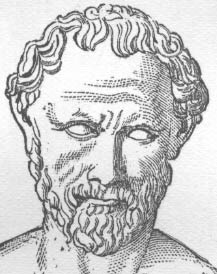
[ABOVE: Portrait of Democrates, from the Young People's Cyclopedia of Persons and Places, 1881]
Sailing round the coastline, Demosthenes made it to Oeneon in Locri, camping at the Sanctuary of Nemean Zeus where Hesiod was supposedly killed centuries prior. Come morning, his forces were successful in taking several Aetolian settlements, being equally successful the next couple of days. His plan was to reach the Ophionean peoples, and if terms could not be reached, he would return to Naupactus to regroup and assault again. However the Aetolians had been aware of this campaign into their lands the moment it began, and large forces were being raised to fend off the Athenians. With Messenian reassurance, Demosthenes quickly took the city of Aegitium, whose inhabitants had fled to the hills nearby, ahead of the promise of Locrian reinforcements, since his army was lacking in light infantry and skirmishers.
By now, the rest of Aetolia had rallied together in support of Aegitium. They met in the hills surrounding the settlement and repeatedly charged down them as one to attack the Athenians together, gradually forcing the Athenians to withdraw. Unfamiliar with the terrain, many Athenians were caught up to and killed by the lightly armed natives. Of the original three-hundred plus Athenian citizen hoplites that accompanied the army, one-hundred and twenty died, and the other commander of the army Procles. The army withdrew to Athens, but Demosthenes stayed behind at Naupactus, fearing what would be done to him for his grand failure.
The Aetolians were able to use these events to send envoys to Corinth and Sparta and persuade them to make aggression upon Naupactus. Sparta agreed, sending three-thousand allied hoplites, commanded by Eurylochus. With the army gathered at Delphi, their path towards Naupactus was blocked off by the Athenian-allied territory of Locris, but they were able to gradually be persuaded to let the army pass, mostly out of fear of it, with many peoples in the region joining forces and supplying Sparta with more troops.
On route, towns which refused terms were seized before the army grouped with the Aetolian allies outside Naupactus, raiding the lands outside the city. Demosthenes, still within Naupactus, received advanced intel of the approaching forces, managing to persuade some allies to provide a thousand hoplites in support, now bolstering the city’s large but previously un-garrisoned walls. When learning himself of these new reinforcements, Eurylochus pulled his forces back from Naupactus, as summer gave way to winter.
BATTLE OF OLPAE
Eurylochus began his return journey with his army back to Spartan territory. On the way, allied Ambraciots persuaded him to leave his army with them while they were attacking Amphilochian Argos, under the argument that should the region fall then all cities within it would fall under Sparta’s Peloponnesian League. The promise was kept, and by winter the fortified hilltop town of Olpae, only three miles from Amphilochian Argos, was captured. Argos did what they could to prevent being encircled, and sent emissaries to Demosthenes, fresh from his failure in Aetolia, and the twenty warships that were still sailing around the Peloponnese, for their support. When Eurylochus heard of of the Ambraciots’ taking of Olpae, they hurried to reinforce them.
Athens soon arrived at the Gulf of Ambracia with their twenty warships to support Amphilochian Argos, alongside Demosthenes and his six-hundred hoplites and sixty archers. The fleet blockaded the port of Olpae, and Demosthenes was chosen to lead the united Athenian-Argive army, which he took and camped near Olpae by a ravine which separated the two opposing forces. Six days passed before both sides formed up for battle.
The Peloponnesian army was larger than Demosthenes’ and its lines outflanked his own. To counter this, he assigned a small unit of hoplites and light skirmishers totally four-hundred men to conceal themselves in an overgrown and sunken path nearby, ready to ambush the enemy’s rear. Demosthenes himself occupied his right wing with his fellow Athenians and allied Messenians, while the rest of the line was formed of the Acharnanians and the Amphilochians’ javelineers. On the other side, the Peloponnesians were organised more roughly, with the Mantineans occupying much of left wing, with Eurylochus and his Spartans occupying the far left. The rest of the line was occupied by the Ambraciots.
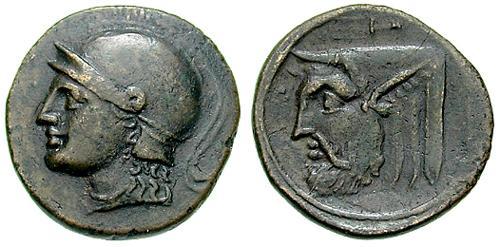
[ABOVE: Federal coinage from the Acharnanian League]
With preparations made on either side, the battle began. Eurylochus’ strong Spartan-occupied left wing quickly beat back Demosthenes’ right wing, as the Peloponnesian wing began to outflank the Athenian army. It was at this moment that the trap was sprung; the four-hundred hoplites and javelineers emerged from hiding to hit the rear of the Peloponnesian left wing, causing a route which spread throughout the army. Soon, Eurylochus and his Spartan company were encircled and killed. The Ambraciots were, however, successful against their Messenian opponents, pushing them off the battlefield, only to return and see the rest of the army and its commanders killed or fleeing, causing a route to Olpae which lead to more men being cut down. Only the Mantineans remained fighting in formation, causing the battle to go on until late in the day.
With Eurylochus dead, command passed down to Menedaïus. He was now worried that such a small force left in Olpae could not withstand a siege by land, let alone by sea too, and he worried he could not make a safe escape by himself. He thus asked for a truce and safe passage, which was only granted for him and the other notables in his army as Demosthenes was hoping to separate the Spartan command from their allies to disunite the forces. And when reports of allied Ambraciots, unaware of the battle that just took place, were on their way to reinforce their Peloponnesian allies, Demosthenes set up another ambush for them.
Many Mantinean captives, sent out to gather firewood and supplies while under Demosthenes’ truce, slowly started walking away to return to their homes, being chased by the Acharnanians who thought they were betraying them. When it was explained that they were being allowed to return under Demosthenes’ truce, one Acharnanian threw a javelin at them, but let the Mantineans return home while setting about killing the Ambraciots, occasionally mixing them up with other Peloponnesians. At the end of the incident, two-hundred Peloponnesian and Ambraciot men died. The Athenians returned to Athens with plenty of loot, and the Ambraciots and Ambracians signed a truce, which was suppose to last a hundred years.
PYLOS AND SPHACTERIA
Come the spring of 425 BC, amidst another Peloponnesian invasion of Attica by Agis II and a fleet of forty Athenian ships led by Eurymedon were being sent to Corcyra, Eurymedon got word that sixty Peloponnesian ships had already made it to Corcyra, causing the Athenian fleet to make a stop first at Pylos. While it was Spartan-controlled land, the area was rich in timber and stone, allowing the Athenians to easily fortify themselves effectively, and a nearby natural harbour aided the fleet well too.
Fortunately for Demosthenes, the Spartans were celebrating a religious festival at the time he made landing at Pylos, being too busy to respond to his presence there. Their forces were still occupied in Attica, and Demosthenes’s other commanders, more keen to press on to Corcyra, left him with five ships and made their way to Corcyra. Eventually, the Spartan raiders in Attica would pull out to repel the army at Pylos after only fifteen days of pillaging. Soldiers from across Laconia and Messenia were recruited to fight Demosthenes, also calling back their sixty ships at Corcyra to join the land army once they reached Pylos. During this time, Demosthenes was able to warn the Athenians ships at Zakynthos to assist in the coming fight.
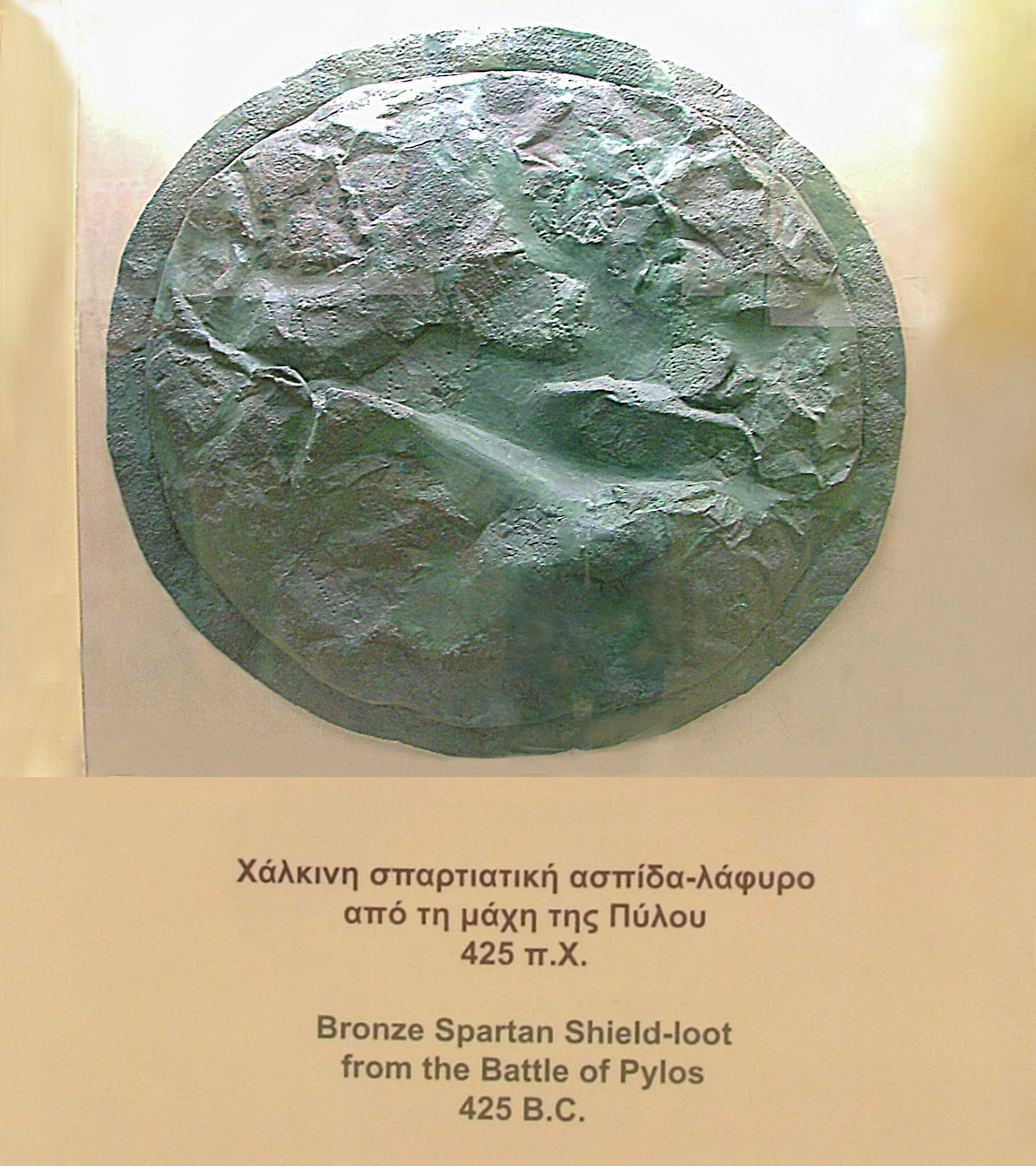
[ABOVE: A bronze shield belonging to a Spartan from the Battle of Pylos, now held in the Ancient Agora Museum, Athens]
The small, uninhabited island of Sphacteria lay only a mere mile from the mainland. Confident in taking down Athens’ flimsy fortifications, the Spartans marched and sailed to Pylos confident in victory. They planned to blockade the entrances to the harbour to block out Athens’ coming reinforcements. All Sparta had to do was stop the Athenians on the island from being able to dock on the mainland and gain reinforcements, and avoid a naval battle with them. With encouraging words from Demosthenes, the Athenian army too deployed for battle, along the shoreline.
BATTLE OF PYLOS
With forty-three triremes, the Spartan navy, commanded by Brasidas and Thrasymelidas, and the army moved together to attack the fort on two sides. The fleet attacked in repeated relays. Brasidas, however, soon noticed that the Spartan ships were reluctant to assault the coastal defences, weary of damaging their ships. Brasidas encouraged his men to forgo their ships’ safety and attempt to disembark on the island as soon as possible to engage in a land battle, where he hoped his Spartans would win the fight instead.

[ABOVE: Golden crown and silver ossuary of Brasidas, now held in the Archaeological Museum of Amphipolis]
Brasidas urged his on onwards, attempting to make his way down the gangway. When forced back by the Athenians, he withdrew from his attempt, wounded and losing his shield in the process. Other soldiers found disembarking near impossible. In a reversal of roles, the Spartans were now the ones making the naval assault, while the Athenians were dominating the land battle.

[ABOVE: "Brasidas During an Assault", by Walter Crane, c.1900]
Tired of their failed naval assaults, the Spartans resorted to constructing siege weaponry. By then, however, fifty reinforcing Athenian ships arrived, sailing for the nearby uninhabited isle of Prote, camping there before putting to sea the next day, hoping to lure the Spartans into the bay. They were not met in battle by the Spartans, however, so the Athenians sailed into the harbour through both entrances to meet them. The fighting was tough, but the Spartans were driven from the waters and pursued in their flight. Five ships were captured, while the rest fled for the mainland before their ships too were disabled. In desperation, seeing their stranded allies on the island, the Spartan army dashed - fully armoured - into the waters to aid them and pull their ships back, which failed. The remaining Spartans were trapped on the island of Sphacteria.
BATTLE OF SPHACTERIA
When news of the disaster at Pylos reached Sparta, they went so far as to consider sending the council there to see the situation for themselves and determine the best course of action. Seeing it would be hard to recover their soldiers from the island, Sparta attempted a peace truce with Athens. Athens would come to agree, as long as all Athenian captives and ships were returned and no offence was made on their fort, and all men within it were granted provisions. Athens would guard the island as they were before, but make no attack upon it. By the end of negotiations, sixty Athenian ships were handed over.
Since the Spartans on Sphacteria were trapped, the negotiations were on Athens’ terms. This view was further incited by Cleon, the most persuasive demagogue of the masses of the time in Athens, who persuaded that the Spartans on the island must surrender their weapons and be sent to Athens, in exchange for some regions and cities which had surrendered to Athens during the war. Since Sparta did not respond to this but asked to meet the diplomats in private, Cleon declared that the Spartans had no noble intentions. On their return, the truce was over, and Athens refused Sparta their ships back. Hostilities at Pylos were set, while two Athenian ships circled the island. Twenty more Athenian ships arrived in aid, bringing the Athenian fleet there to seventy in total, while the Peloponnesians on the mainland made attacks on the wall.
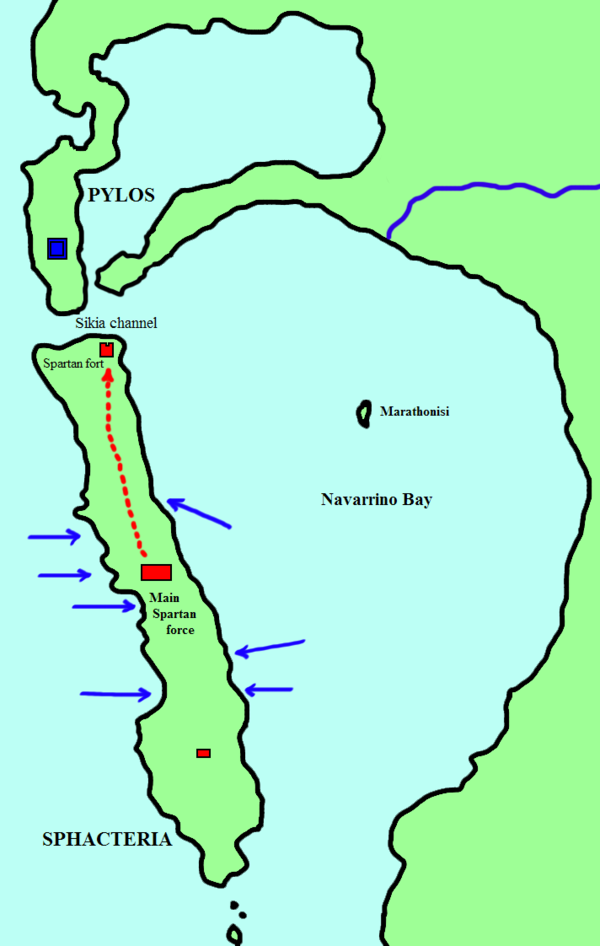
[ABOVE: Location of the Isle of Sphacteria in relation to Pylos, and the Athenian blockade]
The blockade would last a while, running the Athenian ships low on provisions in already squalor conditions. Men aboard had to take turns provisioning for food on land. This prolonged blockade was furthered in length by the trapped Spartans calling for volunteers to provide them with provisions, rewarding those who provided including freedom for Helots who did so too. Provisions from across the Peloponnese were getting to the Spartans on Sphacteria. The lack of habitability of the island only worsened the lack of supplies for the Athenians.
Cleon became aware of the Athenians’ resentment of him for preventing the agreement, and thus challenged the reports coming back to Athens about what was happening at Pylos. Those who brought back the reports stated that anyone who challenged the reports should go and see for themselves, thus the Athenians chose for this role Cleon. Afraid that he would either be forced to confirm the reports or be seen as a liar, Cleon advised that no more resources and time should be wasted patrolling the stranded Spartans, but they should be dealt with head-on instead. Lead by Nicias, many Athenians began asking why Cleon had not already gathered his own force to do this himself if he believed it so right and easy, he began sticking to his word, that is until he saw how serious Nicias was about this, soldiers were granted to him and he backed down from his word. Nicias would continue to press Cleon in this way, causing crowds to often be found shouting at Cleon, “Sail!”, urging him to sail to Pylos himself.
Backed into a corner, Cleon sailed for Pylos with a small force of hoplites and skirmishers, to meet up with Demosthenes as his colleague. For Athens either way, this was a win - either Cleon would be gone from their politics or the Spartans would be defeated in battle. Demosthenes’ plan was to directly assault the island, further resolved to doing so by word of outbreaks of fire on Sphacteria, as the island was highly wooded, and these trees, either burning or cut down for resources, would have once provided the Spartans with excellent cover against any assault on their position, as it had done in Aetolia.
Landing at either extremity of the island, the Athenian ships beached and the men took their meals. One soldier set fire to a small wooded area, and before long strong gusts of wind caused most of the entire island to be set ablaze, revealing the Spartans’ numbers and positions more clearly. He could now see how easy it would be to land on the island, and he swiftly set about organising the operation to land. When Cleon arrived and grouped him and his forces with Demosthenes, and the two men first invited the Spartans to surrender, promising to keep them in good conditions under custody. When this was, of course, rejected, Cleon and Demosthenes set out deeper into the island. In total, eight-hundred Athenian hoplites advanced into Sphacteria.
The first Spartan guard post the encountered, manned only by around thirty hoplites was quickly taken over before the Spartans could even respond in time to arm themselves for a fight. In the centre of the island, the majority of the army stood with their commander Epitadas. Making their way to the high ground, Demosthenes’ forces, Epitadas’ forces formed up and advanced to meet them, with light troops flanking the main hoplite line and guarding their rear. The Athenians on the hill were able to pin the Spartan army down atop their high ground position as they rained down missile fire, while the exposed Spartan light infantry could not get close enough to loosen their projectiles without taking serious damage.
Seeing the Spartans were unable to counter them, the Athenian army launched themselves at their foe with everything they had. Not use to this unusual style of fighting, the Spartans were quickly overwhelmed. Ash from nearby fires also made it hard for the Spartans to fight. All of this broke their command structure down, and eventually they became surrounded. With more and more of their soldiers falling, what was left of the Spartans regrouped and made their way to the fort at the end of Sphacteria. Most of them made it, and the Athenians did not attempt a frontal assault on the fortified position.
With no end in sight, a Messenian commander on the side of the Spartans made an offer to take his own and Demosthenes’ light troops’ to move around the eyes of the Spartan army to appear at their rear side in the hills. Demosthenes accepted, and soon the Spartan army was encircled. Trapped on all sides like they were at Thermopylae, the Spartans withdrew from the fort. Cleon and Demosthenes, however, wanted these Spartans alive to bring to Athens, and so stopped their army from pursuing the routing, exposed soldiers. Getting word of their situation now being either death or surrender, the Spartans - against their perceived norms - did the unthinkable: they dropped their shields and waved their arms in the air. They surrendered.
Now an armistice was in effect, discussions between Cleon and Demosthenes, and the only Spartan commander that was still alive: Styphon. Athens would not let the stranded Spartans communicate with their allies on the mainland. With this, the captured Spartans, 292 in total out of an original force of 420, were brought to Athens after a gruelling island assault that lasted seventy-two days in total. Cleon had kept to his word against all expectations: the Spartans were captured within twenty days of him setting off. Athens was in shock that the Spartans would surrender instead of fighting to the last man. One Athenian was noted for shouting out to a captured Spartan,
Were the dead, then, your good men and brave?
The Spartan replied,
The spindle would indeed be a weapon of great value if it could pick out the brave.
These 292 Spartans would be kept chained in Athens until further negotiations, and killed if Sparta attempted an invasion. With this, for the first time since the war began nearly a decade ago, Athens could farm their lands in Attica peacefully knowing Sparta would have major repercussions for invading. A permanent garrison was also established at Pylos, manned by the Messenians, who once called Pylos their home, who would make raids from here on out into Spartan territory. They also shared the same Doric dialect of Greek with the Spartans and the local populations in their territory, and were thus able to rile up many Helots into revolt and freedom against Sparta. In Athens, Cleon returned a hero, being granted large feasts and meals at state expense for his victories, and he would later go on to use his influence to increase the levy of tribute for the empire.
Sparta became increasingly worried. The tides were swinging in Athens’ favour, with victories at Tanagra, Olpae, Idomene, Pylos and Sphacteria. Sparta would need to double down their efforts, raise more forces from across their League, and show the Athenians they were not to be crossed.
NEXT POST: THE BATTLE OF DELIUM, 424 BC: Friendly Fire and Flamethrowers

SOURCES
- Thucydides, "History of the Peloponnesian War", Books 3.91 - 4.41
- Donald Kagan, "The Peloponnesian War"
YOUTUBE LINKS
(I do NOT own these videos)
"Ancient Greek History - Part 3 of the Peloponnesian War - 19" by "Historyden"
"Battle of Pylos 425 BC - Peloponnesian War #3 History 4K DOCUMENTARY" by "Kings and Generals"
MY ANCIENT GREEK HISTORY BLOG PAGE
MY ANCIENT PERSIAN HISTORY BLOG PAGE
All feedback - positive and/or critical - is appreciated!
All images used are copyright-free
Don't forget to rate this post, share it and leave a tip if you enjoyed it
Thanks for reading :)





