
Despite the hard hits against Athens since the start of the Peloponnesian War, neither conflict nor plague could wither the Empire enough to be brought down. Atop of this, key victories at Lesbos and Pylos showed that the lion still had immense power. After defeat and defeat, Sparta was ready to step their game up and mass their allies against the Delian League to fight back. The last phase of the Archidamian War and a real chance at peace were on the horizon, and the decisive and fiery battle of Delium approached.
Check out my previous post on the Battles of Pylos and Sphacteria
CORINTHIAN CAMPAIGN
Still in the summer of 425 BC, not long after their victories at Pylos and Sphacteria, Athens, keen to cut off Sparta’s mainland lines of communication and movement, targeted the Isthmus of Corinth for their next campaign. Nicias led this campaign, leading allies from Andros, Karystos and Miletus at the head of eighty ships, two-thousand Athenian hoplites and two-hundred allied cavalry. Docking near the unfortified settlement Rheitus (later known as Solygeia), only around seven miles from Corinth itself, Corinth received word quickly from Argos, allowing them to levy some soldiers to defend the Isthmus.
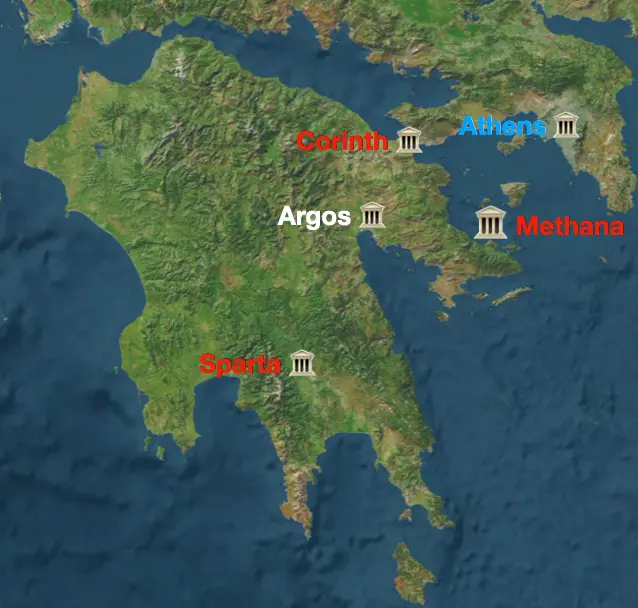
[ABOVE: The locations of Corinth and Methana within the Peloponnese]
Upon arrival, one Corinthian general, Battus, took a division of soldiers to protect Solygeia. The other commander, Lycophoron, attacked the Athenians. The Athenians were initially successful on their right wing after a struggle as the Corinthians were still disembarking, forcing them to withdraw to a nearby wall atop a hill, where they pelted the Athenian army with stones before regrouping, forming up for battle and charging down the hill. While the Athenians were still successful, a division of allied troops appeared to aid their engaged comrades, driving the Athenian right wing towards their ships. Lycophoron’s Corinthian right wing was also struggling as the Athenian left attempted to push towards Solygeia. However, since the Corinthians had no cavalry and the Athenians did, Athens was able to gain the upper hand and drive the Corinthians up towards the hill. In their retreat, Lycophoron was killed. With their enemy unable to retaliate once more, Athens was able to strip their enemy dead.
Following the battle of Solygeia, reinforcements came to Corinth’s aid; elders and veterans from Corinth arrived alongside an allied force who were stationed opposite the nearby Mount Oneium, who approached once they saw the dust clouds of battle fly high into the sky. Seeing what they thought was a large, professional army coming to reinforce, Athens made for their ships. In total, 212 Corinthians and around fifty Athenians lay dead. The Athenian fleet would travel to nearby Peloponnesian-allied islands to raid them, before going to Methana in Epidaurus, on the north-east coast of the Peloponnese, taking control of and fortifying and garrisoning the narrow Isthmus, before sailing back to Athens.
KORKYRA
Further Athenian campaigns were also made at this point in Korkyra, Corfu, which was still undergoing a period of civil war. Athens was able to attack and take over a fortified Korkyraean position, forcing them to retreat to higher ground and surrender to be taken as prisoners to Athens. However, upon many Korkyraeans attempting an escape by boat after their journey to Athens, the truce was declared at an end and all prisoners were executed.
PERSIAN NEGOTIATIONS
Come winter, the Athenian Aristeides, who was in the Aegean raising funds from his Delian allies, captured a Persian ship which was on its way from the Persian King to Sparta. Capturing a man named Artaphernes, he was sent to Athens and his letter was translated and read in front of the Assembly. The letter was vague, but it was clear that Sparta wanted something from Persia, and the Persians stated in their letter that Sparta should come to Persia if they want something instead. Artaphernes was sent back to Ephesus.

[ABOVE: Relief of Shah Artaxerxes I, shown on his tomb at Naqsh-e Rostam, Fars region of southern Iran]
On their return from Ephesus, Athens got word of a possible brewing rebellion in the island nation of Chios. Suspicious, Athens ordered Chios to demolish their city walls. Athens and Chios both assured each other that neither would make any attempts on the other.
ATTACK ON CYTHERA, 424 BC
The summer of 424 BC began rather mysteriously for the Greeks; a partial eclipse at the time of the new moon cast a shadow over the Greek world, while an earthquake ruptured the lands.
That same summer, Athens sent sixty ships, commanded by Nicias and manned with two-thousand hoplites and some cavalry, to attack Cythera, off the southern coast of Sparta’s homeland of Laconia. The islands inhabitants were the second-class citizens, the Perioeci, and the island had a permanent native-Spartan garrison watching the island around the clock; Sparta was keen on protecting and keeping the island in check given its importance in trade with places like Libya and Egypt, and protection from raids from Sicily and Crete.
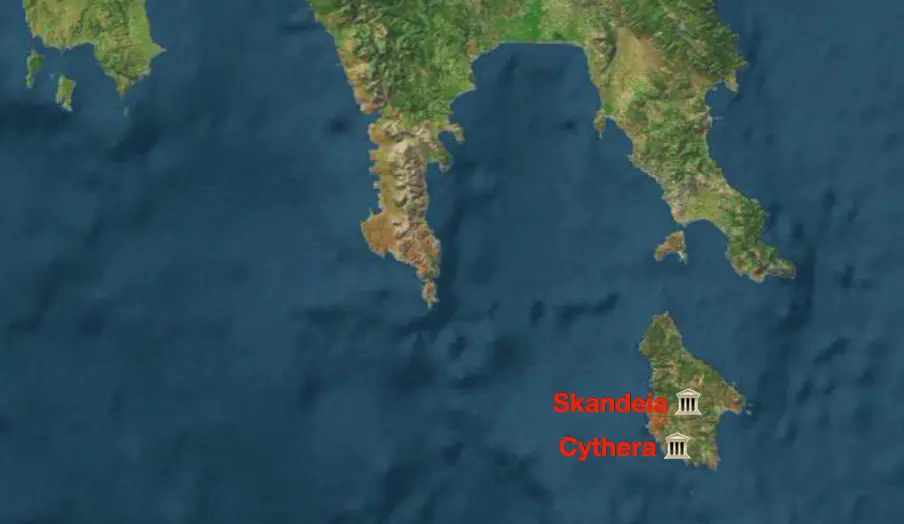
[ABOVE: The settlements of Cythera and Skandeia on the Spartan-owned island of Cythera]
Athens moved in. With ten ships, they took the port town of Scandeia. The rest of the force landed on the north side of the island to move south and attack the city of Cythera, where the entire population was already mobilised and waiting for them outside the city walls ready for battle. The ensuing battle was tough, with the Cytherans putting up a good fight for long, until eventually being broken and routing for the upper city. Under terms, the city and the island was surrendered to Nicias under threat of death. An Athenian garrison was established back at Scandeia to protect the island from Spartan reconquests.
Further raids and attacks would be made across the islands surrounding coastal Laconia for the next week, meeting little resistance. One city in particular, Thyra, was met with harsh resistance by Athens, who promptly torched the entire city, and its inhabitants and governors were captured and taken to Athens. With their foreign citizens falling in battle and negotiations, Sparta concentrated their efforts to protecting their countrysides, fearing a rise up of non-Spartan citizens.
THE BATTLE OF MEGARA
Athens had been invading Megarian territory for some time now since the war broke out. Twice a year, forces from Athens would push west towards the narrow Isthmus of Corinth to attack Megara. On top of this, Megarian exiles in the nearby city of Pegae, once expelled for political differences, also made regular incursions on Megara. After discussions, Megara thought it best to attack and reclaim their exiles in Pegae. Many allies of the exiles, however, stepped forwards to counter this manoeuvre, including Hippocrates and Demosthenes of Athens, who Megara offered to hand their city over to. it was agreed for Athens to firstly seize the city’s walls, before attempting to deliver the upper city, thinking it would come over easier once the walls had been secured.
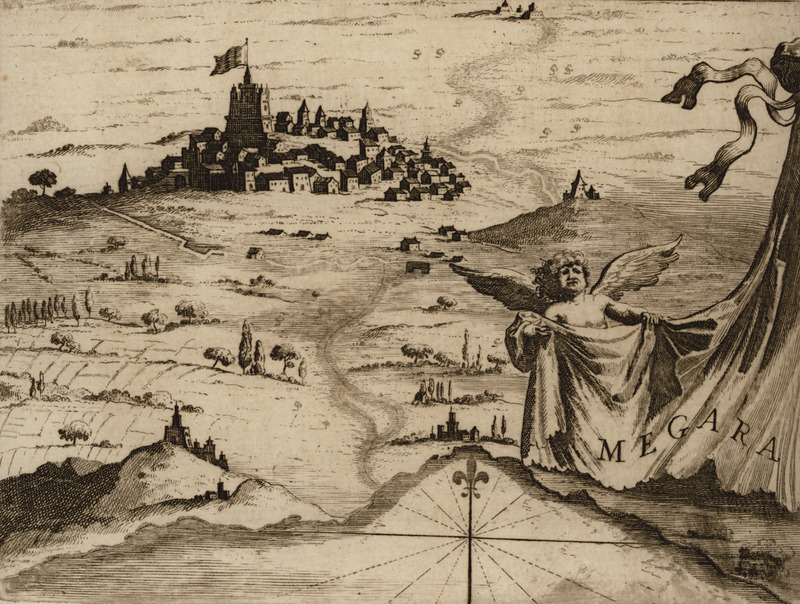
[ABOVE: "Megara" by Vincenzo Coronelli, created in 1687]
Hippocrates set out for Minoa, a small island facing Megara, with six-hundred hoplites, while Demosthenes made for a sanctuary closer to Megara’s walls. To enter through the city gates, a conspiracy was hatched from within the city; the city had a trench dug out to transport boats from the city to the coast, so a portion of the Athenian army was tasked with disguising themselves as one of these transporters occupying one of these boats taking them towards the city and distracting the gate guards long enough for Demosthenes’ army waiting in ambush to charge forward and enter the city. The plan was pulled off at night with ease; the gate guards were killed as Demosthenes and his personal guard were the first to enter the city alongside the Plataenas, who swiftly dealt with the first wave of defence inside the city, making first for the wall to occupy it. Most Megarians fled from the onslaught.

[ABOVE: The archaeological site of Theagenes Fountain in the ruins of Megara]
Remaining Megarians were offered peaceful transition over to Athens’ side should they lay down their arms. With much of the remaining defenders convinced that the entire city had betrayed them, many fled for the nearby port town of Nisaea. Come morning, A Megarian plan to open the gates to meet the main body of the Athenian army in battle outside the city walls was foiled by the city’s oligarchs, and the Athenian army outside the city - alongside the reinforcing force of four-thousand hoplites and six-hundred cavalry - joined Hippocrates to encircle Megara. Stonemasons and builders were borrowed from Athens to build a strong wall of circumvallation around Megara surrounded with a ditch. By the following afternoon, the walls were up. Fearing this rapid progress, the Megarians who had fled to exile came to terms with Athens and surrendered, earning their personal freedoms but giving up Nisaea to Athens.
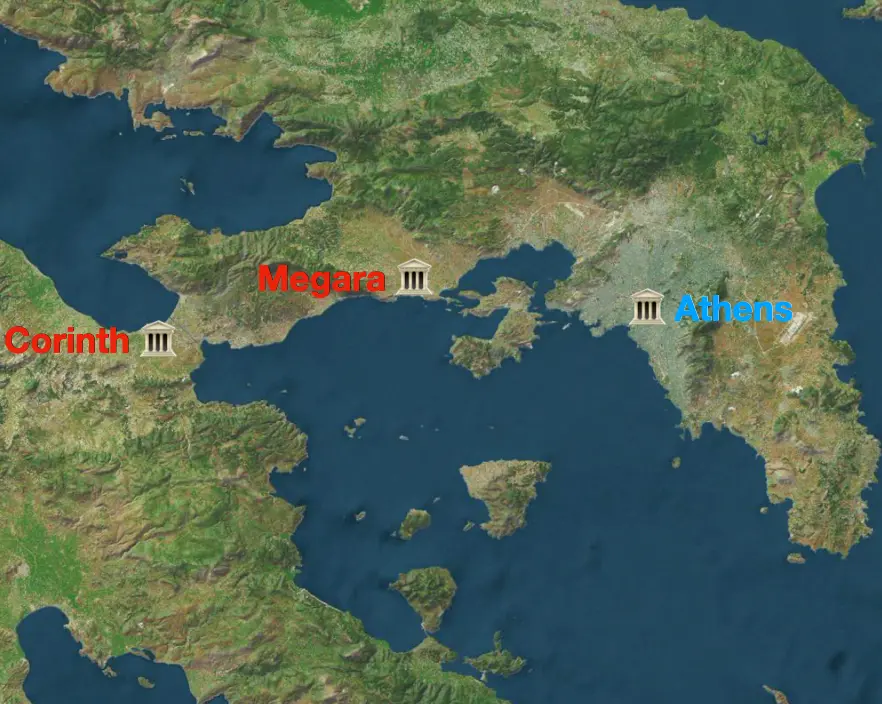
[ABOVE: The location of Megara, between Athens and Corinth]
At this time, it happened that the renowned Spartan commander Brasidas was in the region near Corinth preparing for a campaign in Thrace. Hearing of Nicaea’s fall, he marched to Megara with an army of two-thousand, seven-hundred of his own, and eleven-hundred allied, hoplites. Reaching Megara unnoticed, he told the Megarians that he intended to retake Nisaea, causing the city’s oligarchs to worry that he would later impose Nisaea’s exiles into the city and drive out their faction which could bring the city into civil war. Megara thus did not admit Brasidas, waiting instead for the coming battle’s outcome to decide who to side with.
THE BATTLE
Brasidas had also called upon Boeotia for aid; they sent two-thousand two-hundred hoplites and six-hundred cavalry, totalling Brasidas’s force to six-thousand hoplites and six-hundred cavalry. Hippocrates lined his Athenian army up outside Nisaea by the sea, with light troops and skirmishers screening the main body of the army of some five-thousand-plus hoplites and six-hundred cavalry. The battle opened with Brasidas’ Boeotian cavalry charging at the Athenian light infantry, causing them to route towards the sea in no time. With little time to respond to such a swift manoeuvre, Hippocrates ordered his cavalry in to counter Brasidas’, causing a long engagement in which both sides claimed to have the upper hand. The Boeotian cavalry commander was killed in this melee, but both sides withdrew.
Brasidas’s men advanced closer to Megara, taking hold of a more advantageous position on the field. Keen to keep their new advantage, no attack was made by the Spartans. The Athenians, still lined up outside the city walls, waited for an attack. When it did not come, Hippocrates eventually withdrew back in to Nisaea. Megara, assuming Brasidas as the battle’s victor, opened the gates to his army. With Nisaea back in Peloponnesian hands and Megara safe, Brasidas returned to Corinth to prepare for his Thracian campaign. Megara would go on to kill those within their city who had sided with Athens, and the city changed into an extreme military oligarchy, and would remain so for some time.
DELIUM
Following the withdrawal from Megara, Hippocrates made contact with the fellow Athenian general Demosthenes, who had just landed in Naupactus with forty vessels. Both had a keen eye for turning the cities of Boeotia into democracies, by force if necessary. Cities like Siphae and Chaeronea were prime targets for the Peloponnesian mercenaries now being recruited for this task by the generals. Among these settlements was Delium. Delium had a sanctuary of Apollo located nearby, and the goal was to occupy this sanctuary at the same time as the other Boeotian cities in order to help stop the annual Spartan raids into Attica and begin doing the very same in Sparta’s own lands.
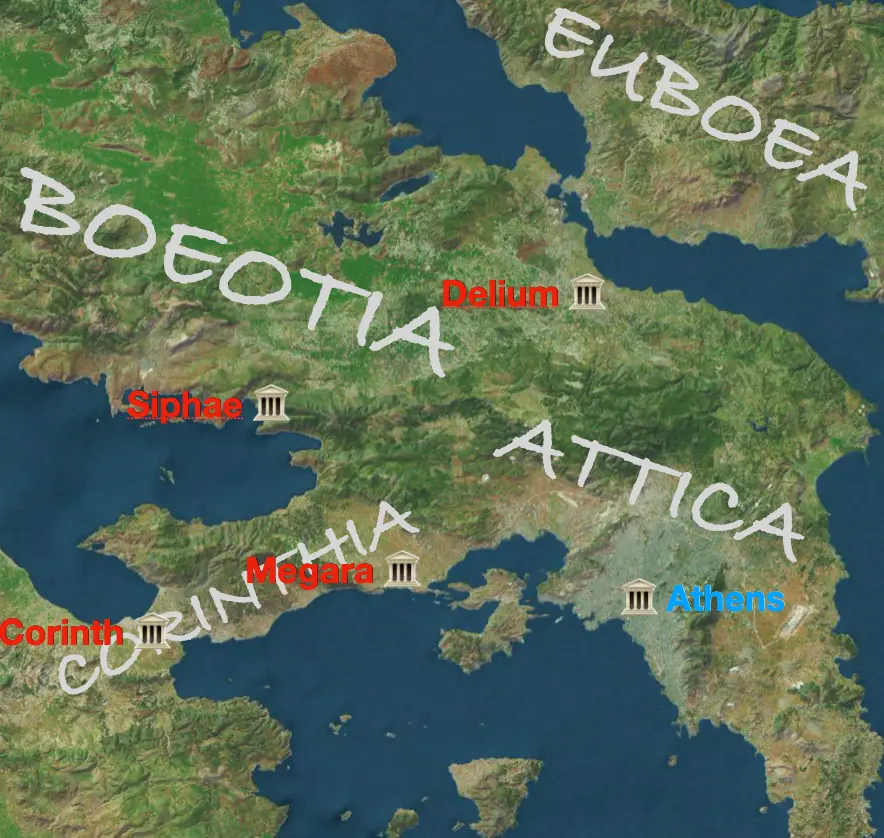
[ABOVE Delium and Siphae]
Come the time, Hippocrates was to march with his Athenians into Boeotia while Hippocrates was to be sent to Naupactus with his navy and collect allies on the way, making port at Siphae to expect their betrayal.
Come winter, Boeotia was ready to be betrayed to Athens. However, mistakes were made between Hippocrates and Demosthenes as to when to attack together; Demosthenes sailed for Siphae too soon, and the expedition was a failure. Knowing this, and knowing Hippocrates was not yet in the region to create a major disturbance, the Boeotians rallied a force into action, quickly securing Siphae and Chaeronea. Hippocrates had raised a full-scale Athenian army, rallying allies to his cause too, and set for Delium to fortify the settlement’s sanctuary and await battle, digging a trench around the sanctuary and forming a wooden palisade wall atop the dug earth to fortify themselves, while Hippocrates’s hoplites took up positions ready for battle outside, sending many of the light troops back to Athens.
PAGONDAS
The Boeotians noted this Athenian withdrawal back to their own territory, yet many were sceptical of engaging. One chief Boeotian officer however, Pagondas, thought the risk of battle was one worth taking, and through an impassioned speech he persuaded Boeotia to take up arms against Athens at Delium. Not far outside the city, the two armies were lined up opposite each other, with a slight crested hill blocking direct vision of one another.
The entire Boeotian force of some seven-thousand hoplites, ten-thousand light troops, one-thousand cavalry and five-hundred skirmishers - a total of 18,500 men - faced opposite Hippocrates’s force of seven-thousand hoplites and ten-thousand light troops - 17,000 men; nearly forty-thousand men would face off in the Peloponnesian War’s largest battle to date, by far.
Pagondas’s Theban infantry held the right wing, the Thespians and Tanagrans held the left, the centre was manned with various other allied troops, and the thousand cavalry were placed equally on either far wing. Pagondas altered the normal order of battle by forming his Theban right-wing of hoplites up into an unusually thick formation twenty-five ranks deep - as opposed to a typical depth of around eight men deep. The idea was to use his best troops en-mass to overwhelm the Athenian left wing in an attempt to dominate one side of the battle early and outflank and surround the rest of the opposing force.
HIPPOCRATES'S SPEECH
As was typical of hoplite warfare, Hippocrates’s seven-thousand hoplites formed up eight ranks deep, with some cavalry manning the wings. While the Athenians outnumbered the Boeotians, much of their force was unprofessional, and comparatively ill-equipped. Nevertheless, Thucydides records this speech Hippocrates gave to his men before the battle:
Men of Athens, this is only a brief exhortation, but for brave men brief is as good as long: and it is more a reminder than an instruction. None of you should think for a moment that there is no cause for us to be facing dangers such as this on foreign soil. At stake in this country is the future of our own. If we are victorious, the Peloponnesians will lose the use of the Boeotian cavalry and you will never see them invading our land again. In one single battle you can both win this country and promote the freedom of yours. Go to meet them, then, with a spirit worthy of our city - the first city in all Greece, where everyone of us is proud to claim his birthright - and worthy of our fathers, who in their time fought and conquered the Boeotians at Oenophyta under Myronides and took possession of their country…
THE BATTLE
Hippocrates reached halfway up his battle line giving his speech before the Boeotian line, presumable encouraged by a speech by Pagondas, shouted their paean war cry and quickly advanced towards the Athenians over and down the hill. The Athenians met their advance with a run, engaging the main hoplite line and beginning the Battle of Delium. While the two army’s extreme cavalry and skirmisher wings were stopped by a gulley in their way, the main infantry lines clashed violently as shields smashed into shields. Pagondas’s centre and left was pushed back by Hippocrates’s centre and right, with the Thespians taking a particularly brutal hit after the men around them fled, leaving the Thespians surrounded, fighting hand-to-hand to the end. Amidst this encircling engagement hallway in the line, some Athenians reportedly attacked and killed several of their own men in the confusion in what has gone down as the first major documented instance of friendly fire in warfare.
Many of the Boeotians on the failing left wing ran to accompany the Theban right wing, which was making excellent ground against the Athenian left, pushing them down the hill. Noting his failing left wing, Pagondas snuck his cavalry and skirmishers manning his right wing behind the hill out of view of the Athenian forces to reinforce his won left wing and attack the Athenian right wing. This further confusion caused the Athenians there to believe that a second reinforcing army was coming to the Boeotian’s aid, causing much panic and a subsequent mass retreat. With his left wing being dominated by the Thebans and the right wing taking to flight, Pagondas ordered his army to retreat.

[ABOVE: The deployment, engagement and outcome of the battle of Delium, 424 BC]
ALCIBIADES AND SOCRATES IN THE RETREAT
One man who fought in this battle according to Plato was Socrates himself, alongside the renowned Alcibiades. In his “Symposium”, Plato has Alcibiades give the following account of Socrates’s involvement amidst the mass Athenian retreat: Socrates was armed as a hoplite and Alcibiades a cavalryman. While Socrates and the rest of the men pulled back, Alcibiades happened upon them and swore to protect them amidst the ensuing carnage. Noting how Socrates had saved his life in turn at the Battle of Potidaea eight years prior. Utilising his advantage on horseback, Alcibiades was able to note how Socrates overcame any man who attempted a duel with him, and was able to flee the battle in safety.

[ABOVE: "Socrates at the Battle of Delium", by Thomas Couture, 1843, now held in the Collection of National Gallery, Canada]
Those retreating Athenians made their way either for Delium, another settlement called Oropus or for Mount Parnes nearby. They were pursued until nightfall by the Boeotian light infantry and cavalry. By nightfall, around one-thousand Athenians lay dead, alongside five-hundred Boeotians. Among the Athenian dead was Hippocrates. The Boeotian troops returned to their homes, while the Athenians who reached Delium and Oropus fled by ship back to Athens. When an Athenian delegate met with a Boeotian to ask for the recovery of their dead, it was denied, at least until the Athenians left Boeotia for good; the Athenians had blasphemously set up their fortifications around Delium’s holy sanctuary, and were even supposedly using the sanctuary’s holy water as a supply for the army. Nevertheless, a truce was reached.
FLAMETHROWERS AT THE SIEGE OF DELIUM
Pagondas was soon joined by reinforcements comprised of skirmishers, two-thousand Corinthian hoplites and Nisaea’s three-hundred cavalry garrison, who all put Delium under siege. A walled city like Delium would typically be taken via rams and ladders, for example, however in 424 BC, something rather different would be employed. As described by Thucydides:
… the application of an engine which succeeded in taking the place. This engine was constructed as follows. They sawed a great beam in two, hollowed it out completely, then fitted the two parts precisely together again, like a pipe; at the far end they suspended a cauldron on chains, with an iron nozzle curving down into it from the beam; most of the rest of the wood was also cased in iron. From some distance they brought this machine up on wagons against those parts of the wall which were largely built of vine-wood and other timber. Wherever they got it close, they applied large bellows to their end of the beam and made them blow. The pipe was airtight, so the blast went straight through to the cauldron, which was full of lighted charcoal, sulphur and pitch. The result was a huge flame which set fire to the wall and made it impossible for anyone to stay manning it: the defenders abandoned the wall and took to flight, and so the fort was captured by this means.
[Thucydides, Book 4.100]

[ABOVE: The Tassios Drawing study-design of the Boeotian flamethrower, by J. Nakas]
[BELOW: A replica model of the Boeotian flamethrower, now held in the Thessaloniki Science Centre and Technology Museum, Greece]

With the Boeotian flamethrower proving a massive success, Delium was taken after only seventeen days. Many men garrisoning the city were killed and two-hundred men were taken captive, while the majority of the defenders boarded ships and withdrew.
All the while, Demosthenes’s side of the plan, what with Hippocrates’s death and his army's defeat at Delium, to ambush and take Siphae came to nothing. Instead, he took four-hundred hoplites to land on the coast of Sicyon. This too did not go to plan, and many of the Athenians were killed or captured upon landing, forcing Demosthenes to retreat.
THE PEACE OF 423 BC
Come the spring of the following year, Athens agreed to a truce with Sparta. Athens was concerned that Brasidas would be able to gain the alliance of Delian League defectors, while Sparta, identifying Athens’s concerns, saw this as an opportunity for a period of relief and pressure, and since their main concern of their Spartans from Sphacteria had been returned by now, they saw a possibility at peace itself.
Concerning the sanctuary and the oracle of Pythian Apollo we resolve that any who should have access according to the established laws, without fraud or fear. This is resolved by the Spartans and their allies here present: and they undertake to us all diplomatic means to persuade the Boeotians and Phocians likewise. Concerning the money belonging to the god, it is resolved that we shall be diligent to discover the guilty parties, properly and justly in accordance with the established laws, both you and we and those other who do wish, all in accordance with the established laws. These are the resolutions of the Spartans and their allies in the matters aforesaid.
A resolution of the Spartans and their allies in the event of the Athenians making a treaty. Both parties to remain within their own territory, retaining possession of what we each now hold: the Athenians at Coryphasium to stay within the bounds of Bouphras and Tomeus; in Cythera to have no communication with the Peloponnesian alliance, neither we with them nor they with us; at Nisaea and Minoa not to go beyond the road leading from the gates at the shrine of Nisus to the temple of Poseidon, and then directly from the temple of Poseidon to the bridge over to Minoa (nor should the Megarians or their allies cross this road); the Athenians to keep the island of Minoa which they have captured, but with no communication in either direction; and at Troezen the Athenians to retain what they now control, as agreed with them by the Troezenians.
In the use of the sea, the Spartans and their allies may sail in their own and allied coastal waters in any oared vessel of a capacity up to five hundred measures, but not in warships.
There shall be safe conduct both by land and by sea for any herald or embassy (with attendants as appropriate) travelling to or from the Peloponnese or Athens in diplomacy to end the war or settle disputes.
During this period there shall be no reception of deserters, either free or slave, either by you or by us.
You shall be legally accountable to us, and we to you, according to established practice, and any matters of contention shall be resolved by arbitration without recourse to war.
These are the resolutions of the Spartans and their allies. If you reach better or fairer resolutions than these, come to Sparta and explain them to us. Neither the Spartans or their allies will refuse to consider any fair proposals which you make. Those who come should come with full executive authority, as you required of our spokesman too.
The truce shall be for one year.
Thucydides, Book 4.117-119
War between the two alliances, however, would continue for the next year; up north, Spartan general Brasidas was keeping to his side of the plan, making his way north to Macedonia and Thrace. With the coming battle of Amphipolis, the final phase of the Archidamian war was to come.
NEXT POST: THE BATTLE OF AMPHIPOLIS, 424 - 421 BC: The Peace of Nicias
SOURCES
- Thucydides, "The Peloponnesian War", Book 4.42-119
- Plato, "The Symposium", 220d-221c
- Donald Kagan, "The Peloponnesian War", chapter 13
YOUTUBE LINKS
(I do NOT own these videos)
"Battle of Delium, 424 BC ⚔️ Athens takes on Sparta ⚔️ Peloponnesian War" by "HistoryMarche"
"Ancient Greek History - Part 4 of the Peloponnesian War - 20" by "Historyden"
"Was There Friendly Fire in Ancient Battles?" by "Invicta"
MY ANCIENT GREEK HISTORY BLOG PAGE
MY ANCIENT PERSIAN HISTORY BLOG PAGE
All feedback - positive and/or critical - is appreciated!
All images used are copyright-free
Don't forget to rate this post, share it and leave a tip if you enjoyed it
Thanks for reading :)
And have a happy new year!





