
For years, the main argument for investing in altcoins has been simple: "Bitcoin may do 3x or 4x, while the right altcoin can do 10x, 20x, or even 100x". That asymmetry is what made the great altseasons so attractive. But what happens when the number of tokens grows exponentially, liquidity becomes fragmented, and thousands of projects compete for the same pool of capital? Data from 2020 through 2026 suggests that something has changed fundamentally. Altcoins can still produce extraordinary returns. The problem is that finding the winners in advance has become much harder, while the cost of being wrong remains enormous.
BITCOIN VS ALTCOIN MARKET
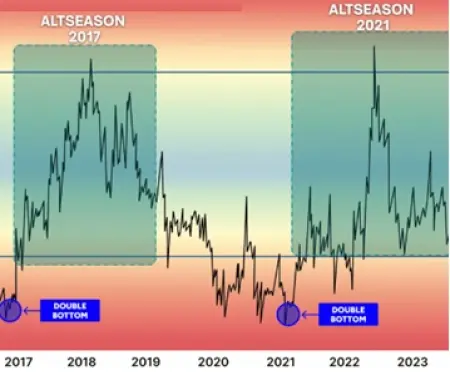
Let's start with the simplest comparison. From January 2020 to June 2026, Bitcoin gained approximately 730%. Over the same period, an equally weighted altcoin index lost approximately 53%. There was, however, one major exception: the 2020–2021 bull market.
Between February 2020 and November 2021:
- Bitcoin: +508%.
- Altcoin index: +904%.
This was the classic altseason. And this distinction matters. The 2021 altseason was not simply a perception created by crypto investors looking back at the past. It was very real. The question is whether those conditions can be replicated.
SOME NUMBERS
According to research from Blockchain Research, approximately 1,970 tokens surpassed $50 million in market capitalization between 2020 and 2025, only 1.7% of them outperformed Bitcoin over a 24-month period. In other words: roughly 98.3% failed to beat BTC.
The downside was even more striking. The median loss among the underperforming tokens was approximately 97%.
This reveals the extremely asymmetric distribution of altcoin returns:
- A very small number of winners generate enormous returns, while a huge number of tokens lose most of their value.
- That distribution makes altcoins particularly difficult to treat as long-term investments.
2021: THE ALTSEASON WAS REAL BUT FEW TOKENS EXISTED
In 2020-2021, 187 altcoins outperformed Bitcoin through November. At first glance, this looks like overwhelming evidence that buying altcoins was the right strategy. But what happened afterwards tells a very different story. Approximately 85% of those 187 tokens subsequently lost at least 90%**. Their median subsequent return was approximately -97.6%.
This leads to an important distinction:
- Being a winner during an altseason does not mean being a good long-term investment.
- A token can rise 10x during a speculative phase and subsequently lose 95–99% of its value.
For an investor who simply holds, the final outcome can therefore be disastrous.
SURVIVING TOKENS
Another interesting pattern emerges when looking at the few tokens that continued to outperform Bitcoin over longer periods. One of the clearest examples was $OKB**, the token of OKX Exchange, which launched in 2018. This suggests that some of the strongest long-term performers were associated with established businesses, strong network effects, or infrastructure with persistent economic activity, rather than simply being the most popular narrative of a particular cycle. This does not mean exchange tokens or DeFi tokens are automatically good investments. It simply highlights how exceptional long-term survival has been.
COLLAPSES
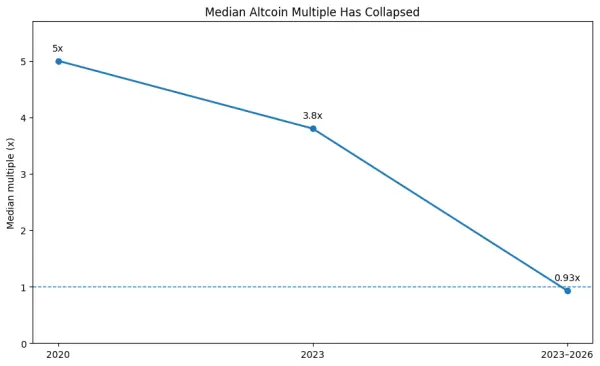
One of the most important changes concerns the multiples generated by altcoins. In 2020, the median altcoin multiple was around 5x. By 2023, it had fallen below 4x. From the end of 2023 through 2026, it fell to approximately 0.93x. The market effectively moved from:
"Find a good altcoin and you can generate an enormous multiple"
to: "The median altcoin doesn't even generate a meaningful positive return".
This may be the most important structural change in the entire market.
FINDING PERFORMING ALTCOINS
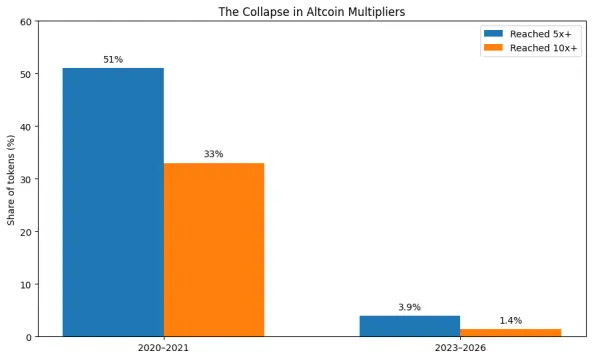
How hard is it to find a 5x? This is where things become particularly relevant for speculators. Among approximately 1,000 tokens with at least $50 million in market capitalization analyzed between 2023 and 2026: 3.9%** reached at least 5x and 1.4%** reached at least 10x.
So historically, fewer than 4 out of 100 tokens in this sample reached 5x. For a 10x, the figure was roughly 1 out of 70. These numbers should not be interpreted as the literal probability that a randomly selected altcoin will produce a 5x or 10x in the future. They are historical frequencies within a specific sample. But they clearly illustrate how difficult the game has become.
WHO MADE 10X?
The composition of the winners is particularly interesting. The 10x group from 2023 onward was dominated by memecoins, including:
$PEPE, $WIF and $BONK.
There were notable exceptions such as: $HYPE and $VIRTUAL.
Several more fundamental or infrastructure-oriented projects also produced very large multiples, including: $PENDLE and $ONDO. So it would be incorrect to say that only memecoins produced 10x returns. The most important conclusion is: 10x outcomes became extremely rare and increasingly difficult to predict in advance.
MARKET CAP
Altcoins that had already surpassed $1 billion in market cap by 2023 were less likely to suffer extreme losses than tokens in the $50–100 million range. But there was a trade-off. Their median multiple was approximately 1x. This is intuitive. A $50 million token can theoretically become a $5 billion asset. A token that is already worth $5 billion needs an enormous amount of additional capital to generate the same multiple.
In simple terms:
- Smaller market cap: higher risk, higher potential upside.
- Larger market cap: lower risk, lower potential upside.
The difficult part is finding an asset that offers both low risk and a 10x upside.
THE MARKET IS DIFFERENT NOW
One of the most plausible explanations is capital dilution. In 2020–2021, the crypto market was already large, but the number of genuinely relevant assets was much smaller. By 2024–2026, the number of tokens had exploded:
- new L1s and L2s.
- DeFi protocols.
- restaking.
- RWA/NFT.
- DePIN.
- gaming.
- memecoins.
- governance tokens.
- more airdrops (quests, points/XP, etc).
- tokenized stocks.
- thousands of new launches.
The amount of capital available to the market did not increase at the same rate as the number of tokens. If $100 billion of capital is competing across 300 assets, the situation is very different from $100 billion competing across 50,000 assets. The natural consequence is lower average multiples.
SO, IS ALTSEASONS DEAD?
Not necessarily. And it is important to distinguish between two different concepts.
- An altseason can simply mean that a group of altcoins outperforms Bitcoin for several weeks or months. That can still happen.
But this is very different from the old assumption that:
- Buy a basket of altcoins and hold them for years because most of them will eventually go up. The historical data do not support that strategy. Quite the opposite. Returns are extremely concentrated among a tiny number of winners.
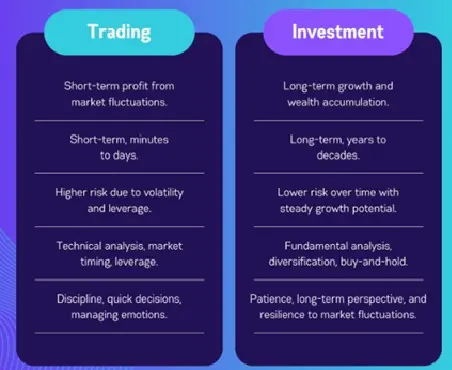
TRADING VS INVESTING
Altcoins can still make sense as trading opportunities. A token can enter a narrative, attract liquidity and rise 5x within a few months.
But you need an exit strategy.
INVESTING
Long-term investing is much more difficult. If your strategy is to buy an altcoin and hold it for 2–3 years, the historical probability of beating Bitcoin is extremely low. The problem is not only choosing the right token. You also need to choose the right time to sell it. And this second part is often completely ignored.
BIAS PROBLEM
When we look back at previous altseasons, we naturally remember the winners: $ETH, $BNB, $SOL, $UNI, $HYPE, $PENDLE, etc
But we forget the hundreds or thousands of tokens that disappeared, lost 95-99%, or never recovered their previous highs. This creates a powerful retrospective illusion:
"If only I had bought altcoins in 2020...".
But in 2020, nobody knew which tokens would become the winners. That is precisely what these statistics attempt to quantify.
BITCOINS AS THE BENCHMARCK
There is another question every altcoin investor should ask. It is not enough to ask: "Can this altcoin do 3x?". The correct question is: "Can this altcoin outperform Bitcoin by enough to justify the additional risk?". If Bitcoin doubles and an altcoin triples, the altcoin technically won. But you assumed dramatically more risk to achieve a relatively modest additional return. If the altcoin loses 90% while Bitcoin doubles, the opportunity cost becomes enormous. Bitcoin should therefore be treated as the benchmark against which every altcoin investment is evaluated. For this reason, it is very useful to look at the BTC/altcoin chart and not BTC/USDT.
HAS THE ALTCOINS ASYMMETRY DISAPPEARED?
This is perhaps the most important conclusion. In 2020–2021, there was an extraordinary asymmetry:
- Very high downside, but potentially enormous upside that was relatively common among the winners.
In 2024–2026, the situation appears to have shifted toward:
- Almost the same downside, but much rarer upside.
That is a terrible change for a speculator. The risk has remained high while the average reward has deteriorated.
IS IT BEST TO BUY ALTCOINS IN 2026?
The data do not say that you should never buy altcoins. They say that you should understand the game you are playing. In the 2023–2026 sample: ~3.9% → 5x+ and ~1.4% → 10x+. And across the broader 2020–2025 sample: ~1.7% → outperformed Bitcoin over 24 months. Meanwhile, among the non-winning tokens, the median loss was approximately: -97%.
Again, these are not predictions of what will happen to future altcoins. They are historical frequencies. But they provide a useful framework for understanding the odds. The main analysis considers tokens that reached at least $50 million in market capitalization. That already introduces a form of survivorship bias. It excludes the enormous number of microcaps that never reached that threshold and may have lost virtually all of their value. Therefore, the -97% median loss should not be interpreted as a maximum downside. In the real market, plenty of tokens have lost 99%+ or effectively gone to zero. Bitcoin is not necessarily the asset with the highest possible upside. But it may be the strongest risk-adjusted long-term bet in crypto when considering historical performance, liquidity, survival and the probability of selecting a lasting winner. Altcoins offer something Bitcoin cannot: the possibility of finding a 10x, 20x or 50x winner. But that possibility has become much rarer. And the cost of being wrong remains enormous.
So the question should not simply be:
"When is the next high season?".
It should be:
"How much am I willing to lose to find the next 10x?".
Because in 2026, the real problem with altcoins isn't that 10x winners no longer exist. It is that the winners have become a tiny fraction of the investable universe.
For a crypto portfolio, the distinction may therefore be simple:
- Bitcoin for core exposure.
- Altcoins for speculation (4-5%).
And an exit plan before an entry plan.
Article always updated with all the possibilities of on-chain farming (airdrop): Some Sites To Earn Crypto Bonus (Old & New)






