
With Spartan victories at the battles of Delium and Amphipolis causing major setbacks for the Delian League, Athens finally agreed to a peace in 421 BC. The goal was for both sides to recover from the ten years of brutal conflict they had encountered thus far since war broke out, however the peace would not last as long as planned; both Leagues had their own respective war hawks keen to take vengeance on the other. As a result, what should have been a period of peace would result - only three years later - in one of the late 5th century BC’s deadliest and decisive battles at Mantinea.
Check out my previous post on The Battle of Amphipolis and the Peace of Nicias, 424 - 421 BC
THE ARGIVE ALLIANCE
In March of 421 BC, the Peace of Nicias, intended to be fifty years in duration, finally came into effect. Both Athens and their Delian League allies, and Sparta and their Peloponnesian League allies, swore to remain at peace, that is aside from a handful of alliance members on either side. Chief among these was Sparta’s most powerful ally, the city of Corinth, who would continue their own smaller-scale campaigns into the period of Peace.

[ABOVE: Ruins of the Heraion sanctuary in Argos]
Among their personal escapades was a visit to Sparta’s old enemy, the neutral city of Argos. They argued to Argos that since Sparta had now allied itself with Athens, their goal was not peace as such, but the subjugation of the entire Peloponnese - Argos and Corinth included. Corinth argued, therefore, that it should be up to Argos - themselves a powerful city-state - to become the centre of its own alliance outside of the Delian and Peloponnesian Leagues, and that with hatred for Sparta so rampant across Greece, their following would be large very quickly.
Argos took up the idea, appointing twelve commissioners to begin accepting other Greeks - except Athens and Sparta, who terms would not be made with - into their new Argive Alliance. Argos’s own peace with Sparta was coming to an end, and while Sparta had taken many major setbacks in the war’s ten-year duration so far, Argos had benefitted greatly from its non-participation in the war, becoming a notably prospering state in Greece.
MANTINEA
First to enter into alliance with Argos was the democratic city of Mantinea, and their allies. Since subjecting a part of Arcadia, they thought that Sparta would now turn their gaze towards them, seeing them as an expansionist adversary in the Peloponnese. None of this went unnoticed by the Spartans; as leader of the largest League in the Greek world, they had eyes and ears all over, and intended to make a treaty with Argos themselves to end this dispute and keep the peace truly going.

[ABOVE: The ruins of an ancient theatre in Mantinea]
Spartan envoys were sent to Corinth, saying that their non-agreement in the Peace, as members of the Peloponnesian League, was a violation of it. Corinth, on the other hand, argued that since their Thracian-based colony cities of Sollium and Anactorium had not been returned to them since their capture by Athens during the war, they thought themselves too disadvantaged to participate in Spartan negotiations. These cities joined Potidaea in revolt against Athens, and Corinth swore support and provided it independently of Sparta. Thus Corinth argued that their refusal to enter into alliance with Athens was not breaching the treaty.
ELIS
Not long afterwards, envoys from Elis, who too had past grievances with Sparta, arrived in Corinth. They too made an alliance with the city before making their way to Argos to do the same, seceding from the Peloponnesian League. Two Peloponnesian League members who were notably keen to remain on Sparta’s side were those in Boeotia, and Megara, whose oligarchic governments lined up more with Sparta’s constitution.

[ABOVE: Remains of a theatre in Elis, southern Greece]
It was around this time, during the Spring-Summer time of 421 BC, that Athens’ siege of Scione was successful. Its male inhabitants were killed and the women and children enslaved, and the land was granted to their Plataean allies.
TEGEA AND BOEOTIA

[ABOVE: Ruins of the Temple to Athena Alea, Tegea]
Now allies, Corinth and Argos sent a joint envoy to Tegea, who too were keen on seceding from Sparta. Their view was that with all three in one alliance, they could together dominate the Peloponnese. When they refused, however, Corinth looked elsewhere to the Boeotians to ask of them the same proposal. They also asked the Boeotians to accompany them to Athens and ask for the same ten-day truce that had been granted at the onset of the Peace. Should it be denied, Corinth and Argos said that Boeotia should renounce their part in the Peace. Athens, however, refused to grant the ten days, arguing that Corinth already had this granted to them since they still saw them as allies of Sparta, whom this also applied to. With Boeotia making no subsequent action, an informal armistice between Corinth and Athens stood.
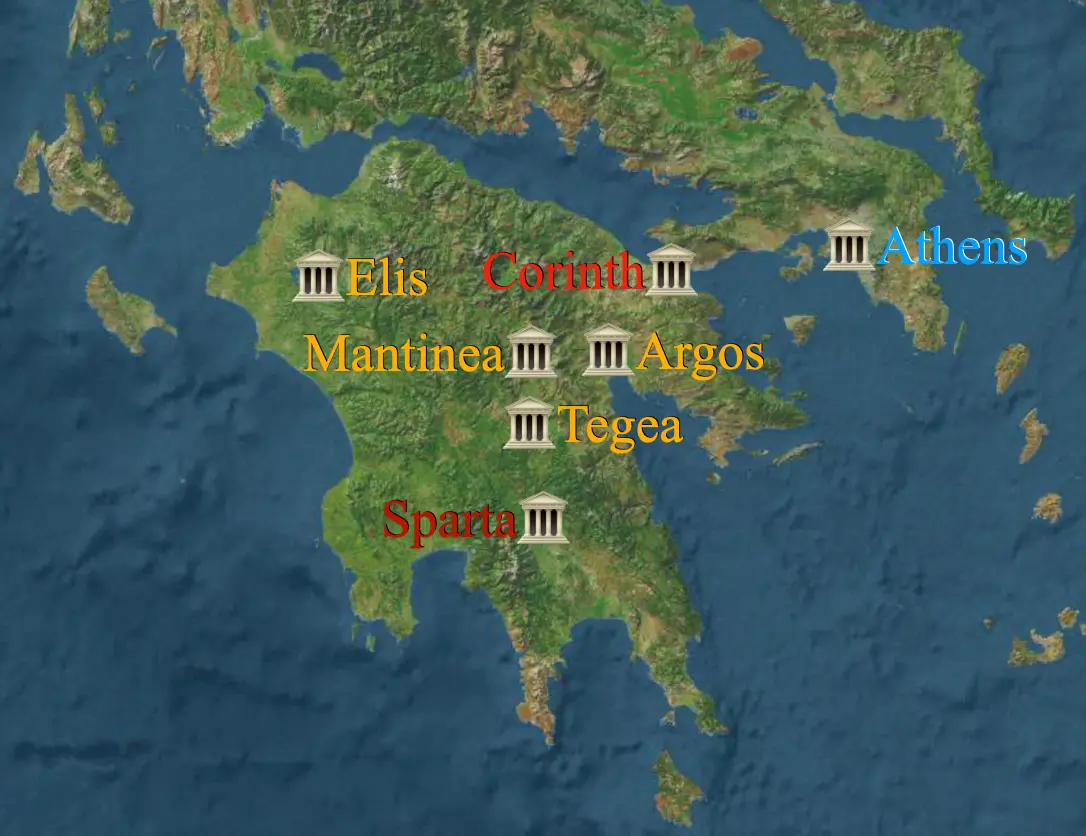
[ABOVE: Major members of the Argive League (orange) following negotiations, summer 421 BC]
SUMMER CAMPAIGNS
In summer, a dispute between Parrhasia, in Arcadia, and Mantinea resulted in open conflict between the two states. Parrhasia was a subject-state to Mantinea, and had called for Spartan aid following Mantinea’s construction of a fort inside their territory. Given the fort’s location and how it could also be threat to them, Sparta accepted the call against Mantinea. Sparta began to ravage the lands of Parrhasia, eventually taking the fort, restoring Parrhasian independence and returning home.
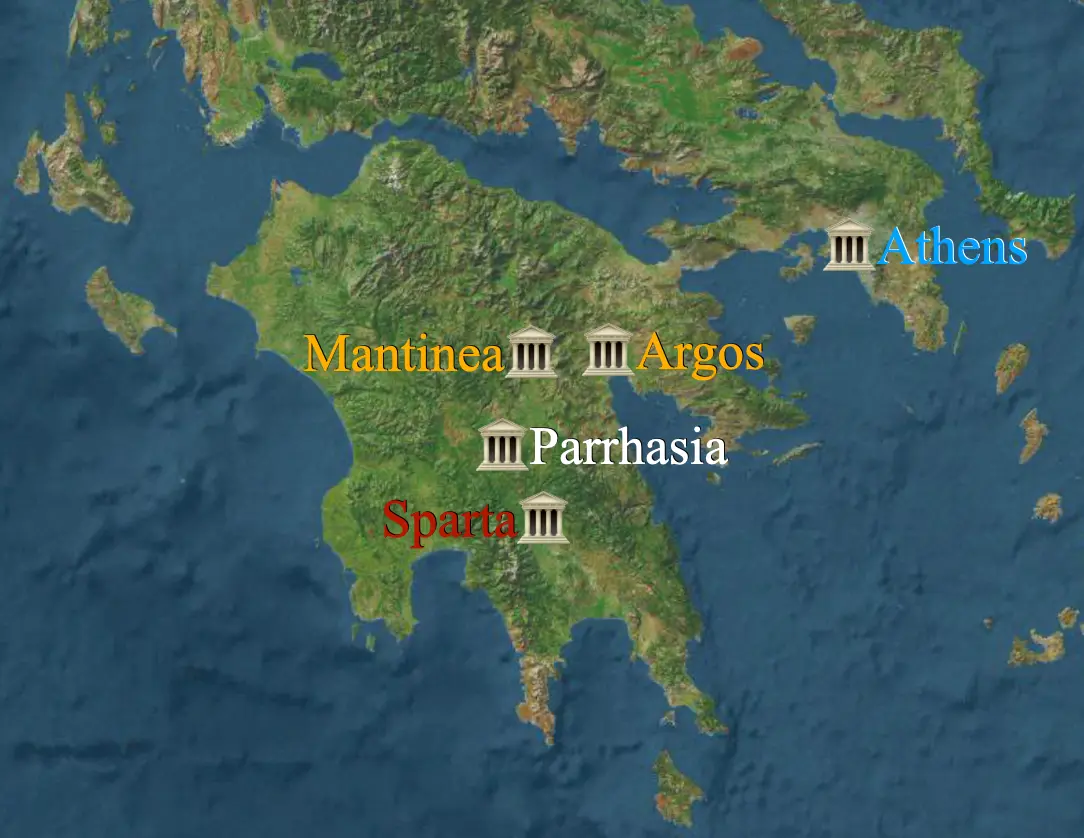
[ABOVE: The city of Parrhasia in the Peloponnesian region of Arcadia]
THE TREATY’S NON-FULFILMENT
Athens and Sparta remained in contact with one another during the summer of 421 BC. However, shortly afterwards, miscommunications led to a growing mistrust between the Leagues as many cities were not being returned as per the treaty’s demands. While Sparta had gone out their way to be the first to adhere, cities like Amphipolis weren’t returned on time, and many of their rebellious Thracian and Boeotian-based allies - including Corinth, of course - were forcing Sparta to consider using force to gain their part in the treaty.
Seeing none of this coming to practical terms, Athens refused the return of Pylos to Sparta (the Spartan prisoners from the aftermath of the battles of Pylos and Sphacteria had already been returned), retaining control of many other cities until full Peloponnesian compliance had been gained. Sparta claimed they’d done what they could, stating they had insufficient authority in Amphipolis to give it back, but would continue attempting bringing Corinth and the Boeotians into agreement. After persuasions, Athens pulled their forces out of Pylos.
INTRIGUES IN BOEOTIA
Come winter of 421 BC, Sparta elected five ephors, the king’s overseers, two of which were opposed to the Peace of Nicias. When meetings were held in Sparta between the two Leagues, the two ephors, Xenares and Cleoboulus, had private words with the Boeotian and Corinthian delegates to persuade them to ally with Argos, then attempt to ally Argos and its allies with Sparta, in the process removing pressure on Boeotia to join the treaty with Athens. This would cause a full Peloponnesian League to ally with a full Argive League that could, they thought, easily oppose the weakened Delian League. On condition, the two ephors demanded Boeotia to hand over the city of Panactum to Sparta as an exchanging piece for the full return of Pylos and resume the war.
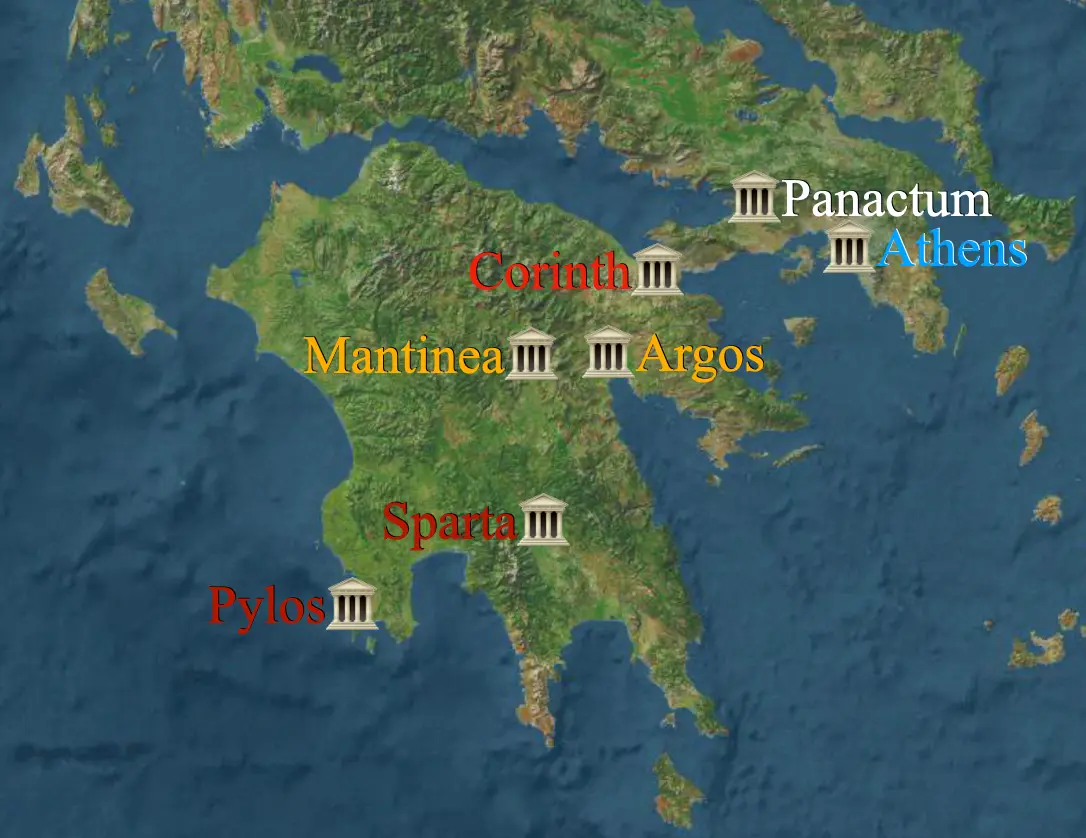
[ABOVE: The city of Panactum, Boeotia]
Boeotia and Corinth’s delegates returned home to report this. On their way back, two observing Argive delegates met them on the road, discussing their wishes for Boeotia to join Corinth, Mantinea and Elis in alliance with Argos, arguing that this alliance could be powerful enough to wage war on whoever they chose, Delian or Peloponnesian League alike. This delighted the Boeotians, who returned to report both meetings back home, who were joyed to know that both Sparta’s two ephors and Argos had like interests.
Boeotia, Corinth and Megara began swearing oaths to ally alongside Argos. This, however, was neglected by the Four Councils of the Boeotians, where their supreme authority ultimately fell, fearing this would offend Sparta, halting the plans for an alliance.
Constant Athenian-Spartan negotiations carried through into 420 BC. Sparta still wanted Boeotia to hand over Panactum in order to help regain Pylos. When they sent a delegation to Boeotia to ask for this, it was rejected, requesting a full and independently-made Spartan-Boeotian alliance, as Sparta had done with Athens. Part of the treaty stated that no alliances should be made without the consent of the other party, however the Boeotian-Spartan alliance was made, hoping that the Panactum-Pylos dealing would benefit them greatly. With that, Panactum was handed over.
OTHER INTRIGUES
Summer of 420 BC arrived, and Argos still hadn’t received their promised Boeotian delegates. They were aware of Panactum’s situation and the Spartan-Boeotian alliance, and now feared their entire alliance would go over to Sparta. They also held the opinion that Boeotia had been persuaded into this dealing in part by Athens, which also made them fear that they couldn’t in turn ally with them, leaving them alone and now hostile to both Leagues. With fears mounting, Argos agreed to what they had always seen as impossible: entering into peace negotiations with Sparta, their oldest rival, and to thereafter remain inactive.
Argos asked Sparta for a fifty year truce, alike the Peace of Nicias. Their longest standing dispute was over the border town of Cynouria, and Argos also stated that within their fifty-year peace, one-off battles for this city could be fought as exceptions. Sparta agreed, and the Argive envoys returned home.
ALCIBIADES
As Spartan delegates reached their newly reacquired Panactum, they found the Boeotians there had demolished the city, citing old grievances made with Athens. When this was reported to Athens, they fell into rage, especially once they discovered the Spartan-Boeotian alliance. Those in Athens who were keen to resume war opportunistically pressed their concerns. Chief among them was Alcibiades.
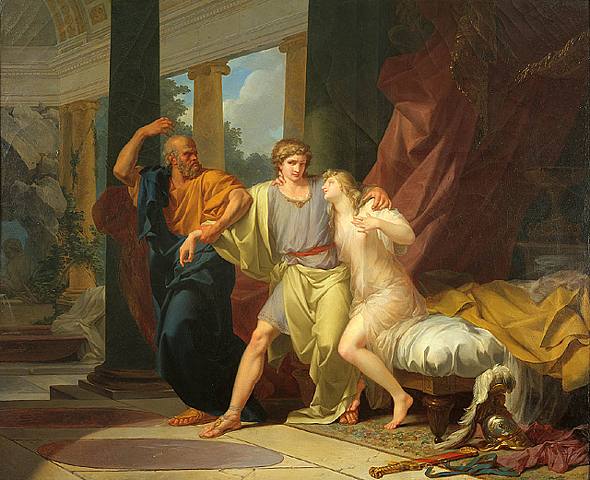
[ABOVE: "Socrates Dragging Alcibiades from the Embrace of Sensual Pleasure" by Jean-Baptiste Regnault, 1791, now held in the Louvre, Paris]
Around thirty years old at the time, Alcibiades came from a respected Athenian family. He believed that Athens would benefit most accommodating Argos. Prideful as he was, he remained ardent against the Peace of Nicias, wishing to resume the Peloponnesian War, citing that Sparta only wanted peace so they could make further alliances to strengthen their position in the war. Privately, Alcibiades sent for Argive delegates to arrive with Mantinean Elean delegates to discuss bringing Athens into their alliance.
Aware of the ruptured Athenian-Spartan relations, Argos concentrated on turning their thoughts favourably towards Athens. Like themselves, they were a democracy, and their past relations were far more favourable. With this, their joint embassy with Mantinea and Elis was sent to Athens. A Spartan delegation too was sent to Athens, fearing they too would turn to Argos for an alliance given the weakening Athenian-Spartan alliance. The Spartans requested the return of Pylos in exchange for Panactum, and explained that their alliance with Boeotia wasn’t made to increase hostilities with Athens.
This worried Alcibiades, fearing Athens might reject an Argive alliance. He thus took the Spartan delegates aside, assuring them he personally could return Pylos to Sparta if they disavowed their full authority when appearing before the Athenian Assembly. His real intentions, however, was to distance the Spartans from Nicias, using this to persuade Athens that the delegation was insincere, in the process achieving an Argive alliance and rumble up talks to resume the war. His plan worked; the Elean delegates claimed to have no authority at the meeting, angering Athens and finally persuading them to ally with Argos.

[ABOVE: Bust of Nicias from "The World's Famous Orations, Vol. 1", pg. 105, by William Jennings Bryan, 1906]
Before dealings could be finalised, a small earthquake disrupted the final processes of formalising the deal, and the meeting was adjourned early. It resumed the following day. Nicias still stood strongly in favour of an alliance with Sparta, arguing for the Argive alliance to be postponed until delegations had been sent to Sparta to discover the state’s true intentions, arguing the peace was just as valuable to Athens as it was discreditable to Sparta.
The Athenian embassy in Sparta, which included Nicias himself, demanded Panactum rebuilt and its full handover back to Athens alongside Amphipolis, and that Sparta renounce their Boeotian alliance unless they joined the Peace, under threat that Athens would ally with Argos. Sparta refused to break their Boeotian alliance. When Nicias returned to Athens, the Athenians considered the outcome of this meeting evidence of Spartan betrayal. With that, Athens allied with Argos.
Surprisingly, Corinth renounced their alliance with Argos. Already having refused alliances agreed with Elis and Mantinea, they now claimed satisfaction towards the original defensive alliance. With that, they turned their focus more favourably back to Sparta. During the summer, Sparta had also been banned from participating in any way in the Olympic Games for their military actions taken against the port of Phyrcus and by sending two-thousand hoplites into Lepreum.
SPARTA ATTACKS ARGOS

[ABOVE: Archaeological site of Epidaurus, southern Greece]
In the winter of 419 to 418 BC, undetected by the Athenians, Sparta sent a small fleet and army of three-hundred hoplites to garrison Epidaurus. Angered as this breached the Peace of Nicias, Argos complained to Athens that their lack of awareness caused this breach of the treaty to happen, ordering them to deal with it. On Alcibiades’ persuasion, Athens ordered raids made against Pylos. Other campaigns took place in the winter, including an Argive raiding campaign against Epidaurus, with Epidaurus itself even besieged, to no Argive success.
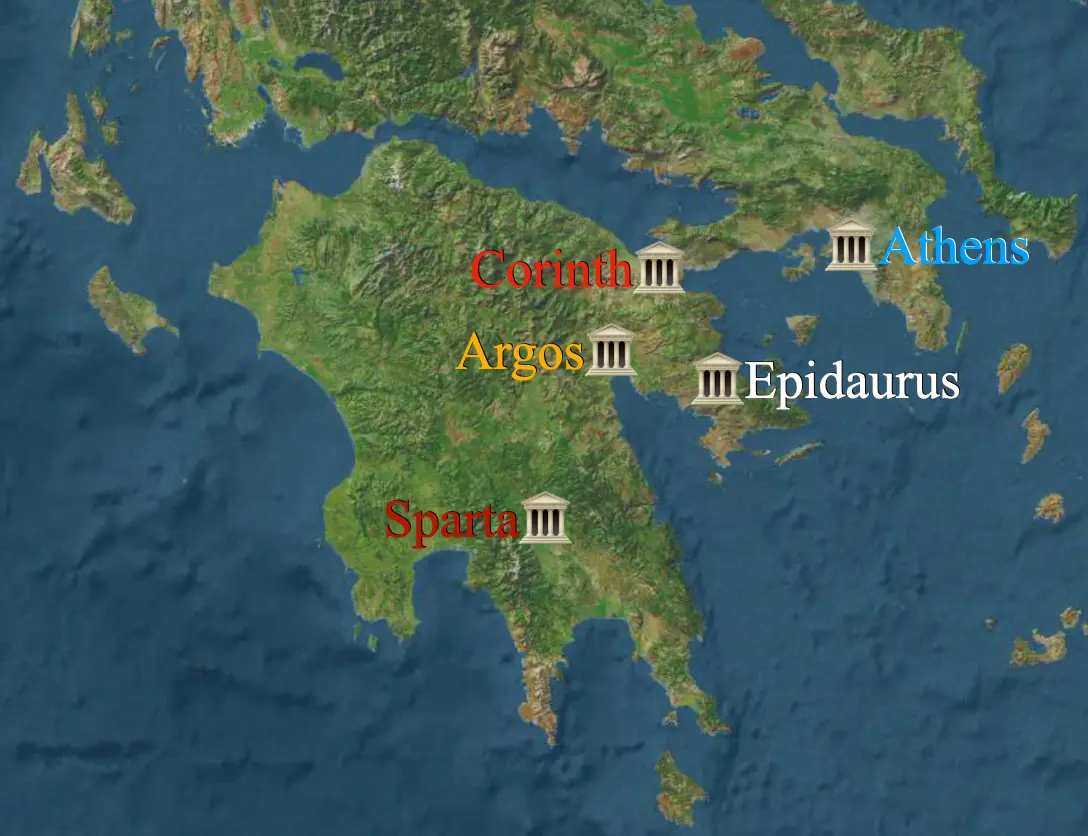
[ABOVE: Epidaurus in Argolis, Peloponnese]
THE BATTLE OF METHYDRIUM
Seeing their Epidaurian allies under threat and many other allies seceding, the summer of 418 BC saw a full Spartan attack, under their king Agis II and joined by their Tegean and Arcadian allies, against Argos. Gathering at Phlius, Agis’s Boeotian allies sent five-thousand hoplites, a further five-thousand light troops and five-hundred cavalrymen, while Corinth sent two-thousand hoplites, all against Phlius’s entire force.
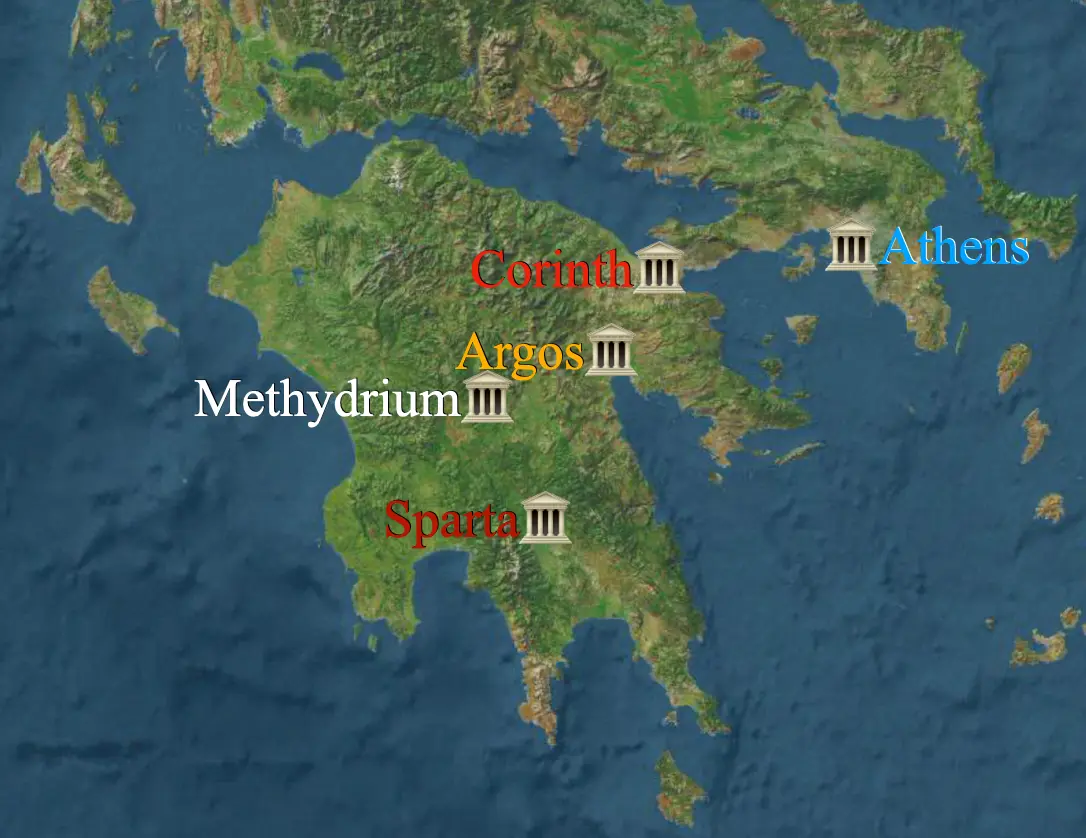
[ABOVE: Methydrium in central Arcadia, Peloponnese]
With prior intelligence of Agis’s movements, Argos set out to meet the Spartans, alongside their Mantinean and Elean allies, who provided three-thousand hoplites. Meeting outside the city of Methydrium, both sides established high ground positions. In the cover of night, Agis moved half his forces to attack the isolated allies in Phlius, using the other half to ravage the lands. Argos met this contingent in battle, suffering more losses than the Spartan allies.
When Agis’s other forces came back to reinforce, and without their promised Athenian contingent arriving, Argos and her allies were surrounded. Before being cut down, two Argives came to Agis asking for a truce. To his army’s anger, Agis agreed, and both sides withdrew. The anger of the Spartans is further justified by Thucydides, recording the events unfolding, who described this Spartan army, with such an advantageous position, as,
the finest Greek army ever raised.
ARGOS ATTACKS ORCHOMENUS AND TEGEA
Athens’ reinforcements, under the generals Laches and Nicostratus, arrived late with their one-thousand hoplites and three-hundred cavalry. Unwilling to break their new private truce with Sparta, Argos neglected this Athenian contingent, at least until pressure from Mantinea and Elis - still campaigning in Argive territory - had been alleviated. Athens, alongside Alcibiades, argued to Argos that the truce was wrong as it did not involve themselves, and that now was the best time to resume the conflict. Argos agreed, and the force set out for Orchomenus, a city housing Arcadian hostages sent there by Sparta. Orchomenus was besieged and assaulted several times. Fearing subjugation, Orchomenus surrendered and joined the Delian League, handing back their Arcadian hostages.
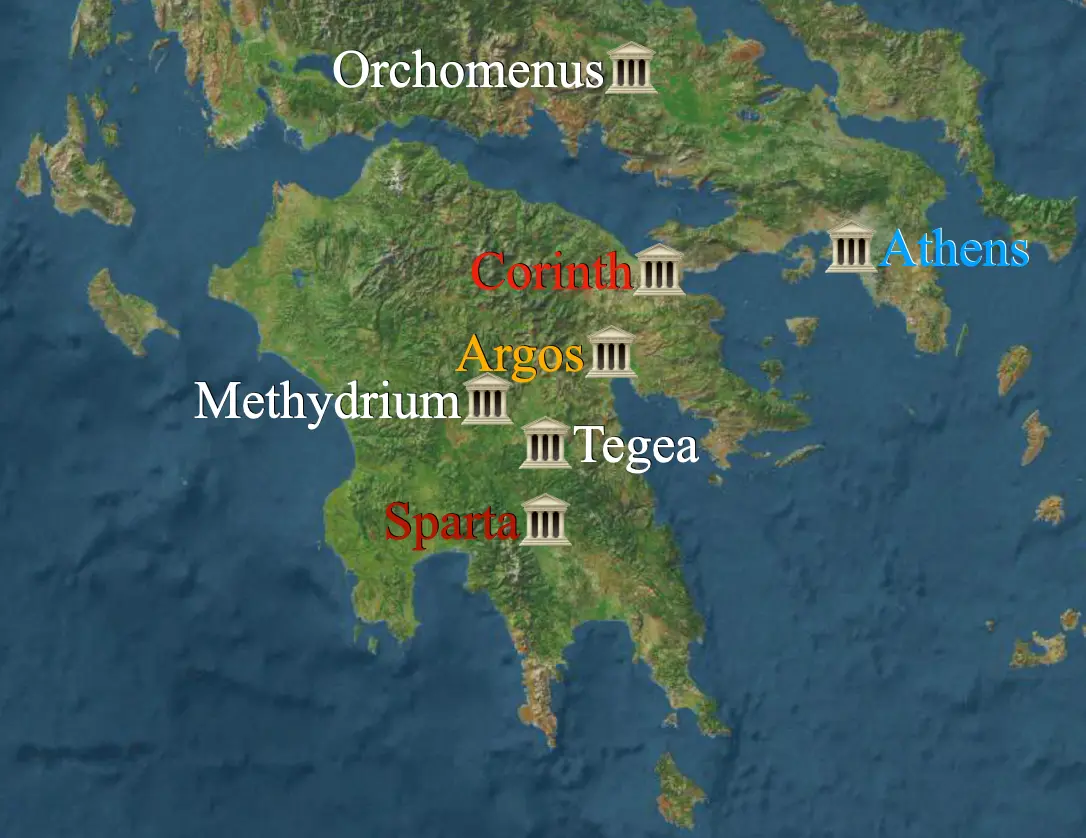
[ABOVE: Orchomenus, Boeotia, and Tegea, Arcadia]
Regrouping at Mantinea, the Athenian-Argive army now agreed to attack Tegea, who’s pro-Argive conspirators inside the city were preparing to help surrender the city to them. News of Orchomenus’s surrender reached Agis and his army, now returned home. Enraged even further, the Spartan army considered going so far as to raze Agis’s home and estate to the ground, scaring Agis into compliance and promising them they could do as they planned to his property should he fail. The army even went so far as to appoint ten Spartans from the army to act as advisors to the King, under who he had no authority over while on the campaign.
THE BATTLE OF MANTINEA
Panicked, Tegea was threatening to join Argos’s alliance should the Spartan relief force not arrive soon enough. Marching at full pace, Agis called for his Peloponnesian allies to join at Tegea, also calling for his other allies to meet him at Mantinea. Making camp, they began ravaging the land around them to entice a fight, which Laches and Nicostartus noticed, setting out with their Athenian-Argive army to meet Agis on high ground and lining up for battle.
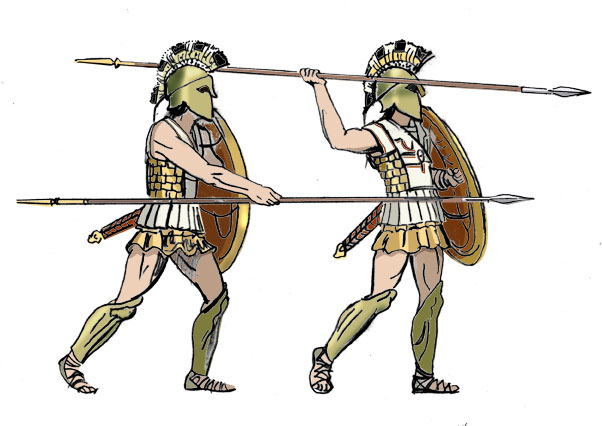
[ABOVE: Modern depiction of hoplite spear infantry, created 2008]
Agis quickly charged towards the enemy line, with such a rush that one Spartan veteran (one of the advisor’s named Pharax according to Diodorus Siculus) called out to him that he,
seemed intent on curing one mistake with another,
implying that Agis was trying more to right his mistake in leaving before by being overly zealous in this situation. With the enemy on an unassailable high ground advantage, Agis quickly withdrew his force from the charge. Returning to Tegea, Agis ordered his army to begin earthworks diverting the local river into Mantinean territory, away from the encamped Argive army, to lure them down their hill into a more level playing field. Agis’s plan worked, and the Argives moved their camp down the hill into the plains.
[66] Argos’s army lined up for battle the next day in the plains, to the Spartan’s shock given the speed they were able to ready themselves. Sparta too lined up for battle; their left wing was occupied by the six-hundred Skiritai, elite light infantry from the mountains of Arcadia who always held the left wing of a Spartan army as an honourable position. Xenophon described the Skiritai and their function in the army:
To guard against hostile approach by night, sentinel duty according to the ordinance was performed by the Skiritai outside the main body. At the present time the rule is so far modified that the duty is entrusted to foreigners, if there be a foreign contingent present, with a leaven of Spartans themselves to keep them company.
To the Skiritai’s right were Brasidas’ Thraceward veterans. Next to them were Sparta’s Tegean and Arcadian allies, and finally on the far right were the Spartans themselves, potentially as many as 3,500 hoplites. Cavalry were positioned on both extreme flanks. Facing them, Laches and Nicostratus’s Athenian-Argive army held their Mantineans on the right wing opposite the Skiritai, followed by their Arcadian allies, and the Athenian’s thousand hoplites and cavalry contingent on the far left facing the Spartans. Agis had roughly nine-thousand men in total, compared to Laches’s eight-thousand.
After encouragements from their respective officers, Agis’s army advanced forward, with the Argives eagerly marching ahead and the Spartans retaining discipline and marching behind in time to instruments. Just before the lines engaged, Agis came up with a plan; because of the way hoplite phalanxes line up for battle, with each man’s shield overlapping to partially cover the man on their left, phalanxes naturally shifted overtime to the right as each man attempted to gain more protection. The Mantinean right wing thus enveloped the Skiritai left wing, while the Spartan right wing enveloped the Athenian left.
Fearing his left wing being overlapped, Agis ordered his Skiritai and Brasidas’s veterans to move further left and attack the Mantinean flank. Agis then ordered some elite Spartan infantry from the far right coming left to fill in their gaps. Agis still outnumbered the Athenian-Argive army, and relied on his elite Spartan right-wing to be able to still hold against the Athenians who they were enveloping anyway. Since the lines were too close to engaging, the commanders in charge of this Spartan right wing refused this order, so Agis ordered his Skiritai to reform on the left as before, but they were too late to line up properly.
Both lines engaged in fearsome combat, with the Mantinean right wing routing the Skiritai and Brasidas’s men, driving into the gap and surrounding the rest of the Spartan army. Agis and his centre, however, consisting of his three-hundred royal bodyguard, held their position immaculately, routing the Athenians and several others around them almost immediately.
With the centre broken, the Argive line was divided into two. Atop this, Agis’s right wing had enveloped the Athenian left wing. Winning in the centre, Agis ordered his remaining men to help his left wing, leaving the Athenian left to retreat safely. Pressed on multiple sides and seeing reinforcing Spartans coming, the Argives retreated. Agis had won the day.
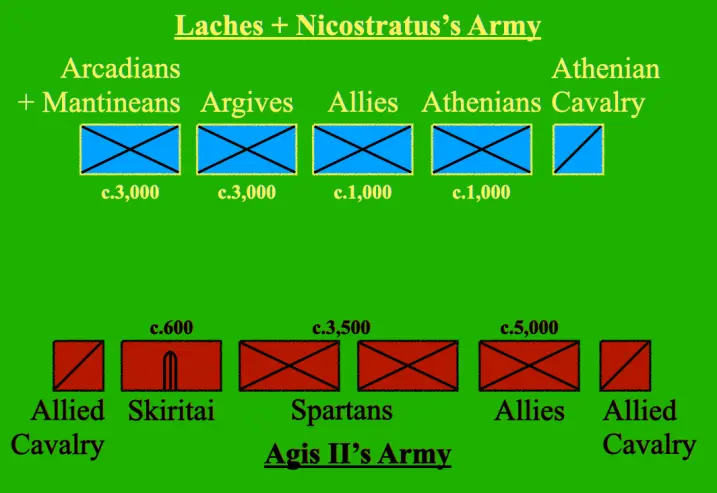
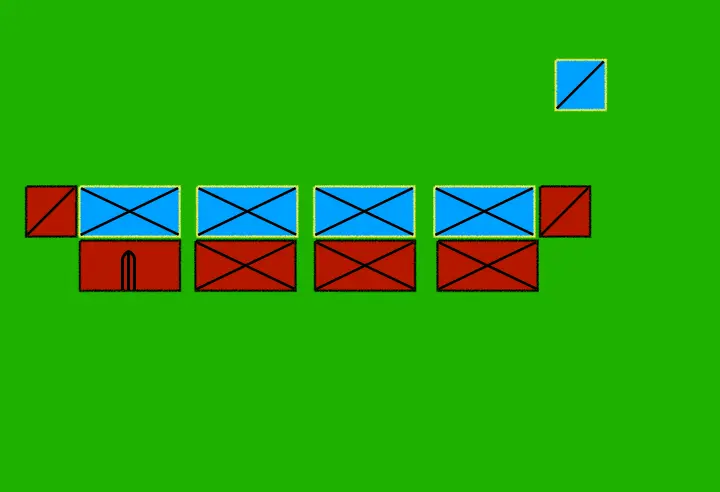
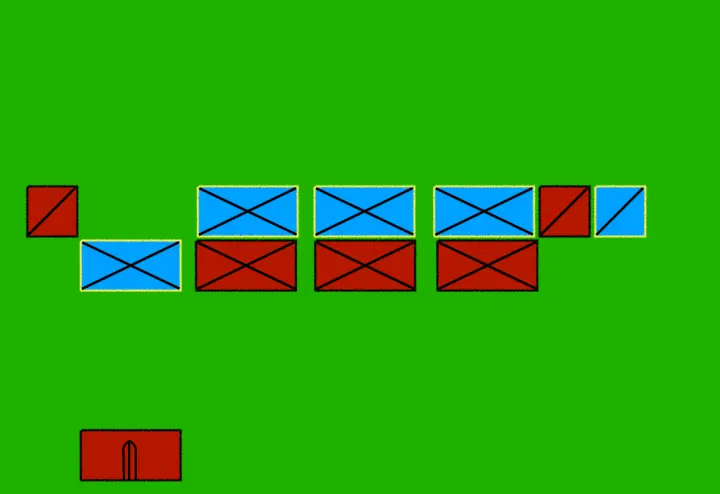
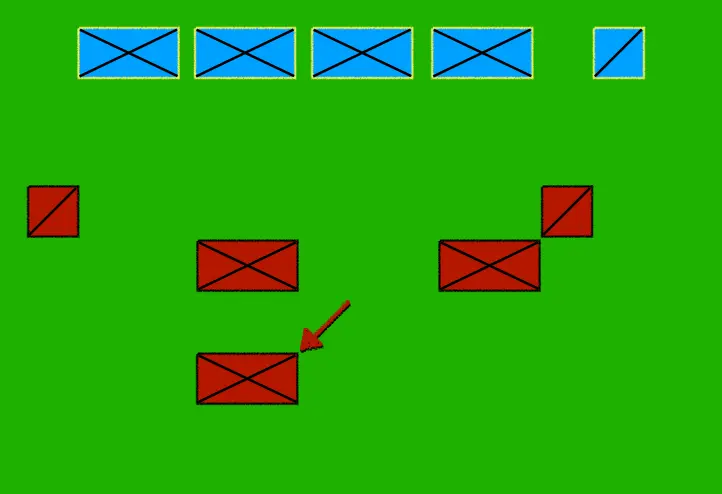
[ABOVE: The stages of the Battle of Mantinea, 418 BC, showing the encircling first engagement, the route of the Skiritai and the holding and repositioning of Agis's centre. (Infantry are represented with a cross, cavalry with a singular diagonal line, and missile infantry (the Skiritai) with a missile symbol, as per the NATO Joint Military Symbology)]
The Battle of Mantinea was the largest fought in Greece for some time. In total, seven-hundred Argives, two-hundred Mantineans and two-hundred Athenians lay dead - around fifteen percent of Laches’ forces - while Agis only lost around three-hundred men. Sparta’s other king, Pleistoanax, turned up late with a small force as reinforcements. Among the Athenian dead were both Laches and Nicostratus. Through this victory, Sparta had improved their standing amongst the Greeks since the debacles during the irresolute debates.
PELOPONNESIAN PEACE
Come the winter season, Sparta celebrated their Carneia festival, a period of weeks in which Sparta generally engaged in war (except for their desperate situation presented before assembling for the battle of Thermopylae). Sparta brought peace terms forwards to Argos, who had Spartan sympathisers inside the city who wished to end the city state’s democracy, Alcibiades among them of course. If Sparta could achieve peace on their terms with Argos, they would be more influenced to being able to end their democracy.

[ABOVE: A male dancer at a festival to Apollo Karneios, from Ceglie del Campo, Apulia, Italy, 5th century BC]
Sparta only asked for the return of all hostages, and they’d do the same, and asked for Argos's commitment to terms against Athens should Athens not withdraw from Epidaurus. Sparta also called for all cities in the Peloponnese to remain neutral between Sparta and Argos, yet all would assemble should any force from outside the Peloponnese enter it with harmful intent. Terms accepted, Agis returned with his force to Tegea. Both parties agreed to also refuse all Athenian embassies until Athens had abandoned their Peloponnesian-based forts, which they would refuse. In these terms between Argos and Sparta, both managed to convince Perdiccas and is Kingdom of Macedon to join them. Loosing power and influence, Mantinea came to terms with Sparta.
ARGOS’S DEMOCRATS, AND PERDICCAS
In the following summer, 417 BC, the democrats within Argos, defending their city’s current institution, grouped together, killing or expelling the conspiring pro-Spartan oligarchs. Agis and his army in Tegea were eventually called to aid, while the Argive democrats received an Athenian embassy, who convinced them to construct long walls down to their harbour, much like Athens’s Port Piraeus. Agis’s campaign there came to little value, as did an Athenian blockade against Macedon since Nicias formalised a peace deal and alliance with Perdiccas, as winter gave way to the summer of 416 BC. Spartan sympathisers within the city the following summer - some three-hundred men - were arrested by Alcibiades.
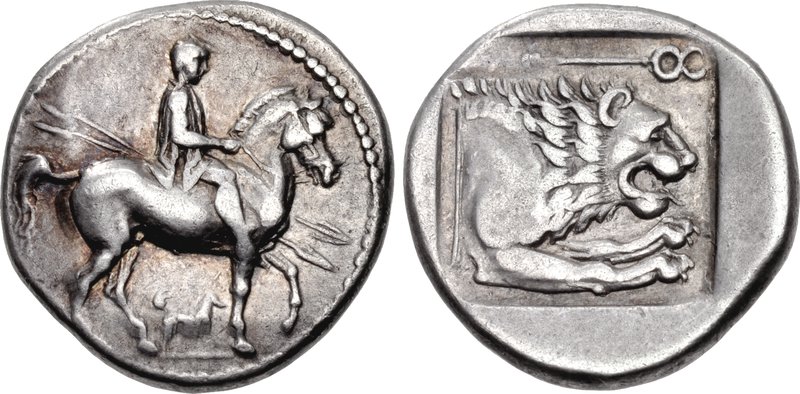
[ABOVE: Silver Macedonian coinage from the reign of Perdiccas II, depicting a horseman (CONVERSE) and the Nemean Lion (REVERSE), struck c.437 - 431 BC]
MELOS
The summer of 416 BC also saw Athens send a fleet to the island of Melos, a Spartan colony in the Aegean. Led by Cleomedes, Athens’ fleet consisted of thirty-eight ships, 2,700 Athenian and allied hoplites, three-hundred archers, twenty mounted archers, and upon landing on the island began ravaging the countryside.
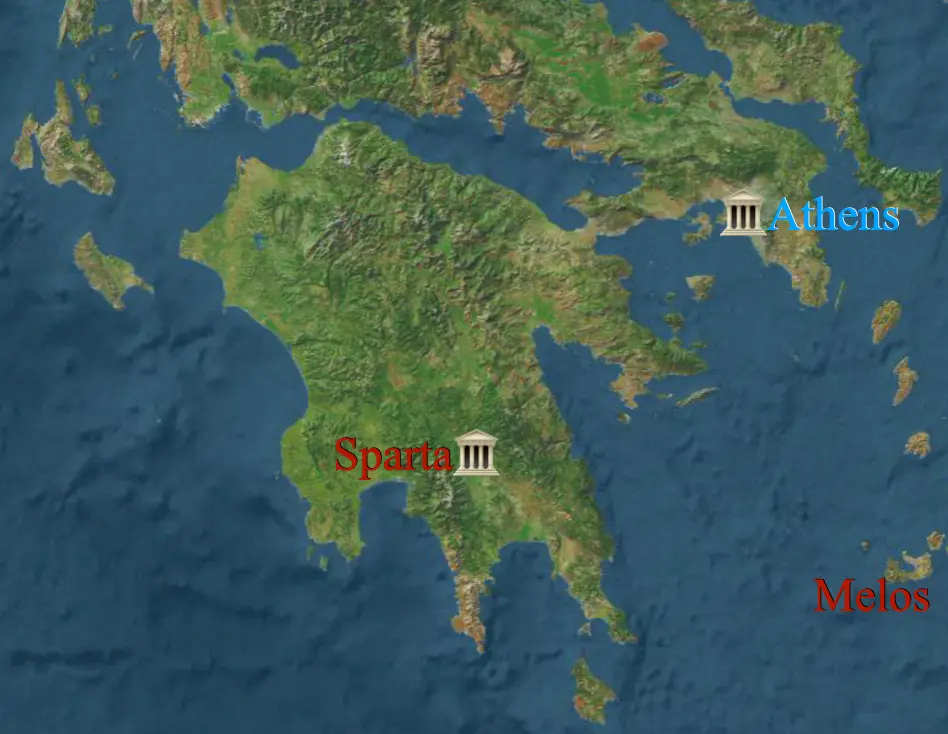
[ABOVE: The island and city of Melos, a Spartan colony city]
THE MELIAN DIALOGUE
Upon reaching the island, Cleomedes began negotiations with the islander’s embassy. It’s here that in his account of the history of the Peloponnesian War, Thucydides gives what appears to be a dramatisation of the discussion between the two parties, known today as the Melian Dialogue, which took place before Athens put the city of Melos under siege. A famous opening line from the Athenians reads as such:
… we shall not bulk out our argument with lofty language, claiming that our defeat of the Persians gives us the right to rule or that we are now seeking retribution for some wrong done to us. That would not convince you. Similarly we do not expect you to think there is any persuasive power in protestations that though you are a Spartan colony you have never joined their campaigns, or that you have not done us any harm. So keep this discussion practical, within the limits of what we both really think. You know as well as we do that when we are talking on the human plane questions of justice only arise when there is equal power to compel: in therms of practicality,
the strong do what they can, and the weak suffer what they must.
In short, the Athenians bluntly tell the Melians that they are there solely for their own needs, irregardless of what it does to the islanders, and that all they had to gain in submission was their lives. Today, it is taught as a classic example of political realism, and the lifting of veils in place of the ends justifying the needs to one side.

[ABOVE: A modern plaster-cast bust of a Roman copy (c.100 AD) of an original 4th century BC bust of Thucydides, now held in the Zurab Tsereteli's Gallery, Moscow. The Greek original is kept in Holkham Hall in Norfolk, U.K.]
Refusing the Athenian demands for submission, Melos received the blunt reply:
To judge by these deliberations of yours you must be the only men, it seems to us, who think the future is more certain than the evidence of your own eyes, and regard speculation as present fact, as if mere wishing will make it so. Spartans, fortune, and hope — the more you stake your trust in this trio, the greater will be your downfall.
THE SIEGE OF MELOS
With hostilities underway, Athens began surrounding the city with a wall to block off resources. Many Athenian troops were sent off to raid more countryside while the rest remained in the siege. Melos found some early success, being able to scale sections of the wall, however internal treachery within Melos eventually caused a surrender. The Melian men were subsequently executed, and the women and children enslaved, and the island was permanently colonised by the winter of 416 BC.
Evidence suggests Melos only surrendered once extreme starvation was endured; the metaphor “Melian Famine” entered the Greek language first in Aristophanes’ play, “The Birds”, written four years later in 414 BC, surviving in Greece well into the Middle Ages. Aristophanes’ character Peisetairus says to Tereus:
P: Now look up.
T: I’m looking.
P: Swivel your head back and forwards.
T: A capital way to dislocate my neck!
P: Did you see anything?
T: The clouds and the sky.
P: Well, isn’t that where the birds will stop?
T: In what way?
P: Their own personal spot, you might say, at present merely stopping or stepping-off place where everything’s in a whirl, so it’s called a world, but as soon as you settle it and make it solid it will be a city-state, and you’ll reign over mortals as you do bugs… As for the gods, you’ll starve them out, like the unfortunate natives of Melos.
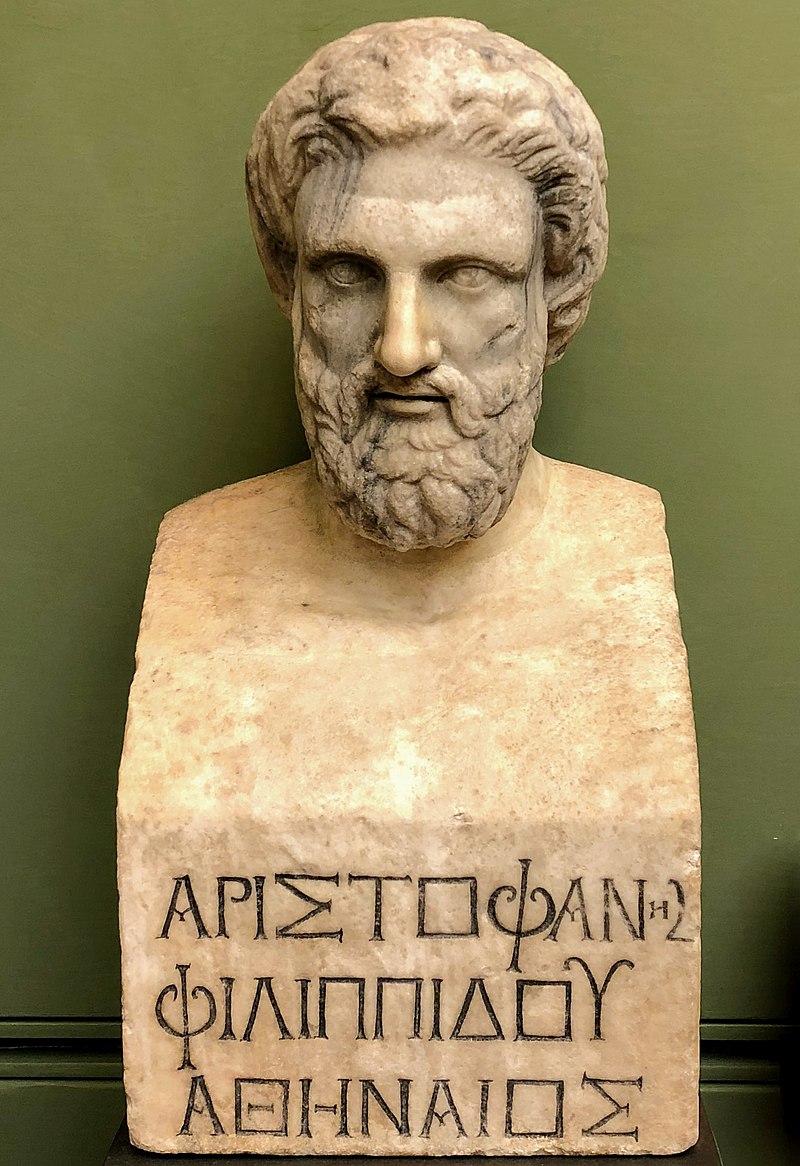
[ABOVE: Herm bust of Aristophanes, 1st century AD, now held in the Uffizi, Florence, Italy]
It is here that Book 5 of Thucydides’ History of the Peloponnesian War ends. What was meant to be a halt in conflicts in mainland Greece turned into diplomatic breakdowns, large-scale battles and sieges and subjugations - business as usual. The Peace of Nicias could arguably even hardly be called a “peace” at all, given how conflicts resumed almost immediately; a planned fifty years of peace broke down in barely three years. Both Athens and Sparta, deep down, were in many ways still rooting for conflict with one another, and the future indeed looked bleak for Greece.
It was only going to get worse. MUCH worse.
Given the shaky situation in the mainland, Athens would set their sights elsewhere; far to the west, the island of Sicily was equally divided and rife with internal conflict. To exacerbate the coming conflicts, the Athenian general Alcibiades was soon to make a name for himself as an ever charismatic turncoat, helping Athens dive into what can confidently be described as one of history’s all-time worst military disasters...
NEXT POST: ALCIBIADES, 416 - 415 BC: Preparing for Sicily

SOURCES
- Thucydides, "History of the Peloponnesian War", Book 5.25-116
- Donald Kagan, "The Peloponnesian War", pages 195 - 250
- Diodorus Siculus, "Library of History", Book XII.78-79
- Aristophanes, "The Birds", line 186
- Xenophon,
- "Constitution of the Lacedaimonians", Book XII, 220-223
- "Hellenica", Book 2.2.3
YOUTUBE LINKS
(I do NOT own these videos)
"Ancient Greek History - Part 7 of the Peloponnesian War - 23" by "Historyden"
"Battle of Mantinea 418 BC - Peloponnesian War 4K Animated DOCUMENTARY" by "Kings and Generals"
"Units of History: The Skiritai - Sparta's Elite Irregulars DOCUMENTARY" by "Invicta"
MY ANCIENT GREEK HISTORY BLOG PAGE
MY ANCIENT PERSIAN HISTORY BLOG PAGE
All feedback - positive and/or critical - is appreciated!
All images used are copyright-free
Don't forget to rate this post, share it and leave a tip if you enjoyed it
Thanks for reading :)





