
In the late summer of 413, the once seemingly invincible state of Athens, at the head of its Delian League, now saw its complete destruction on the horizon. Constant raids against their homeland, the deadliest plague in memory at the time, great defeats at the hands of Sparta, and now their entire grand armada and its army of over ten-thousand bronze-clad soldiers lay in complete desolation in the fields of Sicily. Despite the work of Nicias, fifty years of planned peace was over, and war was coming once again. Now, with Alcibiades at their disposal, Sparta had even further advantages against their rivals. To capitalise on this even further, a new player was about to enter the field and drive the two sides even further into chaos, for while Athens and Sparta had been fighting for nearly two decades now, their old enemy, Persia, had been watching.
Check out my previous post on The Sicilian Expedition, 415 - 413 BC
PREPARATIONS
Following the disaster in Sicily, Athens flew into panic. With much of its citizen and military population depleted, as well as with the deaths of prominent and effective commanders like Nicias, Lamachus and Demosthenes, would leave an opening for Syracuse to retaliate in full force, and with the Sicilians possibly contemplating an attack, surely enemies closer to home would consider the same, and allies could consider revolution. In spite of this situation, Athens would not give up. Resources were to be put into the construction of more fleets, alliances would be secured, sensible and conservative economic policies would be implemented, and new, older, wiser men, would be elected into office. As the summer of 413 BC came to an end, Athens got to work.
THE PROBOULOI
The old men elected into officer were collectively known as the Probouloi. They were ten men, one from each deme/tribe over forty years old, elected to offer advice and propose legislation as befitted the current situation. Only two of the ten’s names are known, Hagnon, and the famous tragic poet, Sophocles. Hagnon fought alongside Pericles in the Samian campaign of 440 BC, making him around sixty years old in this time. Sophocles, around eighty years old, was a renowned general, also having served alongside Pericles, and former state treasurer, altogether making him a renowned and beloved name in Athens. Both conservative men, Hagnon and Sophocles were staunch supporters of democracy and enemies to oligarchy.

[ABOVE: The cast of a bust of Sophocles, now held in the Pushkin Museum, Moscow]
THE DECELEAN WAR BEGINS
Athens’s defeat in Sicily, however, showed other smaller Greek states that even great powers like the Delian League could be brought down. Many once neutral states during the Peloponnesian War thought that if Athens had succeeded against Syracuse, they themselves would be next. So, with Spartan and Peloponnesian resolves now stronger than ever, and Delian allies considering revolution, With winter incoming, Sparta’s king, Agis, set out with an army to officially resume the Peloponnesian War, setting out from Deceleia in Attica and giving the third phase of the war its name: The Decelean War. Turning to the Malian Gulf and looting the cities of Sparta’s enemies for war resources for his army and the planned construction of a new one-hundred-strong fleet, Agis convinced several small states to join his alliance, ready for war in the following spring.
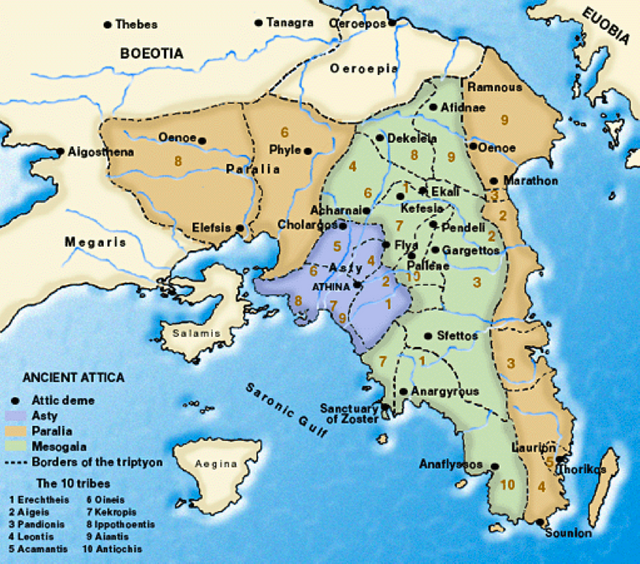
[ABOVE: The demes of Athens, with Dekeleia shown to the north]
ATHENS PREPARES
Athens too was preparing; what woodland was left in Attica was cut down for ship building while Sounium was fortified to protect its wheat stores, and their earlier built fort in Spartan lands were torn down - they could not afford to be too deep in enemy territory right now, and had to pull back and be more on the defensive. They also turned an eye to their allies, nervously awaiting for a revolt or two to break out at any moment.
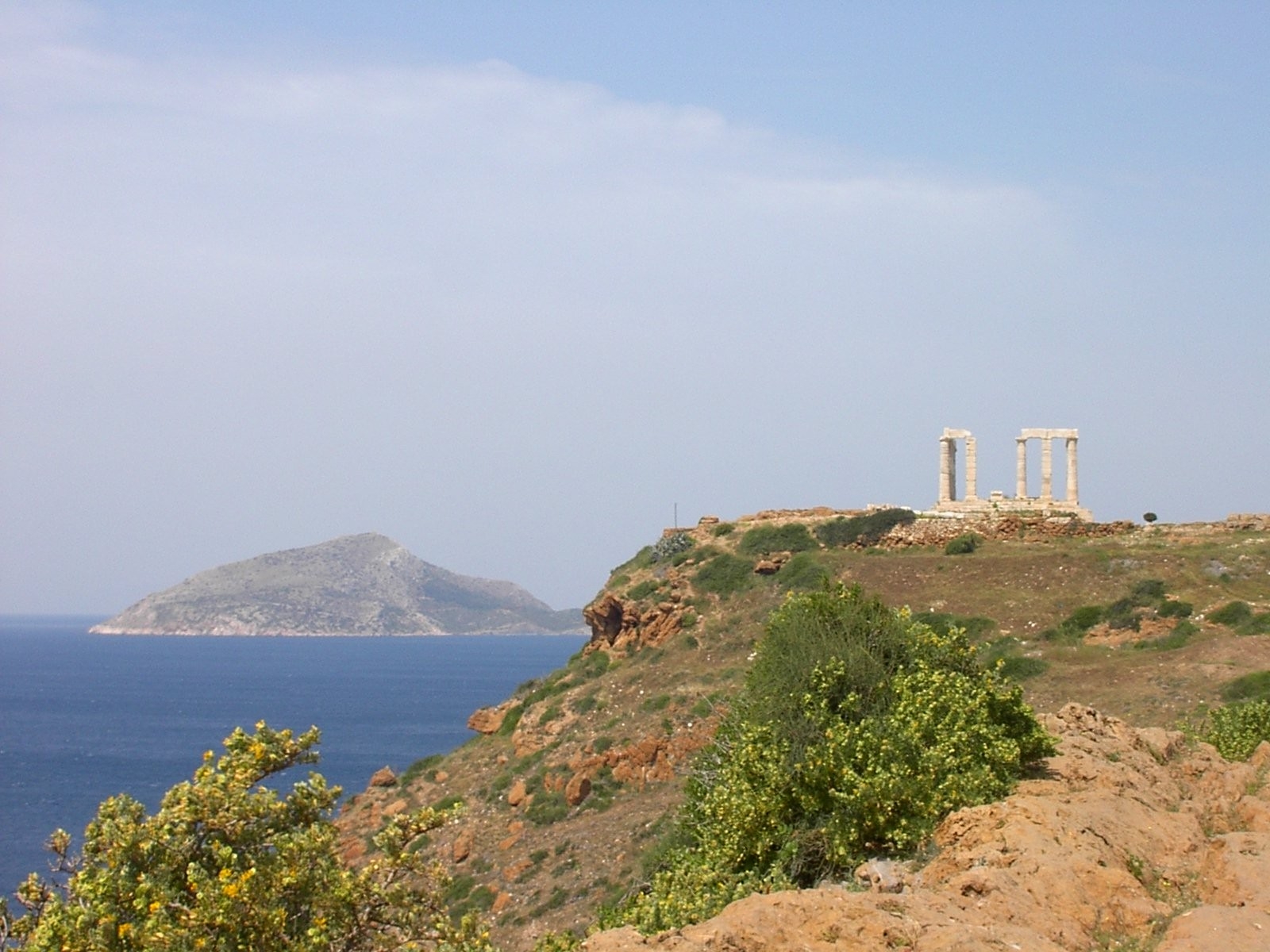
[ABOVE: View from Cape Sounium, showing its ruins of the Temple of Poseidon, constructed c.440 BC]
REVOLTS
It didn’t take long; reaching out first to Agis was the island of Euboea, whose envoys were immediately accepted by the Spartan king, sending for commanders in Sparta to command the Euboean forces alongside a force of three-hundred newly-liberated Helots. At that moment, the island of Lesbos also came to Agis to discuss revolt from Athens. As they were supported by the powerful Boeotians, Agis decided to prioritise aiding and organising their revolt first instead, placing the general Alcmenes as the new Lesbian commander alongside twenty ships, while Agis remained in Deceleia with his army. His key position at Deceleia away from Sparta gave him immense power and authority to raise and manoeuvre armies and reach out to whomever he pleased far more easily.
TISSAPHERNES

[ABOVE: Portrait of Tissaphernes taken from his coinage]
As negotiations with the Lesbians took place, envoys from Chios and Erythrae arrived not to Agis in Deceleia but to Sparta, also keen on revolting from Athens. They were accompanied by Tissaphernes, appointed military governor of the Achaemenid Empire’s western satrapies by Shah Darius II, recent successor to King Artaxerxes. Tissaphernes offered to provide maintenance of the Peloponnesian’s armies, as Darius had demanded tribute collection from Tissaphernes’s Satrapy, a task becoming ever more impossible thanks to Athens’s dominance in the region. Weakening Athens therefore would allow Tissaphernes to collect his tribute for the king, thus securing his powerful position in the west. Tissaphernes also hoped to procure an alliance with Sparta to further weaken Athens. Once more, he was under instruction from Darius to kill Amorges, who was revolting against Persian rule in the region of Caria.
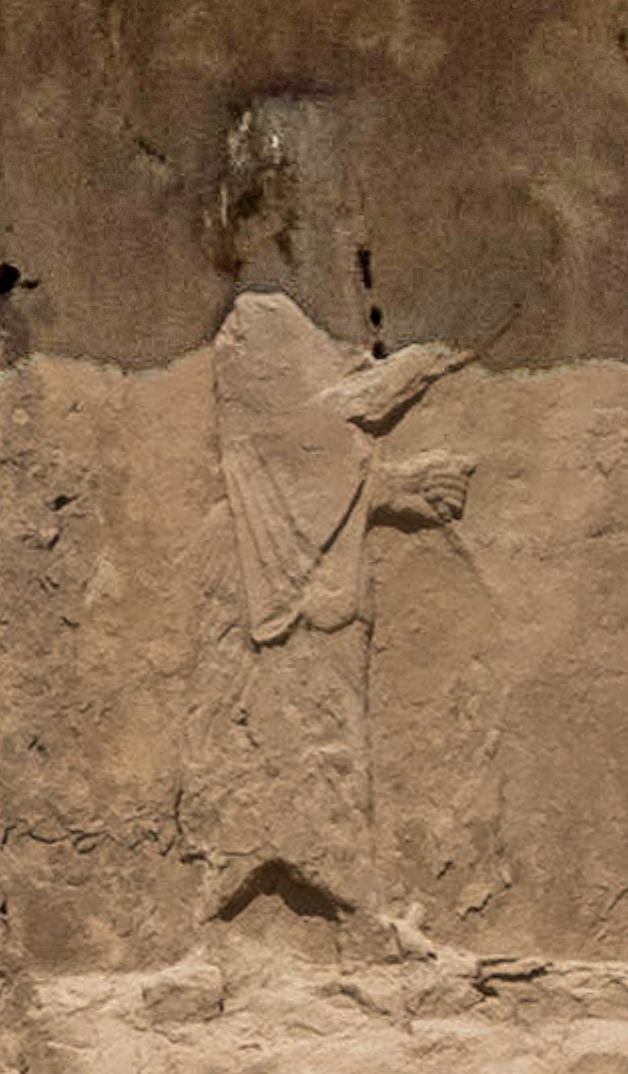
[ABOVE: Engraving of Darius II, as depicted on his tomb at Naqsh e-Rostam, Fars province, Iran]
With their combined resolve, the Chians and Tissaphernes presented their case to Sparta, both in competition to gain priority over the other. These envoys had been sent by the Persian Satrap of Dascyleion, Pharnabazus, also intent on kicking Athens’ power out of his region and providing Shah Darius with adequate tribute. Sparta was inclined towards Chios and Tissaphernes’ case, as they had the backing of Alcibiades. After a Spartan inspector was sent to Chios to check if they had as large a fleet as they claimed, returning with confirmation of their claim, Sparta sent their forty ships to Chios and forged an alliance with them, combined with the Chians own sixty ships to make a grand armada of one-hundred ships, under the command of Sparta’s new admiral-in-chief Chalcideus, as winter gave way to the spring of 412 BC.

[ABOVE: Coinage depicting Pharnabazus II wearing the satrapal cap with a diadem, from Cyzicus, Mysia, with the letters "ΦΑΡ-Ν-[A]-BA ("FAR-N-[A]-BA)" on the obverse and a ship's prow, dolphin and tuna on the reverse, c.398 - 395 BC]
CHIOS’S IONIAN REVOLT
Afraid that Athens would get word of their planned revolt, Chios pressed the Spartans for their promised ships. Agis immediately sent envoys to Corinth, ordering for the immediate transport of the ships to Chios, totalling thirty-nine. Pharnabazus’s agents took no part in this expedition to Chios, bringing their own silver talents intent on funding a later expedition should one be needed. King Agis did not dispute any of this, but Sparta convened a meeting in regards to the Chios expedition, deciding unanimously to sail Admiral Chalcideus’s fleet there too, where command would be taken over by Alcamenes as they set sail for the Hellespont, where the combined fleet would come under the command of an admiral named Clearchus. The splitting of the navy into two waves was done to more confuse the Athenians and give them less cause for concern for seeing a combined fleet too early.

[ABOVE: "Clearchus of Sparta", by Adrien Guignet, 19th century]
There was a delay from Corinth at the time, who were busy celebrating the Isthmian festival. Agis allowed it, and in doing so gave Athens time to catch up with their progress. Finally noticing Chios’s intentions, Athens sent a general, Aristocrates, to confront them on the matter. Denying any ill intentions, Athens demanded a show of loyalty by asking them to provide them with warships, of which they provided seven.
Following the Isthmian festival, the Peloponnesians set sail for Chios with twenty-one ships, only to be intercepted by the Athenian navy, equal in number. Attempting to draw them out into the open waters, the Peloponnesians did not take the bate, withdrawing their vessels back towards the coast. Giving pursuit after nine more of their own ships bolstered their fleet to thirty vessels, the Athenians gave chase to the uninhabited port Speiraeum, south-east of Corinth. Loosing one ship in the chase, the Peloponnesian fleet anchored in the harbour, while Athens attacked on all sides, utilising a small force they had set on land from their ships for this fight. A disorderly engagement resulted in most of the Peloponnesian fleet being destroyed and several killed, including the Peloponnesian commander Alcamenes.
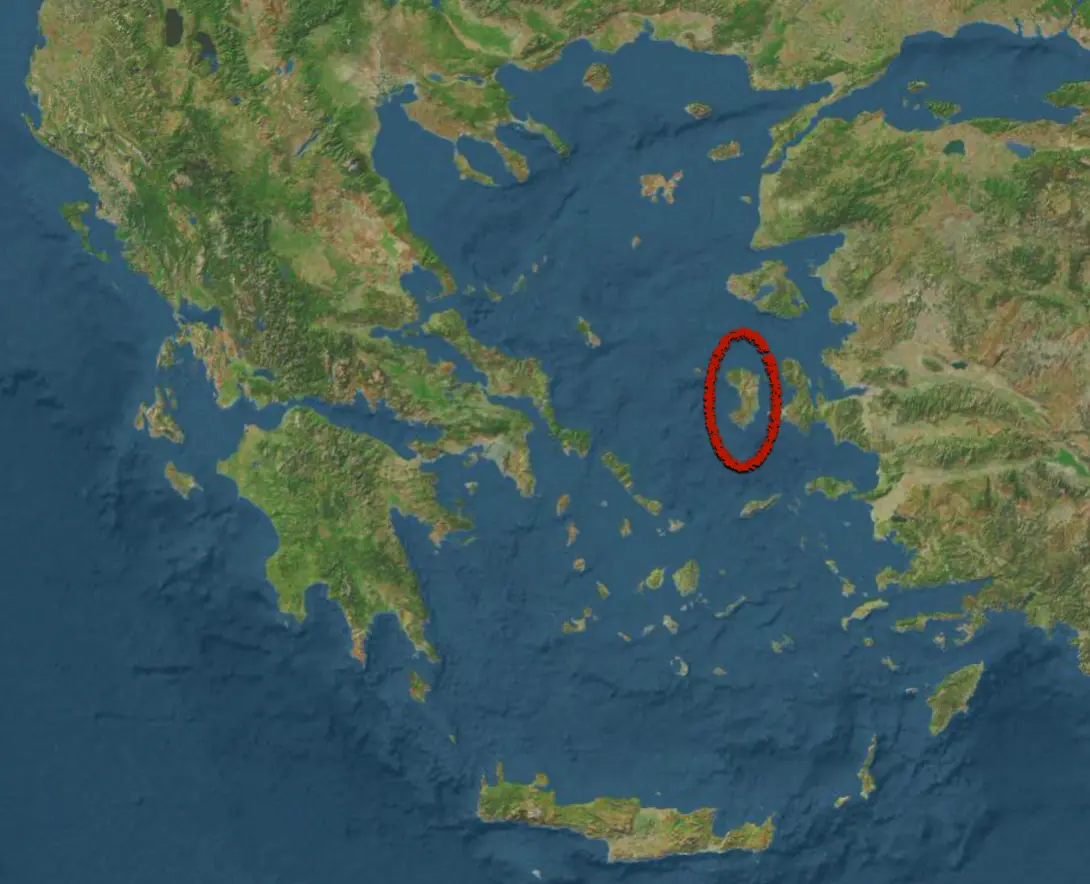
[ABOVE: Location of the isle of Chios]
Breaking off, Athens set a guard up in the region and sent for reinforcements, just as Corinth’s delayed fleet arrived. Keen to guard the area but not knowing how to, they dragged their ships ashore to wait for a viable time to escape. Hearing of the engagement, Agis sent another commander, Thermon, to take charge, while Sparta remained more neutral in their reaction. This was until Alcibiades stepped up, arguing for a continuation of the expedition and the promise of being able to sway more Delian League allies to revolt. He convinced them, and soon he and Chalcideus were sent with five ships to reinforce their allies in Ionia.
Their voyage saw several arrests of people they met on the way, keen to keep their movements secret. Arriving in Corycus on the mainland where the prisoners were released, they met with their allied Chians, who advised them to sail straight into Chios’s harbour unannounced, allowing Alcibiades and Chalcideus to walk into a meeting with the city’s oligarchs and immediately be given the floor. Keeping quiet about the defeat at Speiraeum, Alcibiades was able to sway all of Chios to formally secede from Athens, followed soon after by Erythrae in Boeotia and Clazomenae in Ionia. All seceded cities began fortifying their walls and sending troops to Greece.
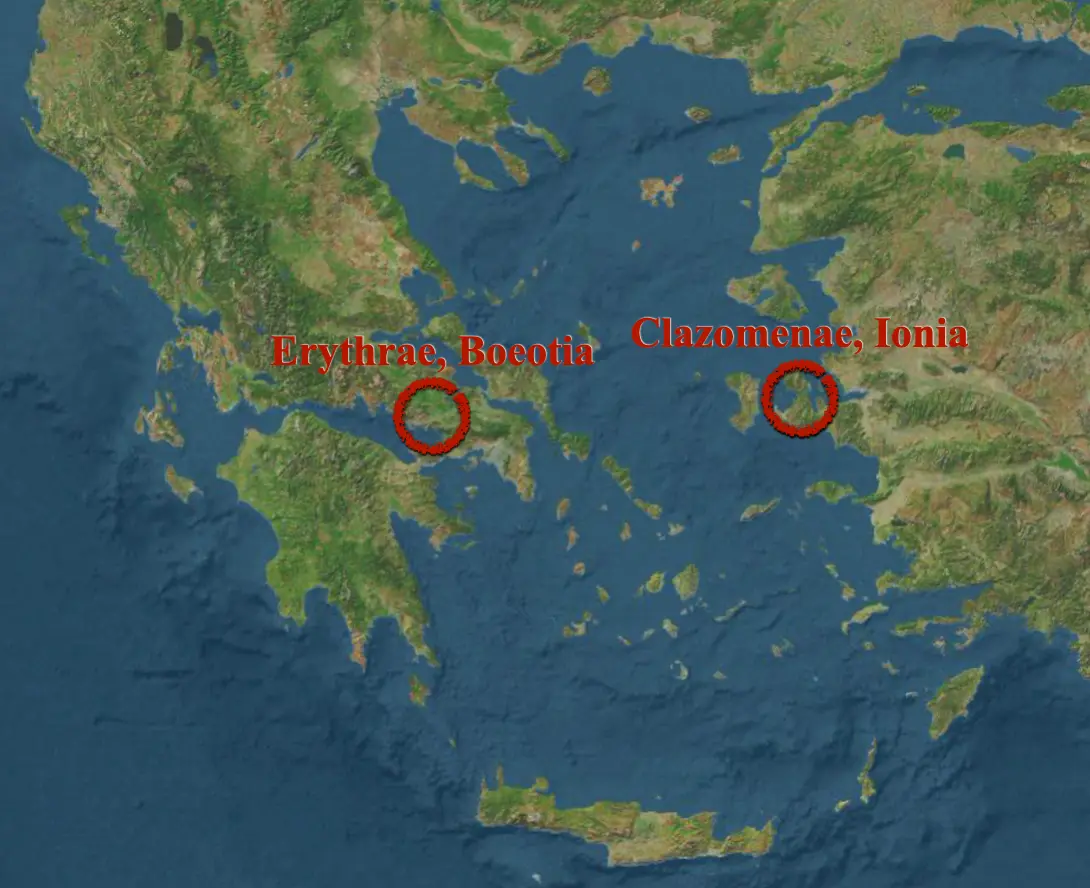
[ABOVE: Locations of Erythrae, Boeotia, and Clazomenae, Ionia]
In a panic, Athens used a thousand silver talents they had jealously guarded in Athens throughout the war to man a large number of ships to enforce loyalty among their remaining allies. Twenty of their thirty ships at Speiraeum were sent to Chios, while taking that fleet’s seven Chian ships, freeing its slave crew and enslaving its citizens, bolstering this remaining fleet at Speiraeum with ten more ships and planning to reinforce it with a further thirty. Athens understood the value of Chios and were set on recovering it back into the Delian League at all costs.
While the Athenian reinforcements were sailing closer to Chios, Alcibiades and Chalcideus were already bearing down on nearby Teos with twenty-three ships, forcing some of the Athenian navy heading there to withdraw. In open waters, this portion of the Athenian navy caught sight of the size of the Peloponnesian fleet and withdrew to Samos, with Alcibiades and Chalcideus in pursuit. Meanwhile, the Peloponnesian army at Teos, now reinforced with soldiers under a deputy of Tissaphernes, made their way into the city and demolished its walls, once funded by Athens to protect it from such a force. Chasing the Athenians back to Samos, the two Spartan commanders were able to send further reinforcing ships to Miletus, intending to bring this powerful Delian League city too to revolt. Even with the twenty Athenian ships now united, Alcibiades was able to convince Miletus to revolt in time as the city refused the Athenian fleet entry, forcing them to blockade the opposite island of Lade.
THE FIRST SPARTAN-PERSIAN TREATY
Immediately after the Milesian revolt, Chalcideus was able to negotiate with Satrap Tissaphernes. Both had so far won in their shared goal to weaken Athens’s influence in Ionia, and now Sparta was able to come to terms with King Darius himself. Their terms were as follows: all cities once belonging to Persia before the end of the Persian Wars and the formation of the Delian League were to be returned to Darius, with Athens receiving nothing in return. Atop of this, all of Persia and Sparta and all her allies were to join efforts in pursuing war with Athens. Any Spartan allies revolting against this would become enemies of Persia and her allies, and any Persian allies revolting against this would become enemies of Sparta and her allies.
Once bitter rivals who fought tooth-and-claw at Thermopylae and Plataea, Sparta and Persia had now formed a military alliance against Athens and the Delian League.
THE FALL OF TEOS
With the Spartan-Persian alliance in swing, Chios manned a further ten ships and sent them towards Miletus, keen on swaying more cities against the Delian League. Chalcideus advised them to go back, as the Persian rebel Amorges was approaching with an army. On route back, the Chians caught sight of sixteen Athenian ships under Diomedon, causing them to flee back to Teos, before securing Lebedus and Aerae into revolt, allowing Diomedon to head for Samos.
Meanwhile, the twenty Peloponnesian ships still blockaded at Speiraeum managed to break through the Athenian line, making their way to reinforce their allies in Chios and Ionia, under the command of the Spartan Astyochus. At the same time, Tissaphernes arrived in Teos to aid in the destruction of the city’s walls. Diomedon would arrive in the region with his Athenian fleet, but a failed attack forced him to turn around.

[ABOVE: Ruins of Teos, modern Sığacık, Türkiye]
THE SAMIAN REVOLT
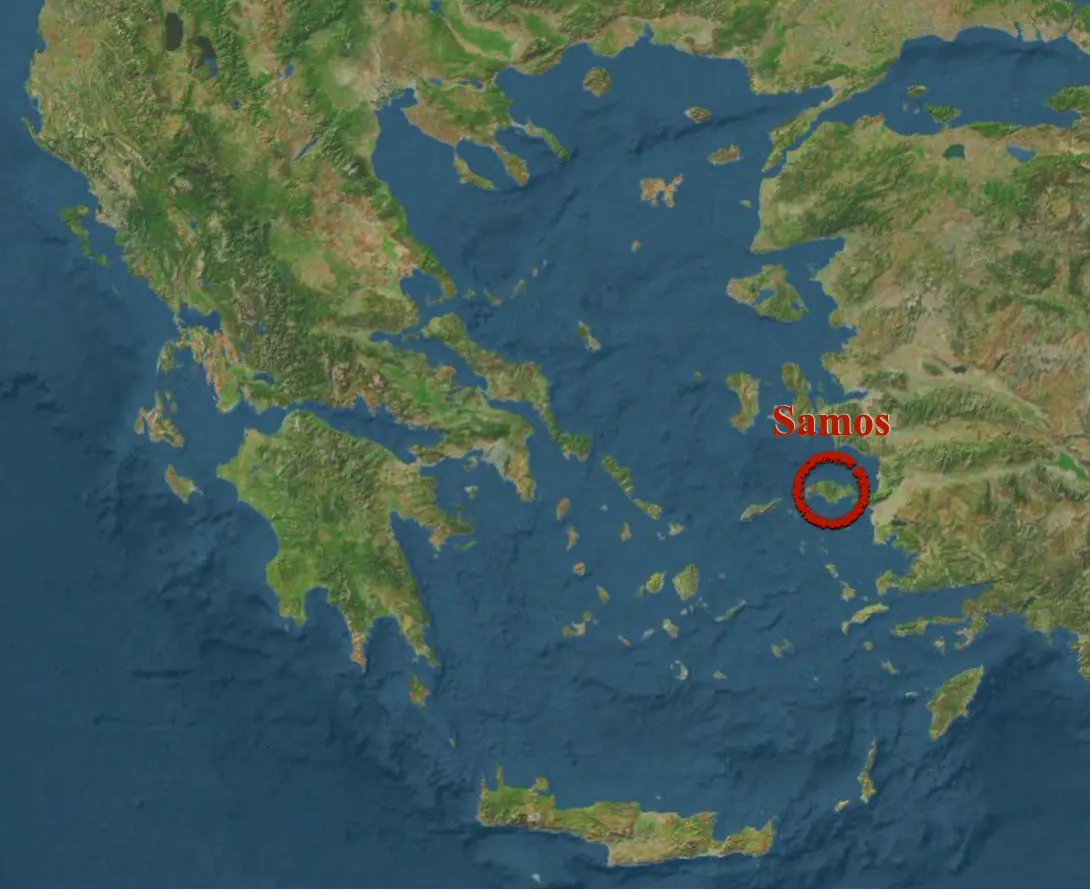
[ABOVE: Location of the isle of Samos]
This time also saw the revolt in Samos break out. Athens had likely instated democracy there around 439 BC, in which case they came to tolerate the later return to comparative oligarchy, and the revolt now was a pro-Athenian overthrow of that very regime. Two-hundred people were killed in the revolt, and another four-hundred were forced into exile, as Athens voted for Samian independence, seeing their loyalty was now assured. All civic rights from former land owners were stripped, and marriages between the once-oligarchic class and the rest of the Samian people were prohibited.
LESBOS
In the summer, the Peloponnesian and Chian plan to head to the Hellespont and further the revolts against Athens were still in swing, as both allies now made their way on-route to Lesbos. Spartan and allied land forces in the region marched to Clazomenae and Cyme in Ionia, commanded by the Spartan general Eualas and admiral Deiniades. They secured the revolts of the Lesbian cities of Mytilene and Methymna.
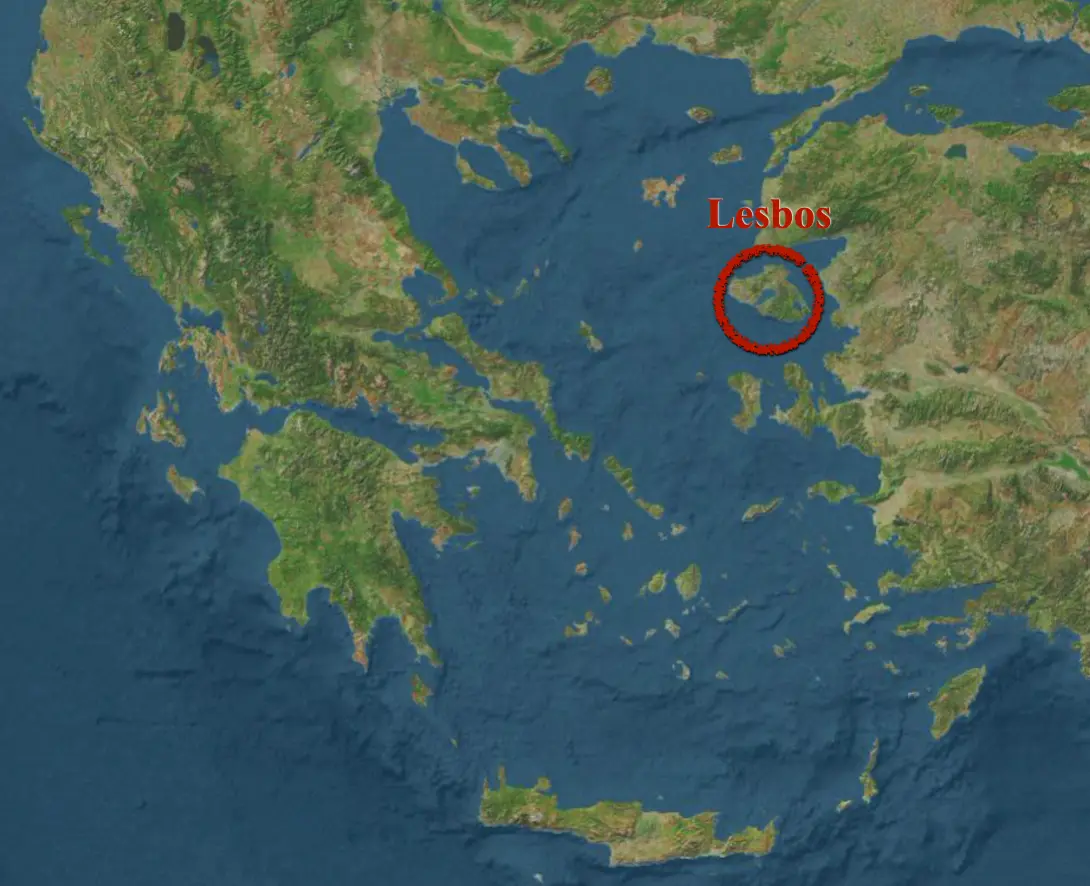
[ABOVE: Location of the isle of Lesbos]
Athens later seems to have given up their blockade of the city of Cenchreae to further their efforts in the Aegean. With this, the Spartan Admiral-in-Chief Astyochus set out with four ships from the city to Chios, and after his arrival his fleet were met by twenty-five Athenian ships under the commands of Leon and Diomedon, who together managed to sail into the harbour of Mytilene before Astyochus could arrive, defeat the local army and Chian navy and recapture the city. Joining with the remaining Chian ships, Astyochus secured the revolt of Eresus before attempting to press on deeper into the island, however the progress made there by the Athenians forced him to turn back to Chios, allowing Athens to capture Polichna and Clazomenae.
CHIOS IN DESPAIR
In the late summer, the twenty Athenian ships at Lade made landing at Panormus. Chalcideus brought up a force in opposition, but was killed in action. Diomedon and Leon capitalised by pushing their navy on to attack the Chians near Chios. Athenian marines made landings there and defeated the Chians, forcing them back to their city and refusing another fight, allowing Athens to ravage their lands, untouched since the Persian Wars. Many Chians, noting the quick revival of Athenian power, considered returning to the Delian League, before instead bringing up the Spartan Admiral-in-Chief Astyochus from Erythreae with his four ships to discuss how to quell the rumours of returning to Athens’s fold within Chios.
MILETUS

[ABOVE: Plan of Miletus during the 5th century BC]
Finally, at the end of the summer, Athens was able to muster 3,500 soldiers under the command of three generals, set for Miletus. They numbered one-thousand hoplites, fifteen hundred heavily armoured Argives and a further thousand allied troops, all aboard forty-eight ships. There, the Milesians met them alongside Peloponnesian allies and Persian mercenaries commanded by Tissaphernes, who had come to reinforce the army with his Persian cavalry. These two armies engaged in battle order, as the Argive wing charged in disorder at the Milesians, who held their ground, killed around three-hundred of them and forced them back. The Athenian troops, however, defeated the Peloponnesians and their allies. Noting this defeat, the Milesians withdrew into Miletus. Since the city lay at the end of a natural bottle-neck peninsula, Athens walled off the city from coast to coast, intent on starving them out into submission.

[ABOVE: Modern illustration of a hoplite phalanx marching in battle order]
Later that same afternoon, reports came in to the Athenians of an approaching fifty-five-strong Peloponnesian-Sicilian fleet, Under the command of the Spartan Therimenes, they had prepared ever since the ousting of the Athenians from Sicily, and now set out for Miletus. Having survived the recent attacks outside Miletus, Alcibiades came to warn them of what was coming, and to defend Miletus at all costs.
Receiving word of this coming fleet, the Athenian general Phrynichus, not knowing the size of the coming fleet, refused his officers’ wishes to leave. He would instead retreat from Miletus to Samos to gather reinforcements and continue the raids, to the disgust of his Argive allies, who promptly sailed home. Having left Miletus, the Peloponnesian forces arrived in the city’s port to collect their trapped Chian allied ships, and upon returning to Teichioussa they were greeted by Tissaphernes’ reinforcing Persian army. The Satrap convinced the Peloponnesians to move against the wealthy city of Iasus in Caria, where his Persian rival Amorges was. Iasus fell quickly as apparently its inhabitants, seeing the coming Spartan-led army, presumed the ships to be friendly Athenians. Amorges was captured and taken to Darius II, while Iasus was looted and returned to Persian control as the simmer of 411 BC came to an end.
AEGEAN CAMPAIGNS
Come winter, Tissaphernes ordered Iasus re-garrisoned before making for Miletus to pay the Spartan fleet, around one drachma per two ships, as promised. Meanwhile, the Athenian fleet too was receiving aid, in the form of the admirals Charminus, Euctemon and Strombichides, who combined their respective fleets and armies against Miletus and Chios. Astyochus was in Chios at the time, preparing for the arrival of Athens, but when he heard that Spartan reinforcements were on the way, he set about instead with twenty ships, first unsuccessfully against the cities of Ptelem and Clazomenae, before making for Phocaea and Cyme.
While in the area, Astyochus was approached by Lesbian envoys, requesting his participation in a second revolt. He was ready to accept, however his Corinthian allies, thinking of the unsuccessful first revolt, refused to partake, so the fleet made for Chios, who also refused any part in the revolt. Astyochus then took a portion of his fleet to Miletus to assume command there.
On their way, the pursuit of three Chian ships resulted in three Athenian ships being caught and wrecked in a storm, while the rest of the fleet waited out the storm in the nearby port of Phoenicus. Arriving after in Lesbos, they prepared their fortifications they wanted to build at Chios.
That same winter, the Spartan Hippocrates set out with twelve ships to Cnidus, rebelling from Athens with Tissaphernes’ aid. Hearing of his arrival, Peloponnesian authorities in Miletus sent their own fleet to aid, half at Cnidus to guard and half at Triopium to acquire local merchant vessels. Receiving intel of these manoeuvres, the Athenian fleet captured the six ships at Triopium and came close to capturing Cnidus, but ultimately failed when the city’s defences were improved upon, forcing the Athenians to return to Samos.
THE SECOND SPARTAN-PERSIAN TREATY
Meanwhile, Astyochus arrived at Miletus to assume command of the fleet. At this time, the Peloponnesians there remained content primarily with their pay and the direction their war as going, but that the prior agreement made between Chalcideus and Tissaphernes tended to their weaknesses. So another Spartan-Persian treaty was made: any cities currently or previously controlled by the Persians were not to be warred against by Sparta or her allies, or tribute demanded, and neither would Persia do the same to the Peloponnesians. Both Sparta and Persia agreed to wage war on Athens, either until victory or if one of them gained a peace deal. Allies of either side were also to be kept in line by the other side should any mutinies take place. King Darius was also to help fund the Peloponnesian soldiers. With this, Astyochus assumed full command of the fleet.
THE BATTLE OF SYME
Given their recent defeats and internal political struggles, Chios took no action even when this Spartan fleet occupied and began fortifying the nearby settlement of Delphinium, adding further fortifications to their military camp and ships. Athenian ships at Samos made several attempts against the ships at Miletus, who waited in the harbour instead, resulting in no ensuing battle while their port was blockaded. Chios would continue to send Astyochus requests for aid, more so since their large slave population began defecting to the Athenians, providing them valuable intel on the surrounding land.
Meanwhile, Sparta’s twenty-seven ships set for Pharnabazus, commanded by Antisthenes, sailed for Ionia. One of these ships was sent to Astyochus at Miletus to aid in his situation, and to replace him as commander with Antisthenes should they deem him unworthy. While the rest of the Spartan fleet reached Melos, they were set upon by ten Athenian ships, capturing and burning three of them. Fearing the remaining seven ships would report of their approach - which they eventually did - Antisthenes decided on a safer route via Crete towards Caria, the region south of Ionia.

[ABOVE: Modern recreation of a trireme warship]
Astyochus sailed towards them to aid, keen to make a good name for himself since he was under watch. Reaching Cnidus, the locals there requested his aid against the twenty Athenian ships that had been patrolling around Syme in waiting for Antisthenes’ twenty-seven ships. The Athenians at Samos, commanded by Charminus, got word of the Peloponnesian fleet’s approach to Caria, so Astyochus sailed for Syme, hoping to catch them out in the open seas.
Bad weather disoriented the Spartans and the fleet became divided into two wing. One wing went too far off course and became visible to the Athenian ships, on the opposite side of the island from the other wing. Most of Charminus’ twenty ships attacked, disabling three ships and causing much damage to some others. However, the other half of Astyochus’ fleet arrived around the other side of the island to cut them off, loosing six of their own ships as they retreated to Halicarnassus. Soon after, Astyochus and Antisthenes’ fleets joined at Caria, putting in at the city of Cnidus to repair any damaged ships.
It was at Cnidus that the Spartans were joined by the satrap Tissaphernes. They discussed what parts of the previously made treaty they agreed and disagreed with. One of the Spartans, Lichas, was keen to express his dissatisfaction with the notion of Persia regaining so much Greek land across the Aegean and to Thessaly for widespread slavery to be revived. This meeting ended with Tissaphernes storming off when Lichas and his argument’s supporters said that Sparta would not observe the treaty.

[ABOVE: 5th century BC Persian coinage with no markings, thought to depict Tissaphernes, from Phocaia, Ionia]
Shortly after, the combined fleet sailed for the island of Rhodes at the city of Cameirus, currently in the Delian League. Sparta's sudden arrival terrified the locals, who were convinced to join the Peloponnesian League, as the island would from here on be attacked on and off by the Athenian navy.
ALCIBIADES DEFECTS TO PERSIA
During these events, the Spartans began to have suspicions over the recent defected general, Alcibiades. A letter was sent from King Agis to Astyochus to have Alcibiades killed following the death of Chalcideus at the hands of the Athenians, forcing him to seek refuse with Tissaphernes in Ionia. Plutarch also alleged that Alcibiades had “dishonoured [Agis’s] wife”, with many historians taking this to mean that Alcibiades had slept with Agis’s wife, Timaea, and may even have had a child with her, named Leotychides.
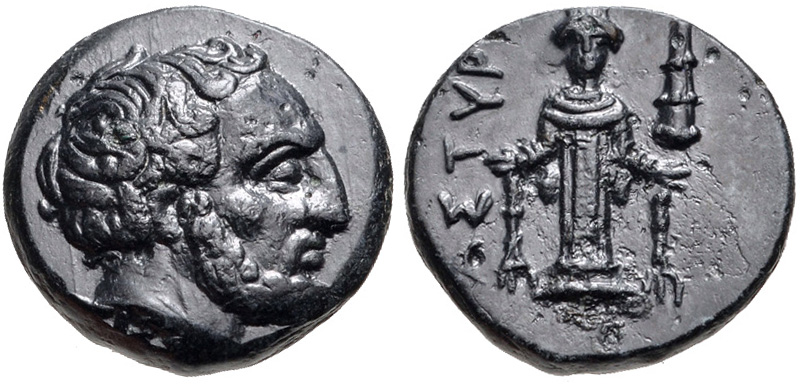
[ABOVE: Persian coinage dedicated to Tissaphernes, with the name "MYSIA" on the reverse, Tissaphernes's satrapy, c.400 - 395 BC]
In Persia, he worked with the satrap to do as much damage to the Spartans as possible, advising Tissaphernes to cut the Spartan sailors’ pay he was funding, further asking him to bribe the Spartan naval commanders into agreeing to do so. Alcibiades remarked to Tissaphernes,
... the Ionians should be called upon to pay their share, since it was for their deliverance, when they were paying tribute to the Lacedaimonians, that the war was undertaken. Neither, however, should the Lacedaimonians be too greatly assisted; for he should remember that he was preparing a way for the the supremacy of others, not for his own; and that the war was only so far to be supported, that it might not be broken off for want of supplies, as the king of Persia, while the Greeks were distracted by dissensions, would be the arbiter of peace and war, and would vanquish with their own arms those whom he could not overcome with his own; but that, if the war were brought to a conclusion, he would immediately have to fight with the conquerors. That Greece, therefore, ought to be reduced by civil wars, so that it might have no opportunity to engage in foreign ones; that the strength of its two parties should be kept equal, the weaker being constantly supported; since the Spartans, who professed themselves the defenders of the liberty of Greece, would not remain quiet after their present elevation.
Only the Syracusan navarch Hermocrates, veteran commander in Athens’s Sicilian Expedition, refused. Alcibiades also advised not to get too involved in the Peloponnesian War and attempt to bring it to a swift end, ordering him to halt the Phoenician navy he was readying. Tissaphernes thus cut the Spartan sailors’ pay, falsely promising them that Phoenician allies were coming in order to dissuade them from engaging in naval combat. Plutarch also states that Alcibiades and Tissaphernes remained in close ties with each other due to the allure of intercourse with the dashing turncoat being too good to ever turn down.

[ABOVE: Depiction of Hermocrates, from "Biography of the Illustrious Men of Sicily", by Domenico Lo Faso Pietrasanta, 1821]
Athens soon caught on to Alcibiades’ growing influence in Ionia. Alcibiades told them that he would consider rejoining Athens, only if their more recent radical democracy was re-replaced with his preferred oligarchic system of governance. Better still for Alcibiades, the leading Athenian navarchs at Samos were in agreement to try and overthrow the current Athenian democratic government. This movement spread soon from Samos to Athens itself, with the men at Samos crossing to meet with Alcibiades, who told them that should the democracy be overthrown, he could win them the favour and support of Tissaphernes, and later by extension of King Darius himself. Athens’s wealthiest citizens were the most imposed upon in the city’s democracy, and now they had hopes of taking the government into their hands. They too now moved to the fleet Samos to convince the soldiers, who were silenced from distaste at the promise of Persian gold.
Opposing this notion was Phrynichus. He (correctly) stated that Alcibiades’ motivation was to safely return to his lavish home in Athens, and he cared not for either democracy or oligarchy. His political motivation was to avoid civil strife, and Persia potentially siding with Athens would only deepen war with Sparta further. His words fell on deaf ears. Fearing Alcibiades would get word of his attempt to undermine him, Phrynichus sent word to Astyochus, still at Miletus, telling him that Sparta’s cause was being undermined by Athens and Tissaphernes’ dealings. Outraged, Alcibiades sent envoys to Samos demanding Phrynichus’ execution.
Phrynichus planned on Alcibiades’ reaction, so utilising his position as general in Samos to get out of his own execution, stating he knew of the enemy’s plans to attack Samos while it remained unfortified. Phrynichus thus received the go-ahead from Athens to fortify Samos and rebuff its navy, and soon the fortifications were complete. Even when a letter came from Alcibiades to Athens claiming Phrynichus has betrayed his forces to the enemy, his perceived untrustworthiness meant this letter fell on deaf ears and only strengthened Phrynichus’ resolve. Alcibiades thus moved back to attempting to bring Tissaphernes into an Athenian alliance, who was worried of the Spartans having the largest navy around Ionia.
Athens’s envoys previously sent to Samos returned to Athens, telling them of how the recalling of Alcibiades and the move towards Athens becoming an oligarchy could help them secure victory over Sparta. Alcibiades’ opponents claimed it would be monstrous to allow such a law-breaker to return, to which the envoys asked if they could think of any better way to convince the Persian King to come over to their side. One envoy, Peisander, reinforced this point at length:
Well, this is not going to happen unless we win the King’s trust by adopting a more prudent form of government and restricting eligibility for office to a select few; unless we concentrate now on survival rather than the constitution (we can always change things later, if there is anything we do not like); and unless we bring back Alcibiades, who is the only man alive who can make things happen.
Seeing no other way, Athens was convinced. Peisander was sent to Alcibiades and Tissaphernes to negotiate. Alcibiades still remained more worried of Sparta than Athens, so set to setting Tissaphernes’ demands of Athens so high that there could be no possibility of an agreement at all, which eventually made Athens look responsible for these talks failing. The demands included the full return of Ionia and its outlying islands to Persia, and Darius being allowed to build, sail and use however many ships he wanted in the area. Leaving in a rage and feeling duped by Alcibiades, the Athenian delegates made for Samos.
Peisander also travelled to Phrynicus to relieve him of command, handing the position instead to Diomedon and Leon. Diomedon and Leon sailed first to Rhodes, who had recently defected to Sparta from the Delian League, defeating the Rhodian force which came to oppose them in battle before heading for Chios. A Spartan force did soon after make an attack against Chios’ fortifications, and while a breach was made, the attack was ultimately a failure, resulting in the loss of much of the army, including its commander. Many Chians were also killed during this assault, worsening the famine there.
THIRD SPARTAN-PERSIAN TREATY
Concerned that his funding of the Spartan navy could only go so far as to help them and keep them loyal to Persia, Tissaphernes invited the Peloponnesians to meet him as Caunus to conduct a third Spartan-Persian treaty. It concluded that Darius was permitted to make any actions within his own territories as he saw fit and with no intervention from Sparta and their allies, and vice-versa. Maintenance for Sparta’s Ionian-based fleet was to remain under the responsibility of Tissaphernes until Darius's reinforcing fleet arrived, at which point it would be up to Tissaphernes and the Spartans to decide who should be in charge of funding. Tissaphernes also agreed to bring up his Phoenician ships, who ranked as some of the Persian Empire's finest sailors.
THE CAPTURE OF OROPUS
[ABOVE: Oeroepos, to the north of Attica]
Come the end of the winter of 411 BC, the city of Oropus, on the border between Attica and Boeotia, was captured by Boeotian forces. Traitors from Oropus received aid from Eretria, a city on the island of Euboea lying opposite to Oropus, and gave the city up. Their goal was to get Eretria to revolt and turn over to the Delian League, where they would pose a threat to the rest of Euboea. When Eretria came to the Spartans based in Rhodes for aid, their current affairs meant they were too occupied to help the Eretrians.
NEXT POST: THE ATHENIAN COUP, 411 BC: The Battle of Cynossema

SOURCES
- Thucydides, “History of the Peloponnesian War”, Book 8.1-60
- Diodorus Siculus, “Library of History”, Book XIII.34 - 51
- Plutarch, “Parallel Lives”, Alcibiades
- Justin, "Philippic Histories", Book V.2 - 4
- Donald Kagan, “The Peloponnesian War”, part six
YOUTUBE LINK
(I do NOT own this video)
"Ancient Greek History - Part 11 of the Peloponnesian War - 27" by "Historyden"
MY ANCIENT GREEK HISTORY BLOG PAGE
MY ANCIENT PERSIAN HISTORY BLOG PAGE
All feedback - positive and/or critical - is appreciated!
All images used are copyright-free
Don't forget to rate this post, share it and leave a tip if you enjoyed it
Follow my FACEBOOK
Follow my INSTAGRAM
Follow my REDDIT
Follow my TRUTH SOCIAL
Follow my TUMBLR
Thanks for reading :)






