
Sparta and Persia, once the most bitter of rivals at battles like Thermopylae and Plataea, had now forged an alliance against Athens. Coupled with Alcibiades's defection, a recent defeat at Syme and revolts across the Delian League, many Athenians began seeing their current government as ineffective, turning instead to more authoritarian means to lead Athens out of the debacle they found themselves in. Moreover, if Athens were to succeed, a rebuffing of their navy and its commanders would have to take effect. The Athenian Oligarchic Coup and the decisive battle of Cynossema were about to commence.
Check out my previous post on the Spartan-Persian Alliance
AEGEAN CAMPAIGNS
With Astyochus still doubting his ability to aid the Chians in their blockade, Chios was forced to attempt to break through the blockade and fight it out by themselves. Chios did gain some luck however; since the death of Pedaritus, they gained a new Spartan governor and commander named Leon (not the Leon who replaced Phrynichus’s command position alongside Diomedon), who brought with him twelve ships in aid from Miletus. Chios’s thirty-six ships faced off against Athens's thirty-two ships, and after much struggling, the Chians, while not able to break the blockade, did come out on top in the fighting.
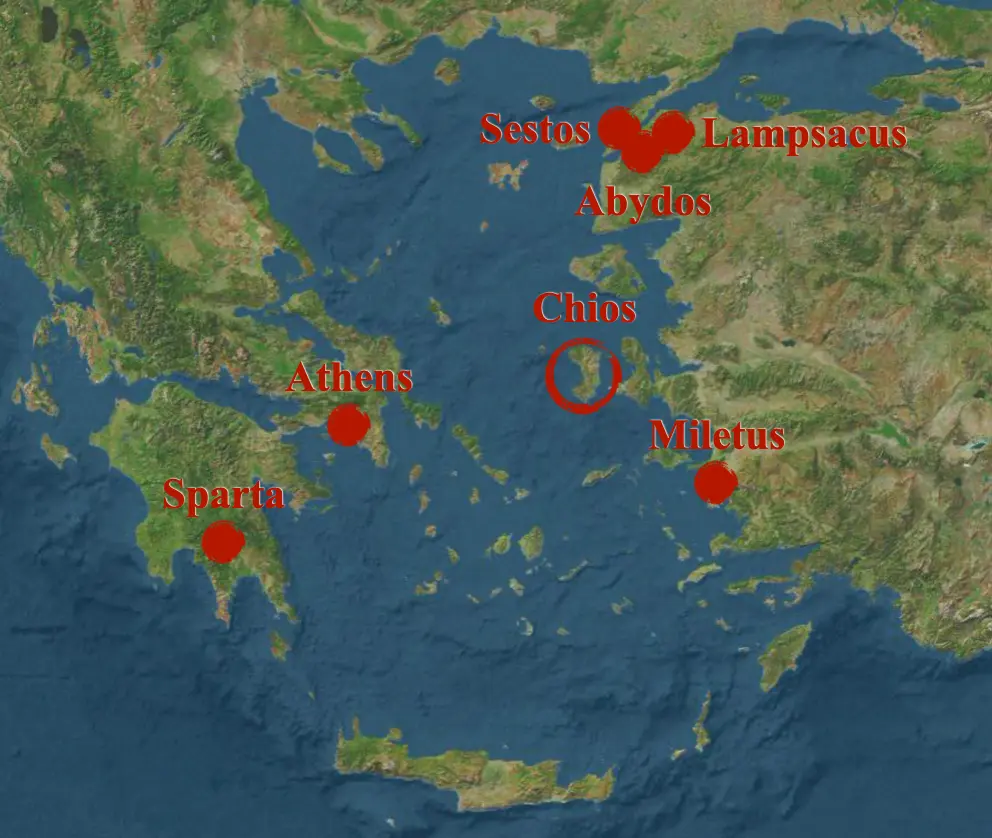
[ABOVE: Locations of various cities and islands in the Aegean Sea]
Meanwhile, Dercylidas, alongside Pharnabazus, secured the secession of Abydos, and later Lampsacus. Lampsacus was soon after retaken in battle after twenty-four reinforcing Athenian ships led by Strombichides, but a follow-up attack on Abydos failed, forcing the Athenians to the Chersonese city of Sestos, opposite Abydos, to fortify it. All the while, Chios was gaining good control over the local seas. This all emboldened Astyochus to rally some allied ships to attack Samos, but to no avail after the Athenians did not come out to meet them in battle, being entangled with the Oligarchic coup taking place in Athens at the time.
REVOLUTION OF THE 400
Following Peisander’s meeting with Tissaphernes at Samos, steps were made to establish a greater following for the attempted establishment of oligarchy in Athens, despite Samos’s own recent oligarchical revolutions. Athenian revolutionaries on the island also decided to leave Alcibiades out of the whole affair, since he was clearly unwilling to help. They thus conferred to send Peisander to Athens, and establish oligarchies in any cities they arrived at on the way, taking aboard reinforcing hoplites as they went. This also included another Athenian envoy among them establishing oligarchies across Athens’s Thracian cities. An attempted intervention in such a way of the island nation of Thasos only resulted in the Thasians fortifying their city against Athens while awaiting Spartan aid.
Reaching Athens, Peisander and his followers found most of the work gearing Athens towards oligarchy already completed by their fellow conspirators already within the city, including the murder of the popular populist Androcles, who had been instrumental in banishing Alcibiades. The conspirators agreed to make sure that there was no state pay for anyone not in military service, and that participation in government should be limited to five-thousand people. This was only a pretence to gain popular support first; they would really hold power between their few selves. Anyone speaking against the oligarchic government was to be put to death. Citizens were left demoralised thinking that the oligarchy spread much further than just Athens, and the sheer size of the city itself and its vast population made it impossible for terrorised citizens to know who was for and against the oligarchy, turning people on each other in further suspicion. This is the situation Peisander and his party found when arriving in Athens.
To combat this, they gathered a public assembly in secret, at a sanctuary about a mile outside the city. They proposed to elect ten commissioners to decide upon the management of the city, before putting their ideas before the people for voting. The commissioners said the only proposition they wished to put forward was that any citizen should have the right to introduce any proposition they liked. A notion to abolish state pay for politicians was also put forward. They also put forward that a presiding board of five people should be elected, and that those five should elect another hundred people, who should each elect three men each, Four-Hundred in total. These Four-Hundred would meet in the council chamber to govern Athens with absolute authority, being able to summon the five-thousand whenever they saw fit. No opposition was met when these motions were put forward.
PEISANDER
This motion’s most ardent supporter was Peisander himself. Antiphon remained the one who had done the most work towards this oligarchic movement becoming reality. Described by Thucydides as a gifted man of good quality, outstanding amongst his contemporaries, Antiphon remained reluctant to ever come forward on public meeting stages or assemblies, leaving the people ever-suspicious of him but simultaneously praising him for his intellect. In the hands of so many intellectuals of the time, it was no surprise that the oligarchic movement succeeded, around a hundred years after democracy was first established.
OCCUPYING THE COUNCIL CHAMBERS
The oligarch’s next move was for the Four-Hundred to occupy the council-chamber. They occupied it by sneaking up to the city wall’s patrol - those guarding against the Spartan attackers from Deceleia - and killing them between their shifts before heading into the chambers where they installed themselves. They each decided on their own specific office positions by lot, before working through the city to either imprison, exile or kill those who they saw as potentially good opposition.
NEGOTIATIONS WITH KING AGIS
They also spoke in private with Sparta’s King Agis, still campaigning in Deceleia, stating that they were more prepared to have Athens come to terms. Agis, however, knew that the citizens would not support peace so quickly with his army still campaigning near their city, and knowing they had occupied the city, calling for further reinforcements from the Peloponnese to reinforce his army in Deceleia. A quick move of his forces closer to the Long Walls let him know that Athens was still very resilient to Spartan intervention. Negotiations between the Four-Hundred and Agis would continue.

[ABOVE: The Long Walls of Athens, constructed by Themistocles at the end of the Persian Wars, connecting Athens to Port Piraeus]
SAMOS RETURNS TO DEMOCRACY
Samos, meanwhile, was reassured by the oligarchs that Athens presented no threat to them now. The oligarchy’s followers set about immediately to reassure the rest of the Delian League across the Aegean of the same message, since they were concerned that Athens’s citizen sailors would oppose them in time too. Samos, however, was already in opposition to the oligarchy. Following Peisander’s arrival on the island earlier, many under his influence in Samos began changing sides, forming a group of around three-hundred men to face off against who they called “the people”, being everyone else in Samos.
With conspiracies to murder opposition in the city growing, the people called out to Athenian co-commanders Diomedon and Leon, appointed to their offices under Athens’s former democracy and opposed to its oligarchy, begging for their aid, which they accepted. This had its intended effect, since whenever Athens’s three-hundred attacked, Samos rallied out with confidence and repelled, killing around thirty in the first fight and forcibly exiling the captured main instigators. The rest were offered amnesty and allowed to join Samos’s new democracy.
When a Samian envoy was sent after to Athens to report of the recent events in Samos, the envoys, being for the Athenian counter-revolutionists and not knowing that the Four-Hundred had taken power, were arrested on arrival and sent to a patrol ship around Euboea. One envoy escaped capture and was able to return to Samos, giving an over-exaggerated account of what Athens had become, telling them of public floggings of free men, the raping of women and children, publicly announced planned arrests of Samian opposition and hostage executions being spoken of. When the soldiers heard this, they considered attacking the oligarchs, supported by the counter-oligarchs two leaders, Thrasyboulus and Thrasylus, who were made the new commanders of the army at Samos.
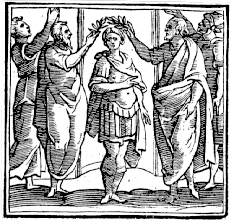
[ABOVE: Thrasyboulus receiving an olive crown, from Italian artist Andrea Alciato's Emblemata, 16th century]
A native Athenian and son of Lycus, Thrasyboulus was described thusly by Cornelius Nepos in the 1st century BC:
If merit were to be estimated absolutely, without reference to fortune, I rather think that I should rank this man first of all. Thus much is certain: I put no one above him in sense of honour, in steadfastness, in greatness of soul and in love of country.
PELOPONNESIANS AT THE HELLESPONT
At around this time, unrest arose amidst the Peloponnesian troops stationed at Miletus. They complained that Astyochus and Tissaphernes were ruining their cause, the former for not being aggressive enough when Sparta had military advantage and the latter for his delay with providing Phoenician naval reinforcements, and his lack of payments were causing further anger. Astyochus became aware of this growing descent, with he and his followers agreeing to meet the Samian opposition in battle at sea to prove their worth. 112 ships made for Mycale, where Xanthippus, Pericles’ father, once formerly ended Xerxes’ invasion of Greece decades earlier in battle. Athens at the time had eighty-two ships in waiting nearby. Fearing being outnumbered, the Athenian forces retreated to Samos, allowing the Peloponnesians to set up camp there with their local allies, soon sailing for Miletus when news of Strombichides’ arrival there reached them.

[ABOVE:Persian coinage dedicated to Tissaphernes, with the name "MYSIA" on the reverse, Tissaphernes's satrapy, c.400 - 395 BC]
With the Athenian fleet now at Samos, the Peloponnesians refused to fight this combined fleet, fearing their own inadequacy at sea. Clearchus was thus sent to Pharnabazus to collect needed payment, while talks came in from Byzantium of their intentions to revolt against the Delian League. However his ship and many others were caught in a storm and forced to return to Miletus, leaving only some ships being able to make it to Pharnabazus, securing his payment and the revolt of Byzantium. Hearing of this, Athens sent eight ships to attack Byzantium, who in turn sent eight of their own ships to counter.
ALCIBIADES JOINS THE FLEET
Ever since restoring democracy to Samos, Thrasyboulus and his followers retained the idea of recalling Alcibiades. He was eventually able to convince his troops to go along with the recall, while providing him with legal immunity for his actions. After sailing to Tissaphernes and picking up Alcibiades, he was brought back to Samos, convinced that their only hope of survival was if both he and Tissaphernes could take Athens's side against Sparta. When an assembly with Alcibiades was called, where he complained at great length about his exile and the current political situation, he intended on frightening the oligarchy back home and dissolving the cabals by boasting of his and Tissaphernes’ promises relating to the Phoenician ships and the funding Tissaphernes was willing and able to provide, now to Athens instead of Sparta, as long as Alcibiades was restored to Athens with no prosecutions.

[ABOVE: "Alcibiades being taught by Socrates", painting by François-André Vincent, 1776]
Hearing this, the Athenians elected Alcibiades as a general, allowing him full control of current affairs. Despite the wishes of the Athenian people, Alcibiades refused to sail to Port Piraeus and attack the Four-Hundred in power at Athens while greater foreign threats loomed large. He also later refused military aid from Argos, stating that he would call for help when it was needed. He instead made sure that his first action as a returning Athenian general was to return to Tissaphernes and let him know of this new development, now being in a beneficial - or harmful, if he wished - position for the Satrap. This, in effect, put pressure both on Tissaphernes and the Athenians from each other.
MINDARUS SUCCEEDS ASTYOCHUS
Hearing of Alcibiades’ recall, the Peloponnesians at Miletus now grew more resentful of Tissaphernes, already having not received their promised full payment and reinforcements, bringing about the prospect of desertion. This was in part the fault of Astyochus, who was flattering Tissaphernes for his own profit. Many sailors demanding pay approached Astyochus, who in return dismissed their pleas with threats. Angered, the sailors and troops chased Astyochus to a nearby alter, where he hid for safety. He was eventually replaced by Mindarus as admiral-in-chief and sent back to Sparta.
PHOENICIANS IN ASPENDOS
Wary of the Peloponnesians’s growing disdain over him, Tissaphernes travelled east to the city of Aspendos, leaving his second-in-command Tamos in charge to deal with payments. Tissaphernes’s goal in Aspendos was to hurry the promised reinforcing Phoenician ships. 147 ships were there in waiting, but beyond that nothing is known of Tissaphernes’s ongoings in Aspendos, or why he later returned to the Peloponnesians with no reinforcements. It is thought that he was simply buying time for the Spartan’s morale in Miletus to drop as their promised goods took even longer to arrive.
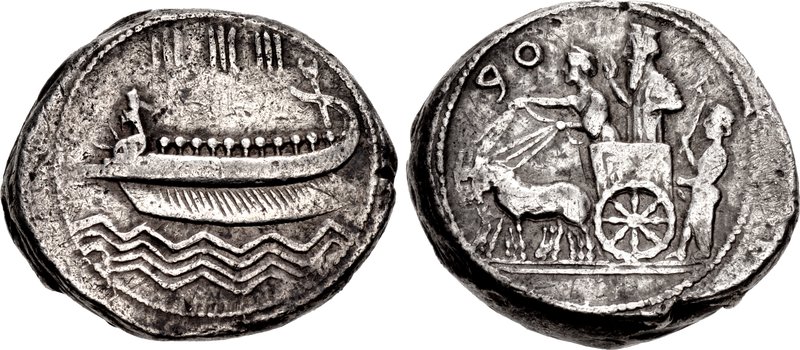
[ABOVE: Achaemenid-era coins from Sidon, Phoenicia, depicting a Persian king riding a chariot in front of a Sidonian King]
Thucydides states that he thinks it obvious that Tissaphernes wanted Sparta to fail in the war, given how, as he says, it would be easy for the war to come to a quick end given how powerful and numerous Persia’s forces and navy were. He also states that Tissaphernes’s excuse to the Peloponnesians that the reason he didn’t provide the reinforcements was that it wasn’t the larger number promised by the king is more proof that he wanted Sparta to fail, and in turn he would save the king money and increase his own favour with him.
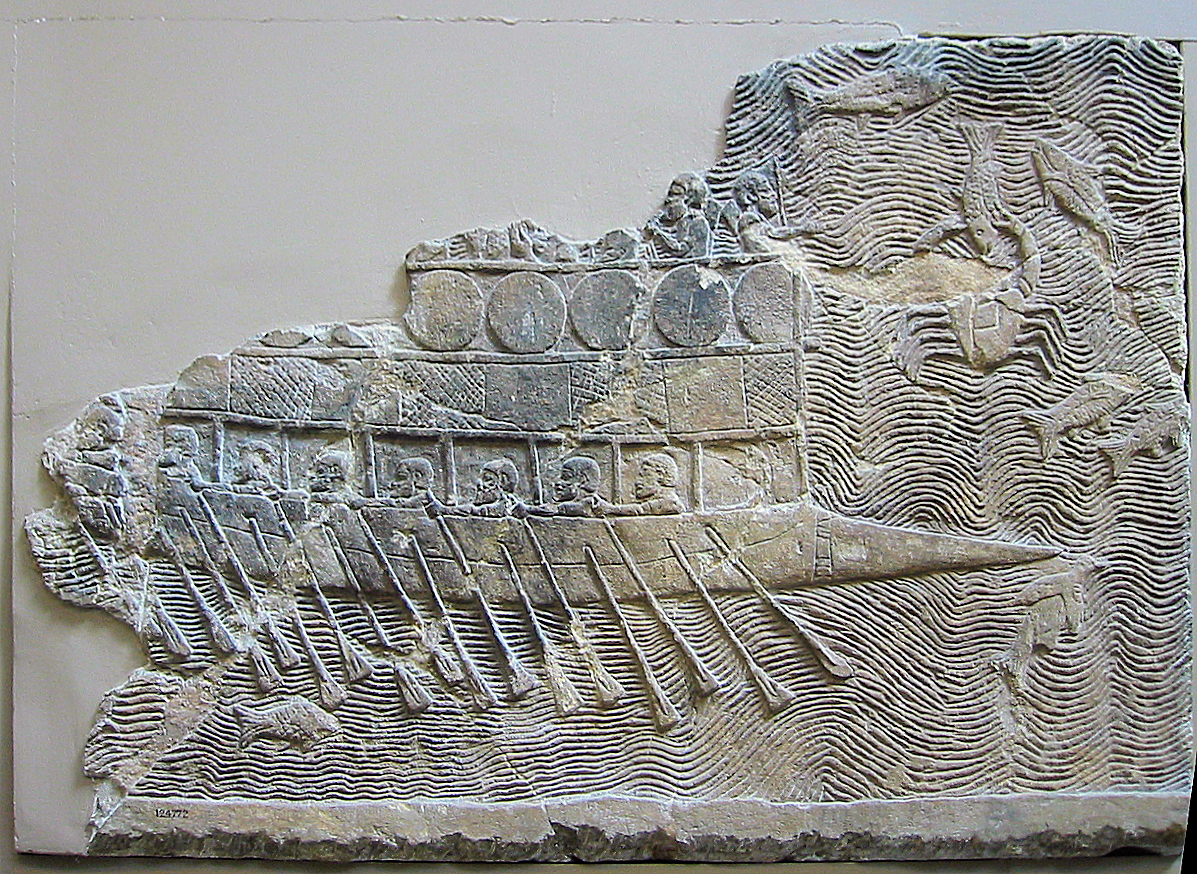
[ABOVE: Phoenician warships depiction found in Nineveh, c.700 BC]
Losing their patience, the Spartans sent one of their own to gather the ships. Hearing of this, Alcibiades too made for Aspendos, promising the Athenian army at Samos either to supply them with the Phoenician ships or merely just stopping the Peloponnesians from gaining them. It’s possible he’d known all along that Tissaphernes had no intention of giving the Phoenician fleet over to the Spartans at Miletus, and wanted to compromise him as much as possible.
REPLACEMENT OF THE FOUR-HUNDRED
Athens’ oligarchy was encouraged when news came back from Samos of Alcibiades’s resolve seemingly being against Athens’s foreign enemies instead of themselves. Afraid of the potential threats that could be made against Athens, they resolved to move on quickly with their plan to install the Five-Thousand in power, and to establish a constitution that would provide greater equality, however many in the oligarchic ranks still held their own private ambitions. Many among them opposed to the idea, including Phrynichus, had already been sending delegates to Sparta to try and organise a formal peace dealing, an action which they put into double-time given recent affairs, as well as fortifying Eëteioneia with a wall.
FORTIFYING EËTEIONEIA
Eëteioneia is a promontory that closes the entrance to Piraeus. The wall being built by the Four-Hundred would join with the Long Walls’ western wall, which would form a bastion with which a few men could command any approach from the sea. They also fortified the walls’ local grain depot, only allowing the sale of corn to be permitted from there. Word soon got around that a Spartan fleet of forty-two ships was heading to reinforce the oligarchs.
PHRYNICHUS ASSASSINATED
Shortly after his return from the embassy to Sparta, Phrynichus was attacked by a border-guard in a planned assassination, being stabbed and dying on the scene. While the assassin was tortured and killed, no further action was taken to get to the bottom of the plot, emboldening Theramenes and the oligarchs opposition. This boiled over until a prominent oligarch, Alexicles, was captured by citizen hoplites. The Four-Hundred were ready to take arms against them, threatening Theramenes, who was ready to take arms himself and rescue Alexicles. Arriving at Port Piraeus, Theramenes and his followers caused much panic and confusion on arrival before beginning to pull down the fortifications which were still under construction. Soon, the wall was demolished and Alexicles was released. Fearing the hoplites, select members of the Four-Hundred came out to convince Theramenes that names of the Five-Thousand would be published for transparency’s-sake.

[ABOVE: 5th century BC depiction of a Greek hoplite]
THE BATTLE OF ERETRIA
Coming to an agreement, the two sides agreed that dealing with the forty-two Spartan ships, commanded by Hegesandridas, heading their way was more important. These ships had put in at Oropus, roughly six and a half miles from the city of Eretria. Sparta's recent attacks on Deceleia had largely blocked Attica off from Athens, forcing them to rely on Euboea for goods, and the recent political and internal struggles meant that the navy they were now preparing to counter the forty-two Spartan ships were comprised of raw untrained recruits, with thirty-six ships being mustered.

[ABOVE: Modern replicas of Greek triremes]
Commanded by Thymochares, a Euboean squadron was sent ahead to prove their loyalty to Athens, however they secretly sided with Sparta, sending fire signals back to Hegesandridas and the Spartan fleet at an appropriate time to attack when they knew the Athenians would be least prepared to fight. In the ensuing naval battle, the Athenians held their own for a while, but were eventually forced to retreat and chased back to land. Those who retreated to Euboea, expecting to be welcomed, were butchered on arrival, and in total, twenty-two Athenian ships were captured.
With this defeat, all of Eretria, minus the city of Oreus, was secured in revolt by Sparta against Athens and the Delian League. When news of all this reached Athens, the cries of fear amongst the city, according to Thucydides, were apparently more-so than during the reaction to the disaster in Sicily two years prior. As they saw it, their only solution was to pull their fleet at Samos back to help, risking the loss of all Delian League territories to the east and essentially the whole Athenian Empire as they knew it. With this, a meeting was held in Athens, leading to the deposition of the Four-Hundred and the formal installing of the Five-Thousand. Pay for public officials was cut to help fund the army, and to prove the desperate situation they now faced, Athens finally agreed to fully recall Alcibiades and his followers in Samos, giving him equal power over the army as Thrasybulus and Theramenes.
THE BATTLE OF CYNOSSEMA
With no reinforcements or funding coming to them, the Spartan fleet at Miletus under Mindarus left. In total, eighty-nine ships left for the Hellespont. Hearing of Mindarus’s movements, Thrasyllus moved from Samos with fifty-five vessels, hoping to make for the Hellespont before his opponents did. Thrasyboulus had made it to Eresus beforehand, and their two combined fleets now totalled sixty-seven. Mindarus established his fleet at Abydos, joining local reinforcements to make eighty-six ships (eighty-eight, according to Diodorus Siculus) forcing a small Athenian fleet there to flee, taking losses in the withdraw. In response, the main Athenian fleet sailed for Elaeus, joined by eight more local ships to total seventy-six.

[ABOVE: The Lenormant Relief, from the Acropolis of Athens, showing rowers aboard a trireme, found in 1852, from c.410 BC]
Battle ensued quickly the next day after a five day stand-off, both sides eager to keep the current on their side. The Athenians sailed in column formation close to the coastline towards Sestos, forcing the Spartans to come out from Abydos and face them. The Spartan’s right-wing was occupied by the Syracusans under Hermocrates, with Mindarus commanding with his fastest ships on the left. Athens’s left wing was commanded by Thrasyllus himself, and the right by Thrasyboulus. (Diodorus Siculus states incorrectly that commands of both wings went to the opposite generals mentioned.)
Mindarus planned on using his superior numbers to outflank Athens’s right wing to block off their escape from the strait, driving the rest of the fleet to land. Realising their plans, Athens simply extended their lines to prevent this flanking manoeuvre, weakening their centre. This weakness encouraged the Pelopnnesians to attack the centre, driving the Athenians there onto land where they too disembarked to finish the survivors off. Both of Athens’s wings were too occupied to help. Thrasyboulus was being pressed too hard by the sheer number of enemy ships, and Thrasyllus, with his far-extended left wing, had his view of the engagement blocked by the land, while simultaneously being pressed by experienced Syracusan ships.
Sparta’s victorious centre, however, got too confident too soon, breaking down their formations to chase individual ships. Seeing this, Thrasyboulus stopped extending his line, reorganised the ships and attacked all at once, chasing the Spartan left-wing from the field and going on to shatter the already-disorganised Spartan centre. Athens’s ships were described as having much of their time during the battle occupied by executing great manoeuvres around the Spartan ships in order to deal good ramming damage. Their appearance was so sudden and shocking to the Spartans that many retreated without a fight. Sparta’s Syracusan contingent also fled at this moment, giving Athens victory.
AFTERMATH
In total, fifteen Athenian and twenty-one Spartan ships were lost or captured. Diodorus Siculus numbers five Athenian ships sunk and eighteen Peloponnesian ships captured. Either way, this was a decisive victory for Athens, forcing the rest of Sparta’s navy to retreat to Abydos. Shortly after the battle, Athenian ships went on to recapture Cyzicus, seizing eight triremes in the process before making for Sestus. News of the victory greatly enthused and emboldened Athens, who previously lay in fear of what Sparta’s growing naval power was becoming. It seemed now to Athens, even after every setback so far, that victory was still attainable.
Repairing his ships at Abydos, Mindarus sent for reinforcements from Euboea, gaining fifty vessels. Sailing past Mount Athos, however, the fleet was caught in a violent storm, so violent that only twelve men in total survived. On a temple in the city of Coroneia, Boeotia, an inscription commemorates this loss:
These from the crews of fifty ships, escaping destruction,
Brought their bodies to land hard by Athos’ sharp crags;
Only twelve, all the rest the yawning depth if the waters
Took to their death with their ships, meeting with terrible winds.
TISSAPHERNES
Hearing of the Peloponnesian’s movements from Miletus, Tissaphernes, still in Aspendus, set out for Ionia. Locals who had taken advantage of the Peloponnesian presence in the Hellespont brought several hoplites into the city of Antandrus to reinforce, in response to oppression by Tissaphernes’ deputy, Arsaces, who had much of the local Antandrians slaughtered one day with his own Persian soldiers. The Antandrians thus used their reinforcing hoplites to drive Arsaces out of the city. Tissaphernes thought this was the work of the Peloponnesians.

[ABOVE: The Persian satrapy of Lydia]
THUCYDIDES

[ABOVE: A plaster-cast bust of Thucydides, from an original Roman copy, c.100 AD, in turn copied from a Greek 4th century BC original, now held in the Pushkin Museum, Moscow]
While the Peloponnesian War would continue, it is here that the accounts of the war from Thucydides come to an end. This is likely due to Thucydides dying before he could finish his work, sometime around the year 400 BC. The history of the Peloponnesian War would be voluntarily finished by Athenian historian Xenophon, whose work we shall follow in the next post. Much like Thucydides, I wish to end this post right in the middle of a
NEXT POST: THE BATTLE OF CYZICUS, 410 BC: War for the Hellespont
SOURCES
- Thucydides, “History of the Peloponnesian War”, Book 8.61-109
- Xenophon, “A History of My Time”, Book 1.1.1
- Cornelius Nepos, “The Book of the Great Generals of Foreign Nations”, Thrasyboulus 1
- Diodorus Siculus, “Library of History”, Book XIII.34 - 51
- Plutarch, “Parallel Lives”, Alcibiades
- Justin, “Philippic Histories”, Book V.2 - 4
-
Donald Kagan, “The Peloponnesian War”, part six
YOUTUBE LINK
(I do NOT own this video)
"Ancient Greek History - Part 12 of the Peloponnesian War - 28" by "Historyden"
MY ANCIENT GREEK HISTORY BLOG PAGE
MY ANCIENT PERSIAN HISTORY BLOG PAGE
All feedback - positive and/or critical - is appreciated!
All images used are copyright-free
Don't forget to rate this post, share it and leave a tip if you enjoyed it
Follow my FACEBOOK
Follow my INSTAGRAM
Follow my REDDIT
Follow my TRUTH SOCIAL
Follow my TUMBLR
Thanks for reading :)






