
Xenophon opens his third chapter of his Histories, reminding us that in 404 BC, the ninety-fourth Olympic games in honour of Zeus were held as per usual:
At this Olympiad Crocinas the Thessalian was winner in the stadium.
- Book 2.3.1

[ABOVE: Marble bust of Xenophon, c.120 AD, now held in the Library of Alexandria, Egypt]
For many across the Greek world, life was as normal. The mainland however was comparatively, on the whole, a smouldering wasteland; it had been twenty-eight years since seemingly small, irrelevant events at Epidamnos, Sybota and Potidaea led to the longest war in ancient Greek history, and the total collapse of the Athenian empire.
At the helm of the great city now were the Spartans, victors of the nearly three decades long Peloponnesian War. Yet this title was hollow: the conflict had been harsh to both sides, and Sparta now found itself at the head of an empire it would come to struggle to maintain, as other Greek powers would sniff out the coming weaknesses.
For now though, after his crushing victory at Aegospotami, the Spartan navarch Lysander had accepted Athenian surrender. What followed was the imposition of Spartan oligarchy on the democratic state of Athens. While a brief rule, the thirty men placed in charge of the city would come to earn a reputation as some of the most cruel oligarchs in ancient history, turning this once prosperous and hopeful state into a distrusting, blood-soaked tyranny of the masses - the ancient world’s bloody version of the French Revolution: blood in the streets of Athens.
Check out my previous Greek history post on the primary historian of the Peloponnesian War, Thucydides
BACKGROUND
The Athenian defeat at Aegospotami was near total: 160 out of 180 Athenian war vessels were lost, thousands of sailors were executed, and nearby territories such as the isle of Sestos were effortlessly brought under Spartan control. Further yet, when grain shipments from the Black Sea were cut off from Athens and the city itself was put under siege by Lysander, Athens - now enduring a famine, spreading disease and political insanity - had to admit defeat. The city walls and other fortifications in Athens and the port city of Piraeus were ordered to be brought crumbling down, and the Athenian navy was reduced to just twelve ships. All overseas territory was surrendered, and Athens was reduced to a subordinate ally state of Sparta.
Athens was broken.
To finally implement proper Spartan rule over Athens, Lysander held an assembly, where it was decided that thirty men should be put in power to codify ancient laws as the framework for a brand new Athenian constitution. While the exact ways in which the Thirty were implemented are not detailed, Xenophon does tell us the names of all thirty men:
Polychares, Critias, Melobius, Hippolochus, Eucleides, Hieron, Mnesilochus, Chremon, Theramenes, Aresias, Diocles, Phaedrias, Chaereleos, Anaetius, Pison, Sophocles, Eratosthenes, Charicles, Onomacles, Theognis, Aeschines, Theogenes, Cleomedes, Erasistratus, Pheidon, Dracontides, Eumathes, Aristoteles, Hippomachus and Mnesitheides.
Don’t worry: it’s not important to remember all of their names. Key among them for us though will be Critias.
Elections over, Lysander sailed off to Samos, leaving the Spartan king Agis to withdraw his troops stationed at Decelea, letting them disperse back home to their respective city-states. At Samos, the Samians offered resistance to Lysander, but upon an organised Spartan attack heading their way, they came to terms, agreeing that every free man should be allowed to leave with just a cloak - the city was surrendered to Lysander, who reinstated the formerly exiled rival political party in the city before dispersing his navy back to their home cities. With this, we can say that the Peloponnesian War formerly and properly came to an end.

[ABOVE: Samos and its colony cities]
Returning home with his Spartan ships, Lysander brought with him the prows and triremes of his fallen enemies from Piraeus, as well as 470 talents from Persia, all of which was given to the government in Sparta itself.

[ABOVE: Lysander's portrait from the book "Promptuarii Iconum Insigniorum" by Guillaume Rouille, 1553]
THE THIRTY IN POWER
Meanwhile in Athens, the Thirty were hard at work. At first, they merely appointed five-hundred councillors, and ten others to support themselves in Piraeus. Alongside three-hundred whip-wielding attendants, the Thirty took a firm grip of Athens. Their rule at first seemed to be merely punishing common criminals but soon their intent became clear as day; they tore down the old law of the Areopagus, and annulled the old laws of Solon which once gave citizens the scope for public political disagreement, solely in order to legally remove the opportunity for said-disagreement.

[ABOVE: Roman bust of Solon, 90 AD. Copy of a Greek original, c.110 BC. Now held in the Farnese Collection, Naples]
Now, the Thirty could begin their reign of terror; constantly filibustering, tasks were delegated for a later time. No new laws were framed, and they appointed men into the council as they saw fit. Not long after, the real brutality of their reign began: the Thirty first called for the arrest of all Athenians who had profited or simply made a living during the time of Athenian democracy by acting as informers, coming to make it a habit of attacking Athenian aristocrats openly in the streets. Put on trial, these Athenian citizens were often gladly condemned to death, with no objections heard from the rest of the terrified populace.
THE SPARTAN GARRISON
In order to better reinforce their rule, two of the Thirty, Aeschines and Aristoteles, went to Sparta to ask Lysander to send contingents of hoplites to garrison the city, at least until they were rid of the “criminals” as they described them, offering to pay for the soldier’s expenses themselves, which presumably they could do with Athenian loot. Lysander agreed, and hundreds of Spartan warriors - presumably some of whom were veterans of the war - were sent to garrison Athens and reinforce the Thirty’s tyranny with raw muscle.

[ABOVE: Depiction of a Classical Greek hoplite, credited to either J. Krasnoborski or F. Mitchell published in 1984]
The Spartan Callibius was also sent to act as governor of the city, and upon his arrival, the Thirty made sure to be as agreeable as possible with him simply in order to get their way with Athens. With man-power and the approval of Athens’s new governor, the Thirty were free to openly arrest all Athenians that they wished, particularly those who they deemed would be the least likely to comply with being shoved out of politics and who could amass the most support in any theoretical rebellion.
Amongst the targeted and killed was Niceratus, son of Nicias, the man who forged his name-sake peace deal during the Peloponnesian War and led the Sicilian Expedition, described at the time as first in Athens in terms of wealth and reputation. Any exiles from Athens who were not handed over by other Greek cities were also decreed to be fined five talents each should they not hand over said exiles. Fearing Spartan power right at the end of the war, almost every Greek city obeyed. Only Argos and Thebes stood aside from this decree, with Thebes declaring that anyone who witnessed an exile and did not help would be fined.
This was all decided on and done by thirty men, simply acting as they wished with zero remorse or grounded reason for doing so: Athens was occupied Spartan territory, and the Thirty simply did as they pleased.
THERAMENES AND CRITIAS
Two of the Thirty, Critias and Theramenes, were known to be friends who shared similar views. Critias had been exiled by the Athenians before, and now had a “lust” for putting Athenians to death. Theramenes came to oppose Critias’s blood lust, stating,
There is no sense in putting a man to death simply because he has been honoured by the democracy and when he has done the aristocracy no harm at all. After all, both you and I have often said and done things in order to make ourselves popular with the citizens.
- 2.3.15
Critias responded:
It is quite impossible for those who want to gain power to avoid getting rid of those people who are most likely to form an opposition. And it is pure simplicity on your part if you think that, just because we are thirty and not one, we have to keep a less close watch on the government than is done by an absolute dictator.
- 2.3.16
More Athenians were unjustly put to death. It soon became clear that many citizens were starting to form groups in opposition to the Thirty. Theramenes again spoke up to Critias regarding this, expressing his view that the oligarchy couldn’t survive unless a larger number of others were brought in to the new oligarchy. Concerned with how much Theramenes wished to divide power up more between more Athenian citizens and seemingly take it away from the Spartans, Critias and the Thirty became alarmed and worried by Theramenes, fearing the Athenians could turn to him as some kind of leader.

[ABOVE: Theramenes seated next to a young man emptying a flask. 16th century engraving by Giulio Bonasone, 1555]
THE 3,000
Concerned as they were, the Tyrants enrolled a group of three-thousand citizens who were now to become associated with the oligarchic government. Theramenes opposed this too:
In the first place, it seems ridiculous to me, when we want to bring the best men into the government, to fix the number at three-thousand, as though this number must necessarily comprise all the good people there are, [as in the rich, and those who qualified for hoplite service] and as though there cannot possibly be a number of excellent people who are not included and a number of rogues who are. And secondly, it appears to me that we are trying to do two absolutely inconsistent things at once - to organise a government based on force, and at the same time to make it weaker than its subjects.
- 2.3.19
This greatly troubled the Thirty. Under arms, they held a meeting, while the new 3,000 paraded in the market place. A new order was soon given by the Thirty to pile weapons, and when the men were off duty, the Thirty ordered the Spartan hoplite garrison to seize the weapons of all Athenians who weren’t among the 3,000, carrying them up to the Acropolis and locking them away in the temple.
With no means of fighting back effectively, the Athenians were now truly at the mercy of the Thirty; the oligarchs were free to put many to death in great numbers, for any reason as small as personal feuds or because someone had too much money. Especially since the Spartan garrison needed paying, it soon became practice for each Spartan soldier to arrest one Athenian each, arrest them and take their entire property. Among those ordered to seize Athenians and their goods was Theramenes, who gave his view:
In my view it is dishonourable for those who call themselves “the best people” to act worse than the informers did. The informers took money from their victims, but did at least allow them to stay alive. Are we, in order to get money, going to kill people, who have done nothing wrong? Is not this worse in every way?
- 2.3.22
This was the final straw; the Thirty now plotted in secret against Theramenes, calling him a “menace to their government”. They thus chose a handful of men - picked out for their rugged toughness - and armed them with daggers, concealed, waiting for Theramenes outside Athens’s Council.
At the Council meeting, after Critias rose up and gave a long speech asking for anyone who disagreed with the Thirty’s rule to speak out and calling Theramenes hypocritical for wanting this government in the first place and now opposing it, calling for him to be punished “as a traitor”, claiming no peace can be made with traitors. Theramenes defended himself, calling out Critias and the government’s actions and hypocrisies in the process, but concluded that if indeed he was actually a traitor, then he would deserve death. His defence speech worked, and the audience applauded Theramenes.

[ABOVE: Ruins of the Pnyx, with speaker's platform, in Athens, where Theramenes and other politicians often stood when public speaking]
Pulling away privately, Critias and the Thirty put their plan into action, telling the young men with daggers to stand at the railing separating the Council from the public. Critias then rejoined the Council, and openly admitted that while none of the Three-Thousand could be put to death, the Thirty Tyrants held supreme power over life and death, and thus he stood up and openly called for Theramenes to be struck from the list and condemned to death. Theramenes sprung up, stating that those who made the list in the first place should have a say in his fate, not the oligarchs, in accordance with the law.
It mattered not: Theramenes was seized and given to the cloaked assassins, who dragged him away while he called out the gods to bear witness:
I flee for refuge to the gods, not with the thought that I shall be saved, but to make sure that my slayers will involve themselves in an act of impiety against the gods.
- Diodorus Siculus, “Library of History”, XIV.4
Theramenes was dragged through the public market. Citizens mourned his ill-fortune, yet did nothing under the threat of death from the Spartan garrison. Three of Theramenes’ philosophical friends - one including none other than Socrates - ran forward to hinder the men apprehending Theramens, but he wished for them not to intervene, admiring their loyalty and bravery but not wishing himself to be the reason they too may be killed. Dragged to a private, dark room, Theramenes was told he was to drink hemlock. With death looming over him, Theramenes smiled, raised his drink, and said,
And here’s to that delightful fellow, Critias.
- 2.3.56

[ABOVE: Marble Roman-made portrait of Socrates, 1st century AD, a copy from an original Greek bronze statue made by Lysippus, 4th century BC]
Theramenes drank the hemlock, and died. At least he didn’t loose his good spirit in the end.
THRASYBULUS
With no clear and serious opposition left, the Thirty were now even freer to act as they wished. They called for citizens who were not part of the Three-Thousand to have all their property and estates seized and handed over to the oligarchs. Those who sought refuge from this tyranny in Piraeus were driven out as refugees, with the cities of Thebes and Megara soon becoming swarmed with Athenians.
Amongst the exiled in Thebes was Thrasybulus. Veteran of the Peloponnesian War battles at Cynossema, Abydos, Cyzicus and Arginusae, Thrasybulus was one of the first to oppose the new oligarchy. Described by Roman historian Cornelius Nepos, Thrasybulus, son of Lycus, was ranked by the historian as the most merit-worthy, honourable, steadfast and patriotic man there was.

[ABOVE: "Thrasybulus Athenienses" bust, Roman copy of a Greek original from the 5th century BC, unknown author. Now held in the Historical Archive, Rome]
REVOLT
Enraged, naturally, Thrasybulus used his charisma and wartime resume to gather around thirty followers - later seventy - who together seized the stronghold fortress of Phyle, which lies to the north-west of Athens in Attica. In response, the Thirty sent out the Three-Thousand and a detachment of cavalry. So confident were the Three-Thousand that they head-on attacked the fortification, but achieved nothing in the process, sustaining many wounded. Thrasybulus would stand as the very first man to make war against the Thirty.
The plan now became to blockade the fortress and cut its supplies off until Thrasybulus and his men were starved out. However, the following night, a heavy snow storm hit the region, and under the cover of night and snow, Thrasybulus sent out a detachment to harass and raid the enemy and their camp. Desperate, the oligarchs sent the entire seven-hundred-strong Spartan garrison and two cavalry detachments, stationing them in a naturally-sheltered garrison two miles away from Phyle.
THE BATTLE OF PHYLE
Around this time, Thrasybulus was joined by seven-hundred more men from Thebes, who together marched out to around half a mile away from the Spartan forces. Waiting silently until dawn, and until the Spartans were beginning to organise and rustle their horses up, Thrasybulus and his men charged in and attacked the Spartans. 123 Spartans were killed, and the rest either wounded or routed from the field, pursued by Thrasybulus and his men for over a mile, though those who surrendered were ordered not to be killed by Thrasybulus. Collecting the enemy weapons, Thrasybulus returned to Phyle. From Cornelius Nepos:
All men ought to bear in mind this thought, that in war nothing should be scorned, and that it is a true saying that the mother of one who knows what fear is seldom has cause to weep.
- C. Nepos, VIII.2
This was the start of the “Phyle Campaign”, which would see Thrasybulus become too much for the brief-ruling Thirty Tyrants.

[ABOVE: Map showing the location of Phyle, in the Parnes Mountains, Attica]
Now seeing their unsafe position, the Thirty considered taking over the city of Eleusis (in Attica, around twenty-three kilometres west of Athens) simply to have a place to retire should everything go south for them. Critias thus took the rest of the cavalry with him to Eleusis. Gathering the people there into the public square, and feigning a census check, the people were one by one ordered out of the city gates to the shoreline, where the cavalrymen were waiting to seize and bind them. The cavalry commander, Lysimachus, was ordered to take these citizens to Athens, where they were forcibly voted on by Critias and the Thirty, with the vote deciding whether these Eleusian men should be made to help the Thirty arm up and take down Thrasybulus, or be killed right there and then.
By now, Thrasybulus had amassed over a thousand men, and together marched to Port Piraeus, Athens’s once-walled harbour city. Hearing of this, the Thirty along with their hoplites and cavalry marched out against them. Although small forces of Thrasybulus’s supporters came out to support them, their position along the trade road from Athens to Piraeus was not fortified enough anymore, and they pulled back to the nearby hill known as Munychia.
THE BATTLE OF MUNYCHIA
Critias’s men - thousands in total - advanced to the nearby market square and lined up for battle, no deeper than fifty ranks. They marched straight up the hill towards Thrasybulus’s men, whose ranks were no deeper than ten men. Behind their hoplite line, however, were skirmishers armed with javelins and slings - locals to the area - and this, on the high ground, gave Thrasybulus’s force a great advantage. They were still, however, greatly outnumbered by Critias.

[ABOVE: Modern-day Munychia, known today as Kastella. Photo taken in 2008]
Before the lines engaged, Thrasybulus told his men to ground their shields, and gave them a rousing speech. He reminded them that the men on the enemy’s right wing were the very men they had beaten at Phyle four days prior, while the men on the enemy’s left wing were the Thirty Tyrants themselves who had stolen Athens from them. Reminding them of how this is all they had wanted for the past few months - with their sworn enemy right in front of their spears - the exiles were ready for battle.
Told before the battle by the army’s prophet that they should not advance until one of their own men had been wounded or slain, Thrasybulus stayed on the high ground, stating,
When that has happened, however, we shall lead you on. You will follow and victory will be yours. But for me, so far as I can see, it will be death.
- 2.4.18
Xenophon, who may have been fighting amongst the Oligarch’s cavalry, recounts that the prophet then, seemingly inspired, fulfilled his own oath himself by being the first to charge at the enemy, and died fighting.
The rest of the army, however, was successful. The Thirty’s army was driven down the hill to the level ground below. Many were slain - among them were several of the Tyrants, including Hippomachus, and Critias himself who supposedly died fighting Thrasybulus face to face. In total, the Thirty, lost seventy men, while Thrasybulus took very light casualties.
Also amongst the slain was one of the oligarch-appointed governors of Piraeus, Charmides, husband to a wife who herself was a descendent of Solon, and the father of a then-twenty to twenty-five year old Athenian, a wrestler given a nickname to match his broad shoulders. In Greek: Plato.

[ABOVE: Genealogy chart of Critias and Plato, from Plato's Socratic Dialogues]
AFTERMATH
Victorious, Thrasybulus’s men stripped the enemy dead of their weapons. Once the dead were handed back to each other’s side, delegates from both sides met to speak under truce. On Thrasybulus’s side, the herald Cleocritus, described as having a “very fine voice”, spoke to the Oligarch’s delegates and mustered-up Athenian soldiers. He pleaded, asking why they, who had done no wrong, had been driven from their own city, when once they shared drink and partook in festivals as Athenian brothers. Cleocritus begged the Athenian men to stand down and join together, stating that the Thirty had led to the deaths of more Athenians in the past ten months since the end of the war than the entire Peloponnesian League had done in ten years of war.
EXILE OF THE THIRTY
Surviving officers of the Thirty lead the Athenian soldiers back to Athens, noticing that they may have been taking Cleocritus’s words to heart. The Thirty were now seriously considering their isolated position, even amongst their own subjects, while the Three-Thousand, stationed throughout the city, began to quarrel amongst themselves. Seeing which way the wind was blowing, pro-Oligarchs who had committed wrong-doings during the Thirty’s rule were committed to standing their ground against Thrasybulus and his men - now stationed at Piraeus itself - while those pro-Oligarchs who personally had not yet committed any crimes persisted that the Thirty should in fact be overthrown.
Gathering together, it was decided that, yes, the Thirty were to be ousted from Athens. Getting word of this, the Thirty - or what was left of them - took up their retirement plan and retreated to the city of Eleusis. In their place, the Athenians elected a man from each Athenian deme or tribe - ten in total - to lead them.

[ABOVE: Ruins of Eleusis, modern Elefsina, showing the Telestarion ("Initiation Hall"), one of the primary centres of the Eleusinian Mysteries devoted to Demeter and Persephone
They now had command of the cavalry, the soldiers and the commanders: Athens was reclaimed, but the ten now in charge were still not willing to come to terms with Thrasybulus, and the city itself was disorganised, distrusting, and notably bloody; an estimated five percent of the Athenian population had been killed. We should bear in mind that Athens at the time had a population of up to 300,000, meaning it’s possible that upwards of fifteen-thousand people had been slain in the past eight months by their own government.
Athens was restored, yes, but its wounds were struck deep, and struck hard.
BATTLE OF PORT PIRAEUS
The hoplites and cavalrymen stationed still in Athens would be seen patrolling the city in distrust. By day on horseback and by night on foot, patrolling what remained of the city walls, the soldiers and citizenry became very distrusting of their new government, given recent events. Thrasybulus and his army still remained not far away in Port Piraeus, building shield using wood and any other materials they could find, even building some out of wickerwork.
After ten days, the exiles took to the field once more, their army now containing well over a thousand hoplites and skirmishers, and had now acquired some cavalrymen. They took to the field for the next few days collecting resources. Some men were captured by pro-oligarchic forces, but aside from that losses were minimal at most. When some of Thrasybulus’s captured men were put to death, he responded by killing some captured men of his own, including a cavalry commander, Callistratus.

[ABOVE: Map of Athens and its port city, Piraeus, connected by the Long Walls, demolished after 405 BC. Illustration by Napoleon Vier]
SPARTAN AID
When direct attacks against Piraeus failed, the oligarchs sent embassies to Lysander in Sparta to ask for help. He stated it would be best to simply blockade Thrasybulus by land and sea to cut off supplies. Lysander thus marched himself towards Athens with a hundred talents of silver, while his brother Libys lead the fleet. Reaching Eleusis, Lysander began recruiting local Peloponnesian allied troops while Libys patrolled the waters nearby.
Thrasybulus was now trapped in Piraeus, and the ten oligarchs in Athens regained their confidence.
Affairs at this stage reached the point to where the Spartan king himself, Pausanias, (grandson of the victor at Plataea, also named Pausanias, seventy-six years prior) lead a Spartan army himself north towards Piraeus. His main motive, however, was jealousy; he didn’t want Lysander hogging the glory all for himself, and feared that if Lysander won this great victory, all of Athens and Piraeus could become his own personal property outside of Pausanias’s domain. Mustering up governmental and popular support, Pausanias marched out with a force from nearly all corners of the Peloponnesian League, minus Boeotia and Corinth who claimed that Athens was not violating the peace treaty.
THE BATTLE
Pausanias met up with Lysander, and made camp in the plains outside Piraeus. Lining up for battle, Pausanias commanded the honorary right wing and Lysander the left with his mercenaries. When Thrasybulus refused emissaries ordering them to surrender, Pausanias ordered an all-out attack… an ‘attack’ that amounted to no more than merely marching in battle formation up to the crumbled walls, cried their war cries, made their intentions clear and promptly marched back to camp.
The next day however, battle broke out; while Pausanias took his men to patrol the coast in order to try and find suitable grounds to build a blockading wall around Piraeus, their march back to camp was met with a sudden attack from Thrasybulus’s foot soldiers. Pausanias, angry, ordered a retaliatory charge, killing nearly thirty men in the process and chasing the rest back to Piraeus.
The rest of Thrasybulus’s men were ready for this. From their position amidst the ruins of Piraeus, the rest of Thrasybulus’s skirmishers hurled javelins and slung stones at the charging Spartan army. With the Spartans hard-pressed and sustaining casualties and wounds, Thrasybulus ordered a large-scale counter-attack. So vicious was the attack that two Spartan colonels and a former Olympic champion were killed.

[ABOVE: A peltast javelinmen depicted on a ceramic red-figure kylix, made c.500 - 450 BC. Now held in the Robinson Collection in the Arthur M. Sackler Museum, Harvard University]
Lining up his hoplites now, eight ranks deep, Thrasybulus now forced a retreat. Pausanias pulled back to a nearby hill a mile away. Assembled with nearby reinforcements, Pausanias too lined up for battle. The two sides met each other head-on, and despite initial Athenian successes, many of Thrasybulus’s men were driven to the marshlands nearby, causing their ranks to break up. After around a hundred and fifty Athenians were killed, Thrasybulus ordered a withdrawal to Piraeus.
AFTERMATH
Despite his victory, Pausanias felt no animosity towards Thrasybulus and his men. In fact, he secretly sent ambassadors to Thrasybulus, urging him in turn to send his own ambassadors to him, advising him what should be said. Acting on this advice, Thrasybulus’s delegates were met with warm welcomes, stating that Pausanias wished to come to terms and end this conflict, wishing to follow a “common policy of friendship with Sparta”, calling for an end to the murder and/or property confiscation of Athenian citizens - democracy was to be restored. Favouring this over Lysander’s pro-war policy, terms were agreed.
Meanwhile, however, authorities in Athens sent a delegation of their own to Sparta, declaring that they were surrendering themselves to Sparta, as well as Piraeus if Thrasybulus and his followers claimed to be friends of Sparta. Eventually, terms were reached: the two parties should be at peace with one another and all should return to their original homes, except the Thirty Tyrants and the new ten in power. With this settled, Pausanias disbanded his soldiers from Piraeus and marched to the Athenian Acropolis to sacrifice to Athena.

[ABOVE: Territories controlled by Sparta, late 5th - early 4th centuries BC]
Coming down, an Athenian assembly was called, in which Thrasybulus spoke at length. He advised his Spartan foe, telling them they had no right - even after victory in the previous war - to be occupiers of their city, calling the Spartan occupiers arrogant, immoral and self-entitled, and pointing out that despite them having victory, numbers of men and arms and armour, they were defeated twice by exiles who had none of those things. He asked only that, with accordance with the new peace dealings, that the Spartans could keep their word. Reassuring the people that there was no need to feel threatened if they merely just lived under good Athenian law, Thrasybulus dismissed the Assembly.
Cornelius Nepos leaves us with his words on Thrasybulus and his achievements:
… while many have wished, and a few have been able, to free their country from a single tyrant, it was his good fortune to restore his native land from slavery to freedom when it was under the heel of thirty tyrants.
- C. Nepos, VIII.2
For his notable achievements, Thrasybulus was awarded with an honorary olive-branch crown by the Athenian people, a glorious sign of the people’s love for him. He asked for nothing more.
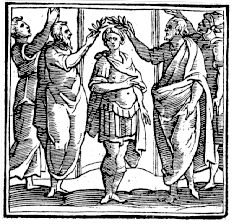
[ABOVE: Thrasybulus being crowned with an olive garland, from "Emblemata" by Andrea Alciato]
Democracy was restored. But, when so deeply wounded, how far would the will of the people go to preserve their way of life?
In his “Apology”, Plato recounts an event Socrates himself described while living under the rule of the Thirty:
When the oligarchy was established, the Thirty summoned me to the Hall, along with four others, and ordered us to bring Leon from Salamis, that he might be executed. They gave many such orders to many such people, in order to implicate as many as possible in their guilt. Then I showed again, not in words but in action, that, if it were not rather vulgar to say so, death is something I couldn’t care less about, but that my whole concern is not to do anything unjust or impious. That government, powerful as it was, did not frighten me into any wrongdoing. When we left the Hall, the other four went to Salamis and brought in Leon, but I went home. I might have been put to death for this, had not the government fallen shortly afterwards. There are many who will witness to these events.
- “Apology”, 32c-e
In Plato’s Seventh Letter, he recounts the following interaction between Socrates and the Thirty, written from his own point-of-view:
Among their other deeds they named Socrates, an older friend of mine whom I should not hesitate to call the justest man of that time, as one of a group sent to arrest a certain citizen who was to be put to death illegally, planning thereby to make Socrates willy-nilly a party of their actions. But he refused, risking the utmost danger rather than be an associate with their impious deeds. When I saw this and all other things of no little consequence, I was appalled and drew back from hat reign of injustice.
- Letters VII, 324d - 325a
Aristotle, “The Athenian Constitution”, 35.1-4
NEXT POST: SPARTAN MERCENARIES IN PERSIA: The Battle of Cunaxa, 401 BC

SOURCES
- Xenophon, "History of My Time", Book 2.3 - 2.4
- Plato
- "Apology", 32c-e
- "Letters" VII, 324d - 325a
- Aristotle, "The Athenian Constitution", 35.1-4
- Cornelius Nepos, "Thrasybulus"
-
Diodorus Siculus, "Library of History", Book XIV
YOUTUBE LINK
(I do NOT own this video)
"Ancient Greek History - Spartan Hegemony - 32" by "Historyden"
MY ANCIENT GREEK HISTORY BLOG PAGE
MY ANCIENT PERSIAN HISTORY BLOG PAGE
MY RANDOM THOUGHTS BLOG PAGE
All feedback - positive and/or critical - is appreciated!
All images used are copyright-free
Don't forget to rate this post, share it and leave a tip if you enjoyed it
Follow my FACEBOOK
Follow my INSTAGRAM
Follow my REDDIT
Follow my TRUTH SOCIAL
Follow my TUMBLR
Thanks for reading :)





