
Before the birth of democracy in Athens in the late sixth century BC, the Greek world - still a patchwork of small, independent city-states - still included old forms of governmental rule used throughout the ancient world; Monarchies, the rule of one, Dyarchies, the rule of two, Oligarchies, the rule of few, and Tyrannies, the enforced takeover and rule of one, were still dominant. With this in mind, and knowing that around six-hundred individual city-state nations existed in mainland Greece alone, an idea can be gained of just how diverse and disunited the Greek world really was. One aspect that separated Greek states from one another were their individual ideas of how their people should be ruled over.
Check out my previous posts on ancient Greek writing, and the poems of Hesiod and Homer
FORMS OF ARCHAIC GREEK GOVERNMENT
GREEK TERMS FOR "LAW"
- Unwritten Law = "Nomos" (pl. "nomoi")
- Written Law = "Thesmos" (pl. "thesmoi")
DEMOCRACY
("demokratia", "demos" = "people" + "kratos" = "power")
- "isonomia" = equal under law ("isos" = "equal")
- "igēgoria" = equality of speech rights
- "Ostracism" = an Athenian vote using potsherds ("ostraka") to expel a politician for 10 tears, unless they are recalled in the meantime. This exile affected their reputation, but not their position and title
MONARCHY
Kingship ("basileia")
Dyarchy (dual kingship, such as in Sparta, wherein two kings co-rule at the same time)
Tyranny ("tyrannis", when one person takes complete power for themselves by force)
OLIGARCHY
"Oligarchia" - a group of people ruling over a nation through bloodlines
"hoi oligioi" = "the few"
DEFINITIONS AND VARIATIONS OF GOVERNMENT TYPES
TYRANNY AND OLIGARCHY
Aristotle described tyranny as "monarchy which exerts despotic power over its political community", whereas oligarchies form when a government comes into the hands of the people that own the properties. Of the various kinds of oligarchies that existed, one was for the magistracies to be appointed from property assessments so high that the majority poor had no say in politics and government. Another form of oligarchy is when a man succeeded his father into office, and another kind of oligarchy is when this hereditary/bloodline system existed alongside the magistracies governing. Among oligarchs, this is the form which corresponded to tyranny among monarchies, and an oligarchy of this kind had the specialist name of “dynasteia” (a “dynasty”).
DEMOCRACY
In vast contrast, democracy - first famously started in Athens in 508/7 BC - is when more political power is granted to the poorer citizens classes that do not own property. As is known today, ancient Greek democracy didn’t include giving voting power to women and foreigners, but it was a huge step in the right direction to democracy as we know it today, so it can’t just be dismissed.
DEFINING A CITIZEN
There is often differing opinions as to what the essential nature of a citizen was. Different nations didn't always agree as to the definition of a citizen, in that a citizen in one Greek polis wouldn’t be considered a citizen in another. In Thucydides’ “History of the Peloponnesian War”, he describes Athenian citizens in revolt in Athens:
Their cry in public was that no pay should be given except to persons serving in the war, and that not more than five thousand should share in the government, and those such as were most able to serve the state in person and in purse.
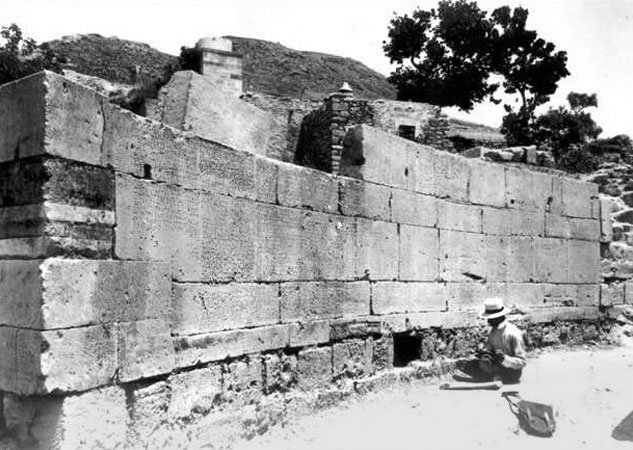
[ABOVE: The Law Codes of Gortyn, Crete, c.450 BC, treating property rights, divorces, inheritance, relations between free men, slaves and serfs, and more]
WEALTH AND RANK
The reason Greece had several different forms of government and their own constitutions was that every city had a considerable number of parts to it. All cities were composed of households, and in the multitude in which they existed, some had to be owned by the rich, some by the poor and some by the middle class. Rich citizens were able to afford heavy armour and good weaponry for warfare, whereas the poor often couldn’t. The poorer citizens were often divided by occupations too, with some being classed as agricultural citizens, whilst others dealt with trade and others with manufacturing and mechanics. On top of this, the upper classes were divided, corresponding to their personal wealths and property. This also included the ownership of a horse, as owning such an animal could only be done by the rich. Because of this, most oligarchies formed around nations whose military strengths lay in their cavalry, notably in Thessaly.
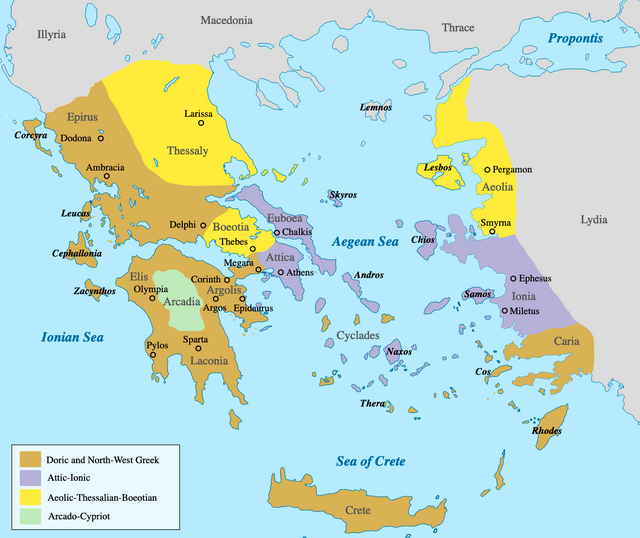
[ABOVE: A map of Greece, with Aeolian Greeks highlighted in yellow, including the region of northern Greece called Thessaly]
I shall praise, too, his noble brothers
because they bear on high the custom of the Thessalians
and increased it. In the hands of good men lies
the careful hereditary governance of cities.
[Pindar, "Pythian 10"]
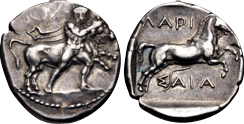
[ABOVE: Drachma from Larissa showing "taurokathapsia" (bull wrestling) and a horse, with the inscription "Larisaia" ("Larissa", a major city in Thessaly]
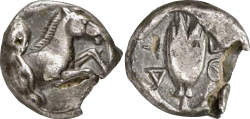
[ABOVE: Drachma showing Skyphios emerging from the rock at Tempe, Thessaly]
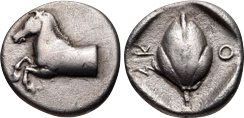
[ABOVE: Drachma from Skotussa, Macedonia]
EXAMPLE TEXTS ON LAWS FROM HISTORY
ARISTOTLE
And he [Solon] established a constitution and made other laws, and they ceased to observe the ordinances of Draco, except those relating to homicide. They wrote up the laws on the Boards and set them in the Royal Colonnade, and all swore to observe them; and the Nine Archons used to make affirmation on oath at the Stone [possibly the altar of Zeus Agoraios] that if they transgressed any one of the laws they would dedicate a gold statue of a man; owing to which they are even now still sworn in with this oath.
[Constitution of the Athenians, 7.1]
PLUTARCH
All his laws were to have force for a hundred years, and they were written on ‘axones’, or wooden tablets, which revolved with the oblong frames containing them. Slight remnants of these were still preserved in the Prytaneion when I was at Athens...
[Life of Solon]
HERODOTUS: 2 ARISTOCRATIC CLANS URGE XERXES TO INVADE GREECE
Messengers came from Thessaly from the Aleuadae (basileis of Thessaly) and invited the king into Hellas with all earnestness; the Peisistratids who had come up to Susa used the same pleas as the Aleuadae, offering Xerxes even more than they did.
[The Histories, 7.6.2]
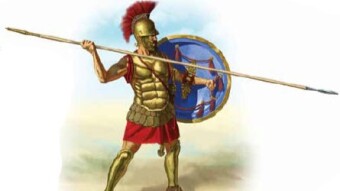
NEXT BLOG: THE HOPLITE: Ancient Greece's Frontline Soldiers
SOURCES
- Herodotus, "The Histories"
- Aristotle, "Constitution of the Athenians" and "Politics"
- Plutarch, "Life of Solon"
- Thucydides, "History of the Peloponnesian Wars"
- Pindar's "Pythian 10" fragment
YOUTUBE LINK
(I do NOT own this video)
"History of Syracuse - Part 2 - The Tyranny of Hieron" by "Ancient History Guy"
MY ANCIENT GREEK HISTORY BLOG PAGE
MY ANCIENT PERSIAN HISTORY BLOG PAGE
MY TWITTER
All feedback - positive and/or critical - is appreciated!
All images used are copyright-free
Don't forget to rate this post and leave a tip if you enjoyed it
Thanks for reading :)






