
The Peloponnesian War had been a seemingly never-ending cycle of great victories and terrible defeats, primarily for Athens. Having started the war at the height of their power under the great statesman Pericles, one year later they found themselves debilitated by the worst plague the Greek world had bore witness to, killing Pericles and his family. Now, following the Battle of Notium and the Second Battle of Mytilene, the Peloponnesian War was approaching its final act. Despite recent setbacks, Athens had not yet been broken. The city still commanded a formidable fleet and had recovered from the disastrous Sicilian Expedition seven years prior. However, the political turmoil in Athens continued to destabilise the war effort, as radical democrats and oligarchic sympathisers fought for control.
Sparta, meanwhile, had suffered a major setback at Mytilene with the death of Callicratidas, a commander who had rejected Persian influence in favour of a self-sufficient Spartan war effort. In the aftermath, the Spartan leadership once again turned to Lysander, reinstating him as their most influential naval leader. With Persian gold flowing once more, Sparta was rebuilding its fleet and preparing for another confrontation.
As Athens struggled with internal discord, Sparta sought to capitalise on the instability. However, the stage was set for one final, unexpected Athenian victory—a battle that would demonstrate the last flicker of Athenian naval power before the war’s decisive end.
Check out my previous post on the Battles of Notium and Mytilene, 406 BC
Political Manoeuvering and Leadership Changes
Athens at War with Itself
By 406 BC, Athens was gripped by deep internal division. The recent military defeats, coupled with economic exhaustion, had weakened the democratic leadership. The Assembly, still dominated by the radical faction led by Cleophon, resisted peace overtures from Sparta, believing Athens could still secure victory. However, naval supremacy was slipping, and experienced commanders were becoming scarce. Athens’ fleet was severely depleted, and the Spartan naval blockade at Mytilene threatened the forces under Conon, Theramenes, and Thrasybulus. The Athenians, aware of the dire situation, sought to raise an emergency relief fleet to break the blockade. However, the city lacked the necessary funds, having exhausted much of its treasury over years of war.
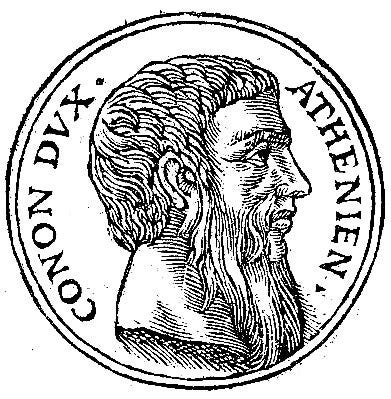
[ABOVE: Conon's bust portrait, from Promptuarii Iconum Insigniorum, 1553]
In an act of desperation, the Athenian Assembly ordered the melting down of the statue of Nike, the God of Victory, to provide funding for the fleet. This was a symbolic and tragic moment, showing just how precarious Athens’ situation had become. The fleet that would fight was largely newly manned, consisting of inexperienced sailors and freed slaves. It is even thought that Athens extended citizenship to many of these slaves. While Athens had once relied on its vast network of allies for manpower, attrition had taken its toll. The state’s finances were in dire straits, and the funding needed to maintain a navy was depleting rapidly.
The Return of Lysander
The death of Callicratidas at Mytilene had created a leadership vacuum in the Spartan fleet. Despite his previous success, Callicratidas’s anti-Persian policies had left many Spartan elites uneasy. With his death, the ephors had no choice but to reinstate Lysander, a shrewd and politically astute commander who had already secured Persian backing under Cyrus the Younger.
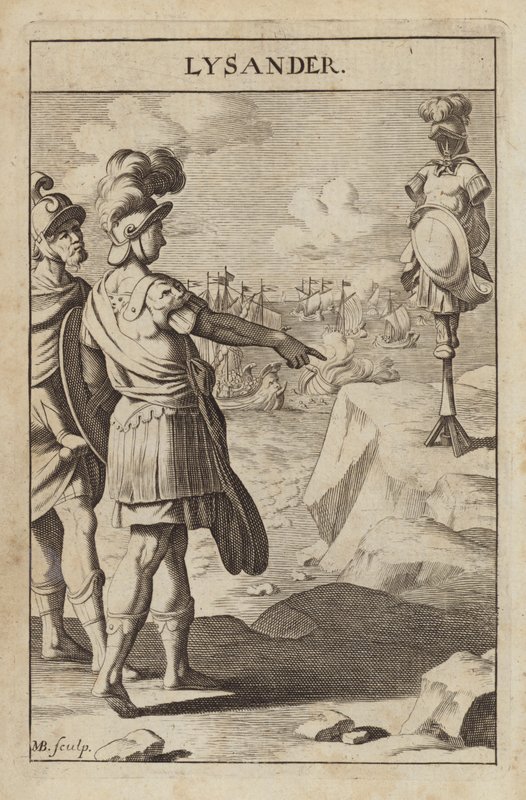
[ABOVE: "Lysander, Spartan Admiral" by Michael Burghers, c.1700]
Lysander was not formally made navarch again, as Spartan law forbade consecutive commands, but his influence overshadowed his nominal successor. With Persian gold, he immediately began strengthening the Spartan fleet, setting the stage for the war’s final years.
The Commanders and Their Armies
The Athenian Commanders
Athens, desperate for experienced leadership, appointed an unprecedented ten generals—ten strategoi—to command the fleet. Among them were Conon, a seasoned commander and future naval strategist, Pericles the Younger, son of the famous statesman, hoping to restore his father’s legacy, Archestratus and Thrasyllus, who while experienced were politically vulnerable, Aristocrates, a skilled but perhaps lesser-known navarch, and other competent officers like Diomedon, Erasonides, Lysias and Protomachus.

[ABOVE: Roman marble bust of Pericles, Pericles the Younger's illegitimate father. Copy of an original, now held in the Museo Chiaramonti, Vatican Museums]
The decision to split leadership reflected the political climate in Athens, as factions within the Assembly sought to prevent any single general from wielding too much influence, ensuring checks and balances within the command structure.
The Spartan Commanders
Although Aracus was the nominal Spartan commander, true leadership lay with Lysander’s protégé, Callicratidas’s successor, and advisors within the Peloponnesian fleet. Despite their numerical inferiority, the Spartans relied on superior funding and experience to counter Athens’ larger force. Callicratidas soon got word of the Athenian movements before the engagement and had spotted their signal fires in the night. He thus planned to attack at night, but a thunderstorm forced him to wait until the morning.
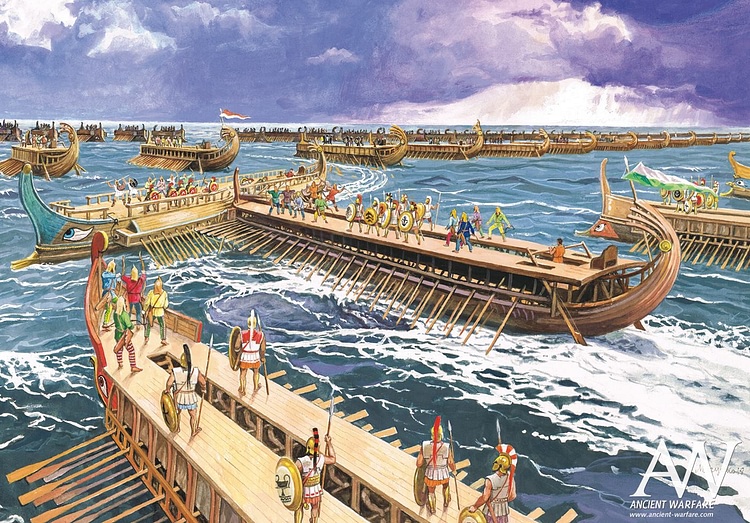
[ABOVE An illustration of the Battle of Arginusae, by Marek Szyszko, from Ancient Warfare Magazine, 2020]
The Battle of Arginusae
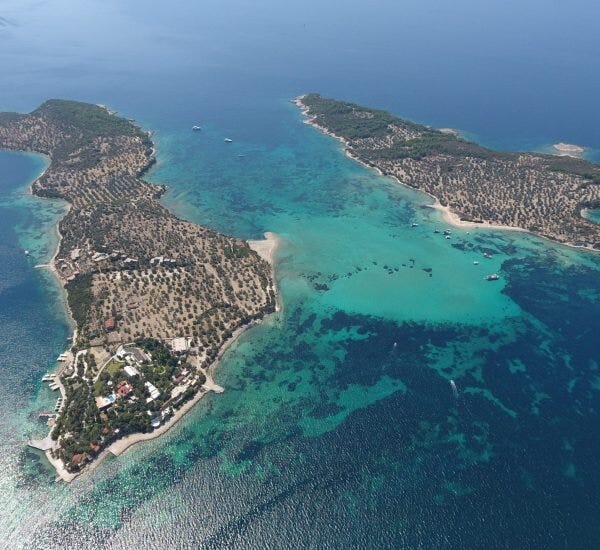
[ABOVE: Arginusae Islands. The battle would have taken place to the north of the west island, shown on the right]
Strategies
The Athenian fleet at Arginusae numbered approximately 150 triremes, facing a Spartan fleet of around 120 ships. Due to the shortage of experienced sailors, Athens resorted to manning many of its vessels with freed slaves and inexperienced rowers. To counter Spartan experience, the Athenian commanders adopted a double-line formation, hoping to mitigate their fleet’s lack of skill by maximising defensive cohesion; they hoped to extend their fleet in order to prevent a Spartan encirclement. This approach would maximise their numbers while minimising any risk of a Spartan breakthrough.
The Spartan fleet under Callicratidas, numbering around a smaller 120 triremes, moved to intercept the Athenians near the Arginusae Islands, northeast of Lesbos. Callicratidas, confident in his Spartans and his Peloponnesian ally’s naval discipline and battle-tested rowers, sought to utilise his fleet’s experience to outflank, encircle and destroy the Athenian fleet before it could reinforce Conon at Mytilene.
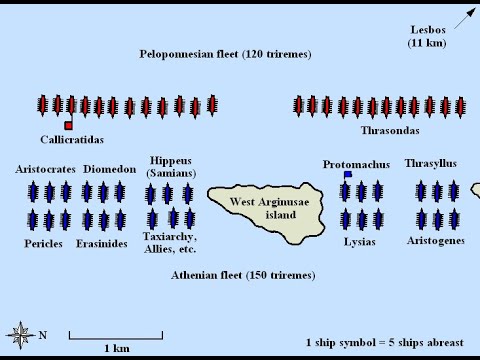
[ABOVE: Athenian (blue) and Spartan (red) ships at Arginusae, 406 BC. The Athenians extended their line to prevent a Spartan diekplous]
The Engagement
The battle began with the Spartans executing a standard naval flanking manoeuvre, attempting to envelop the Athenian formation. However, the Athenians, rather than engaging head-on, used their superior numbers to stretch their line further, making it difficult for the Spartans to complete their encirclement.

[ABOVE: Attic vase depicting naval combat, now held in the Louvre Museum, Paris]
Despite this, the engagement was fierce, with ramming and boarding actions taking place across the battlefield. The Athenians, despite their lack of experience, fought with desperation, forcing the Spartans into a prolonged engagement rather than a swift victory.
The Death of Callicratidas
During the battle, Callicratidas personally led a charge, attempting to break through the Athenian centre. His ship was soon overwhelmed, and in the chaos, he was reportedly thrown into the sea and drowned. Xenophon describes his death:
As the waters swallowed him, his men knew at once that the tide of war had turned against them.
[Hellenica 1.6.34]
With their leader gone and their formation disrupted, the Spartan fleet began to collapse, with many ships either destroyed or forced to flee. In total, Athens sank 70 Peloponnesian ships, one of the worst Spartan defeats in the war so far. Athens lost an estimated 25 vessels.
Immediate Aftermath
Missed Opportunities and Stormy Consequences
Despite the victory, the Athenians failed to capitalise on their momentum. The original objective—to relieve Conon’s besieged fleet at Mytilene—was abandoned due to a sudden storm, preventing further naval manoeuvres and causing mass public outrage in the city. The delay allowed surviving Spartan forces to escape, an outcome that would prove costly for Athens in the long run.
Furthermore, Sparta, in a surprising move, offered a conditional peace to Athens. However, the proposal was rejected outright by the Athenian Assembly, which, under radical democratic influences, still believed in ultimate victory.
The Trial of the Athenian Generals: A Political Firestorm
The aftermath of the battle saw one of the most infamous political trials in Athenian history. The inability to recover Athenian sailors from wrecked ships, due to the storm, led to public outrage in Athens. Radical democrats, led by figures such as Theramenes, turned the blame onto the victorious generals.

[ABOVE: Modern view of the Pnyx, the hill Athenians convened on for assemblies]
A multi-day trial ensued, during which all six present generals were accused of dereliction of duty and failing to rescue their men. The trial itself was highly controversial, as it was conducted as a single mass trial rather than individual hearings—a direct violation of Athenian legal tradition.
Plato, in his works, later criticised the trial, with Socrates himself refusing to endorse the decision to execute the generals, stating:
To judge in haste is to condemn without reason.
["The Apology", 32c]
Despite their service and victory, the generals were sentenced to death - Pericles the Younger among them - marking one of the darkest political episodes in Athenian democracy. This purge also left Athens without many of its best naval leaders, fatally weakening its ability to recover from future defeats. Xenophon later described this event as one of the greatest self-inflicted wounds of the war:
Never before had the city turned so swiftly on those who had fought in its name.
[Xenophon, "Hellenica", 1.7.34]
The Beginning of the End
The Battle of Arginusae, though a tactical victory for Athens, became a strategic disaster due to internal political turmoil. The execution of its generals deprived Athens of experienced leadership, while Sparta, under Lysander’s guidance and fuelled by Persian gold, continued to regroup and rebuild its naval power. The war’s conclusion was now inevitable, and the coming confrontation at Aegospotami would seal Athens’ fate.
One last fight remained…
Next Post: THE WRATH OF SPARTA, 405 BC: The Battle of Aegospotami

SOURCES
- Xenophon, "Hellenica", 1.5.20 - 1.7.35
- Plutarch, "Life of Lysander / Alcibiades / Agesilaus"
- Diodorus Siculus, "Library of History", 13.98.4 - 13.101.4
- Cornelius Nepos, "Lysander"
- Justin, "Epitome of Pompeius Trogus"
- Polyaenus, "Stratagems of War"
- Aristophanes, "The Frogs"
- Pausanias, "Description of Greece"
- Diogenes Laertius, "Lives of Eminent Philosophers"
- Donald Kagan, "The Peloponnesian War", pages 451 - 468
- Paul Cartledge, "Sparta and Laconia: A Regional History, 1300 - 362 BC"
YOUTUBE LINK
(I do NOT own this video)
"Athens Strikes Back - Spartans Defeated - Peloponnesian War DOCUMENTARY" by "Kings and Generals"
MY ANCIENT GREEK HISTORY BLOG PAGE
MY ANCIENT PERSIAN HISTORY BLOG PAGE
MY RANDOM THOUGHTS BLOG PAGE
All feedback - positive and/or critical - is appreciated!
All images used are copyright-free
Don't forget to rate this post, share it and leave a tip if you enjoyed it
Follow my FACEBOOK
Follow my INSTAGRAM
Follow my REDDIT
Follow my TRUTH SOCIAL
Follow my TUMBLR
Thanks for reading :)






