
Before we continue our discussion of Europe after the Revolutions of 1848, I think it’s important to remind you of the political and economic situation of the countries and specific Money Changers who profited from the panic and volatility of society before, during, and after the largest mass revolutionary effort in world history. In doing so, we can understand the important function Money Changers had during some of the most historical and Earth-altering events in human history that shape the world we live in today. In addition, we can understand the context of the European region before entering into the largest military conflict up to this point, World War I.
Europe’s geography, society, and politics can seem overwhelming because of the constantly changing leaders, territories, and government structures. However, it’s important not to become overwhelmed by the details, but rather take the time to study the individual subjects and names on your own, because the details can become blurry and go further in-depth than I can capture in this book. Although they can be important, it's more important to understand and reflect on the general themes that allow Money Changers to take advantage of, persuade and affect the policy-making of elected and unelected leaders because of the power and influence Money Changers wield on the economic strength of a nation. Before the Revolutions of 1848, the 5 large superpowers of Europe were the UK, France, Prussia (Germany), Austria, and Russia. After the Revolutions of 1848, the UK and Russia were the two powers still standing with large political and geographical influence. Furthermore, various smaller nation-states within Europe gained a sense of nationalism and believed unification, independence, colonialism, and growth were necessary to emerge as powerful nations themselves. Furthermore, Money Changers continued the consolidation of their wealth and power throughout the world, regardless of the internal disruption that was occurring in Europe, because of the immense financing, value and influence they were able to provide to the nation’s most wealthy and needy alike.
Let’s briefly review the situation in Europe by going country by country to understand the important events that led up to the largest revolt in European History.
Belgium
Belgium declared independence from the Netherlands in 1830 and after a short military conflict with the Dutch, was successful at electing their first King, Leopold I. 10 days after Leopold I was announced King, the Netherlands attempted to invade Belgium and claim the territory for itself. Belgium was able to defeat the Dutch after 10 days, however, it took 10 full years before the Dutch finally recognized Belgium’s independence. As a result of that relationship, hostilities between the two nations ensued and the Netherlands shut down ports that were connected to Belgium, forcing their economy into a depression from 1845-1849.
The Rothschilds in Paris became personal bankers for King Leopold I after he accepted the throne in 1831 and provided banking services for his descendants, royal friends, businesses, and the nation as a whole. After creating economic reforms and the injection of capital, the Belgian economy was able to recover and maintain strength through the Revolutions of 1848, which saw Leopold I maintain his kingship. Leopold I would pass away in 1865 when the crown would be passed to his son Leopold II, who continued the strong relationship with the Rothschild family
The strength and direction of the economic reforms combined with Leopold II’s goal of his increasing his fortune during his reign as king allowed for large investments to be made by the Rothschilds family into Leopold II personally and Belgium as a nation, which spurred economic activity and concentration of wealth with incumbents who already held substantial power and influence.
The relationship the Rothschilds were able to maintain during Leopold II’s reign allowed the banking family to continue their dominance of finance in the region by squeezing the lower and middle classes of their wealth, property, and confidence. Also, the relationship between the two families is probably good, even today, nine of Leopold I’s heirs maintain royal titles including King Philippe of Belgium, who rules over 10 million people in Belgium today.
(Ehrenburg Palace in Coburg, where Leopold was born in 1790, pictured c. 1900)
France
The July Revolutions in France fought in 1830 were an attempt to escape the poverty and political disarray occurring under King Charles X. When they were successful Louis-Philippe was named King, who came from the House of Orleans and served until the Revolutions of 1848 overthrew him. The House of Orleans is a French family that has amassed enormous wealth, land, and power since the 17th century and continues to hold enormous power in Paris through Jean Carl d'Orléans, the current Count of Paris, also called the Pretender to the French Throne, while those who follow and support him believe he is the rightful heir to the throne because of his relationship with Louis Philippe I.
Not only did Louis Phillipe uncover enormous power with his promotion to King, but he was also able to take advantage of the vast connections that came with such a royal title. The Paris Rothschild branch extended numerous loan packages to the king personally, his monarchs, and the country of France as a whole. At the start of this process, James Rothschild and the Paris branch had a starting capital of, “£55,000 (equivalent to £4 million in 2019); by 1852 the figure was £3,541,700 (equivalent to £431.5 million in 2019), and just ten years after his death, £16,914,000 (equivalent to £1.81 billion in 2019)” (The House of Rothschild (vol. 2) : The World's Banker: 1849-1999, Niall Ferguson). It can be assumed that much of that wealth was created from lending to the king, then the king printing money, raising taxes, or issuing debt to pay the money back. Why is it so easy to be assumed? Well, Louis Philippe gave him the title of Grand Officer of the Legion of Honour for his help with economic recovery.
Another large investment from the Rothschilds was the Chemin de Fer du Nord railways opened in 1845 in France, the country’s largest railroad system at the time. This retail and commercial train system would continue its operations until it became nationalized by the French government in 1937. Allowing the family to earn income
The result of the Revolutions of 1848 in France were the citizens abdicating Louis Phillipe as King, establishing the Second French Republic, and electing Napoleon III as president. Shortly after his election, Napoleon would make himself Emperor, creating the Second French Empire. When he came into power Napoleon sought to extend his geographical reign and began encroaching on Prussian territory. After Napoleon entered German territory, the Franco-Prussian war occurred between France and Prussia in 1870. Six months later in 1871, the Franco-Prussian war resulted in a Prussian victory.
As a result of the Franco-Prussian War the Second French Empire was dissolved, Napoleon III lived out the remainder of his life in exile, and the Third French Republic was formed. Also, the Franco-Prussian war created the Empire of Germany, which unified numerous smaller states with the Kingdom of Prussia in 1871. The German Empire would encompass Prussia as its largest Kingdom acting as a Nation-State. Prussia would continue to exist inside of the German empire until its dissolution less than 50 years later at the conclusion of World War I.
During the 1871 Armistice which concluded the Franco-Prussian war, the Rothschild Paris branch was created as a syndicate to help raise 5 billion francs for the French government who were required to pay Germany for war damages and took a handsome percentage for their services in the process.
After the Armistice of 1871, the Paris Rothschild branch continued its accumulation of power and wealth. In 1873, the Paris Rothschild branch worked with their English counterparties to purchase the Rio-Tino Copper Mines in Spain and turned the business around to become exceptionally profitable. From 1877 to 1891, the Rio Tinto Mine was the world's leading producer of copper (Stevens, Horace Jared (1908). The Copper Handbook).
In 1877, the French and English Rothschilds teamed up to become the largest shareholders in the world’s principal diamond producer that mined out of South Africa, the De Beers group led by Cecil Rhodes. In 1902, De Beers controlled 90% of the world's diamond production (Chilvers, Henry (1939). The Story of De Beers. Cassell. p. 310.)
(Rio Tinto headquarters in Melbourne Australia registered office)
Furthermore, the French Rothschilds became largely involved with oil exploration in present-day Azerbaijan by creating the Caspian and Black Sea Oil Industry and Trade Society in 1883 and a fleet of oil transportation ships called the Mazut Transportation Society. The company was extremely profitable as oil was being consumed more and more by industry and retail alike during the industrialization and electrification of society. In 1911, Royal Dutch Shell purchased all of the Azerbaijan oil fields from the Rothschilds. “Between 1898 and 1901, Baku produced more oil than the US. By 1901, half of the world's oil was produced from 1,900 wells, located within 6 square miles.” (Blau, Eve; Rupnik, Ivan (2019). Baku: Oil and Urbanism.)
(Oil wells in Baku, Azerbaijan, "Where it Rains Petroleum", ca.1909)
The French Rothschilds also owned huge wine vineyards that allowed them to become a major producer of wine throughout the world.
Ultimately the Rothschilds were controlling the raw materials that go into the most important systems, products and services that society used during an industrial revolution that saw amazing technologies become commonplace. With this strategy, they were able to vertically monopolize the industry and amass wealth, influence, and control on a scale we could not comprehend. In most cases, the Rothschilds did not care who won the battles or wars, they understood that they could provide immense value to the military and political leaders on both sides of the war and still profit immensely. A quote that is often attributed to the Rothschild family proves that point, “Let me issue and control a nation’s money and I care not who writes the laws.”
France was going through a vast military conflict with a barrage of different nations in Europe, they were struggling to find a political and economic structure that worked for their people or a comprehensive social structure that benefited the citizens. While society was in chaos, strategic Money Changers and Politicians were gradually positioning themselves to profit from the scenarios, regardless of the outcome, behind closed doors.
Austria
The Habsburg empire which consisted largely of Austria, German territory, Hungary, and a barrage of other revolutionary states was one of the most drawn own military conflicts in the Revolutions of 1848. The Habsburg empire came from the House of Habsburg, which was founded and has been accumulating wealth, land, and property since the 11th century. Prince Lorenz of Belgium is currently the head of the Habsburg house and prince of Belgium through marriage.
The Revolutions of 1848 ended in Hungary, the longest revolutionary effort when over 300,000 Russian troops sent by Tsar Nicholas I of Russia easily defeated the revolutionary efforts. However, Hungary was able to gain political strength during the Austrian-Prussian War in 1866. The war resulted in most of the German states siding with the Prussian Kingdom. One of the important consequences of the war was evident in the growth of Hungary’s political influence which eventually led to the creation of the Austria-Hungary Dual-Monarchy in 1867. However, this was an indicator that Austria’s strength was declining as an Empire, as it had to partner with another kingdom to maintain its status as a superpower in Europe.
Inside Austria, the Vienna Rothschilds continued to purchase massive properties, priceless art, amass spectacular wealth, and unmovable influence. Some of their largest investments were in the Nordbahn rail transport which connected various mining centers in Europe to cities that could process the raw materials. The Emperor Ferdinand Northern Railway in the 1830s was created to help move materials collected from salt mines in present-day Poland to processing plants. In the 1860s the Rothschilds invested heavily in the Austrian Southern Railway which connected Vienna, the capital of Austria, to a port city in Italy. The Austrian Southern Railway is still operational today.
The Rothschild's investment in the Austrian economy was so great that members of the family had close connections with Austrian Prince Klemens Metternich and politician Friedrich von Gentz who were directly tied to the economic decisions of the nation. As a result of these close ties, the entire Rothschild banking family received noble recognition and awards that were created specifically for the family. In addition to lending to the Austrian government, the Vienna Rothschilds secretly made large loans to other governments in the surrounding areas including the modern-day Czech Republic and Hungary.
In 1855, the Vienna Rothschilds created Creditanstalt, one of the first Austrian banks in the region. Rothschild's connections with the Austrian leaders such as Prince Metternich and Emperor Franz Joseph allowed the bank to quickly became one of the largest financial institutions in the region. Therefore, when Austria-Hungary was formed in 1867, Creditanstalt immediately became the largest bank in Austria-Hungary. However, World War I proved to be a difficult time for the bank’s financial situation. In fact, the bank had to declare bankruptcy on May 11, 1931, which is one of the first bank shutdowns that started the Great Depression, which consequently led to the creation of the Federal Reserve. More about that later. For now, we should understand that Creditanstalt was the largest bank in one of Europe’s most powerful empires for over 50 years and was financed and owned by the Rothschild family.
(Austria–Hungary on the eve of World War I)
Germany
(The German Confederation in 1815)
Germany finally became unified after Prussia defeated France in the Franco-Prussian War of 1871. When Prussia became victorious and Germany declared itself an empire it encompassed Prussia as being the largest kingdom inside of it. The emperor was Wilhelm I, King of Prussia. Wilhelm I was one of the Royal Elite who had important connections with other leaders we’ve mentioned at the time. While Emperor, many of the duties of leadership and organization fell on his Chancellor, Otto von Bismarck.
(Bismarck in 1890)
The German Empire also consisted of the consolidation and integration of numerous smaller nation-states to the South making Germany geographically dominant in Europe. In 1855 Amschel Rothschild died in Germany and the assets were distributed to his brothers who controlled the different European banking branches. Although the story seems short now, Germany will play an important role in the near future as we move through time.
Italy
Another example of a country becoming unified and experiencing Nationalism occurred when Giuseppe Garibaldi unified Italians in 1861 after successfully defeating Austrian forces that were strangling the area. When Garibaldi unified Italy, many of the previous aristocrats were forced out of the Country to preserve the health of the nation. This Included the Rothschild family in Naples, who after 40 years of business in the area had to shut its doors for good and consolidate its assets to their other European divisions because of Garibaldis take over and family troubles. However, before Garibaldi took over, the Rothschilds managed to obtain spectacular wealth and land that continues to hold immense value in Italy today.
England
In England, the country was largely unaffected by the Revolutions of 1848 and the Rothschild branch continued its dominance as a leader in high finance. Remember that in 1825 the Bank of England was going through a serious liquidity crisis that nearly saw the collapse of the central banking system. To make up for the shortfall, they went to the Rothschilds who personally financed the Bank and escaped the crisis without catastrophe. The records don’t tell us how much the Rothschilds made off the deal or how much was loaned to the British government. However, it is clear that after this point the Rothschilds had large control over the world’s most important bank.
The England Branch teamed up with the French branch to purchase the Rio Tinto mines and the De Beers Group. The English branch also funded Cecil Rhodes who started the British South African Company, a large and important mining company. The Rothschilds also helped with creating and distributing Rhodes estate, while taking a percentage for their services.
Part of the Rothschilds' strategy for success was sharing the prevailing events occurring in their respective nation with members of their families. In that way, the bankers would have credible news and business opportunities ahead of others.
The main theme of the decades following the Revolutions of 1848 in Europe can be understood as new and existing nations creating domestic identities inside of their respective countries, by expanding their international reach and attempting to improve their domestic systems. This expansion of identity inside of respective nations led to strong Nationalism by the citizens of the regions that gradually unfolded to become radical by the start of the 20th century.
Many historians regard the Revolutions of 1848 as a failed effort by citizens to regain control and economic freedom within Europe. Many of the characteristics that existed before the battles, existed for the decades following the conflict. Wealthy land owners continued to own land and powerful politicians remained in power. Initially, small changes were made that moved the region forward such as numerous nations ending slavery or serfdom, which set the foundation for positive changes to come. However, these changes were trivial compared to the Money Changers' greed that fueled their continued reign of capturing land, wealth, and power at the hands of the lower and middle classes.
Historian Priscilla Robertson explains that the goals of the Revolutions of 1848 would be accomplished in most parts of Europe 25 years later by the same people who the revolutionaries identified as enemies during 1848, “Most of what the men of 1848 fought for was brought about within a quarter of a century, and the men who accomplished it were most of them specific enemies of the 1848 movement. Thiers ushered in a third French Republic, Bismarck united Germany, and Cavour, Italy. Deák won autonomy for Hungary within a dual monarchy; a Russian czar freed the serfs; and the British manufacturing classes moved toward the freedoms of the People's Charter" (John Feffer. 1992. Shock Waves: Eastern Europe After the Revolutions. Black Rose Books Ltd. p. 291.)
Although it may not feel like it, that was a quick summary of the causes and short-term effects of the Revolutions of 1848 in England, France, Belgium, Austria-Hungary, Germany, and Italy. Now we will move on to the years after the Revolution of 1848 to understand what forces led the world to enter into the greatest and most involved war the planet has seen up to this point in World War I.
AFTERMATH
Belgium
(Map of Belgium)
After Leopold I died in 1865, his rightful heir Leopold II took the throne and began his control over an important geographical area of Europe with port cities to the Northwest, strong economic neighbors, and productive citizens that allowed the country to flourish with trade. Leopold II had large and powerful connections, including the Rothschild banking family and being the first Cousin to Queen Victoria of the United Kingdom. One of the events Leopold II found himself in was the Berlin Conference in 1885. This event was sponsored and led by Otto von Bismarck, a German diplomat who led the German Unification and served as its First Chancellor until 1890.
The Berlin Conference, also called the Congo conference, was an international meeting with some of the most powerful nations in the world including the United States, Austria-Hungary, England, and Russia. The conference's main concern was how the largest countries were going to handle the colonialization of Africa. At this point in history, most of Africa had self-governing and mostly unorganized cities and nations. However, Money Changers found valuable resources in the land and raced to capture as much property as humanly possible to extract value from the people and property.
This started the “Scramble for Africa”. The Berlin Conference was plainly organized to split up an entire continent of self-governing Africans and transition it into a perpetual money-making machine for the respective politicians and Money Changers involved. Many of the proposals didn’t get adopted, and some countries didn’t get any land like Russia and the U.S. The multi-pronged outcome was complicated but ultimately by 1902 90% of Africa was under European control (Roger Owen, Lord Cromer: Victorian Imperialist, Edwardian Proconsul (Oxford UP, 2005).
(European claims in Africa, 1913. Today's boundaries, which are largely a legacy of the colonial era, are shown. Belgium = Yellow. Germany = Teal. Spain= Pink. France= Blue. Britain=Salomon. Italy=Green. Portugal= Purple. Independent= Gray)
One of the pieces of land was the Congo and it was decided by Otto von Bismarck that the entire country of Congo would be given to Leopold II as a personal gift where it would be named Congo Free State. However, the people who lived there were everything but free. The land wouldn’t belong to Belgium’s government, but rather to the king personally. During this time, countries were being created based on the ideas of constitutions, citizens’ rights, and the improvement of treatment of others. However, when you expand the size of your nation to give your citizens rights, you are often taking away the rights of others. With Leopold II having a country to himself he was able to maneuver around the concerns of a government or society wanting to review if any basic human or universal rights were being broken. Spoiler alert, they were.
Leopold II’s treatment of the Congolese had reached such wicked levels that when the international community became aware of the treatment occurring, he was forced to stop his practices or face serious economic and political consequences. Historians dispute the actual number, but estimates range from 1.5 million to 13 million people dying from 1885 to 1908 in the Congo as a result of Leopold IIs control.
The reason land in the Congo was so valued is because of the natural resources that could be extracted from the land, especially rubber, and the unorganized labor supply. Leopold II nationalized over 1,000,000 sq mi of land in the Congo for himself, allowing the king to capture the wealth production of an entire nation. Private companies began entering the area with the permission of Leopold, as long as he was paid a percentage of their profits. The companies used slave labor of the Congolese to provide the work necessary to extract, transport, and export the materials for profit.
To enforce his rules, Leopold appointed the Force Publique, a private militia group used as a personal army that grew by 1900 to 19,000 soldiers. Leopold would implement a rubber quota for the different areas in Congo, and if the villages failed to reach their quota it was punishable by death. The emperor insisted every slave the Force Publique had to kill, they had to chop off the slave’s hand where it would be collected and offered to a superior to ensure the Force Publique wouldn’t plan mutiny against the King. Therefore, the Force Publique would partially pay the quota in slaves’ hands to ensure they wouldn’t be part of the massacre for not producing enough resources. In one instance, a Catholic missionary quoted a Congolese man named ‘Tswambe’, who was discussing the events that occurred in his village and describing a Force Publique who oversaw a large area,
“All blacks saw this man as the devil of the Equator ... From all the bodies killed in the field, you had to cut off the hands. He wanted to see the number of hands cut off by each soldier, who had to bring them in baskets ... A village that refused to provide rubber would be completely swept clean. As a young man, I saw [Fiévez's] soldier Molili, then guarding the village of Boyeka, take a net, put ten arrested natives in it, attach big stones to the net, and make it tumble into the river ... Rubber causes these torments; that's why we no longer want to hear its name spoken. Soldiers made young men kill or rape their own mothers and sisters (Hochschild, King Leopold's Ghost, p. 166).
(A Congolese man, Nsala, observing the detached hand and foot of his five-year-old daughter who was killed and allegedly cannibalized by the Force Publique in 1904. Thompson, T. Jack. October 2002)
The hands were intended as a symbol for a dead slave, but often the soldiers would just cut off the hands of the living slaves and leave the person to live or die to save on ammunition. Also, soldiers would often be relieved of duty quicker for bringing in hands faster, which led to the practice being extremely widespread (Renton, Seddon & Zeilig 2007, p. 31.)
Child colonies were created that would be set up to raid villages, steal the children and send them to a national school where they would be brainwashed to become a soldier or workers. This resulted in tens of thousands of children dying from the extreme conditions they had to endure during the travel and time in the concentration camps (Hochschild, Adam. King Leopold's Ghost A Story of Greed, Terror, and Heroism in Colonial Africa. Mariner Books. p. 135).
Aside from the mutilation, murder, and slave labor; famine and disease were among the main contributors to a large amount of death of the Congolese. In total, around 50 to 75% of the Congolese population was wiped out, and the region’s population has had difficulty recovering since.
As a result of the missionaries spreading the word of the disgusting and repulsive Atrocities that took place from the procedures Leopold II implemented for labor, the “Congo Free State” was annexed by Belgium and became the Belgium Congo in 1908. When Leopold II was forced to annex the area, he burned all of the records about the area stating, “they have no right to know what I did there" (Hochschild, Adam. 1998). In addition, Belgium took possession of the land from Leopold while having to pay around 215.5 million Francs. The money went to paying off the bondholders who invested in the area (banks like the Rothschilds), paying 45 million Francs for the private companies who were paying Leopold a concession, and a payment of 50 million francs for King Leopold. (Hochschild, Adam. 1998). Leopold II used government funds (taxpayer dollars) to pay himself 50 million Francs for selling land that was being worked by tortured slaves to produce materials that would be used to pay off the wealthy and make him rich.
Leopold II would die in 1909 and he would be booed at his funeral because of his treatment of the Congo situation (Keating, Dave. 9 June 2020). The throne stayed in the family when it was passed to the son of Leopold II’s brother, Albert I of Belgium, who would rule until 1934. We will discuss his reign shortly. The Congo would not become an independent country until 1960.
France
After the French Defeat in 1870 during the Franco-Prussian War, Europe saw the end of the Second French Empire, the fall of Napoleon III, the Birth of the Third French Republic, and the emergence of the German Empire. The Third French Republic experienced what many historians believe to be one of the greatest causes of financial corruption in the 19th century, the Panama Scandals.
In 1879 a man named Ferdinand de Lesseps was put in charge of creating a canal that would cross through Panama and allow for easier transportation between the Atlantic and Pacific Oceans. Lesseps had previously completed construction for the Suez Canal in 1869, a successful project, that connects the Mediterranean Sea to the Red Sea and acts as a border for Africa and Asia.
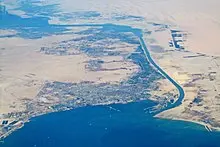
(Aerial view of the Suez Canal at Suez)
This successful project gave the government and shareholders confidence that Lesseps would deliver once again. Lesseps was able to raise funds from the international community by touring the world and soliciting credit. Once enough capital was gathered and the construction was planned, work started on the Panama Canal in 1882 with an estimated cost of around 650 million Francs and a time frame of 8 years until completion. However, Lesseps greatly underestimated the terrain and climate of Panama, which included huge floods, dense forests, rainstorms, and landslides. In addition, the area was crawling with poisonous and venomous spiders, snakes, frogs, and other creatures that European men were not accustomed to. Still, most deaths were caused by the transmission of diseases through mosquito bites carrying diseases, such as yellow fever and malaria, and by 1884 the death rate was over 200 workers per month (Cadbury, Deborah. 2003).
What makes this event a financial scandal is a corruption that was occurring when Lesseps kept the construction going long after it was realized by project leaders the development was going to be a failure. During the procrastination of shutting down the project, over 100 French Legislators took bribes to keep quiet about the economic struggles of Lesseps’ company, while they were continuing to raise money for the project and trade the stock on the market.
When the business finally declared bankruptcy in 1889, over 800,000 investors had their investments of over 1.8 billion francs completely wiped out, with estimates of around 300 million francs being given as bribes and kickbacks to politicians ("THE PANAMA CANAL 1880-1914: Why de Lesseps failed to build the Panama Canal"). This is just another example of how Money Changers and politicians collude to take money from the public and put it to work to create money-making machines, even when the project is a failure.
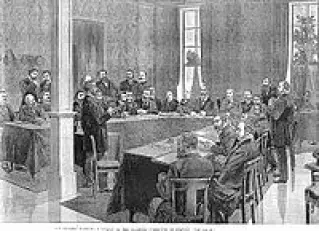
(1891 Panama Canal Company Liquidation Court Trial in Paris, France)
One of the most influential political theorists of the 20th century, Hannah Arendt, believes the Panama scandal was a large contributor to the antisemitism that arrived in France (The Origins of Totalitarianism. New ed. Harvest Books). Especially guilty was a Jewish doctor and businessman Cornelius Herz, who was responsible for paying out the bribes to politicians. Herz was passionate about science, especially electricity and after partnering and gaining funding from the Rothschilds, a fellow Jewish family, was able to create the American Syndicate of Electricity, the Society for the Construction and Maintenance of Electrical Machinery, Apparatus, Cables, etc.; the Society for Brazing by Electricity, the Society for the Manufacture of a Special System of Small-bore Guns, the Society for the Application of Electric Light to Railway Trains, the Society for the Construction of Telephone Apparatus, etc. and an enormous arrangement to connect the 36,000 communes of France with electricity and telegram service (HERZ, CORNELIUS". JewishEncyclopedia.com. 2011). All while the Rothschilds were getting paid for their investments, plus compounding interest.
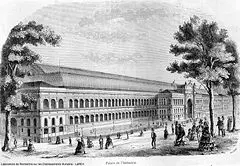
(Palais de l'Industrie in 1855, site of the International Exposition of Electricity 1881)
The Panama scandal helped to create antisemite views toward Jews because of their involvement in the scandal; reduce the people’s trust in government officials because of their bribe-taking; and lose faith in believing that private corporations act in our best interest.
After the Panama scandal, more political corruption further divided the country and deepened hate toward Jews.
The scandal started as a result of a Jewish French Captain, named Alfred Dreyfus, being convicted of treason for sharing war secrets with the German military in 1895 through a secret court-martial (Read. The Dreyfus Affair. p. 113). Dreyfus was sentenced to serve life in prison at Devils Island off the coast of South Africa. Two years after the conviction, it was discovered the actual perpetrator was French Major Ferdinand Walsin Esterhazy, but politicians and high-ranking military officers kept secret the new evidence that would lead to Esterhazy’s conviction, and he was acquitted of all charges.
Once Esterhazy was acquitted, the French Military brought more charges against Dreyfus that were based on fabricated government documents. Eventually, word got around about the wrongful conviction and the introduction of new and malicious evidence. As a result, the protesters successfully pressured the government to give Dreyfus another trial in 1899. In this trial, he would be convicted again and given a 10-year sentence. Dreyfus was eventually pardoned and it came out that all the evidence used against him came from fabricated documents produced by the government. Therefore, in 1906 Dreyfus was reinstated as a Major in the French Military.
This scandal largely divided the country because of Dreyfus’ Jewish religion. People who were pro-conviction were prejudiced toward Jewish people, while Dreyfus’ supporters were mainly Jewish. This reality deepened the religious and social divide in France. It was rare to see people in the middle of the argument, people who believed the predatory banking practices were hostile, yet Dreyfus should be let go. If you are caught detracting to one side or another, radicals from edges of the political spectrum pressure you into joining them, or be fearful of the consequences if you don’t.
The Rothschilds were able to make it through the scandals with little damage because after all, they were loaning out money to manipulators, cheaters, and liars who would take advantage of the public and be the first collectors when the companies when bankrupt.
One instance that illustrates the Rothschild family's growing power was in 1880 when Alphonse James de Rothschild created a deal to purchase Eramet, a mining organization that harvested nickel and other metal alloys off the east coast of Australia. By 1890, the Rothschilds maintained full control of the organization and it’s still operational today. Furthermore, the Rothschild family was able to help the French economy recover after the Franco-Prussian war which saw Alphonse receiving the Grand Cross, in the Legion of Honor, the highest class of the Legion of Honor reward, for his contributions to helping the economy recover (loaning out money to institutions and government).
The aftershock from the political corruption and Money Changer's financial influence contaminating the scheme was radical political parties gaining traction that began to undermine the effectiveness of Political leaders and Money Changers to run a cohesive country. In addition, France was able to identify specific enemies, such as Italy, who were large supporters of Dreyfus during the disaster. This gave citizens the ability to point blame on others while ignoring their own faults for being sheep to a system that manipulates them.
In the aftermath of the Panama scandal, the French government shifted its concern to its foreign policy with Germany, which was quickly expanding its territory and production to become one of the most important social, economic, and manufacturing hubs in Europe and one of France’s biggest enemies. In response in 1907, France formed the Triple Entente, an alliance with Great Britain and Russia, in hopes to use their coalition as a deterrent for any military conflict with the much more powerful German empire that would soon arise in World War I.
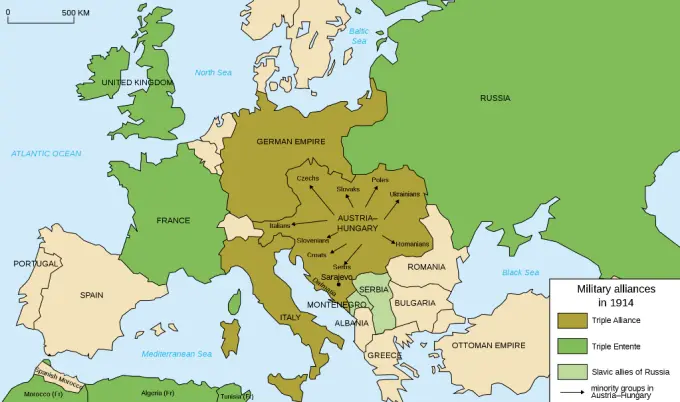
(The Triple Entente in green and the Triple Alliance in brown in 1914)
Russia
There were no serious uprisings inside of Russia during the Revolutions of 1848, in fact, Russia provided essential assistance to Austria when they put an end to Hungary’s revolt. However, the main conflicts that affected the Russian empire during the 18th and 19th centuries were the Russo-Circassian War from 1763-1864, the Caucasian Wars from 1817 to 1864, and the Russo-Turkish Wars of 1877–1878.
The Russo-Circassian and the Caucasian Wars were independent, but extremely related events in the same area of the globe that saw the destruction of lives, families, and countries. The start dates of the conflicts as well as their relation to each other are often disputed by historians. However, it’s clear that conflicts arose as earlier as 1763 and continued until a definitive end in 1864 with a Russian victory.
The reason Russia was passionate about its expansion into the area is that Money Changers and politicians were attempting to spread political influence, and religious views, increase its military strength and have a warm water port on the Black Sea to transfer value through the international economy. The Russian’s gradual winning of battles and movement on Circassian soil allowed them to claim territory that was never rightfully theirs, to begin with. After fierce resistance for more than a century, in 1861 all of Circassia and much of the Baltics were controlled by Russia which is still true to this day
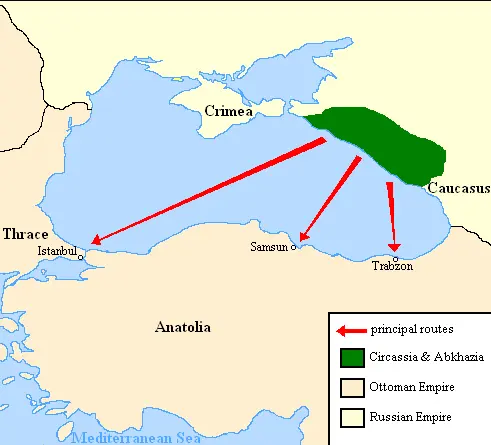
(Area of Circassia)
The area was of large importance to many European powers because of its geographic importance, economic potential, and unorganized government structure. The Ottoman Empire had an interest in spreading its influence, religion, and culture to the area of Circassia to defend against the growth and influence of Russia. Initially, the Ottomans were having more success in spreading their influence throughout the region and supported the Circassians in their fight against the Russian empire. After the Ottomans financially, politically, and militarily supported Circassia, a country that was losing in war, the Ottomans continued their downfall of being a powerhouse throughout the region.
The Russo-Circassian war was the longest war Russia has ever fought and involved massive humanitarian issues. Circassia was a country in the North Caucasus region that bordered the Black Sea to the North East. The area had been legally and internationally recognized by the European Super Powers throughout the 18th century, but in 1763 Russia claimed the territory for itself and began to slowly encroach on Circassia soil while setting up military neighborhoods to survive the harsh conditions and move further inland.
The original fight was against Circassia and is sometimes referred to as the Western Front of the Caucasian Wars, but as Russia gained momentum, they slowly pursued the North Caucasus region which began the Caucasian wars in 1817.
The war ended in 1864 with a final battle between 20,000 Circassian men and women against a force of over 100,000 Russian Soldiers. The Russian military surrounded the Circassians while they emptied bullets from their barrels, sent exploding artillery, and effortlessly cut through bodies of men, women, and children with swords. When all was said and done, all 20,000 of the Circassian men and women were killed and the Russian army celebrated on top of the dead corpses while observing over 100 Circassian prisoners be mutilated during a public execution. Around the same time, another Circassian army was surrounded by Russians and committed mass suicide to avoid going through the cruelty of being a Russian Prisoner or being tortured (Kafkasya Bülteni,. 19 May 1864).
Overall, the Russian conquest of the area around the Black Sea led to the Circassian genocide, which is where Russian Christians partook in the methodical genocide, ethnic cleansing, and forced migration of the Circassian population. Throughout the Circassian War somewhere between 800k to 1.5m people were massacred resulting in around 90% of the Circassian population being displaced or dead. Russians raped kids and pregnant women, murdered the elderly, slit open pregnant women’s stomachs to feed their fetuses to Russian dogs, and even used Circassians for scientific experiments. Some Russian Nationalists still celebrate May 21st as a holy conquest day, while the Russian government continues to deny the genocide even happened to this day. (Эльмесова, А. М. ИЗ ИСТОРИИ РУССКО-КАВКАЗСКОЙ ВОЙНЫ.)
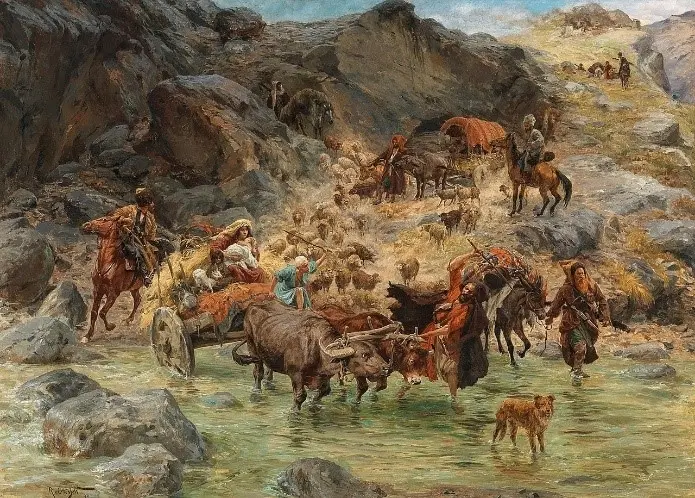
(Circassians leaving their villages in 1890)
The Circassian war became an issue when the Ottoman Empire attempted to spread Islam throughout independent countries and Kingdoms in Eastern Europe. Tensions began to rise between the Christian-dominated Russians and anyone who practiced the Muslim Religion for a power struggle over the area. Starting in 1711 Tsar Peter I of Russia ordered troops to begin raiding, killing, stealing, and raping various villages throughout the Circassian region. However, the intent was never to make Circassia part of Russia, but rather as a method of stealing resources and symbolism of Russian superiority.
Estimates suggest that from 1711 to 1763, Russians killed 43,000 Circassian men and women, and drove away 39,200 horses, 190,000 cattle, and 227,000 sheep from Circassia. (Natho, Kadir. "The Russo-Circassian War"). From 1763-1817 Russians began gradually moving farther into Circassian territory while setting up military bases along the way, manifesting the first sign of Russian invasion with the goal of conquering the land. The Circassian people strongly opposed the Russian forces and put-up strong fights to protect their lands. Russian forces would often burn down entire villages, steal their livestock and murder entire families to crush the spirits of their enemies.
The year 1817 seemed to be a turning point in the military efforts because of the involvement of Russian General Aleksey Yermolovs in the Caucasus region. When Yermolov arrived, he realized the Circassian people were passionate about their culture and land, so they were not going to give up easily. In response, Russian forces ramped up their destructive efforts when they began to extinguish Circassian strongholds, burn down entire villages and massacre the people (Ahmed 2013, p. 161).
As time went on Russia would force inhabitants to relocate or be killed, sometimes they weren’t given a choice, and Russia gained large plots of land that could be claimed as their own which would be given to Christians who shared the same interests as the Russian government, allowing there to be Russian rule in areas they never inhabited before. The Circassian area and Northern Caucasus region were constantly being influenced by the Christians of Russia and Muslims of the Ottoman Empire who were trying to compel their authority, culture, and religion on the self-governing society while they were attempting to live in a self-governed society.
Throughout the battles the Circassian people begged other European powers, like the United Kingdom, to provide military or humanitarian aid. The Circassian people even went as far as writing, “A Petition from Circassian leaders to Her Majesty Queen Victoria" at the beginning of 1864. Still, with the knowledge of what was occurring in the region, the Circassian requests were left unanswered, and the mass suicide and death of 20000 warriors in the last battle of the Circassian War occurred only months later (Rosser-Owen, Sarah. 2007. The First ‘Circassian). For the Circassians that weren’t killed, they were exiled to the nearby Ottoman Empire were friendly to their beliefs, “Ottoman archives show nearly 1 million migrants entering their land from the Caucasus by 1879, with nearly half of them dying on the shores as a result of diseases” (Neumann, Karl Friedrich).
The Ottomans were not exempt from the massive killing of their own citizens either. The April Uprising of 1876 by Christian Bulgarians was a rebellion attempt against the Ottoman Empire because of the government’s suppression of their rights, religion, political influence, or economic status. As a result, the Ottoman Empire brutally murdered nearly 30 thousand citizens which would lead to further insurrection and sparked international concern for how the Ottomans handled the situation.
During the end of the Circassian war, another conflict arose between Russia and the Ottoman Empire directly, The Crimean War from 1853-1856. During this conflict, the United Kingdom and France would act as the Ottoman Empires' largest allies because they were fearful of the Russian Empire’s growing strength during their expansion of territory to the west. The cause of the war involved what religion should be ruling over Palestine, which was located inside the boundary of the declining Ottoman Empire at the time. The egos of Napoleon III and Tsar Nicholas I caused the Russian occupation of Ottoman territory, which caused the Ottomans to declare war on Russia. In the end, the Russians were defeated, were forced to demilitarize the Black Sea, and had to cede their previously occupied Ottoman territory.
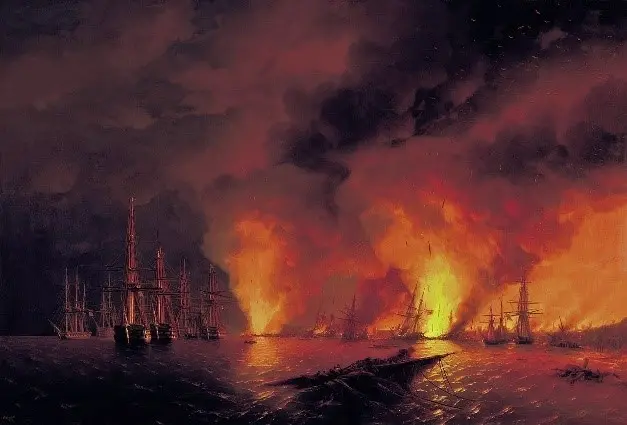
(The Russian destruction of the Ottoman fleet at the Battle of Sinop on 30 November 1853 sparked the Crimean war (painting by Ivan Aivazovsky)
Although the Russians lost the war, it led to Russian Money Changers and aristocrats modernizing Russian society, economics, and politics. A high-ranking official of the Tsar, stated, “We cannot deceive ourselves any longer; we must say that we are both weaker and poorer than the first-class powers, and furthermore poorer not only in material terms but in mental resources, especially in matters of administration” (Lieven, Dominic (1993): "Nicholas II: Emperor of all the Russias").
The Crimean war would ultimately set up many of the alliances we see during World War I. As a result of Austria failing to support Russia during the Crimean wars, Russia returned the favor when Austria got destroyed during the Franco-Austrian Wars of 1859 and the Austro-Prussian War in 1866. In the latter war, Russia agreed with Prussia to stay neutral in return to have military access to the black sea. Finally, when Austria-Hungary was created, it was one of the last powers Russia was concerned with because of the relationship to its border and the vast territory Austria-Hungary comprised.
In 1855 Russian Tsar Nicholas I would die after marrying into the Prussian royal family and his heir Tsar Alexander II, who was the nephew of Emperor William I of Germany, would take over the Russian throne and be the target of assassination attempts in 1866, 1879, and 1880. Ultimately, he would be assassinated by a bomb in 1881, after seeing through the end of the Circassian War and the mass exportation and genocide of the Circassian population.
The next conflict between the Russians and Ottomans was the Russian-Turkish war from 1877-1878. For Russia, its goal was to have control over the Black Sea and establish pro-Christian countries in the surrounding area such as Serbia, Bulgaria, and Romania that would act as Russian satellite states. Turkey was part of the Ottoman Empire and was continuing its decline, which was worsened by the Crimean Wars, which put the Empire in unpayable amounts of debt with high-interest rates because of its excessive borrowing for military efforts.
The Russian-Turkish War was decisively won by the Russian Christians from the North. This resulted in regions that were previously controlled by the Ottoman empire becoming independent nations (Serbia, Bulgaria, and Romania), leading to the Ottoman empire deteriorating in strength and size even more. After treaties were decided by the international community it was agreed that Bulgaria would be split into the various territories, while awarding some land to the Ottomans. However, Russia was able to push the Ottomans back to Constantinople and was able to keep most of the land that was captured.
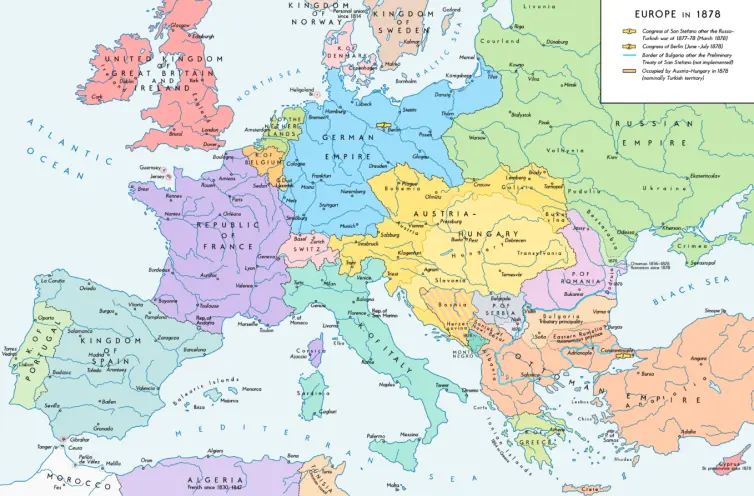
(Europe after the Congress of Berlin in 1878 and the territorial and political rearrangement of the Balkan Peninsula)
Throughout the Russian-Turkish War, hatred toward each other was so great that the Ottomans and Russians both participated in the genocide of the other nation, Villages were burned to the ground, women and children were killed and torture seemed to be a norm (Balkan tarihi Archived 6 January 2010 at the Wayback Machine İngilizce)
After Tsar Alexander II was assassinated in 1881 his son Alexander III would take the throne and rule through relative peace in the Russian Empire until his death in 1894. Alexander IIIs son was Nicholas II who would rule from 1894-1917 with much more conflict throughout his reign.
The first conflict Tsar Nicholas II went through was the Russo-Japanese War which occurred from 1904-1905. The conflict was fought over which country would have control and influence over Korea and parts of present-day China. The war ended with the Russians losing, which caused tremendous humiliation on the international level and led to the Russian people revolting in the Revolution of 1905, the same year the war ended. Although the Russian people fought to throw out the empire system, Tsar Nicholas II was able to continue his reign as Emperor as a result of giving the people some freedoms. However, the revolution set the foundation for future civil insurrections that would see a new government structure take over Russia and Tsar Nicholas II would have to fix much more if he planned on keeping his place on the Russian throne.
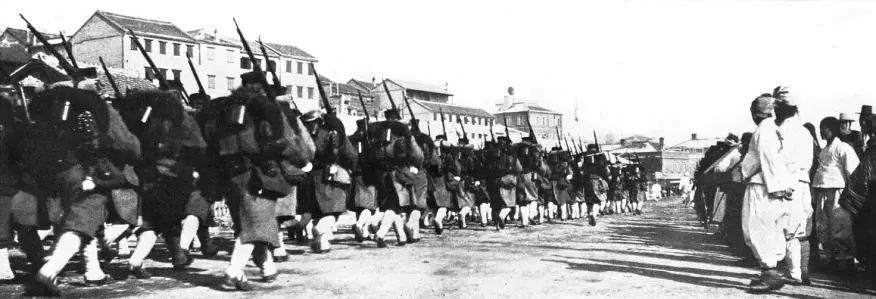
(Japanese infantry during the occupation of Seoul, Korea, in 1904)
Ottoman Empire
The Ottoman Empire started in 1299 A.D and was a transcontinental empire that at one time controlled vast areas of land throughout Africa, Europe, and Asia. At their peak in the mid-15th century, the Ottomans were able to, through a series of civil wars within Eastern Rome, invade the capital city of Constantinople and end the Byzantine empire.
Throughout the 16th century, the Ottomans had a number of kings, called sultans, who were fanatical about expanding their territory through invasions and armed conflict throughout the Middle East and Asia. This was the Ottoman's peak in world history because of their massive land holdings, influence, and military strength.
The Ottoman Empire’s decline came after a series of financial burdens that arose from taking war-time loans to defend their territory from foreign invasion and being the aggressor in other wars throughout the 19th century. These wars led to a disruptive political and social atmosphere between the Christians and Muslims who were now inhabiting the area. In addition, the loans were becoming unpayable, as the debt was so high and the interest payments, they were making were not effectively getting rid of the principal. The tension between religious groups led to contrarian views in Europe on how to handle the deteriorating power and influence of the Ottomans.
There were no major uprisings in the Ottoman Empire during the Revolutions of 1848, but as time went on and other European superpowers saw the decline of the Ottomans, they were all eager to take over the land and make it their own. Russia has particularly been interested in the region mainly because of the access to the black sea to create warm water ports for international trade and globalization.
We have discussed the Crimean War throughout the Russia section that ended with the Ottoman victory with the help of the United Kingdom, France, and Austria while highlighting the ethnic cleansing that was being practiced on both sides. However, I should reiterate that the Caucasian Wars coming to an end in 1864 resulted in the Circassians becoming ethnically cleansed and around 1,000,000 people moving into the Ottoman-controlled region of Turkey. This large influx of people who were not paying taxes or being productive to society assisted in the eventual bankruptcy of the Ottoman State in 1875 (Rogan 2011, p. 106).
The next conflict in the Ottoman Empire was the Bulgarian Uprising or April Uprising in 1876. The creation of the Bulgarian Orthodox Church in 1870 manifested a mood of nationalism within the area that caused a large group of Bulgarians to rise up and revolt against the Ottoman Empire. This resulted in the Ottoman empire “massacring up to 100,000 people in the process” (Jelavich, Charles; Jelavich, Barbara. 1986).
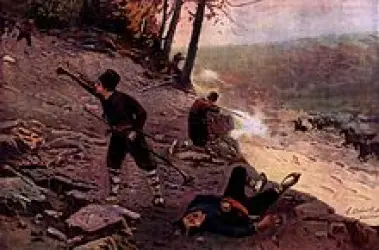
(Bulgarian rebels in 1876)
This event was a large cause in the Russo-Turkish War from 1877-1878, along with the expansionist vision of Russia, and ultimately ended with a Russian win. This allowed Russia to severely reduce the territory of the Ottoman empire in Europe and the Balkans. In addition, Bulgaria was established as an independent state within the Ottoman Empire, along with Romania, Serbia, and Montenegro achieving full independence after the conflict.
The decline of the Ottoman Empire continued on its decline from 1894 to 1897 when the Sultan, Abdul Hamid, took part in a genocide against the Armenian people, killing around 200,000-300,000 of his citizens while attempting to remain a stabilizing power in Europe. Armenians were in the middle of a protest in Constantinople when the murders started and there was even an American Reporter on the ground when it happened to explain the events,
“Along the wall on the north, in a row, 20 ft (6 m) wide and 150 ft (46 m) long, lay 321 dead bodies of the massacred Armenians. Many were fearfully mangled and mutilated. I saw one with his face completely smashed in with a blow of some heavy weapon after he was killed. I saw some with their own necks almost severed by a sword cut. One I saw whose whole chest had been skinned, his forearms were cut off, while the upper arm was skinned of flesh. I asked if the dogs had done this. "No, the Turks did it with their knives." A dozen bodies were half burned. All the corpses had been rifled of all their clothes except a cotton undergarment or two.... To be killed in battle by brave men is one thing; to be butchered by cowardly armed soldiers in cold blood and utterly defenseless is another thing” (The W. L. Sachtleben Papers on Erzerum in the 1890s. Gia Aivazian, 2003)
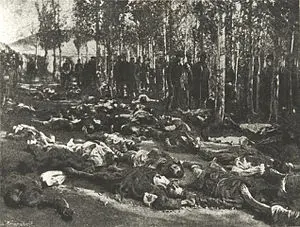
(A photograph taken in November 1895 by William Sachtleben of Armenians killed in Erzerum)
Although it was an international crisis and widely acknowledged, nothing was done by European or American powers to stop the event. (Edhem Eldem, "26 Ağustos 1896 'Banka Vakası' ve 1896 'Ermeni Olayları,). Most likely because they didn’t see any potential benefit for themselves to gain wealth or power from getting involved.
From 1912 to 1913 the Ottomans lost the First Balkan Wars, once again severely crippling their influence in Europe and leading to the expulsion of Muslims and non-Muslims alike.
After this war, the Ottomans struggled to maintain political influence and had difficulty producing economic value which caused large social unrest within the nation. However, World War I was right around the corner and the declining Ottoman Empire would see its last light
The United Kingdom
As we previously mentioned, England did not directly encounter revolutionary forces during the Revolutions of 1848 and was able to continue its growth as the economic and military leader of the world. The United Kingdom had the largest navy in the world and expanded its influence into all corners of the planet through globalization, including nearly the entire continent of India that wouldn’t be independent until 1947 and large pieces of land in Africa.
Although the United Kingdom wasn’t involved with the Revolutions of 1848, they were still interested in extending its political and military influence across the globe and played an important role in the Crimean Wars from 1853-1856. The Crimean war was primarily fought between Russia and the declining Ottoman Empire with the help of allies such as France and the United Kingdom. The United Kingdom and France were supporting the Ottomans because they would rather be dealing with a declining power in the Ottomans than deal with the expansive, powerful, and growing empire of Russia in Europe. Furthermore, the size of the UK’s navy allowed them to be international peacekeepers in Europe and negotiate treaties that would benefit the UK.
One of the major conflicts the United Kingdom involved itself with was the First Boer War from 1880-1881 and the Second Boer War from 1899-1902.
The reason for the United Kingdom’s interference in South Africa was because of the large deposits of raw materials that could be used in industry, the ability to control and expand trade through India and China with important warm-water ports, and access to the ocean and the competition of other European and American powers attempting to conquer the land for themselves.
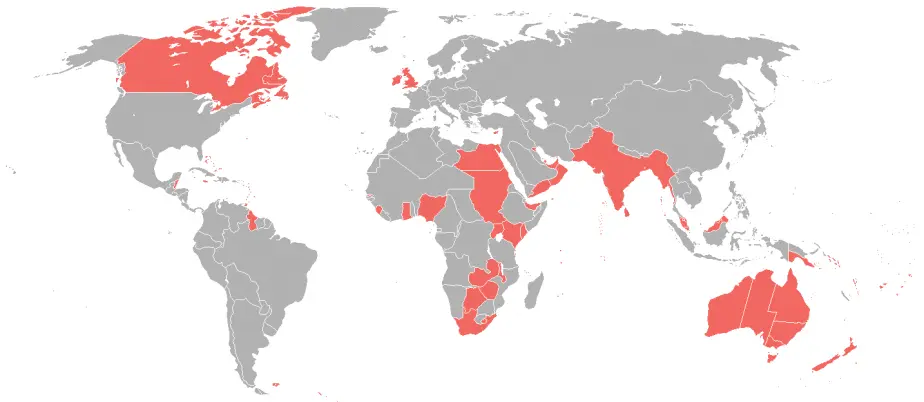
(Extent of the British Empire in 1898, prior to the outbreak of the Second Boer War)
The end result of the First Boer War was the UK offering a truce because of the vast resources that were required to win a long-distance war. However, their influence in the area would continue to be strong, and in 1899 Boers attacked UK representatives because of their increasing influence in the area. As a result, the UK brought war onto the Boer region with large military forces. The Boers' fighting style consisted of Guerilla warfare, which the British were not accustomed to. Therefore, after suffering initial defeat, the UK military was directed to light fire on anything that could be seen as useful to the Boers: Villages, farms, industrial centers, and even their livestock were slaughtered to ensure they wouldn’t have food.
In addition, the UK began to slowly push back and block off Boer resistance, effectively creating concentration camps where over 25,000 women and children were forced to partake in work and manipulative education. The British were able to get important help from the Cape Colony and Rhodesia, which were being run by Cecil Rhodes who was being funded by the Rothschilds. Once the treatment in the concentration camps became unbearable, the Boers were required to allow the UK to have control over the region and unwillingly forfeited the fight after a long and hard-fought resistance. In this war, the United Kingdom used outdated tactics and strategies that cost them international power and caused the war to go on longer and more expansive than many Brits thought was necessary, causing internal rifts inside of the country.
Another large and important event the UK was participating in at this time that wasn’t directly related to Europe was the Opium Wars with China. Two separate conflicts involving the UK and the Qing Dynasty in China from 1839-1842 and 1856-1860 led to UK victories that allowed them to continue trading Opium, have important international trade partners, and be paid reparations by the Chinese government.
During the time, Opium’s demand was heavily increasing due to the recreational drug use that was being adopted throughout the world in the 19th century. Looking to take advantage of this, the English, funded by the Baring’s Bank was able to transport thousands of containers of illegal drugs into China for large profits. Throughout the time, the Chinese government attempted to ban the substance. However, the UK ignored the ultimatum and continued its practices, leading to armed conflict.
After a British victory during the First Opium War, the Qing dynasty surrendered Hong Kong to the UK, creating British Hong Kong which was under the British’s control until 1997.
The second war was equally as devastating for China as the first, where as a result of a British Victory, the Qing Dynasty “open(ed) the second group of ten ports to European commerce, legalize(d) the opium trade, and grant(ed) foreign traders and missionaries’ rights to travel within China (Haythornthwaite 2000, p. 239.)
With now having a trade surplus with the Chinese, British Money Changers and politicians were able to take advantage of the military weakness of another government system.
Germany
In Germany the Revolutions of 1848 were unorganized and ineffective, allowing German Aristocrats and Money Changers to maintain their power in the region. In 1871 German became an Empire when they were unified after the Franco-Prussian war and declared the King of Prussia, Wilhelm I, as the Emperor of Germany. One of King Wilhelm’s first measures was to appoint Otto Von Bismarck as the Chancellor of Germany, who was already holding the position of Minister-President of Prussia since 1862. Bismarck was largely responsible for the political and economic decisions during Wilhelm I’s reign.
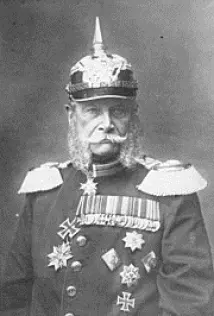
(German Emperor Wilhelm, or William, I in 1884)
With Bismarck in place, the German Empire was able to greatly expand its influence through the Prussian and German victories in the War with Denmark of 1864, the Austro-Prussian War of 1866, and the Franco-Prussian War of 1870 which ultimately united Germany under the sympathy for nationalism by Germany citizens.
Throughout the 70-80s Bismarck managed to govern through relative peace while expanding the territory and influence of the German Empire. However, when Wilhelm II took over the throne after his father’s death, things began to heat up in Europe when the new German Emperor began instructing his cronies to partake in imperialistic tactics, angering European Superpowers (Mommsen, Wolfgang J. 1990). Furthermore, in 1879, Bismarck successfully negotiated an alliance with Austria-Hungary, making them an important influential force in Europe. However, this alliance would soon be to the German Empire's detriment when their relationship with Austria-Hungary dragged Germany into World War I.
Italy
After the Unification of Italy through the efforts of leaders like Giuseppe Garibaldi, Cavour, Victor Emmanuel II, and Giuseppe Mazzini; Italian citizens took on a nationalist attitude toward their government and European neighbors. It’s important to point out that Camillo Benso, Count of Cavour, or simply Cavour, was running the political structure in the Kingdom of Sardinia in Northern Italy. When the Crimean Wars began in 1855, Sardinia assisted Britain and France, giving credibility to Cavour and his government structure to the European Super Powers.
In 1861, Garibaldi in Southern Italy and the King of Sardinia in Northern Italy, Victor Emmanuel II, united the two halves and declared a United Italian Kingdom with Emmanuel II being the first King of the nation. During the Austro-Prussian in the 1866 War, Italy was able to gain back some land and increase their territory for having supported the Prussians. Finally, during the Franco-Prussian War in 1870 when France was forced to leave Rome, Italians quickly claimed the territory and made Rome the capital of the country. Italy was becoming a European Super Power itself.
Once their power was recognized in Europe, Italy began participating in imperialism themselves by taking over numerous territories, islands, and regions across different parts of the world, including material-rich Africa. Before Italy entered World War I, they were ruled by Prime Minister Giovanni Giolitti who was re-elected five times from 1892 to 1921 because of his modernization of the economy, industry, and social circumstances of Italians. However, it was still undecided on who side the Italians were going to fight with during World War I.
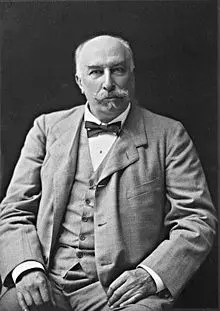
(Prime minister of Italy Giovanni Giolitti)
Austria-Hungary
When Austria-Hungary was founded in 1867, it immediately became one of the largest economies in Europe. In Europe, it was the second-largest country by land mass, third-most populous, and fourth-largest industrial center in the entire world. It was ruled by Emperor Franz Joseph I of Austria of the House of Habsburg. The House of Habsburg was founded in the 11th century with the throne of the Holy Roman Emperor belonging to the Habsburg House from the middle of the 15th century until the Roman Empires' dissolution in 1740. Franz Joseph’s family members were the targets of numerous assassinations and death throughout his reign as Emperor, including his brother Emperor Maximilian I of Mexico in 1867, the suicide of his son Crown Prince Rudolf in 1889, and the assassination of his wife Empress Elisabeth in 1898.
Franz Joseph had strong relationships with Money Changers in Austria-Hungary, such as Albert Salomon Anselm von Rothschild, a descendent from the Vienna branch. Albert Rothschild was the principal shareholder in Credinstandt, Austria-Hungary’s largest bank, allowing his family to profit from the massive industrial development and economic activity in the area. Furthermore, the Northern Railway, a crucial rail line used to deliver raw minerals to different parts of the country, was founded and owned by the Rothschilds. With these two businesses in place, Rothschild’s Vienna branch was making more than enough money to penetrate politicians with their influence.
One of the major crises that occurred leading up to World War I was the Bosnian Crisis in 1878. This crisis occurred when Austria-Hungary annexed Bosnia while under the rule of the Ottoman Empire. After the Russo-Turkish War was won by the Russians, the Treaty of Berlin of 1878 gave Austria-Hungary the area of Bosnia and their troops had occupied the territory ever since. However, Bosnia was inside the Ottoman Empire’s borders. Therefore, when Bosnia was annexed by Austria-Hungary in 1908 the Ottoman Empire was extremely upset and it caused further tensions. While those tensions were occurring, Bulgaria took advantage of the chaos and declared its independence from the Ottoman Empire, further weakening its international influence.
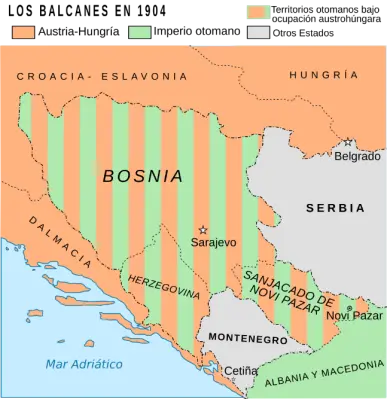
(Austrian-occupied Bosnia-Herzegovina and the Sanjak of Novi Pazar in 1904)
Finally, on 28 June 1914, yet another member of Franz Joseph’s family was killed when Franz Ferdinand was assassinated inside of Serbia. This resulted in Austria-Hungary declaring war on Serbia, which was a Russian ally and satellite state, which led to the outbreak of the largest conflict in world history up to this point, World War I.
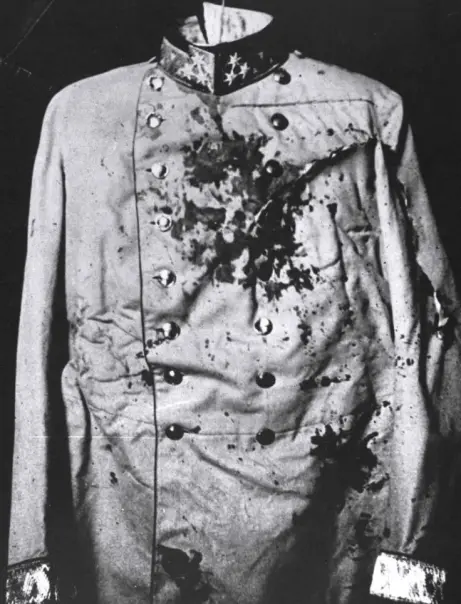
(Author unknown. - LIFE Magazine, from an earlier, unnamed source)






