After years of catastrophic losses, the government has finally recognized my contribution to financial history.
I received a letter in the mail yesterday.
Normally, this would concern me. The last time I received official correspondence, the IRS wanted to discuss my $0.0003 in staking rewards.
But this letter was different.
It came from the National Park Service.
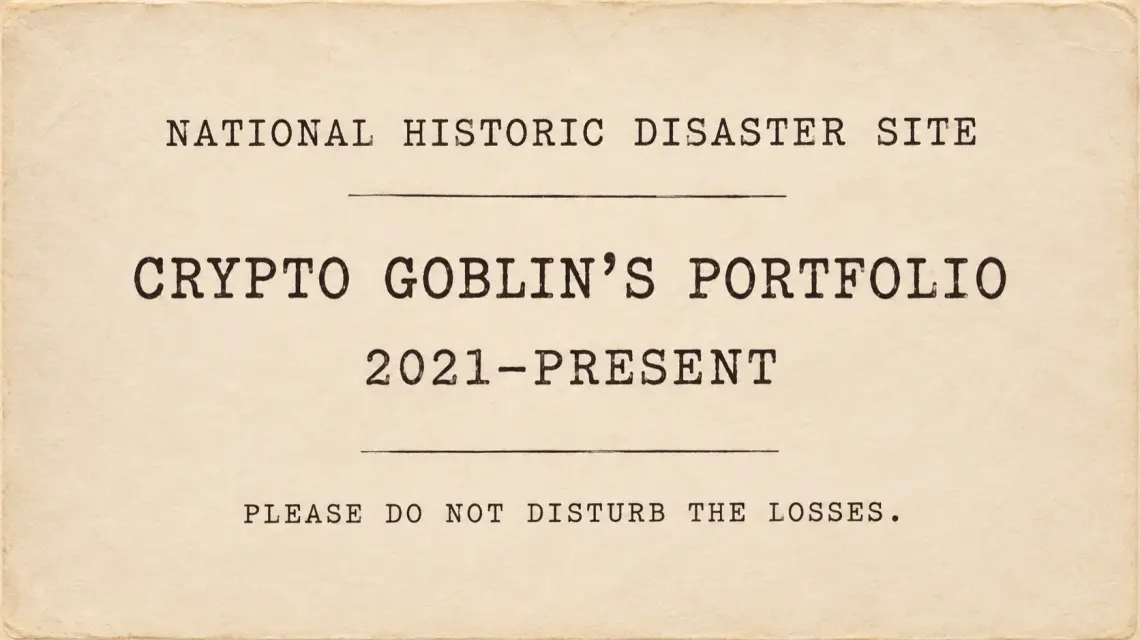
Apparently, my cryptocurrency portfolio has been designated a National Historic Disaster Site.
I didn't even know that was a classification.
According to the letter, my investments represent "an exceptionally well-preserved example of early 21st-century financial mismanagement."
I was honored.
The Initial Inspection
Two government officials arrived at my house on Tuesday wearing khaki uniforms and carrying clipboards.
They asked to see my portfolio.
I opened my trading app.
One of them immediately removed his hat.
The other whispered, "Jesus Christ."
They spent approximately twenty minutes examining my transaction history before determining that the site was too historically significant to disturb.
"Sir," one inspector explained, "we've seen abandoned factories, collapsed bridges, and entire towns swallowed by sinkholes."
He pointed at my 2021 altcoin purchases.
"But we've never seen anything quite like this."
They placed a small orange safety cone beside my computer.
Archaeological Findings
The government dispatched a team of financial archaeologists to examine the wreckage.
Their discoveries were extraordinary.
Buried beneath several layers of failed investments, they uncovered:
A collection of 2017 ICO tokens that haven't traded since the Obama administration.
Three separate dog-themed cryptocurrencies purchased at their all-time highs.
A liquidity pool containing $0.42 and an overwhelming sense of regret.
An NFT depicting a depressed-looking penguin.
A forgotten wallet holding approximately eleven dollars in a token that no longer has a functioning blockchain explorer.
The lead archaeologist described the findings as "deeply troubling but culturally important."
One researcher became visibly emotional after discovering my transaction fees.
"We believe," she explained, "that this individual spent more money moving his assets than the assets were actually worth."
A moment of silence followed.
Protected Historical Status
Under the terms of my portfolio's new designation, I am no longer permitted to alter certain holdings.
Selling them would constitute destruction of historical evidence.
This is unfortunate because I was actually considering cutting my losses.
The government has also forbidden me from averaging down.
Apparently, adding more money to the portfolio would be considered "unauthorized excavation."
For the first time in my investing career, someone has legally prevented me from making a stupid financial decision.
I feel strangely liberated.
The Visitor Center
Construction has already begun on a small visitor center beside my desk.
Tourists will soon be able to observe my portfolio through protective glass.
A commemorative plaque will read:
THE GREAT ALTCOIN COLLAPSE
2021–Present
Here lies the financial ambition of one man who repeatedly mistook a temporary price increase for the beginning of generational wealth.
Admission will be free.
However, visitors wishing to view my Ethereum gas fee history must sign a psychological liability waiver.
There are also plans for a gift shop.
Unfortunately, the gift shop has already lost 63% of its operating budget after accepting payment in a newly launched memecoin.
An Unexpected Opportunity
Several universities have contacted me about studying my portfolio.
Economists want to understand how someone could consistently purchase assets within forty-eight hours of their historical peak.
Psychologists are interested in my continued optimism.
A professor from an unnamed institution described my investment strategy as "statistically fascinating."
He believes that if he programmed a computer to make completely random trades, it would struggle to reproduce my results.
I thanked him.
Then I asked whether his university was hiring.
The Future
The National Park Service has informed me that my portfolio may eventually qualify for inclusion on the National Register of Historic Places.
They're particularly interested in preserving a small-cap cryptocurrency I purchased in 2018.
The development team disappeared.
The website expired.
The community Telegram became a cryptocurrency gambling channel.
But the token still appears in my wallet.
Like a tiny digital fossil.
A monument to hope.
A reminder of simpler times, when a poorly formatted whitepaper and a Discord server were enough to convince me I was investing in the future of finance.
I asked the inspector whether the government planned to provide financial assistance.
He shook his head.
"I'm afraid the damage is irreversible."
Then he handed me a brochure about responsible investing.
I put it in the gift shop.
Price: $19.99.
Crypto accepted.
Goblin Wisdom
"They said my portfolio would make history. I just didn't realize they meant as a cautionary exhibit."
Disclaimer: This article is satire. The National Park Service has not designated my cryptocurrency portfolio a historic disaster site. Yet. All government actions, inspections, and research described are fictional.