The United States is accusing the exchange MEXC of having served, for several years, as a major conduit for the movement of funds linked to sanctioned individuals, Russian, Iranian, North Korean financial networks and cybercriminal actors. The investigation covers the period from May 2021 to May 2026. FinCEN asserts that MEXC facilitated at least $16.7 billion in potentially illicit activity, including:
- Russia-related illicit finance.
- Entities sanctioned by the U.S., EU and UK.
- Garantex Exchange.
- Grinex Exchange.
- A7 Network.
- A7A5 token.
- Iran and affiliated entities.
- The Central Bank of Iran and the IRGC.
- Iran-linked groups, including the Al-Qassam Brigades.
- North Korea.
- Cybercrime.
- Suspicious ransomware payments.
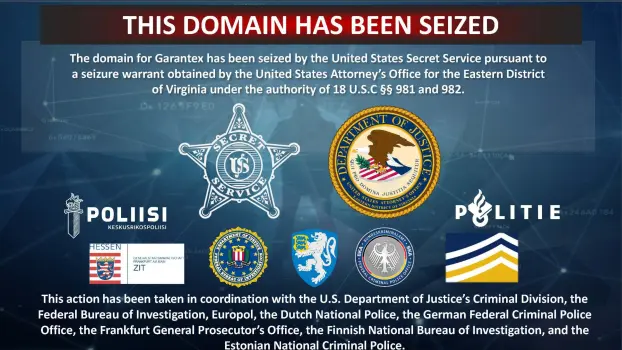
Garantex was a Russian exchange subject to multiple U.S. sanctions. Grinex is considered its successor, established by former employees following the imposition of sanctions. According to FinCEN, MEXC continued to process transactions with both entities even after their respective designations. The reported direct exposure amounts to approximately $129 million with Garantex and $4.1 million with Grinex, through June 2026.
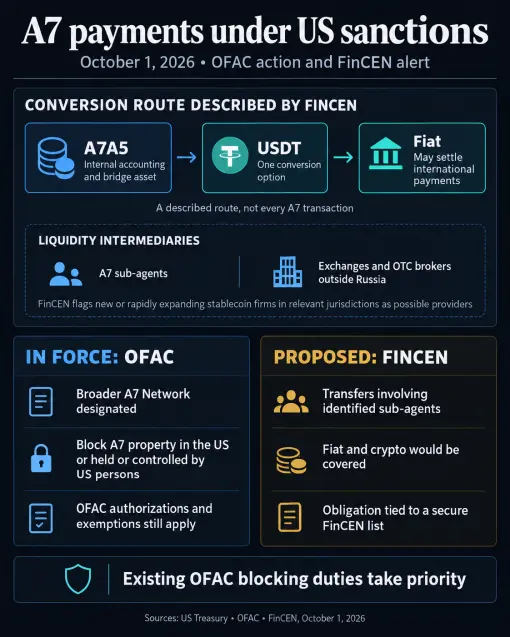
The A7 Network is a financial network associated with Moldovan oligarch Ilan Shor and the Russian bank Promsvyazbank (PSB). According to U.S. authorities, its purpose was to facilitate international payments and transfers while circumventing financial restrictions. The A7A5 token, a stablecoin pegged to the Russian ruble and available on the Ethereum and Tron blockchains, was allegedly used to transfer value between entities linked to the "A7 Network".
FinCEN attributes the following to MEXC:
- At least $26 million in transfers benefiting the A7 Network.
- Nearly $200 million in transactions linked to A7A5.
- Relationships with sanctioned entities, including the issuer Old Vector LLC and Ilan Shor.
FinCEN identified approximately $1.87 billion in transactions with exposure to Iran. More than $1 billion of this consisted of direct transfers between MEXC and over 40 Iranian exchanges, some of which are under sanctions.
Other findings include:
- $22 million linked to the Central Bank of Iran and the IRGC, including the Quds Force.
- $36 million in transactions connected to the al-Qassam Brigades and other Iran-affiliated terrorist groups.
FinCEN also alleges that MEXC facilitated payments totaling approximately $350,000 to Sim Hyon Sop, a North Korean financial intermediary already subject to U.S. sanctions.
At least $1.99 billion in funds, originating from or destined for cybercriminal entities, reportedly passed through MEXC. Between January 2022 and July 2024, over $37.9 million in suspicious ransomware payments were identified.
The FinCEN document also notes previous interventions by regulatory authorities:
- Japan (2023): The Financial Services Agency flagged MEXC for operating without the required registration.
- Hong Kong (2024): The Securities and Futures Commission warned the public that MEXC was operating without a license. - Seychelles (May 2026): The Financial Services Authority had taken action against MX Global Ltd for providing crypto services without authorization.
FinCEN further asserts that the AML/KYC procedures declared by MEXC were insufficient and that certain transactions even violated the exchange’s own internal regulations.
On November 7, reports emerged from individuals who had transferred funds from MEXC to other exchanges, only to encounter the following issues:
- Deposits suspended pending AML (Anti-Money Laundering) checks.
- Funds that have not yet been credited.
- Refund requests currently under review.
- Additional scrutiny regarding the source of funds.
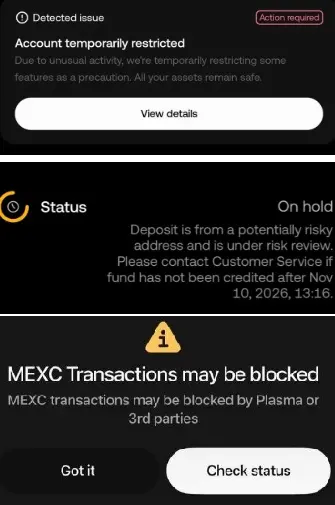
The platforms mentioned include: Binance, OKX, Gate, Bitget Wallet. Regarding Bitget Wallet, it was also confirmed that funds identified as originating from MEXC are currently not being accepted for card top-up services. MEXC has acknowledged that certain USDT withdrawals were temporarily suspended across specific networks, attributing the issue to routine maintenance. The exchange has not officially linked these disruptions to the FinCEN order. In reality, it appears that funds leaving MEXC and arriving at other exchanges are being flagged as "high-risk" and subsequently blocked.
MEXC has stated that it is aware of the situation and that the platform continues to operate normally.

WHO IS BEHIND MEXC? WHO IS "TONY"? Interestingly, an individual named "Tony" is said to be behind MEXC; some sources identify him as the owner or controlling shareholder. His identity has never been publicly verified. This name surfaced notably in February 2025 and again in October 2025. RootData lists him as the owner and founder of MEXC, yet it provides no reliable biography, legal identity, or corporate documentation to substantiate his ownership. On October 31, 2025, ZachXBT issued a public appeal seeking information regarding this alleged shadow owner of MEXC, known as "Tony". It was written that his identity appeared to be kept deliberately hidden. In February 2025, a Chinese source within the crypto sector claimed that Tony had become the controlling shareholder of MEXC following a change in ownership about two years earlier. A report, published by AiCoin and based on information attributed to industry insiders, alleged that Tony had invested in Bybit as a minority shareholder. The same report described a personal relationship between Tony, Ben Zhou (of Bybit) and Liu Shuai (of Bitget). Tony may reside in Dubai, though this is not certain. On March 5, 2026, the Dubai Virtual Assets Regulatory Authority (VARA) issued a warning against MEXC, stating that it lacked the necessary authorizations to offer crypto services in Dubai. On June 22, 2026, VARA further announced sanctions against MX Global Ltd for operating without a license and for violating KYC obligations.
Are you interested in ways to earn crypto bonus? Check it out here: Some Sites To Earn Crypto Bonus (Old & New)