
Tezos is an experiment in formalized on-chain self-governance of a distributed crypto-system, such that it could modify its own set of rules and make protocol upgrades by way of having systematic formal procedures in place, where stakeholders reach agreement on which amendment proposals to go about testing and eventually incorporating into the system. Developers that submit protocol upgrade proposals can also attach an invoice and get compensated in the system's native currency should the proposal be approved and implemented with the next scheduled upgrade.
The general concept derives from philosopher Peter Suber's Nomic (from nomos, Greek for "law") game that he designed in the 1980's, where the initial rules include auxiliary mechanisms and introspective meta-rules that allow players to change them through a system of democratic voting. This on-chain governance model avoids the community schisms and chain-splitting hard forks that disputes all too often tend to inflame and soon lead to (as in the cases of with Bitcoin Cash, Ethereum Classic, etc.), disrupting network effects and fracturing the ecosystem in the process. In comparison, Tezos is both conductive to smooth and democratic social consensus while at the same time fairly adaptable and reactive, since there are no rigid hard-coded boundaries and nothing is permanently set in stone.
Tezzies (XTZ or ꜩ), or Tezos tokens, enable one to interact with the Tezos ledger, granting them access to participate in the governance and decision-making processes. The network itself operates on a proof-of-stake consensus in how it reaches agreement about the state of the ledger. Unlike most PoS schemes though, in Tezos any stakeholder can participate in the consensus process and there's also optional delegation should one prefer to not participate directly but have somebody else do so on their behalf. The act of signing and publishing blocks in Tezos is referred to as "baking" and the participants performing the validation are respectively called "bakers".
For scripting on-chain ("smart contracts") Tezos employs OCaml-derived domain-specific languages and makes use of formal verification techniques for mathematically proving properties about the code and verifying its correctness before going ahead to deploy on-chain, that way avoiding the possibility of costly bugs or contentious debates that might arise from a vulnerability having slipped into the main chain. As a programming language, OCaml extends the functional Caml with modular object-oriented constructs (making it similar to Python and Perl in that respect, when used in their interactive ad hoc shell mode for the purposes of system administration) which makes it easy to swap system components in and out and instantiate a representation of any other shared ledger peer-to-peer network within Tezos (Bitcoin, etc.) by putting together its constituent elements and networking layer.
The original Tezos white paper was released in late 2014 with the crowdfunding taking place in 2017 (uncapped), becoming the biggest ICO at the time, raising $232 million (66,000 BTC and 361,000 ETH) within two weeks. Soon after a dispute ensued between foundation president Johann Gevers and project founders Arthur and Kathleen Breitman over the Tezos intellectual property rights. After dragging out a seven months' court case that stalled the entire project and put investors on the edge, Gevers eventually stepped down, replaced by other community members and the Tezos mainnet officially launched in September 2018.
Brief History and Background
Tezos goes back to the earlier days of 2014 when the position paper and white paper were released, following a basic functioning prototype of the network shell written in OCaml not long after that the same year. The source code was published on Github in September 2016, drawing the attention of other developers and future community members. The Breitmans (husband and wife) are the founders of the Tezos project, both with background in finance and Arthur, more technically leaning, having worked at Goldman Sach's high-frequency trading shop.
The Tezos Foundation was established in Switzerland in 2017, due to the country's relaxed regulations and interest of authorities in fostering such technological innovations, for the purpose of managing and controlling the project's assets. The resources, said to have exceeded expectations about 10 fold, are to be allocated and used for pursuing Tezos' mandate and providing support in the form of grants for funding development.
Associate Organizations, Incubators and Labs
Aside from the Swiss based Tezos Foundation, there are a few other related organizations dedicated to advancing Tezos and such with whom Tezos has overlapping areas of interest and share similar values and goals with.
The Tezos Commons serves as a conduit and facilitator of ideas, projects and organizations dedicated to building the Tezos digital commonwealth through bootstrapping local communities, communications, promotion, education, funding open source initiatives and advocacy, etc.
The Tocqueville Group (TQ Group) is one such entity working to advance the Tezos ecosystem by creating open source software and public goods, providing support to projects and companies that build on or are looking to make use of Tezos, and connecting the global Tezos community.
Nomadic Labs is an R&D focused team specializing in programming language theory and practice, distributed systems and formal methods. Its main focus being on contributing to the development of the Tezos core software, including the Michelson contracts language.
Cryptium Labs is another similarly oriented team of researchers and engineers with expertise and backgrounds across diverse disciplines and fields (such as decentralized protocols, machine learning, programming language theory and design, functional programming and formal verification, economics, etc.) which aside from Tezos is also involved in other projects and protocols such as Cosmos.
System Design and Architecture. Modules and Subsystems.
"I find Tezos interesting because it proposes a version of this concept... ...So, perhaps the highest leverage thing protocol designers can do is think about how to engineer the evolutionary characteristics of their blockchains — specifically, the economic incentives for anyone to come along and improve them."
Fred Erhsam
A Tezos node runs a network shell that is responsible for operating and maintaining the chain and acts as an interface between the peer-to-peer gossip network and the economic protocol around which the network coordinates. The protocol sees only one chain, but the shell may choose and download alternative chains and feed them through the protocol for evaluation. As a rule, the shell is responsible for selecting the valid chain with the highest absolute score. The part that does that is called the validator, the others being the peer-to-peer and RPC (Remote Procedure Call for receiving from clients and injecting blocks into nodes) layers.
The validator subsystem is made up of sets of workers running local event loops that pass messages between each other. The division of labor among them is split between three categories of worker processes - chain validators which are responsible for handling blocks on a single chain, peer validators which collect block proposals from neighboring peers and block validators who verify blocks before confirming chain validator workers to commit them to the ledger. If a block is received via an RPC injection from a baker, it passes through the block and chain validators and if it has been received from a peer it enters through the peer validators before relayed further in the validator subsystem.
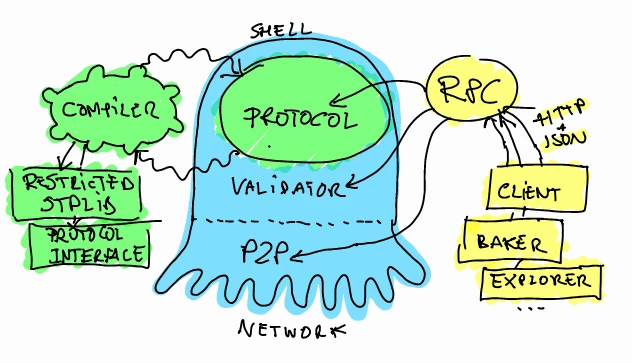
A rough diagram of the Tezos architecture. Source: tezos.gitlab.io
The shell itself recognizes three types of objects - transactions, protocols and blocks. Protocols are implemented as OCaml modules and there is a distinction made between network protocols, transaction protocols and consensus protocols. The shell handles the network protocol, leaving the other two to another component implementation. Transaction protocols describe what makes a transaction valid and the ways it could be executed - it is analogous to what is referred to as a "soft fork" in Bitcoin, or the attributes that a soft fork relates to, more specifically.
Each new block appended to the last one in the chain is also a state transition of executing the sequence of operations that block contains against the current state of the system as rearranged by the block before that. In the shell, state is represented via the Context module which encapsulates the relevant data in an immutable key-value store. Aside from the node, there is also the Tezos client which interfaces with the node through its JSON HTTP API and provides convenient access to the Tezos ledger, handling keys, addresses, etc. and also includes baker functionality. The client is what is usually also referred to as the wallet.
The Tezos ledger keeps track of stateful accounts (their balances, data and code contained within them, etc.) rather than chains of unspent outputs (UTXOs), more in line with Ethereum in that respect and less so like Bitcoin. Accounts are all generally referred to as contracts since an account is really a contract with no executable code in it. A contract has to have a balance of at least 1 tezzie to persist and gets destroyed when it falls below that.
An equilibrating relationship exists between staking ratio, reward and the market price of XTZ. Staking ratio and rewards are inversely correlated as the higher the proportion staked, the lower the rewards earned for validating blocks.
Contracts and OCaml-based DSLs (Domain-Specific Languages)
“The fact that his [Turing’s] Universal Machine had materialized mathematics allowed the reverse, to mathematize matter.”
- David Link, "Archaeology of Algorithmic Artefacts"
There are a number of high-level and domain-specific languages for expressing Tezos contracts to choose from, depending on preference and/or use-case specifics, and there will likely be more to come along as needs arise and specialization increases. All such languages compile down to the native Tezos low-level language called Michelson, which is based on OCaml. Tezos’ contract execution engine is a stack machine, similar to the Ethereum Virtual Machine (EVM), and Michelson is the Turing complete back-end language targeting it. While Ethereum is mostly split between dApp-oriented Solidity (which is somewhat object-oriented, but C and Javascript-like at the same time) and the more constrained and secure contract-centric Vyper, which implements Python 3 type syntax, Tezos makes use of a wider range of specialized languages, most of which are briefly explained further below.
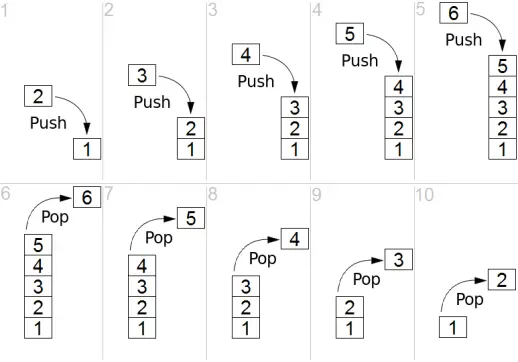
Simple representation of a pushdown stack and its runtime (with just push and pop operations). As an abstract data type, stacks operate on a LIFO ("last in, first out") accounting principle. Source: Wikipedia.
So-called Turing completeness or computational universality is really, in practice, an idealization since computers have finite memory, but also contracts running on the blockchain are bounded in time by limits set per block and per transaction (whether in Tezos, Ethereum, etc.) But since the number of steps in the execution of a contract is bounded in such a way, it makes it theoretically possible to reason about and predict the behavior of any given program/set of instructions for any possible input. The specific choice of functionally oriented and highly modular OCaml, in addition to opening the doors for formal methods and verification of code correctness (via theorem provers like the Coq proof assistant) are altogether crucially important properties for finance-oriented, failure-tolerant and mission critical distributed crypto-systems (an approach Tezos shares with Cardano).
Michelson: Core Logic and Syntax
Michelson is the low-level contract language for Tezos. Similar to the EVM it is stack-based which means that it doesn't use variables, but operates by directly transforming a set of data elements (the stack, an abstract data type that serves as a collection of elements stacked on top of one another, illustrated above) according to some sequence of instructions (a program), working on one or more stacks at a time. Everything in Tezos essentially translates down to stack manipulations carried out in Michelson (which can be tried out within the browser here).
The most significant difference between Michelson and the EVM is that Michelson is written in a human-legible text format, while EVM operations are represented in bytecode.For instance, opcode 01 in the EVM takes two numbers from the top of the stack and adds them together, while the equivalent operation in Michelson is written as ADD.
The seeming restrictiveness and simplicity of Michelson reflects Tezos' concept of a modular platform implementing discrete components and pieces of business logic and operational regimes rather than, for instance, Ethereum's concept of a generic "world computer". Code written in Michelson can also be reasonably analyzed (by SMT solvers), formalized and proven without the need for more complicated techniques and separation logic.
More information and example contracts can be found here.
Liquidity: Higher-Level Michelson with Local Variables
Liquidity is a higher-level language for programming Tezos contracts which has OCaml syntax (also provided with an alternative Javascript-like syntax) and comes with a complier for translating down to the Michelson constraints (from .liq to .tz). Unlike Michelson though it does use local variables for storing values instead of the low-level stack manipulations which aren't particularly intuitive or easy to work with from a human perspective. Liquidity makes use of high-level types and a type interface mechanism with polymorphism.
Overall, Liquidity is a user-friendlier language for writing Tezos contracts which is not directly Michelson. It's development is currently supported by the Dune Foundation (an independent, modified Tezos-based dApps platform) and Origin Labs. More information and resources (e.g., documentation, examples, etc.) can be found here.
LIGO: Layer 2 (Plasma) Applications and Logic
LIGO is an imperative high-level type language developed by Nomadic Labs that compiles down to Michelson and supports both Pascal-like and OCalm-like syntax and a simple type system. It is intended for the development of larger and more complex contracts than one would normally or naturally write in Michelson. It was born out of a necessity in the efforts to implement a plasma-inspired layer 2 solution for Tezos. Marigold, as is the name of the project, is based on fraud proofs enabled smart contracts and it currently implements the Minimal Viable Plasma spec which is a basic simple UTXO side chain.
The plasma and side-chains design space is to do with application-specific implementations which trade off some censorship resistance for the speed and low fees of applications that scale. And LIGO as a high-level language in Tezos is geared towards the development of such plasma-based side-chain dApps.
Smartpy: Pythonesque Contracts
SmartPy is a high-level smart contracts Python library that interacts with an OCaml library (SmartML) and comes with other related tools for ease of accessibility, understandability and provability of smart contracts on Tezos. As shown, it uses Python syntax due to it being widely popular and simple to work with and read/understand.
SmartPy functions as a Python framework with access to regular Python libraries and a set of built-in high-level primitives which a compiler translates to Michelson.
Archetype: Formal Verifications
Funded by the Tezos Foundation and developed by Edukera, Archetype is a Tezos DSL with specific focus on security and formal verifications. As the golden standard for a trustless guarantee of correctness, formal verifications consist in figuring out the mathematical proofs of specific properties (of a given contract or a program) as expressed in the formal logic of code. A formal mathematical proof is therefore a perfect trustless guarantee due to its automatic verifiability. Archetype provides the possibility to write the properties the contract is supposed to have and then generate it in whyml format for verification in Why3, a platform for deductive program verification.
Archetype treats contracts as state machines and supports the transcoding of contracts to one of the higher level languages (LIGO or Smartpy at the moment) or to OCaml under more specific circumstances. There is extensive documentation with many examples included.
Morley Framework: Michelson in Haskell
The Morley framework is a library that is a reimplementation of Michelson in Haskell that comes with a transpiler producing Michelson code from Morley contracts. Documentation is limited as the project is under active development.
Proof of Stake with Liquid Delegation
Tezos uses a kind of delegated PoS which is not to be confused with the model EOS, Bitshares or Lisk implement. While the latter require a fixed set of elected block producers for consensus, in Tezos delegation is optional (allowing for the transfer of validation rights without transferring ownership of tokens), aiming to maintain a dynamic set of validators (i.e. "liquid", as in what that implies in liquid democracy). Block publishing (called "baking" in Tezos parlance) rights are allocated on the basis of a randomized lottery and value staked in the system (a safety deposit collateral) and each block validated is also notarized (“endorsed”) by 32 other random stakeholders.
Delegates in Tezos compete based on fees, payout frequency, reputation, and other metrics and delegate misbehavior is quickly detected and responded to without much friction or delay. And importantly, delegation of baking rights is also bundled with voting rights (but without transfer of token ownership, as already said).
Protocol Amendment Procedure and Upgrades Having Taken Place So Far
The protocol amendment process is split in four discrete periods: proposal, exploration, testing and promotion vote periods, each lasting eight baking cycles (i.e., 32,768 blocks or about 23 days), together almost exactly three months from proposal to activation. Any failure to proceed to the next phase reverts back to a proposal period anew restarting the entire process.
Proposal period
During the proposal period bakers submit proposals on-chain via the proposal operation (taking "source", "period" and "proposals hash" as parameters - "source" being the submitting baker, "period" the specific proposal period in which the proposal was submitted and "proposal hash", the hash of the tarball of concatenated .ml/.mli source files).
Bakers may submit up to 20 proposals in each proposal period and upon submitting a proposal the baker is simultaneously also submitting a vote for that proposal equivalent to the number of rolls in his staking balance. Incoming proposals are monitored at the Tezos block explorer at tzscan.io. Proposals are voted upon via apporval voting, a kind of "upvoting".
Exploration Vote Period
In the exploration vote period bakers vote "yay", "nay" or "pass" on the most upvoted proposal from the previous period. If voting participation meets the quorum and 80% of non-abstaining bakers approve, the proposal proceeds to the next phase.
Testing Period
The testing period launches as a testnet fork running parallel to the Tezos mainchain and terminates after 48 hours. The testnet fork makes sure that the upgrade doesn't corrupt the context and should it be adopted that the network would continue to make valid state transitions. As 48 hours may not be sufficient to determine whether or not the proposal is worthwhile, it is likely to run off-chain for the remaining ~7.3 cycles where stakeholders evaluate and discuss the amandment to gain better knowledge and insight of its properties.
Promotion Vote Period
In the promotion vote period the network decides whether to adopt the amandment based on the off-chain discussions and the results and behavior of the fork during the testing period. Bakers submit their votes via the ballot operation, their votes weighted proportionally to their staking balances.
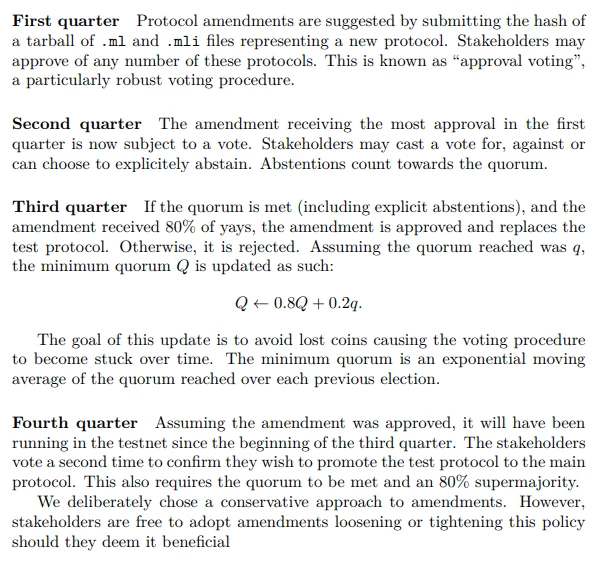
Protocol amendments procedure in Tezos. Source: White paper.
Athens: Gas Limit Increase and Minimum Stake Reduction
Athens was the first on-chain upgrade to take place on Tezos in late February 2019. It involved two incremental proposals, one to do with the increase of gas limit (allowing double the computation steps in each block while keeping the number of I/Os performed in each block unchanged) and the other with reducing the minimum stake amount a baker must have (called a "roll") to be randomly selected to propose or endorse a block (from 10,000 to 8,000 XTZ).
Additionally there were also some minor fixes and adjustments which do not involve any significant changes in the protocol.
Babylon: New Consensus and Michelson Improvements
The Babylon proposed protocol amendment was injected on July 26th and the upgrade officially took place on 18th October, marking the second time a protocol amendment has been approved and implemented through the Tezos governance mechanism. While Athens was fairly simple and straightforward, Babylon involves a new version of the Tezos consensus protocol (Emmy+) and significant improvements to Michelson.
Emmy+ moves a step closer to guaranteed finality (rather than probabilistic) and makes analysis from the point of view of proof construction simpler. Emmy+ takes some ideas from Tendermint, a variant of Practical Byzantine Fault Tolerance, re-implementing them on the basis of how they'd work in Tezos (i.e., Byzantine-fault tolerant state machine replication). Lambda expressions (anonymous functions without an identifier applied to compute something and/or passed to higher-order functions), a common functional programming idiom, is also introduced in Michelson, along with some improvements to gas accounting, type composability from other comparable types, distinguishing between networks with the CHAIN_ID instruction, etc.
Also, a clear distinction between regular (implicit) accounts and scripted (originated) accounts is introduced (said otherwise, a separation between user accounts and contracts).
Other Proposed Mechanisms in Consideration or Development
A number of modifications and necessary auxiliary mechanisms and designs have been proposed and/or modeled, such as for example a reliable stablecoin design to be used within the ecosystem or a treasury for the funding of non-protocol related efforts and endeavors.
Futarchy: Vote on Values, Bet on Beliefs
The Tezos position paper mentions implementing a form of futarchic governance as a possible development. Futarchy, as a term and a form of governance was introduced and proposed by economist Robin Hanson (fairly well known in the space and also advisor to the Augur project) and consist of an arrangement where elected officials define the measures and metrics of wellbeing, while publicly run prediction markets determine the best policies for fulfilling them. Or as Hanson himself puts it, "vote on values, but bet on beliefs." The idea being that while values should reflect the subjective preferences and goals of the group of stakeholders sharing the resource being governed, determining the policies best suited to achieving those goals is best left to a more “objective” prediction market.
Prediction markets, also known as information markets, decision markets, ideas markets, etc. are essentially a forecasting meta-tool for efficiently crowdsourcing predictions about outcomes of specific events (also sometimes referred to as distributed collective intelligence or "the wisdom of crowds"). Within the context of futarchic governance, a prediction market serves as a kind of advisory in the process of policy-making and is not necessarily tied to a financial market (even though implementing market mechanisms and logic). In the proposed implementation in Tezos, it is suggested that the initial approval voting on amendment proposals be replaced with a futarchic based ranking.
Treasury: Non-Protocol Related Subsidies
For the funding of endeavors other than protocol upgrades a treasury system has been proposed (which itself has to come from within a protocol upgrade). Smart contracts enabled platforms generally make it significantly easier to implement application logic on top and a treasury on Tezos would be represented by a special contract encapsulating its operational logic. Initially a very basic MVP (minimal viable product) is proposed, one with just support for multisigs and connected externally to a discussion board off-chain.
Stablecoin Design: Squared Over-Collateralization Model in Four Reserve Silos
A collateralized stablecoin design for the Tezos ecosystem has been recently proposed (USDtz), one guided by a set of criteria which state that the asset (designed to be price stable with respect to some reference point) should be redeemable to its peg (e.g., US dollar in this and most other cases) under all market conditions, that its liquid supply should meet serviceable market demand and its financial incentive dynamics should be in alignment among all participants (investors, DAO trustees, etc.) towards fulfilling the general purpose of the stablecoin as such.
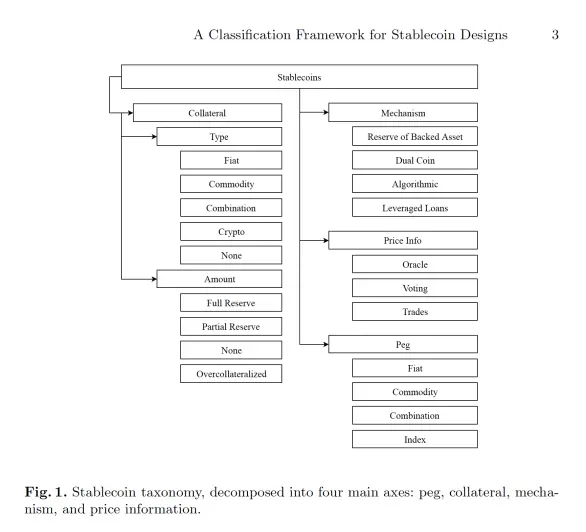
Source: "A Classification Framework for Stablecoin Designs"
USDtz is over-collateralized through two pairs of reserve silos - a fiat one and a crypto-backed one with corresponding backups for each in case either either one needs replenishing. A base fiat silo enables 100% redeemability and serves as a safety fallback so that no matter what may happen to the price of the digital asset or crypto market, the stablecoin will always remain stable while fully redeemable. The second silo, called "base XTZ", starts off empty, but through lending and baking/staking activities it grows in time with the prospect of eventually becoming independent and able to meet its own growth needs strictly from baking activities.
Marigold: Layer-2 Extended Plasma Implementation (Application-specific Side-chains)
Tezos has implemented its own layer-2 plasma-type solution and side-chains design space which sacrifices some censorship resistance for lower-to-negligible fees, faster transaction times and increased throughput capacity for scalable applications. In Plasma, first introduced by Vitalik Buterin and Joseph Poon in 2017, smart contracts that enable fraud proofs are instantiated on-chain, allowing arbitrary computations to be safely executed off-chain.
An implementation of the Minimal Viable Plasma has been released initially - a simple Plasma design restricted to basic UTXO transfers. In Marigold however mass exits are dealt with via delegation of UTXOs exit permissions (when a delegator leaves, all of their delegators’ funds leave at the same time).
As mentioned already, LIGO is a language built and tailored for developing side-chain applications on Marigold. Once having fleshed out the basics and foundation, the project will continue with integrating state-of-the-art research. These include privacy features (either through zk-SNARKs, mixers and/or homomorphic encryption like the one seen in the AZTEC protocol) and reducing protocol interactivity (ideally making it non-interactive) so that users don't have to monitor the chain at all - through an additional incentive layer, auxiliary state channels or recursive zk-SNARKs (similar to the implementation in Coda protocol).
Role and Purpose of the Tezos Project
"The power of a language, like the power of mathematics, consists not principally in its capacity to represent the world, but its capacity to signify itself to itself. This allows it to work on the world by working and reworking its own system of representation."
- Pryor Trotter, "Writing Medium Machine"
Tezos was developed in response to the overall lack of adequate governance mechanisms and models in the space at the time, recognizing how that in itself was a vulnerability and potential dangerous source of political centralization. The creators of Tezos recognized the primacy of social consensus and cultural norms early on before the series of hard forks that took place some years later. Tezos is an effort to formalize governance in alignment of decision-making with the interests of all network participants (stakeholders, bakers, developers, etc.) and towards advancing innovation in the field of decentralized peer-to-peer networks of value creation/circulation and automated record-keeping that accounts for the events taking place (i.e., the canonical ledger).
Digital crypto-assets and systems currencies tend to not be confined to national economies, central bank policies and geographic boundaries as wold currencies money are, but rather depend on the networks of relationships they form and the self-reinforcing dynamics of network effects and feedback loops they come to generate and reify. Tezos' fork-prevention mechanisms and regular continuous cycles of protocol upgrades ensures the capture of network effects while keeping the integrity of the system in making sure it doesn't split off into separate Balkanized coalitions due to some irresolvable community dispute, making Tezos a unified fork-free ecosystem the evolution of which follows the social consensus of the community as a whole.
Aside from the governance aspects, Tezos seems to be especially geared towards financial applications and services. The brining of formal verification to contracts in assuring their correctness with mathematical precision is indispensable to a field such as finance which cannot allow for any arbitrary errors, bugs going undetected or unpredictable behavior upon execution. The proverbial DAO hack comes to mind as the archetypal example - should the code been run through a theorem prover assistant or some such formal verification tool, the bug would have been caught before deploying the code live on-chain.
In some ways Tezos is a scientific organization living and operating in the digital realms of cyberspace and a democratically-driven innovation catalyst, making it one of the handful few projects in the space to actually bring something new on the table and have itself committed to the knowledge production of expertise in these emerging areas, fields and markets of complex trans-disciplinary interrelations and machinic-symbolic state transitions.
Standard interfaces for categories of assets (inspired by the Ethereum ERCs) are already in development (joint work between the Tocqueville Group, Serokell,
Related and Similar Initiatives
Tezos shares much of the same engineering philosophy and methods as Cardano (mathematical precision, functional modularity, etc.) and is similarly biased towards financial applications, but while Cardano is a diverse project with an ambitious grand vision Tezos is primarily focused on system governance in a balanced arrangement of relationships between network participants (users, investors, developers, validators, etc.) Nonetheless, Tezos seems to have really caught up technical momentum ever since its delayed official mainnet launch and especially over the past couple of months. And Cardano in terms of governance seems to have settled on a more elaborate implementation of an on-chain treasury system which functions as a separate component not embedded in the core protocol.
Regarding the social aspects and applications, including organizational governance protocols and mechanisms, Holochain is another ambitious project geared towards organizing collective intelligence and sense-making at scale. Although holochain itself is not blockchain-based (but builds on app/validation-specific distributed hash tables and agent hashchains) and forms only the data integrity engine for running distributed applications (as the base component of the larger and much more ambitious concept of Ceptr), it is nonetheless a framework for collectively run social applications - one that is agent-centric (as opposed to data-centric) and bio-inspired, doing away with the notion of network-wide global consensus and mapping out relationships instead in terms of the kinds of app-specific validation logic, the translations that take place between agents and applications and the kinds of crypto-accounting implemented in any given instance (currencies as "current-sees" or social flows made visible).
As a smart contracts enabled platform, it does to an extent overlap with all the other code executing blockchains with runtime environments, present and future. However, it must be pointed out that what is referred to with the catch all term "smart contracts" may/does include things sometimes quite conceptually different (and as Vitalik has also remarked, the term "smart contracts" is not really too accurate or apt and something along the lines of "immutable scripts" would be more befitting). Ethereum contracts, for example, are object-oriented representations of stack operations which essentially function like passive vending machines - with sequences of instructions triggered by outside input. IOTA's qubics, on the other hand, are more like functional "boomerang" expressions executing on streaming dataflows and dealing with probabilities and Bayesian approximations.
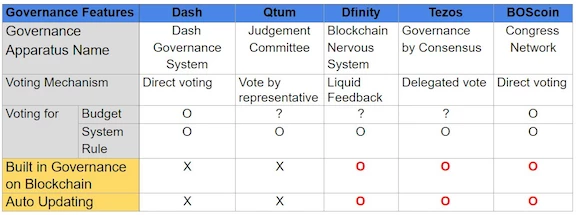
Platform comparisons. Red marked indicates affirmative.
In how they are functionally defined operations on data, Tezos' contracts may be loosely said to constitute something in between Ethereum's simple stack operations and IOTA's complex data processing capacities. Very similar in reasoning and logic to Cardano's Haskell-based Plutus and Plutus Core. And, crucially, similar to Cardano as well, formal verifications and proofs are made possible, something of utmost importance in mission-critical industries where too much is at stake.
Summary and Conclusion
"This field is cross-disciplinary. Have some epistemological humility otherwise you’ll sound like a moron.”
- T-shirt quote from an NYC Tezos meetup
Tezos can without a doubt be said to be one of the few genuine innovators in this space and the first to seriously tackle the problem of on-chain governance (as practice quickly showed that it is not just "all math"). By continuously undergoing community-driven upgrades and improvements and being introspectively self-referential in the rules of its modus operandi, Tezos ensures that no paralysis or stagnation takes hold and no political capture by any one group could take place. But no less importantly, it also leaves the door for future potential, possibility and choice always open with no strictly defined roadmap or final point of arrival. Cultural evolution, among us as humans, is what determines the direction of biological evolution. Similarly in Tezos, the kind of community and culture it grows to foster will determine how the system and its protocol will evolve and, who knows, perhaps eventually even end up playing a role in setting the course of biological evolution, the more pervasive these socio-technical assemblages go on to become.
Aside from that, it appears that Tezos is becoming part of the phenomenon of DeFi or "decentralized finance" (what some call the "crypto-finance fetish"). This is in itself a somewhat controversial development and both a bit of a low hanging fruit for distributed crypto-systems in general and at the same time one that makes a lot of sense in certain ways. But it must be remembered that financial instruments as such are sharpened for value capture more so than value creation. And we're hoping that these networks evolve to become networks of value creation and public good above all. Financial capital as such is a highly abstract and derivative form of capital, one that is mathematically expressed as a function on some underlying asset. And global financial derivatives constitute more than a quadrillion dollar market. That said, it is no surprise that the financial industry is as highly computerized and energy intensive, dealing with complex algorithms and handling enormous amounts of data (as because of its dealing with huge sums it has always had the fiscal resource to adopt breakthroughs early).
The record-keeping function of distributed crypto-ledgers and how they guarantee the integrity of data is hugely important to finance (and not just finance) in the longer term, but again, it should be reminded that finance as such is a field of practice supplementary to and in service of economics/economic order, its institutions and the economic theories which played a role in shaping them. And while technologies tend to democratize access and availability, this almost never leads to anything of much consequence, or least not at first and for some time. For some time until the potential implications of what has been brought about settle and suddenly trigger the imagination of what is possible beyond just reproducing existing models or trying to replicate past success, catalyzing a wave of innovation and change.
The machine-driven democratization of finance ought to similarly undergo a transformation of such sort and given its relation to probability and risk, decentralization and distributed (human or not) sensor networks potentially introduce a high degree of resilience and capacities for effectively managing organizational complexity at scale (also a reminder of how the 2008 financial crisis had, in an important way, been a failure in precisely organizational complexity of accounting for convoluted derivatives). Opening up these technologies to the public sphere and making them available as public services would most likely have an effect very different from the one where they're kept private and proprietary in creating the information asymmetries to take privileged advantage of. In that sense, financial engineering is a great instrument of power and influence and also at the same time a practice that is somewhat anarchic in its heuristic pragmatism (Feyerabend's universal principle of "anything goes").
Given the nature of governance on Tezos and assuming the growing importance and influence of its network in various key industries and fields, the value of being entitled to stakeholder rights within the system becomes immediately obvious. Vectors turn common resources into values by giving them magnitude and direction. Vectors are distributed and define production. Value-circulating peer-to-peer actor-networks likewise define their vectors and operational regimes, of what common resources they utilize, organize and mobilize in the machinic transformations and production of what kinds of value. And to change the channels that value and money flow through is to re-distribute social power. It is of little wonder how every technological revolution has always been accompanied by shifts in power balances and relations. Even if a little too far fetched a speculation, having the capacity to make choices and statements in the governance of Tezos will undoubtedly hold many benefits in the long term.
For some time on-chain governance had been widely considered vulnerable/susceptible to capture by concentrated interests, but usually taking projects like EOS or Lisk as an example and case in point, not taking into consideration the altogether different model Tezos implements. As even though it is possible that powerful voting coalitions could arise or that large, centralized entities like exchanges could end up becoming important/influential stakeholders in the system, users and token holders could still coordinate to rearrange power and hold concentrated interests accountable. This is made possible and facilitated to a large extent by the liquid PoS mechanism which ensures a barrier to entry low enough as to maintain a dynamic set of validators.
Voter participation in Tezos has boasted some of the highest in the industry, roughly approximating to 70–80% of all tokens staked (which, for comparison, is even higher than that of the European elections).






#/media/File:Lifo_stack.png)