
Two months ago I wrote about how, fed up with being the heaviest I’ve ever been, I began an intermittent fasting schedule known as OMAD (one meal per day). Also known as 23:1, I refrained from eating or drinking anything except water for 23 hours of every day, and then ate one healthy meal in the remaining 1 hour. I was shocked that I lost 9 pounds in one week, despite never feeling that hungry.
And so I continued with it, writing again how I lost an additional 11 pounds over the next 3 weeks (a total of 20 pounds in 4 weeks, despite being only 30 pounds overweight). Over the next 3 weeks, I kept at it, losing 7 more pounds with 23:1 intermittent fasting, while increasing my exercise routine of daily jogging and walking, and weekly weightlifting.
What I didn’t say before was that I was able to do this for 7 weeks because my family was out of town. Once they got back, they were shocked to see how much fitter I had become, which was satisfying. But their return also meant that one meal a day was no longer socially feasible. And so I decided to switch to a less restrictive intermittent fasting schedule: two meals a day via a 16:8 schedule (e.g., eat lunch at 11:00am and dinner at 7:00pm).
In the first week of switching from 23:1 to 16:8, I gained back half a pound—no doubt an adjustment of having to retrain my body to eat less per meal now that I was eating two meals instead of one. But I also noticed a jump in energy levels that enabled me to increase my exercise regime. As such, in the following three weeks, I lost another 3 pounds, bringing my collective total to 30 pounds shed in just 10 weeks.
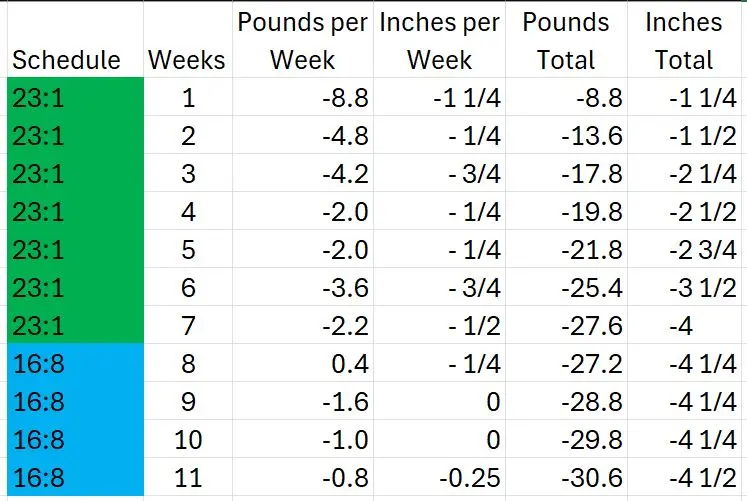
I had now hit my weight loss goal of returning to my high school weight. Additionally, I had shed 4.5 inches off my waistline. My old clothes fit again. I looked good in the mirror. But, most importantly, I just felt better. It was exciting, but the best part is I felt like I had finally cracked the code: fasting. I would now try to maintain this weight, and if I ever started gaining weight again, I could switch back to 23:1 intermittent fasting or even longer to quickly shed it.
At the very least, from here on out I will always adhere to a minimum 13-hour fast window (done easily by skipping breakfast), as it seems that, according to Dr. Mindy Pelz, 13 hours of fasting marks the threshold where our body starts to burn fat and make ketones to use as fuel (the “keto” in “keto diet” stands for ketogenic, referring to ketosis—the metabolic state where the liver converts fat into ketones that are then used for energy).
These discussions of fasting, ketosis, and the like led me recently to the "thrifty gene hypothesis", which was put forward by geneticist James V. Neel to explain the prevalence of diabetes in modern societies, noting that genes which predispose to diabetes (that is, the so-called "thrifty genes") were, in times of feast or famine, advantageous but that in contemporary societies with stable food production and distribution, they are disadvantageous. This hypothesis is undergirded by a recent research paper on genetic selection of certain traits in West Eurasian and European populations, one of which is selection for body fat percentage. It's interesting to think about how the human body has evolved over time.









