
As you know, I consider Bitcoin the best invention of the century, but I'm also following the developments of Ethereum and DeFi. Bitcoin is great for its simplicity (secure, decentralized, store of value), but if you're a degen, if you still believe (somewhat) in traditional finance, you shouldn't miss Ethereum's on-chain developments. Trading perpetuals, airdrop, RWA (NFT), yield, etc. The world of crypto and DeFi, in some ways, is a big casino, but that's also why it's so exciting: you can earn $1M with a token or an airdrop or lose everything to a hack.
NEW ETHEREUM ROADMAP
On July 4, 2026, Ethereum founder Vitalik Buterin published the new technical roadmap for Ethereum. This is a brief recap to understand where we're going. The new direction is called "Lean Ethereum" and aims for five things:
1) Faster L1.
2) Much more scalable L2.
3) Lower fees.
4) Innate privacy.
5) Resistance to quantum computers.
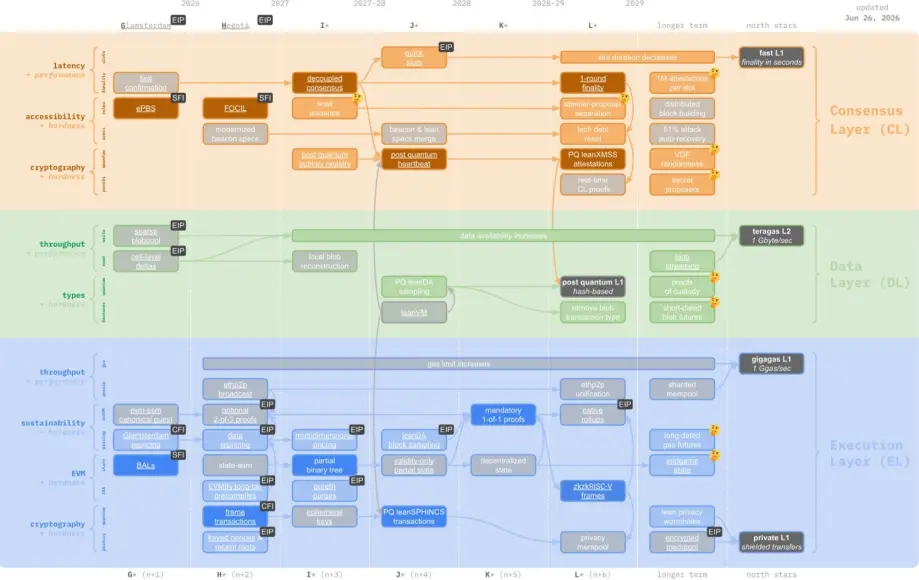
The future direction is to increasingly use cryptographic proofs, such as STARKs, to demonstrate that work has been done correctly without having to redo it every time. Less burden on nodes (STARKs weigh less than plaintext data), more scalability (lower speed and fees), and more verifiability.
Another huge point: privacy. If Ethereum wants to become a global settlement layer for DeFi, payments, stablecoins, RWAs, and institutions, it can't forever remain a system where every financial transaction is completely public. Privacy must become a native feature, not something external that relies on mixers or other sources, easy prey for regulators (remember Tornado Cash?).
What I'd like to add, as a personal opinion, is that privacy, today in 2026, is more important than ever. Governments, regulations, DAC8 (in the EU), MiCA, Travel Rule, etc., are making the sector unnecessarily complicated from a regulatory standpoint. All this, always remember, doesn't serve to protect investors but only to control, extort money, and tax. The argument made by governments is: "We're not early adopters in the sector, we don't understand it, Bitcoin is destroying the fiat toy we control with central banks. We can't stop it because it's decentralized, but we can discourage it with ever-increasing controls and taxes".
Regarding the more scalable Layer 1, in my opinion, this has advantages and disadvantages. While, from a certain perspective, it's the only way for Ethereum to compete with higher-performing blockchains (such as Solana), it has the drawback that lower fees create less demand for $ETH (this was the main driver of the major $ETH bull runs of 2017 and 2021).
Then there's the quantum issue. A blockchain that wants to last decades must, according to Vitalik, start preparing for that risk now, because changing the cryptography of a global protocol takes years. For the execution of this roadmap, we are talking about an update every 6 months and an expected time for final implementation by 2030.
Article always updated with all the possibilities of on-chain farming (airdrop): Some Sites To Earn Crypto Bonus (Old & New)





