
The culmination of economic and humanitarian travesties within the United States led the country into yet another war. However, this war wouldn’t be fought against a foreign enemy encroaching on their territory, affecting our economic status in the world, or taking place in war crimes. Instead, this war was fought between the same people who left Europe to escape political and religious persecution and in a country that was committing humanitarian travesties beyond measure. The war was fought between the Northern and Southern States inside the United States in the American Civil War. This war occurred from 1861 to 1865 in the United States and involved the Union in the North, which believed in ending slavery and its expansion, fighting against the Confederacy in the South, which wanted to maintain and expand slavery.
The central concern between the North and South that led to the political, social, and military efforts against each other was slavery, not other concerns some critics may bring up like states’ rights, industry vs agriculture, and so on. The Civil War led to social, political, and economic causes and effects that are important in our discussion and still affect us today through racism, economic imbalance, and American culture. Understanding the causes and effects of the American Civil War gives us insight into what lengths Money Changers and politicians will go to when struggling to preserve their wealth and power.
Before we jump into the impact and aftermath of the conflict, we will discuss the important causes and details leading up to this war that is unique and historical in nature. Unique to the American Civil War, as opposed to other wars was the major cause of ending slavery and its expansion inside of the United States. Territorial disputes, states’ rights, and human rights include some of the emerging forces that affected slavery and caused economic and political unrest within the United States. This turmoil became so troublesome that the southern states decided to break from the Union to start their own country to create its own political, economic, and social rules.
The issues of ending slavery and state rights did not arrive magically or suddenly inside the United States in 1861. Instead, it was an issue that gradually affected the United States more and more for decades before the culmination of this armed conflict. To understand these events, we will look through the life of a man who is often cited as the greatest American President to ever take office, Abraham Lincoln. We won’t be going into the details of every battle that occurred, because they don’t have important implications for our overall mission. Instead, we will be discussing the political, social, and economic impacts of slavery, important events leading up to the war that occurred, and how Money Changers were able to manipulate the circumstances of a nation to push forward their agenda of control and wealth, even if that means humiliating, murdering and owning an entire race of human beings.
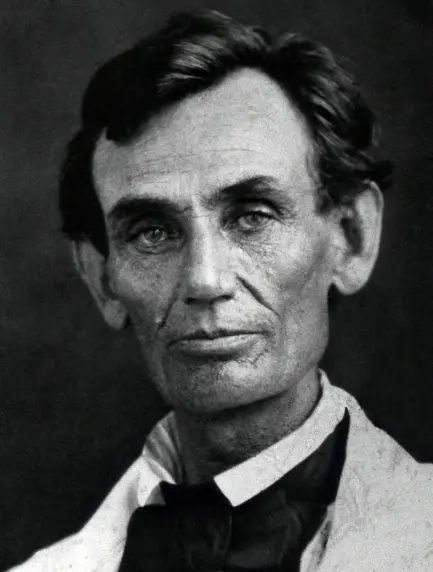
(Lincoln in 1858, the year of his debates with Stephen Douglas over slavery)
Looking through Lincoln’s lens, the future president was born in poverty in Kentucky in 1809 but spent most of his early life growing up in Indiana when the territory wasn’t developed. Living on the frontier, Lincoln was required to teach himself how to read and write at a young age while pushing out the boundaries of American life into the Midwest. When Lincoln wasn’t helping his family on the farm or around the house, he would study law and read important political and social documents from world history. After some economic and land struggles, his family moved to Illinois in 1830. Here Lincoln would become more involved in the growing industrial economy. In the Spring and Summer of 1832, Abe volunteered for militias in Illinois in the Black Hawk War where he would fight against Native Americans in the Midwest to expand the interests of the United States.
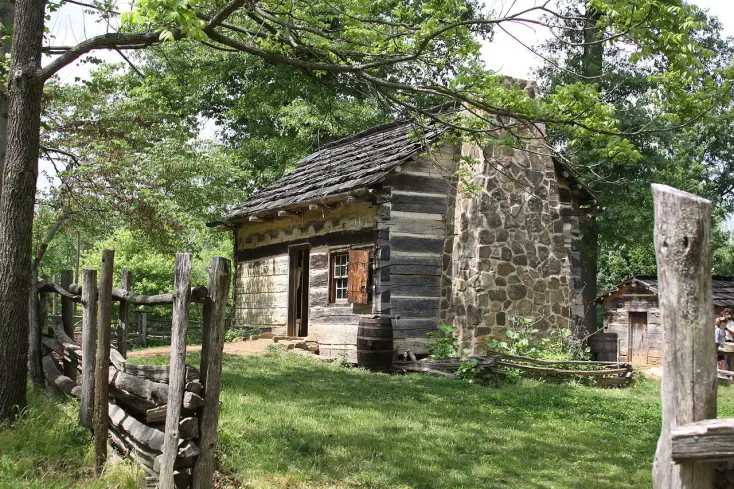
(The farm site where Lincoln grew up in Spencer County, Indiana)
After having success in battle, Lincoln returned to Illinois with some popularity and purchased a tavern in 1833 where he would sell food, drinks, and trinkets to travelers and locals passing through the area. The economy was booming during the time before the bubble popped in the Panic of 1837, allowing businesses across the United States, including Lincoln’s to flourish. However, after Lincoln’s partner became irate and an alcoholic Abe had to manage and operate the entire business himself, he was forced to sell his shares of the business because of increasing debt and changed his career path into something he was always interested in, politics (Blazeski, Goran. October 15, 2016).
To begin his career Lincoln ran for the State legislature in 1832 Illinois but was unsuccessful in reaching a political position. However, Lincoln was not discouraged by this loss and continued to study, learn on his own, improve his human capital and become a recognized politician in the process.
Lincoln’s next attempt at politics would come in 1834 when he represented the Whig political party. The Whigs were becoming more popular inside the US political scene during the middle of the 19th century because of their conservative social policies and expansive monetary policy that put wealth in citizens' hands. Now with the political and financial support of important Money Changers and politicians, Lincoln was able to gain enough endorsement to be nominated to the House of Representatives in Illinois. In the House, Lincoln went on to serve four consecutive terms where he would illustrate his position of anti-slavery, financial modernization, and investing in infrastructure. This mentality frightened some of his political supporters and opponents who believed slavery was necessary for American economic prosperity and that people of African descent were property. However, Lincoln didn’t allow his challenger's beliefs to define him and continued with his goal of rising to political power while allowing his morality and decision-making to be guided by the Declaration of Independence, the Bible, and other important philosophical works by some of the best thinkers in the world.
After ending his term in the Illinois House of Representatives, Lincoln’s next goal was to become a legislator in the US House of representatives to gain immense power and have the ability to directly influence law-making. During his initial campaign in 1844, Lincoln fell short, but he ran again in 1846 where he was successfully elected as a Whig to represent Illinois. In congress, Lincoln continued to make a name for himself by voicing beliefs on the creation of federal institutions, economic innovation, and abolishing slavery. Regardless of the opposition, Lincoln faced on his viewpoints on slavery, he continued to stand for what he believed was moral, regardless of what the law said.
One of the major events that took place during Lincoln’s term in Congress from 1846 to 1848 that had a large impact on the civil war was the Mexican-American war. At the time in the United States, Americans were expanding into the west and many of the inhabitants were eager to create new states defined by borders, so they could produce their own laws. An earlier controversy that started division was the Missouri Compromise in 1820 which created the 36 parallel. This compromise allowed Missouri, a state above the 36’ parallel, to be admitted to the Union as a slave state so long as Maine could be added as a free state in the North. The idea was that the 36th parallel, which is a degree of latitude, would represent a natural boundary that would prevent the expansion of slavery into the North. After Missouri and Maine were added the number of free and slave states were equal, giving each viewpoint equal representation in Congress. As more states were being added to the Union with the expansion of the frontier to the west, each free or slave state that was added was appeased by adding another free or slave to balance the power. The back and forth of newly created states and practice by politicians of appeasement was ineffective and led to additional political disputes, and territorial disputes and ultimately ignored the core issue of slavery while letting the tension build in the process.
One of these major territorial disputes that built up the tension in the United States was the Mexican-American war from 1846-1848. At the time James Polk was president of the United States, leaving him to decide the fate of America's involvement. During the war, Lincoln promoted anti-slavery and stayed out of the armed conflict. During some speeches, he openly spoke out against the Mexican-American war because adding Texas to the United States would mean another slave state would be added to the power imbalance in Congress and slavery could expand into the west. Lincoln received disapproval for his views on both sides of the aisle by those who believed adding Texas to the Union would increase the strength and reach of the United States, and eventually recanted his statements because of how much he was suffering politically.
The war was being fought over disputed territory that both Mexicans and Americans believed was rightfully theirs. When all was said and done, Mexico’s land mass was cut in half and the United States gained ownership of territory all the way to California. The war resulted in around 42,000 Mexican and American causalities including the women and children that were massacred during the altercation by American citizens and soldiers due to racism and religious prosecution of Mexican Catholics. Once again humans illustrated their lack of compassion toward others and highlighted their belief that land, property, and self-proclaimed prophecies are more important than human life.
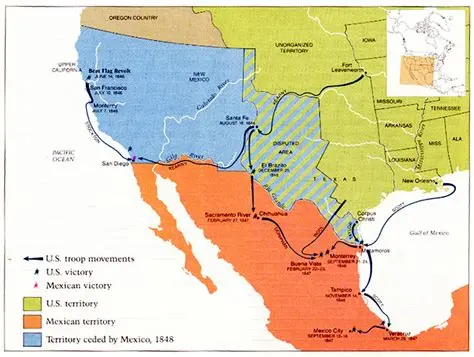
(Illustration of the territory United States gained in Mexican-American War)
Following the United States' victory in the Mexican-American War and gaining the territory of California, settlers in the frontier discovered a special substance that had been used as money for thousands of years. No, they didn’t find paper money with the presidents' faces on them buried in the ground, they found something more intrinsically valuable, gold.
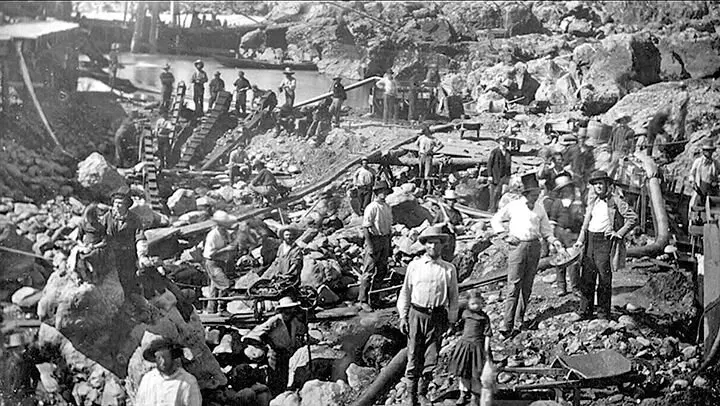
(Mining on the American River near Sacramento, circa 1852)
This started the Californian gold rush in 1848 which began an immediate urgency to migrate into the territory which gave California a bigger population than some of the most popular states in the Union at the time. Discovering gold in California significantly increased the money supply in the west and eventually made its way back to the East coach which allowed the overall economy to prosper. As a result, the territory urgently wanted to become part of the United States and after applying for statehood, they were able to join the Union after the Compromise of 1850. Aside from adding California as a free state, one of the important political ideas emphasized in the Compromise was the idea of 'Popular Sovereignty.' This philosophy dictated that as new states were added to the Union the individual states would have the ability to choose whether or not they would allow slavery inside of their respective state. The next two territories to apply for statehood inside of the Union were Utah and New Mexico. Both voted to become free states through popular sovereignty. Therefore, the balance was tilting in favor of the North leaving southern citizens to believe their only option was succession from the nation. Yet, southerners held off from leaving the country and attempted to reconcile with the North for the time being.
Getting back to Lincoln, after only serving one term in the US House of Representatives and understanding he wouldn’t gain the necessary support to be voted into the presidency, Lincoln supported presidential candidate Zachary Taylor. Taylor won the election in 1849 and became the 12th president of the United States after James Polk. Lincoln was offered unimportant positions in the Federal Government for his help in supporting Taylor. Lincoln declined and started his work as a lawyer where he litigated in the Illinois Supreme Court nearly 200 times and earned his famous nickname “Honest Abe”. However, Taylor would die only one year later and be succeeded by the 13th president of the US Millard Fillmore who served from 1850-1853, and the 14th President Franklin Pierce who served as US president from 1853-1857. During this time, Lincoln was focused on his law practice while gaining regional popularity and didn’t take open positions on Fillmore or Pierce’s presidency. However, one major event that did affect Lincoln’s eventual campaign for the presidency during this period was the Kansas-Nebraska Act of 1854.
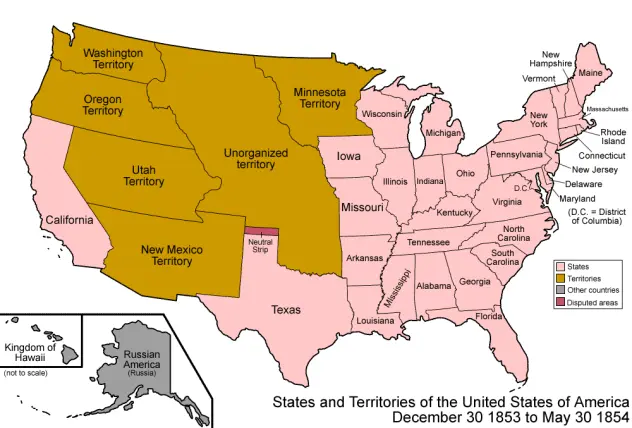
(The United States after the Compromise of 1850 and the Mexican-American War. Senator Stephen Douglas wanted to establish portions of the zone categorized as Unorganized territory).
This Kansas-Nebraska Act was passed to create and organize the two respective territories as states inside of the Union. The issue in this legislation was that Popular Sovereignty was used as the method for determining if Kansas or Nebraska would allow slavery inside of their borders, which could greatly swing congressional influence in Washington in favor of the expansion or contraction of slavery. The inhabitants in the surrounding area understood how the legislative influence could be persuaded by having two new states and four new senators in Washington and began to aggressively migrate to the region to try and establish pro and anti-slavery states through a vote.
This mass migration event turned violent in what’s known today as ‘Bleeding Kansas’. This armed conflict was an important predecessor for the civil war that and some historians recognize ‘Bleeding Kansas’ was the beginning of the Civil War. Nebraska was expected to be added as a free state and it was. However, the controversy arose in Kansas because of its immediate border with Missouri, which was a strong-willed slave state. When the bill passed in 1854, pro and anti-slave citizens from the surrounding area immediately began to pour into Kansas attempting to sway the vote in their direction. As a result, an estimated 200 political deaths, manipulation, and corruption slithered their way into the state (Finkelman, Paul. Spring 2011). The technical end of ‘Bleeding Kansas’ was 1861, however, open violence remained in the area until the end of the civil war.
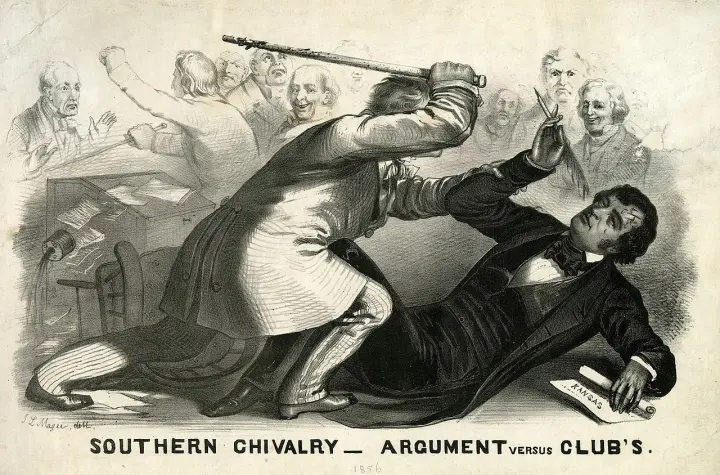
(Preston Brooks attacking Charles Sumner in the U.S. Senate in 1856)
In 1854 when ‘Bleeding Kansas’ was in its early stages, the Whig party was split on their support for slavery. The violence in Kansas further divided the party lines and portions of various political parties including notable Whigs and Know-Nothings started the Republican party which believed in ending slavery, financial modernization, and federal infrastructure projects. The divide between Whigs caused Abraham Lincoln to join and started the Republican Party in Illinois in 1856, the same year as an important presidential election. In this election, the republicans did not emerge victorious, but instead, democrat nominee and former Secretary of State James Buchanan took home a majority of the electoral college and became the 15th President of the United States. Inheriting a struggling country, millions of Americans were looking to Buchanan to help resolve the crisis.
One year into Buchanan’s presidency, a historic and landmark court case took place that further divided the country and led to the eventual succession of the south. In 1857, Dred Scott v. Sandford made its way to the supreme court. For context, one of the agreements emphasized in the Comprise of 1850 brought about by Henry Clay was a regulation called the Fugitive Slave Law. This law mandated that if a slave were to escape the south, then northerners could be tried in court, jailed, or fined for holding, protecting, or helping the escaped slave in any way.
This specific case involved Dred Scott, a slave who escaped the south and found liberty in a free state. Scott was then returned to his owner in the South by a northerner per the Fugitive Slave Law and Dred Scott took the case to a federal court to fight for his freedom, arguing that if Dred Scott lived in a state where slavery was not legal, then by definition he was not a slave. In this case, there was a 7-2 decision that denied Dred Scott his freedom so he would have to remain a slave. In that decision, Chief Supreme Court Justice Robert Taney believed, “(Black People) had for more than a century before been regarded as beings of an inferior order and altogether unfit to associate with the white race either in social or political relations and so far inferior that they had no rights which the white man was bound to respect and that the negro must justly and lawfully be reduced to slavery for his benefit.”
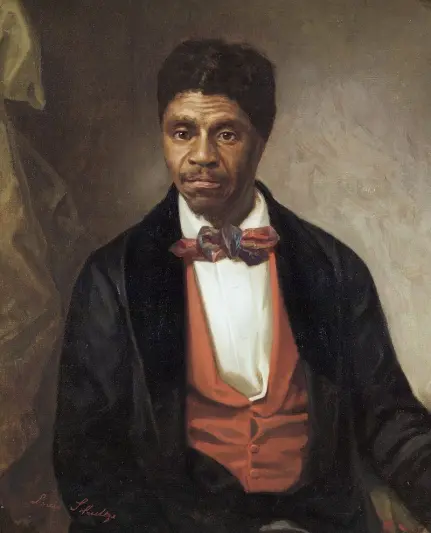
(Oil painting of Dred Scott)
Yes, that was an actual decision by an actual supreme court justice in the United States less than 6 generations ago. After the decision was made, research done by US historians revealed that President Buchannan played a large role in the decision made by the Supreme Court. Communications were discovered between Buchannan and numerous Justices that illustrated the President’s slanted view on having the supreme court ruled in favor of slavery and even to wait to make a ruling until after the presidential election to make ensure it wouldn’t be a topic of discussion during the campaign. (Maltz, Earl M. (2007). Faragher, John Mack; et al. (2005).
Such an important decision by the highest level of courts in the United States is actively manipulated by another branch of government illustrates that morality or laws should not be dictated, judged, or created by a small group of Money Changing and power-hungry individuals, regardless of political affiliation. It highlights the importance of society collectively deciding on what is right and wrong through compromise, bipartisanship, and coordination. The difficult part is finding the coordination mechanisms that are the most equitable and efficient.
During the time leading up to the civil war, there was a ‘conspiracy’ by republicans and abolitionists coined the ‘Slave Power’. Slave Power was the idea that southern states and democrats were part of a large political and social coordination game to empower slavery to generate and preserve their wealth. The term was coined by former slave and social reformer Frederick Douglas and the idea was used in the 1840s through the 1850s, and also by Abraham Lincoln in nearly all of his speeches during his campaign trials. Buchannan manipulating the supreme court is just one example of this conspiracy being true.
Taking a break from the social and political causes for a minute, another major event occurred in 1857 during president Buchanan’s first year in office that led to striking division in the polarization of the United States, the Panic of 1857.
The Panic of 1857 quickly spread throughout the United States and even parts of Europe because of the global economic growth, the entanglement of the global economy, and new technological innovations. A large bubble was forming in the economy from the gold rush in California, westward expansion, and the decision in Dred Scott V Sanford affecting confidence in the financial markets. The downfall in the market began after Great Britain began to pull out liquidity and over 15 tons of gold was lost at sea
During the early 1850s, westward expansion into the Midwest, Southwest, and California created new farmland, railroads, and settlements that were flourishing because of the large supply of specie that was entering the economy from the gold rush. However, toward the end of the 1850s, the supply of gold mined from the excavation sites began to decline, sparking fear to spread through the international economy that the supply of money would fall and debtors would be unable to pay back loans they have taken out. Once again, we can see the power the supply of money has on an economy.
In addition, the decision in Dred Scott V Sanford gave Americans the impression that slavery would be allowed in new western states that were above the 36’ parallel line, leading to large implications for the entire economy if this were to become true. The uncertainty and fear about the future economy led Money Changers to begin the process of taking profits, withdrawing their money from the system, making it more difficult to extend loans, requiring specie or land for collateral, and halting the practice of accepting paper currency for payment.
This combination of factors led to the value of railroads, stocks, and banks falling and, in some cases, going bankrupt, passing their losses on to the consumer and investors. For the businesses able to survive, they had to lower their pay, cut staff, or increase their prices, all leading to a slow down in the national economy. Another important contributor to the public losing confidence in the United States financial system was the largest Money Changers in Great Britain removing substantial liquidity from the United States and increasing interest rates to make obtaining a loan more difficult.
One of the major companies that failed was the Ohio Life Insurance and Trust Company. Historians state, “The failure of Ohio Life brought attention to the financial state of the railroad industry and land markets and caused the financial panic to become more public” (Calomiris, Charles W.; Schweikart, Larry, 1991). When Ohio Life and Trust failed, the company suspended payments for their claims, making so people who paid their premium for decades now being unable to get their insurance paid out. Money invested inside of the trust had vanished right before the client's eyes. The irresponsible nature of concentrated power and wealth leads to direct negative consequences for millions of individuals who produce real value for the economy time and time again.
The final straw that started the Panic was when “30,000 pounds of gold were lost at sea in a shipment from the San Francisco Mint to eastern banks. More than 400 lives were lost as well as public confidence in the government's ability to back its paper currency with specie.” (https://www.u-s-history.com/pages/h159.html). When news circulated that the gold was lost, numerous banks on the East Coast had to declare a bank holiday to avoid bank runs that would drain the banks of their liquidity because the fractional reserve banking system allowed them to loan out many more times paper currency than they had specie in reserves. The gold was eventually recovered in 1988 by a diving crew. The gold the crew found totaled around $100-150 million in value with a single gold nugget weighing 80 pounds and being worth over $8 million at the time. Tommy Thompson, the man who discovered the coins was sued by the creditors who loaned him money for a lack of returns on investment. Tommy Thompson went into hiding in 2006. In 2009 it was discovered he had an offshore bank account with around $10 million and in 2012 he was found and extradited to Ohio where a jury awarded the investors nearly $20 million in the court case.
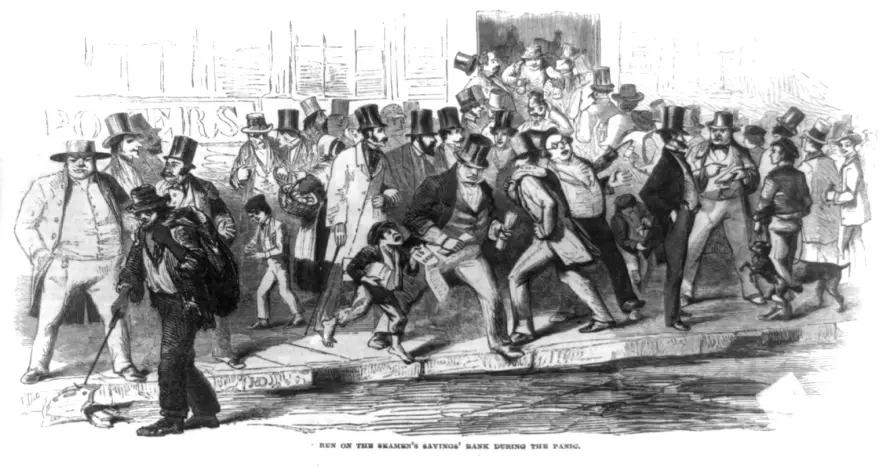
(Bank run on the Seamen's Savings' Bank during the Panic of 1857)
Getting back to the political setting, during the midst of the financial crisis Lincoln campaigned to become a US Senator, representing Illinois as a republican in the 1858 elections. During his campaign trail he would deliver one of the most famous speeches in history titled ‘House Divided’ where he stated, “A house divided against itself cannot stand. I believe this government cannot endure permanently half slave and half free. I do not expect the Union to be dissolved—I do not expect the house to fall—but I do expect it will cease to be divided. It will become all one thing or all the other."
The result of the election ended with the incumbent, Stephen Douglas winning; although Lincoln won a majority of the popular vote. This was a strong signal that Lincoln gained more prominence and popularity throughout the United States because of the famous debates that took place against Douglas. With this momentum, in 1860 with the prominence, Lincoln gained from his speeches, strong stature, and moderate attitude he would take a chance and run to become the 16th President of the United States.
Throughout the campaign, Lincoln did not give speeches or appear in public Instead relied on his followers to spread the word and support him organically. On the day of the election, Lincoln wasn’t shown on many southern states’ ballots. Even without the support of the south, Lincoln was able to prevail and on November 6th, 1860 Lincoln definitively won the popular vote and electoral college. Abraham Lincoln would become the first Republican President of the United States and before he entered office his peers understood his anti-slavery views that were illustrative throughout his legal and political career.
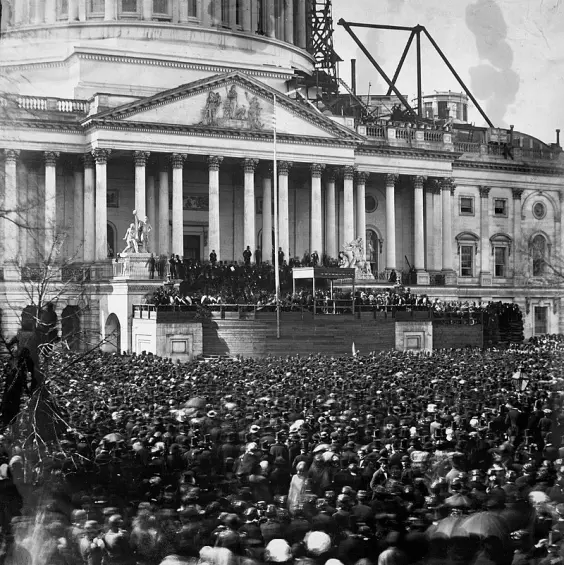
(Lincoln's first inaugural at the United States Capitol, March 4, 1861.)
Lincoln becoming president was the straw that broke the southern states back and immediately following President Lincoln being voted into office, Southern states, led by South Carolina, began the process of succession. 10 other slave states eventually joined them, with 4 border states remaining neutral. The outrage that persisted in the south was due to Lincoln’s threat of opposing the expansion of slavery and the southern state's political influence being endangered because of the imbalance of free and slave states, giving them congressional supremacy and the ability to pass laws that would go against the south’s interests.
President Lincoln wouldn’t accept succession and the Union wouldn’t accept Lincoln as president, therefore a civil war ensued. The fighting broke out in the South with the confederacy infiltrating the Union military Controlled Fort Sumter in South Carolina only 1 month after Lincoln officially took office in 1861. After the Union initially struggled because of poor military leadership, it would eventually become inevitable for the Union to emerge victorious because of the population size, advanced industry, and developed transportation systems. In addition, two years into the war Lincoln used his executive power to issue the Emancipation Proclamation which made over 4 million slaves in the southern confederacy free. This monumental law gave the United States the main goal of ending slavery as part of the objective of ending the war. Escaped slaves made their way to the North in troves and even some all-black military units were formed.
The Union was much more technically advanced than the south and industrialization were advancing in many Northern states with concentrated populations. Weapons, railroads, food, clothing, and other necessary military supplies were more accessible in the North because of this industrial development. The South did have advantages with great military leaders, such as General Robert E. Lee. However, even military prowess and experience could not defeat the efforts of individuals fighting for freedom and the advanced transportation and production systems of the North.
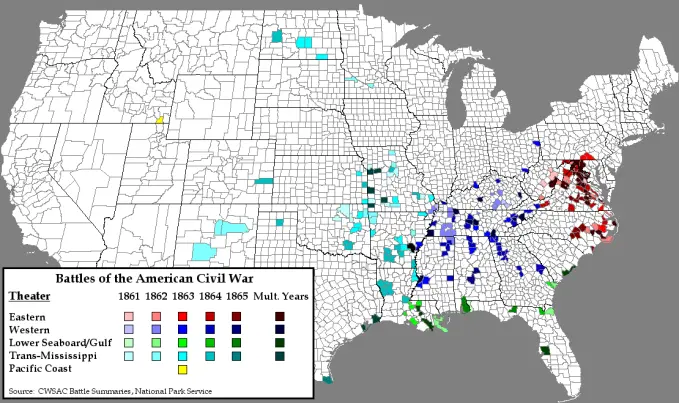
(County map of Civil War battles by theater and year)
On April 9, 1865, Robert E. Lee surrendered to Ulysses S. Grant effectively ending the war. The Civil War remains the deadliest war in American History with an estimated 600,000 to 800,000 thousand people fatally dying after the last shot was fired. The advanced technology sweeping the nation led to advanced weaponry, explosives, and ammo that was being used against brothers, cousins, and family in a war that was being fought with ancient war strategies to create a country that honored the principles it was founded upon. Six days after General Robert E. Lee surrendered to General Ulysses S. Grant in 1865, another monumental event happened in American history. The assassination of President Abraham Lincoln at the Ford Theatre on April 15th. However, before Lincoln died the country was able to pass the 13th amendment to the US constitution in January 1865, which abolished involuntary servitude within the United States, a large step in the right direction for America.
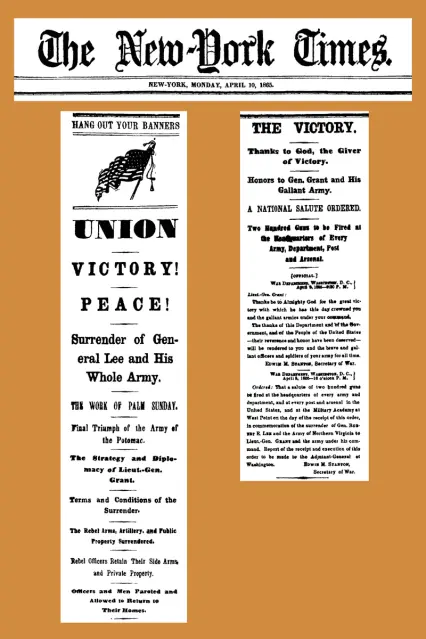
(The New York Times Article spreading the word of the Union Victory in the Civil War.)
Next section we will discuss the effects of the civil war, Lincoln’s assassination, financial implications, inflation, and more in the next section. To review we now understand some of the major causes and events leading up to the civil war, including the Slavery, Dred Scott, the Slave Power, the Kansas-Nebraska Act, the Compromise of 1850, the Missouri Comprise, and how Money Changers and political figures occupy an important role in determining the quality of life of everyday citizens. Yet, these individuals responsible for protecting us only care for maintaining and growing their wealth, a paradox. A new governance model is needed to create more equitable decision-making by the people who create real value in the economy and world.






