AI companies rent the chips behind their models by the hour, and changes in those rates can have a sizeable effect on their budgets. In this week’s PF Weekly, we examine whether Polymarket’s new compute markets can help businesses manage that bill.
Three Polymarket markets on December GPU rental prices had recorded about $2.51 million in cumulative trading as of today. The contracts ask how much it will cost to rent NVIDIA H100, B200 and B300 chips, with further markets extending into 2028.
For prediction markets, this is a useful test of commercial demand. AI companies have computing bills to manage, while GPU operators need to protect the revenues that pay for their equipment. Both have reasons to care about rental prices months before those prices arrive.
The bill behind the market
Compute, in this context, means access to the processing power used to train and run AI models. Renting a GPU creates an hourly cost. Multiply that rate by the number of chips and the hours they run, and relatively small price changes can matter to a business.
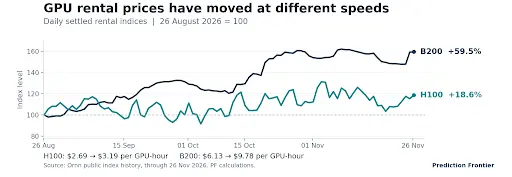
Ornn, the company whose rental-price benchmarks underpin these contracts, publishes a separate index for each type of chip. Its latest daily data shows why the cost matters. The H100 index rose from $2.69 per GPU-hour on 26 August to $3.19 on 26 November, an increase of 18.6%. Over the same period, the B200 index increased from $6.13 to $9.78, or 59.5%.
Ornn H100 data · Ornn B200 data
The same data contains sharp reversals. H100 daily settles ranged from $2.78 to $3.53 during the latest 30 observations. For an illustrative purchase of 100,000 GPU-hours, those two rates imply a $75,000 difference in cost. However, it’s worth noting a customer's actual bill would depend on its provider and contract terms.
What gives the compute market a plausible source of demand on both sides is that a buyer exposed to rising rental rates and a provider exposed to falling rates have opposite financial interests. Whether their actual exposure matches the benchmark is a separate question.
What the contracts are pricing
Polymarket's December H100 market contains a ladder of questions asking whether the month's average rental price will exceed particular thresholds. Under normal resolution, a Yes share pays $1 if its threshold is exceeded and zero otherwise.
The rules specify an arithmetic mean of finalised daily Ornn index values dated within December, rounded to the nearest cent. That detail matters: a jump on the last day alone would not determine the outcome.
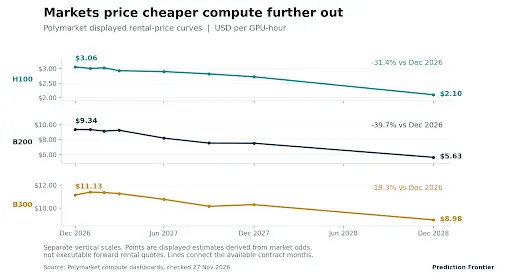
The separate threshold prices also contain information about the expected distribution of rental costs. Polymarket displays a summary of those odds as its Polymarket-implied Rental Price, or PIRP. Its H100 curve showed $3.06 for December 2026, $2.72 for December 2027 and $2.10 for December 2028 when checked on 27 November. H100 curve
The B200 and B300 curves also ended below their December 2026 starting points. From that baseline, the displayed December 2028 estimates were lower by 39.7% for B200 and 19.3% for B300. H100's decline was 31.4%.\
H100 curve · B200 curve · B300 curve
The curves give buyers a public reference for discussing future costs. They do not establish why traders expect those costs to fall. More supply, changing demand and newer hardware are possible explanations, but the displayed prices alone cannot distinguish between them. Nor should an estimate derived from market prices be treated as an unbiased forecast or a price at which a company can secure capacity.
Kalshi made the distinction between a curve and a tradeable instrument explicit in its July announcement. It described its curves as reference prices that could support swaps and private compute deals, with risk transfer available through the underlying contracts or block trades.
A commercial hedge has already been tried
On 2 June, Polymarket announced a six-figure block trade between FalconX and AneraLabs tied to H100 rental pricing. According to the announcement, it was an embedded hedge for a provider on the Anera Exchange, supporting a forward capacity contract for deliverable inference and offsetting renewal risk.
That is a more concrete use case than an investor expressing a general view on AI. A commercial capacity agreement created a financial exposure, and a prediction-market position was used to offset part of it.
The disclosure has limits though. It describes the transaction as six figures without giving an exact size or a breakdown of the hedge's economics and also does not establish how frequently businesses have repeated the trade.
Turnover leaves several questions unanswered
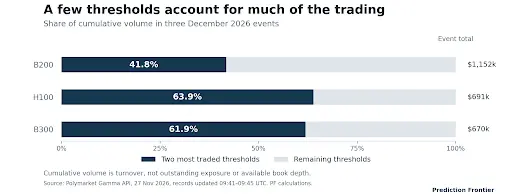
Our Polymarket API snapshot put cumulative trading in the three December events at approximately $1,151,976 for B200, $691,153 for H100 and $670,119 for B300.
Activity was also concentrated; two thresholds accounted for 63.9% of H100's cumulative volume, 41.8% of B200's and 61.9% of B300's. A buyer assembling a hedge across several prices and months would need liquidity in the particular contracts it uses.
Kalshi's displayed quotes illustrate a different constraint. In our sample, the December H100 contract above $3.00 showed a Yes bid of 53 cents and an ask of 88 cents, with 62 contracts quoted at each price. That is a 35-cent spread on a contract with a maximum $1 payout.
However, it’s worth pointing out that the quote is a snapshot of one contract and says nothing about the size available through a separately negotiated block trade.
Polymarket's API showed a much narrower 55–56 cent quote for its H100-above-$3.00 contract in the same Friday snapshot. We could not independently inspect its full order-book depth, so the narrow spread alone cannot establish how much a business could trade at that price.
The settlement definitions also differ. Polymarket's December contract averages finalised daily settles; Kalshi's monthly H100 rules specify an arithmetic mean of hourly Ornn values. A shared chip name and index provider do not make those contracts interchangeable.
Compute gives prediction markets a concrete business problem to solve. Buyers want protection against rising rental costs, while providers need predictable revenues. The next test is whether companies can trade meaningful size, at a sensible cost, in contracts that track their actual bills.
A financial payout can help manage that expense, but businesses still need to secure the GPUs themselves. Repeated commercial use will be the development that we’ll be closely watching at Prediction Frontier.