When traditional assets are brought on-chain, we often see excitement about the promise of easier access. Depending on the product, you can move tokenized assets between wallets, use new platforms, transact outside regular trading hours and own fractions of them.
There’s no doubt that moving an asset around is useful. But I’m also concerned about how I can sell it. Does exit work the same way across different tokenized asset classes? Who’s the buyer, and at what price and volume will they buy? Can a tokenized asset owner redeem directly through the issuer? When will investors get their money? Does an easy way in mean an easy way out?
These were the exact questions that served as the starting point for our research, Liquidity in Tokenized Assets. We conducted it in collaboration withRWA.xyz and included commentary from crypto analyst Michaël van de Poppe.
The biggest takeaway may seem as plain as day: liquidity in each tokenized asset class should be assessed through the conditions under which investors can exit. Asset value, holder count and transfer volume help describe a product’s scale and activity. But each needs context.
What the transfer numbers miss
We studied three tokenized asset classes, and AAPLx, one of the tokenized equities we examined, is the one I’d like to pause on. It had $6.28 billion in monthly transfers against $10.21 million in reported asset value. That striking ratio of roughly 615 to 1 was worth a closer look.
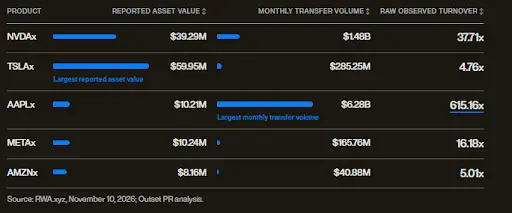
To understand what it says about liquidity, though, we need to look at what counts as a transfer. Transfer volume may include movements through exchanges, DeFi protocols and other infrastructure. That tells us how much tokens move, but not how easily an investor can sell. It’s like assessing demand in a store by counting how many people walk through the door.
How Treasury investors exit
Tokenized Treasuries show us quite a different picture. BUIDL had a reported asset value of $1.66 billion compared with $317.12 million for OUSG. For an investor, the terms governing access and redemption are of paramount importance.
We analyzed the documentation and found that the minimum investment for BUIDL is $5 million, while the minimum redemption is $250K. For OUSG, instant subscriptions and redemptions start at $5K, while non-instant subscriptions require $100K and non-instant redemptions require $50K. Both products also have investor eligibility requirements, so a lower entry threshold doesn’t mean access is open to everyone.
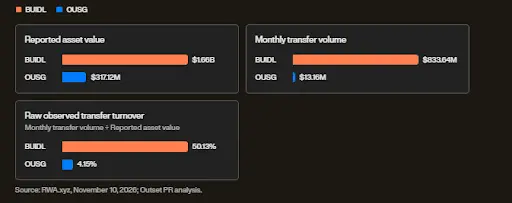
Investor exit here is primarily supported by redemption, stablecoin conversion and permissioned trading among eligible participants. That’s why the absence of a broad public secondary market, on its own, sheds little light on the liquidity available to a holder.
The documentation specified instant redemption limits for OUSG of $25 million per investor and $50 million globally over 24 hours. This is useful operating conditions information, but it doesn’t mean that the full amount is continuously available.
Another point is that an investor may receive stablecoins before the redemption or settlement processes are complete. For the investor, the exit is complete once the stablecoins are received. But when evaluating the product before investing, it matters how that early payout is funded and what could limit its availability.
Same gold exposure, different ways to cash out
As for gold tokens, they can be divided into tiny digital fractions, but issuer redemption may still require enough tokens for a whole bar.
PAXG and XAUT illustrate the difference. Eligible Paxos customers can convert PAXG into dollars without holding enough tokens for a whole gold bar. XAUT’s issuer-redemption route, by contrast, requires a full bar which can then be delivered or sold on the holder’s behalf.
Imagine holding $100 worth of either token. With PAXG, you may be able to exchange it for dollars through Paxos if you meet its requirements. But with XAUT, that amount is too small for issuer redemption, so you would generally need to sell on a trading platform. This is a bright example of how similar gold exposure has different ways to get your money back.
xStocks: Public quotes were available up to approximately $10 million
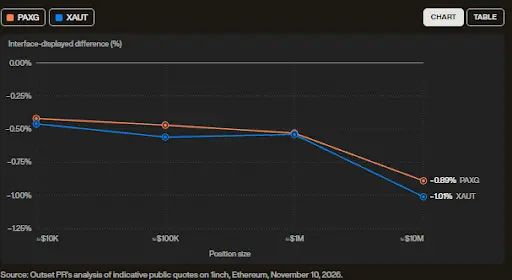
To complement the analysis, we collected public quotes for swapping PAXG and XAUT into USDC through 1inch on Ethereum. We tested approximate position sizes of $10,000, $100,000, $1 million and $10 million.
For positions up to approximately $1 million, the interface-displayed difference ranged from −0.42% to −0.56%. At approximately $10 million, it widened to −0.89% for PAXG and −1.01% for XAUT. PAXG showed a smaller negative displayed difference at each observed size.
Although these quotes were indicative and no trades were executed, they showed that two gold-backed tokens could display different exit pricing through the same platform. Gold backing alone doesn’t tell an investor what terms they will receive when selling.
Although these were again quotes rather than executed trades, we could see that public routes returned pricing for all five xStocks at position sizes up to approximately $10 million. Across the tested range, the interface-displayed differences stayed between −0.63% and +0.37%. This provides concrete evidence that large-position quotes were available through Jupiter during the observation window, alongside the issuer-redemption routes documented in the report.
Those quotes sit within a broader system connecting tokens to the underlying stock market. For investors, the question is also how independent the available exit routes are.
Several exit routes can still lead to the same door
In his commentary for the report, Michaël van de Poppe recommends that investors “evaluate these products like a fund manager would: start with the exit, then look at the return.”
He also points out that market makers may widen spreads or step back during periods of stress. Our study didn’t test those conditions, but his observation raises another question for me: how independent are the available exit routes?
Three signposts can lead to the same door. Different platforms or mechanisms may rely on the same intermediaries, collateral and settlement infrastructure. The number of options alone doesn’t tell us how the system would handle many investors wanting to cash out at once. We need to understand what supports each route.
Liquidity needs more than one metric
After this research, I’d be more cautious about describing liquidity across the entire tokenized-asset market with a single metric. For a tokenized Treasury fund, redemption terms and access to settlement facilities may be decisive. For a gold token, secondary trading and the issuer’s redemption options matter. For a tokenized equity, the assessment also depends on routing and the connection to the underlying stock market.
So the question I’d start with would be like this: if I need to close this position, who will make that exit possible, on what terms, and how long will it take?
Read the full Outset PR × RWA.xyz report featuring commentary from Michaël van de Poppe