Hola, saludos a todos, este artículo será la conclusión de una triada de artículos dedicados a buscadores web. Los artículos anteriores fueron "4 buscadores web Mexicanos actuales" y "5 buscadores web que respetan la privacidad del usuario" que les invito a leer si no han tenido oportunidad y sean bienvenidos a este nuevo artículo.
Lamentablemente como vimos en el artículo anterior, el panorama en el campo de buscadores web en México no atraviesa por su mejor momento, pocos son los buscadores que se mantienen en pie y muchos de ellos se han quedado en el camino y la situación no es muy diferente para buscadores creados en otros países hermanos. He aquí cuatro buscadores nacidos en México o Hispanos con filiares en México que no lograron consolidarse en el mercado y en su momento presentaron buenas propuestas.
Yupi
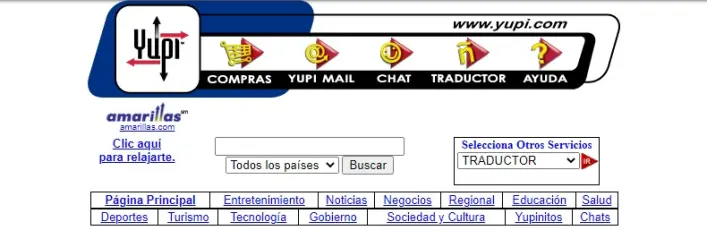
A medio camino entre un buscador web y un portal (no es lo mismo: un buscador web agrega sitios en la red a su base de datos y permite localizarlos fácilmente gracias a sus funciones de búsqueda, mientras que un portal aglomera varias funciones en un mismo sitio; por ejemplo noticias, horóscopos, salas de chat, secciones exclusivas para suscriptores y claro, algún buscador web en algunos casos). Todavía existe pero ahora ya es una tienda online para comprar principalmente ropa.
Podemos encontrar rastros de este buscador en Wayback machine desde el año 2000 (cuando estaba en su momento el apogeo web para muchas empresas), aunque de acuerdo a la propia web fue fundada en 1997. Llego a tener filiares del mismo portal en varios países, por lo que la extensión .com.mx era para contenido exclusivo para México y a la vez había contenido para países como Argentina, Colombia, Ecuador, Estados Unidos, España y como ya mencionamos, México.
Además tenía bajo su control el portal web "Ciudad futura" (y que todavía existe, hablaremos de ello en un próximo artículo), parecía que la empresa estaba muy fuerte, pero "¿qué sucedió con Yupi?".
Aunque tenía mucho contenido y de diversos tipos para competir con otros grandes de la época (un buscador web propio además de noticias, e-mail, videos, secciones de entretenimiento y deportes) terminó siendo comprado por Telmex y Microsoft que en los inicios del 2000 buscaban hacerse un hueco con el portal T1MSN. A partir de ahí Yupi ya entró en declive y en Wayback machine no hay nada para ver su evolución e incluso su versión Mexicana terminó convertida en el sitio web de un salón de fiestas infantiles (en el 2016) para terminar ahora como una tienda online.
El portal oficial se transformó en http://www.yupimsn.com desapareciendo a finales de la primer década del 2000 y actualmente tanto YupiMSN como Yupi ya no existen (estando a la venta actualmente), solo la versión MX y ya como una empresa totalmente distinta de sus inicios.
Ozú
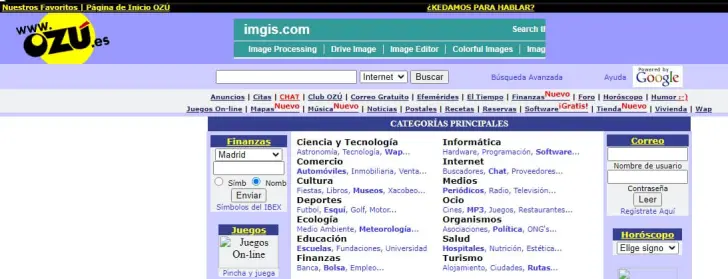
Otro buscador internacional (España) con filiar en México que corrió con una suerte similar a Yupi, es decir, terminaron convertidos en otra cosa muy distinta a su origen. Ozú fue un buscador web que fue desarrollado por la empresa homónima a inicios de los años 2000, este motor de búsqueda ofrecía resultados de búsqueda en español además de tener contenido muy diverso en el portal web (algo muy común en aquellos años) teniendo su pico de popularidad en la década de los 2000, "¿qué fue lo que pasó con Ozú?".
Al igual que Yupi, Ozú también fue comprado por otras empresas hasta que llegó el momento en que ya no era rentable y en el 2012 vino su cierre, su contraparte Mexicana desde el 2021 (fuente Wayback machine) es ahora el sitio web de una empresa Mexicana dedicada al manejo de metales (sí, lo mismo le pasó a la versión mexicana de Yupi).
Simploos
Con una fecha de arranque más reciente (2008) la empresa tras el lanzamiento de Simploos proponía un buscador web mucho "más llamativo". Para ello se recurría a Flash, lo cuál tenía sentido en los primeros años de la década del 2000, los sitios web de aquel entonces eran increíbles, se podía poner todos los efectos que quisiéramos, podíamos crear sitios totalmente originales y en general era de lujo navegar por estos portales de hace 20 años.
"¿Qué fue lo que pasó?", hace algunos años atrás escribí este artículo ("El fin de una era - hasta siempre Flash :(") y pues para ese entonces Flash ya simplemente había pasado de moda, ya ningún navegador web quería darle soporte, le salieron problemas hasta de debajo de las piedras y ya no había nada que hacer. Aunque no me tocó conocer Simploos en sus primeros años, estos tuvieron que abandonar el uso de Flash para pasar a un buscador web "más convencional", pero a la vez ya las cosas no iban muy bien. Si miramos esta entrada de Wayback machine del 2015 veremos que ahora ya se trata de un buscador de empleo y no un buscador web general como en sus inicios.
Lamentablemente esto tampoco funcionó y terminó cerrando este buscador web made in México en el 2018.
Buscamas
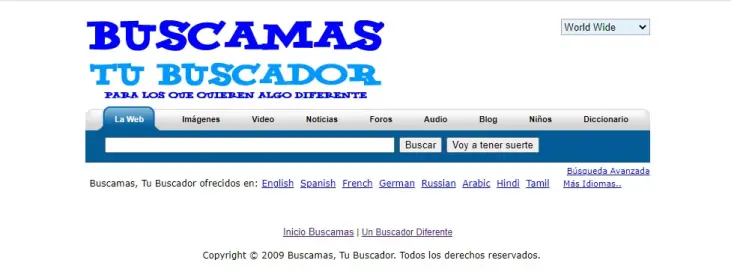
Buscador de origen latino (Perú tengo entendido) que si bien su interfaz es muy similar a Google y otros buscadores minimalistas tenía una propuesta "diferente". Normalmente si un anunciante quiere destacar a las primeras posiciones del buscador debe pagar, bueno, aquí era lo mismo, solo que una parte de la inversión iba a los editores, es decir nosotros nos afiliábamos a su sitio, mostrábamos sus banners en nuestra web y por cada clic válido nos pagaban algo (algo así como los anuncios de Adsense de Google).
Lamentablemente y a pesar de tener soporte para múltiples idiomas el proyecto no terminó de funcionar, en Wayback machine vemos actividad desde el 2009 hasta el 2016, para terminar siendo comprado el dominio por una empresa asiática que solo buscaba meter publicidad al por mayor y actualmente el sitio se encuentra en venta.
Conclusiones:
Las versiones latinas de buscadores web no la tienen fácil, algunos tuvieron sus años de gloria a inicios de los 2000 y terminaron siendo comprados cuando estaban en su mejor momento, pero la mayoría de las empresas que los adquirieron o no supieron seguirlos explotando o cuando vieron que ya no eran tan rentables se deshicieron de ellos.
Ahora algunos todavía existen, pero ya no tienen nada que ver con lo que fue hace 20 o más años atrás, una lástima pero pues como dije hace un momento, no es fácil es un campo tan competido y sobretodo dominado por Google. Si les ha gustado este artículo por favor dejen sus comentarios al respecto, muy agradecido de antemano.
Hello, greetings to every one, this article will be the conclusion of a triad of articles dedicated to web browsers. The previous articles were "4 current Mexican web browsers" and "5 web browsers that respect user privacy" that I invite you to read if you haven't had the opportunity and welcome to this new article.
Unfortunately, as we saw in the previous article, the panorama in the field of web search engines in Mexico is not going through its best moment, few are the search engines that remain standing and many of them have fallen by the wayside and the situation is not very different for search engines created in other brother countries. Here are four search engines born in Mexico or Hispanics with subsidiaries in Mexico that failed to establish themselves in the market and at the time presented good proposals.
Yupi
Halfway between a web browser and a portal (it's not the same: a web browser adds web sites to its database and makes it easy to locate them thanks to its search functions, while a portal bundles several functions into one site; for example news, horoscopes, chat rooms, exclusive sections for subscribers and of course, a web browser in some cases). It still exists but now it is an online store to buy mainly clothes.
We can find traces of this search engine in the Wayback machine since the year 2000 (when the web was at its heyday for many companies), although according to the web itself it was founded in 1997. It came to have affiliates of the same portal in several countries, so the .com.mx extension was for exclusive content for Mexico and at the same time there was content for countries like Argentina, Colombia, Ecuador, the United States, Spain and, as we already mentioned, Mexico.
He also had the "Future City" web portal under his control (and that it still exists, we'll talk about it in a future article), it seemed that the company was very strong, but "what happened to Yupi?".
Although it had a lot of content and of various types to compete with other greats of the time (its own web search engine as well as news, e-mail, videos, entertainment and sports sections) it ended up being bought by Telmex and Microsoft, which in early 2000 They were looking to gain a foothold with the T1MSN portal. From then on, Yupi went into decline and in the Wayback machine there is nothing to see its evolution and even its Mexican version ended up becoming the website of a children's party room (in 2016) to now end up as an online store.
The official portal became http://www.yupimsn.com, disappearing at the end of the first decade of the 2000s and currently both YupiMSN and Yupi no longer exist (being currently for sale), only the MX version and already as a company totally different from its beginnings.
Ozú
Another international search engine (Spain) with a branch in Mexico that had a similar fate to Yupi, that is, they ended up becoming something very different from their origin. Ozú was a web search engine that was developed by the company of the same name at the beginning of the 2000s. This search engine offered search results in Spanish as well as having very diverse content on the web portal (something very common in those years) having its peak of popularity in the 2000s, "what happened to Ozú?".
Like Yupi, Ozú was also bought by other companies until the time came when it was no longer profitable and in 2012 it closed, Mexican counterpart since 2021 (Wayback machine source) is now the website of a company Mexican dedicated to handling metals (yes, the same thing happened to the Mexican version of Yupi).
Simploos
With a more recent start date (2008) the company after the launch of Simploos proposed a much "more striking" web search engine. To do this, Flash was used which made sense in the early 2000s, websites back then were incredible, you could put all the effects you wanted, we could create totally original sites and in general it was luxurious browse these portals from 20 years ago.
"What happened?", a few years ago I wrote this article ("The end of an era - forever Flash :(") and well, by then Flash had simply gone out of style, no web browser wanted to give him support, problems came up from under the rocks and there was nothing to do. Although I did not get to know Simploos in its early years, they had to abandon the use of Flash to move to a "more conventional" web browser, but at the same time things were not going very well. If we look at this entry from the Wayback machine from 2015 we will see that now it is a job search engine and not a general web search engine as in its beginnings.
Unfortunately, this did not work either and ended up closing this web search engine made in Mexico in 2018.
Buscamas
Search engine of Latin America origin (I understand Peru) that although its interface is very similar to Google and other minimalist search engines, it had a "different" proposal. Normally, if an advertiser wants to stand out in the first positions of the search engine, they must pay, well, here it was the same, only that a part of the investment went to the publishers, that is, we affiliated with their site, we showed their banners on our website and for each valid click we were paid something (something like Google's Adsense ads).
Unfortunately and despite having support for multiple languages, the project did not finish working, in the Wayback machine we see activity from 2009 to 2016, to end up buying the domain by an Asian company that only wanted to put wholesale advertising and currently the site is for sale.
Conclusions:
The Latin versions of web search engines don't have it easy, some had their glory years at the beginning of the 2000s and ended up being bought when they were in their prime, but most of the companies that acquired them either did not know how to continue exploiting them or when they saw that were no longer so profitable they got rid of them.
Now some still exist, but they no longer have anything to do with what they were 20 or more years ago, a pity but as I said a moment ago, it's not easy in such a competitive field and above all dominated by Google. If you liked this article please leave your comments about it, thank you very much in advance.





