I've spent enough time in DeFi to know that chasing the highest advertised APY isn't always the smartest move.
Sometimes the more interesting question is how the protocol actually generates its returns and what happens to your capital after you deposit.
Atoma takes a different approach to deploying USDC. Some may say it's easier but I still recommend DYOR before depositing!
Instead of simply relying on a directional bet on the market, its strategies use balanced long and short positions across different trading venues.
The objective is to capture opportunities created by price differences, funding rates and trading spreads while keeping directional exposure neutral.
In simple terms, the strategy isn't built around predicting whether BTC, stocks or commodities will go up or down. That doesn't mean there is no risk!
This system offers a different way of approaching USDC deployment. Atoma offers two separate vaults rather than forcing everyone into the same strategy.
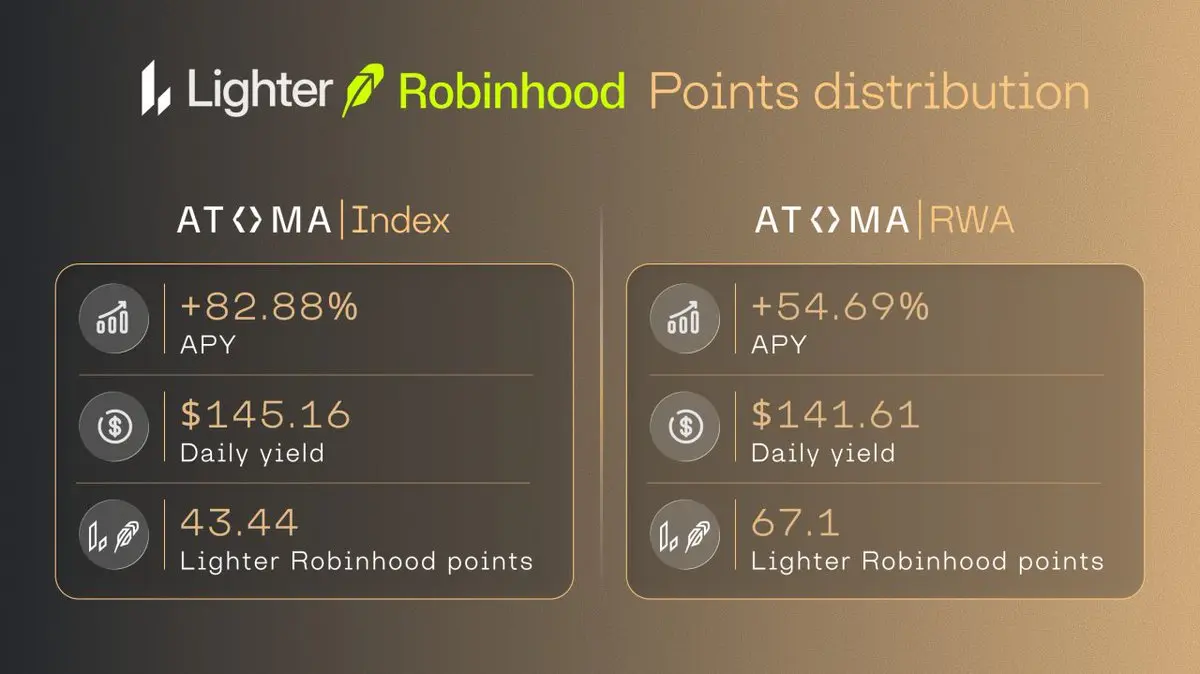
Atoma RWA is more focused on trading returns. It trades stock and commodity perpetuals, primarily using platforms such as Lighter and Trade.
Its strategy operates through shorter epochs, with trading performance taking priority and points providing an additional incentive.
Atoma Index takes a different approach. It rotates capital across more trading venues and focuses more heavily on accumulating venue points through hedged positions.
Its longer epochs reflect that different objective. Both vaults qualify for the Atoma Genesis Points Boost, but the underlying priorities are not identical.
Understand before allocateing capital. One is more return-focused, while the other places greater emphasis on participation and venue points.
There's also another layer to the ecosystem. Depositors can potentially benefit from several sources of activity.
These include USDC trading returns, Atoma Points earned through holding vault shares and venue points generated through supported trading platforms.
Supported ecosystems include Lighter, Robinhood, Extended, Trade, Entropy and QFEX but the Atoma Points and venue points operate independently.
The Genesis Points Boost applies to Atoma's own points system, not the external venue rewards. Getting started is relatively straightforward.
Connect a wallet on Arbitrum, explore the two vaults, select the strategy that matches your objectives and deposit USDC.
Depositors receive vault shares representing their position and can monitor activity and NAV through the application. Job done!
You don't need to manually manage long and short positions across multiple exchanges. The vault handles the trading activity through its underlying strategy.
There are a few practical details worth understanding before committing capital. Withdrawals are not instant and settle after the relevant vault epoch.
A 0.5% withdrawal fee also applies, and requesting a withdrawal stops further points accumulation on the withdrawing position.
I also appreciate the emphasis on transparency. Atoma publishes NAV onchain approximately every hour and provides public protocol statistics.
That doesn't remove the risks associated with smart contracts, trading venues, liquidity or execution, but having information available makes it easier to understand.
I think Atoma is worth looking because it combines several DeFi concepts into one experience. Two vaults, automated hedging and USDC deployment.
I'm not interested in blindly chasing another points campaign. I want to understand where the capital goes and how returns are generated.
Alpha stuff:
InfoFi Campaigns: Nucleus / Hazels / RareList
Play2Earn: Splinterlands & Holozing
PVM The Author - My Amazon Books