After 11 Days of Turmoil, Nvidia Has Got Its Key Leader Back, but the Structural Cracks Within the Company Have Not Disappeared.
In my first article, I wrote that Jensen Huang is literally at the top of the company's hierarchy, even if the era of his absolute operational freedom has come to an end. In my second article, I noted that his sudden resignation on November 12 did not trigger immediate operational chaos within the company, but instead, real chaos began building from the outside.
Honestly, after writing so many articles, I thought nothing in this entire situation could surprise me anymore and that I would not have to write another Nvidia article anytime soon. But just 11 days later, the entire situation took a sharp turn. On November 23, Nvidia's board of directors officially reinstated Jensen Huang as CEO and president.
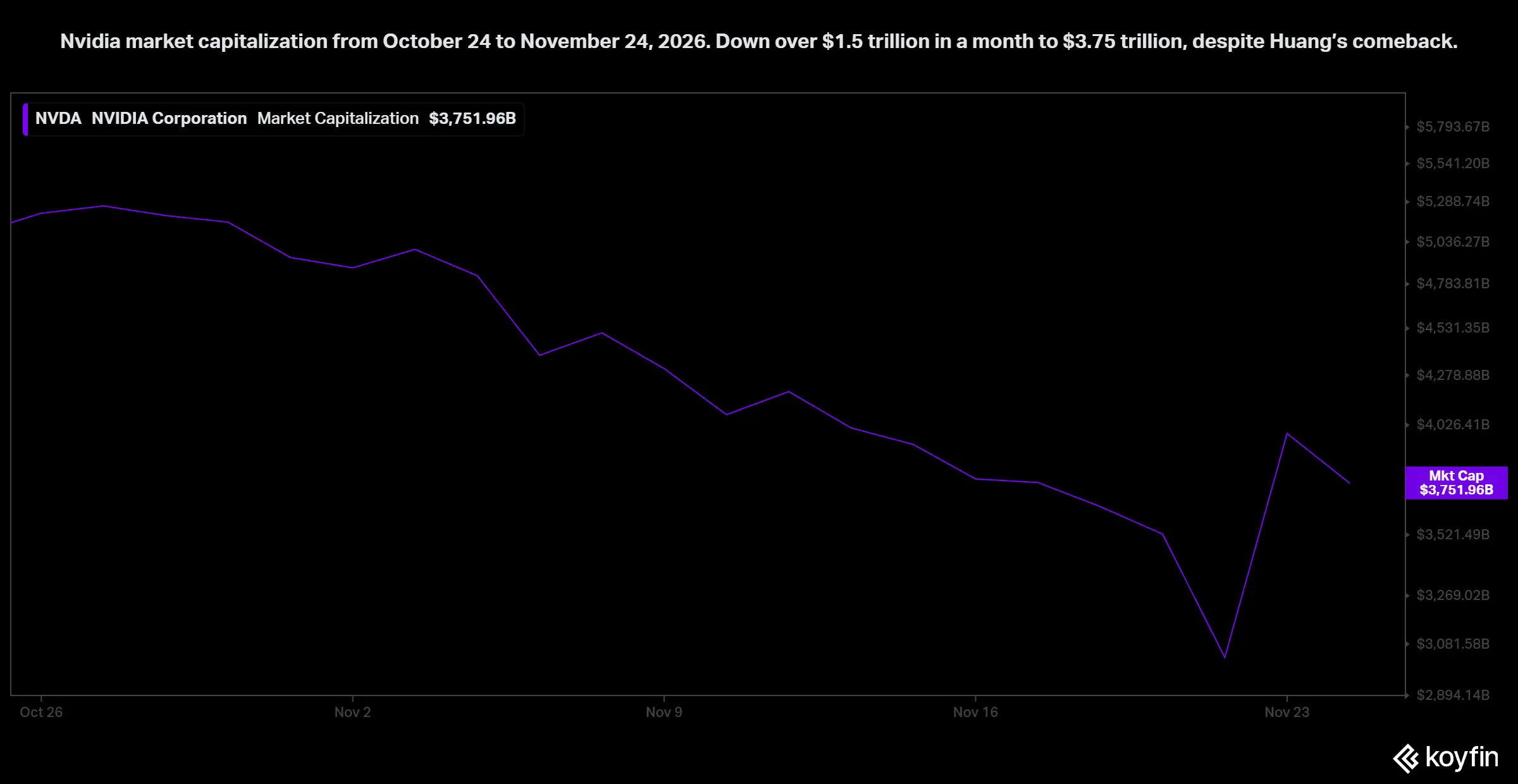
I have not seen this many headlines across the business community in quite some time. All the news revolved around shares surging by 31%, adding nearly $950 billion to the company's market capitalization in a single trading session. However, just one day later, on November 24, the entire emotionally driven market pulled back, with shares falling by almost 6%. Nvidia itself still remains approximately 30% below its October highs.
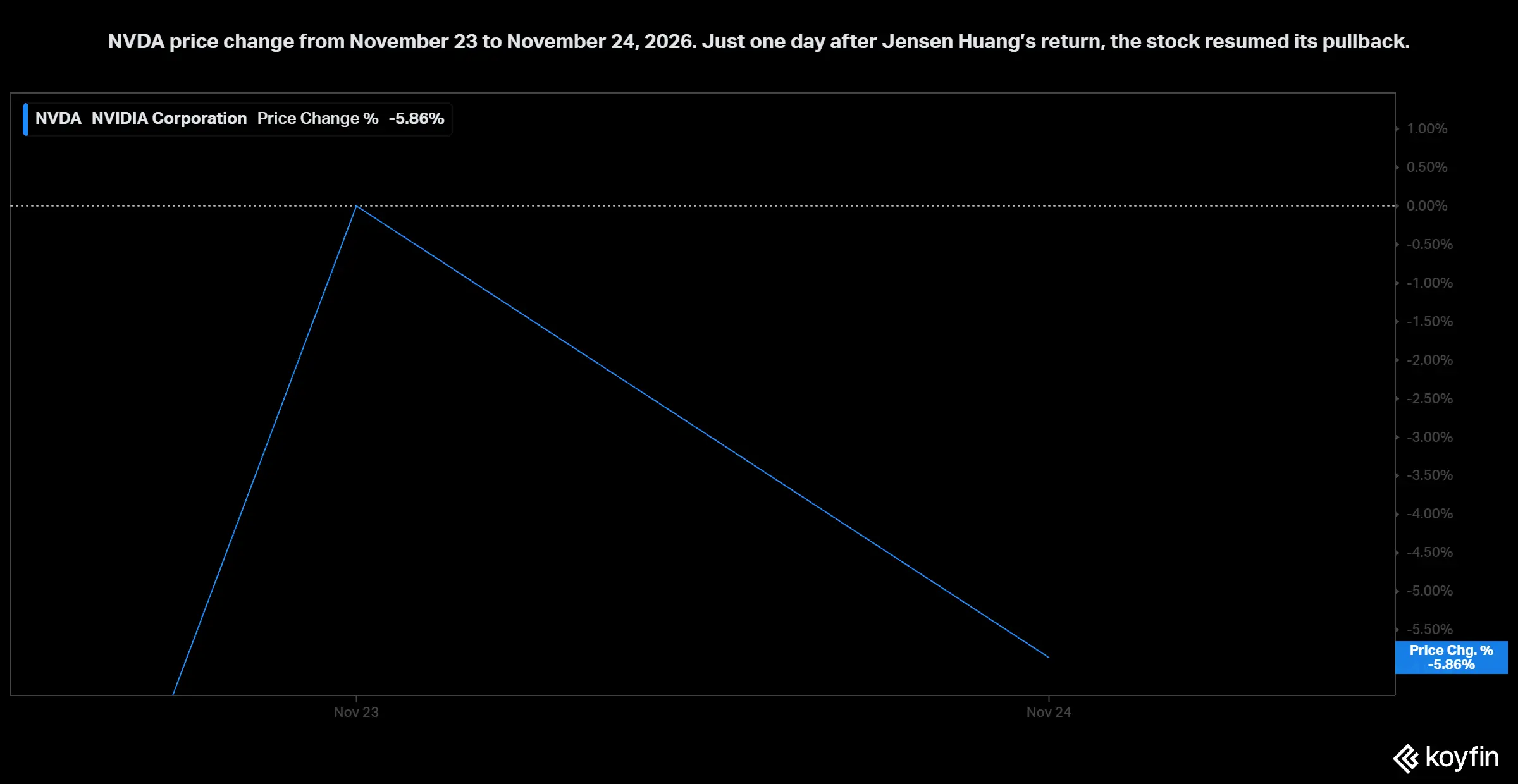
This may sound like a somewhat figurative statement, but if we put aside the loud headlines and look at the situation objectively, Huang's return does not solve Nvidia's main problems. It simply changes their form.
Why did he return?
First, it is worth realistically assessing why the board of directors reversed its own decision so quickly. Even after Nvidia published a strong third-quarter report on November 17, reporting revenue of $115.8 billion and demonstrating that its engineering processes and supply chains were functioning perfectly well without Huang, the shares continued to fall.
This leads to an important conclusion. Investors were buying Nvidia shares not only because of its impressive chips, but also because Jensen Huang was the person running the company. They were paying a premium purely because they believed he would outsmart everyone once again.
To reclaim his position, Huang reportedly had to completely clear himself of the stigma of being a traitor (and I am not talking about his family here, but rather his colleagues at work). He reportedly admitted to the board not only to his connections with former Megaspeed executive Alice Huang, but also to previous romantic relationships with female employees within the company, including a direct subordinate. In corporate governance, this is less a question of morality and more about eliminating the risk of blackmail and putting an end to endless media leaks that repeatedly send stock prices tumbling.
Furthermore, he had powerful political and business support behind him. Figures such as Elon Musk and Sam Altman publicly sided with him, while President Donald Trump explicitly stated that losing Huang's intellectual capabilities in the AI race against China would pose a greater threat to US national security than the personal scandal itself.
Now let's return to the question of why the shares continue to fall.
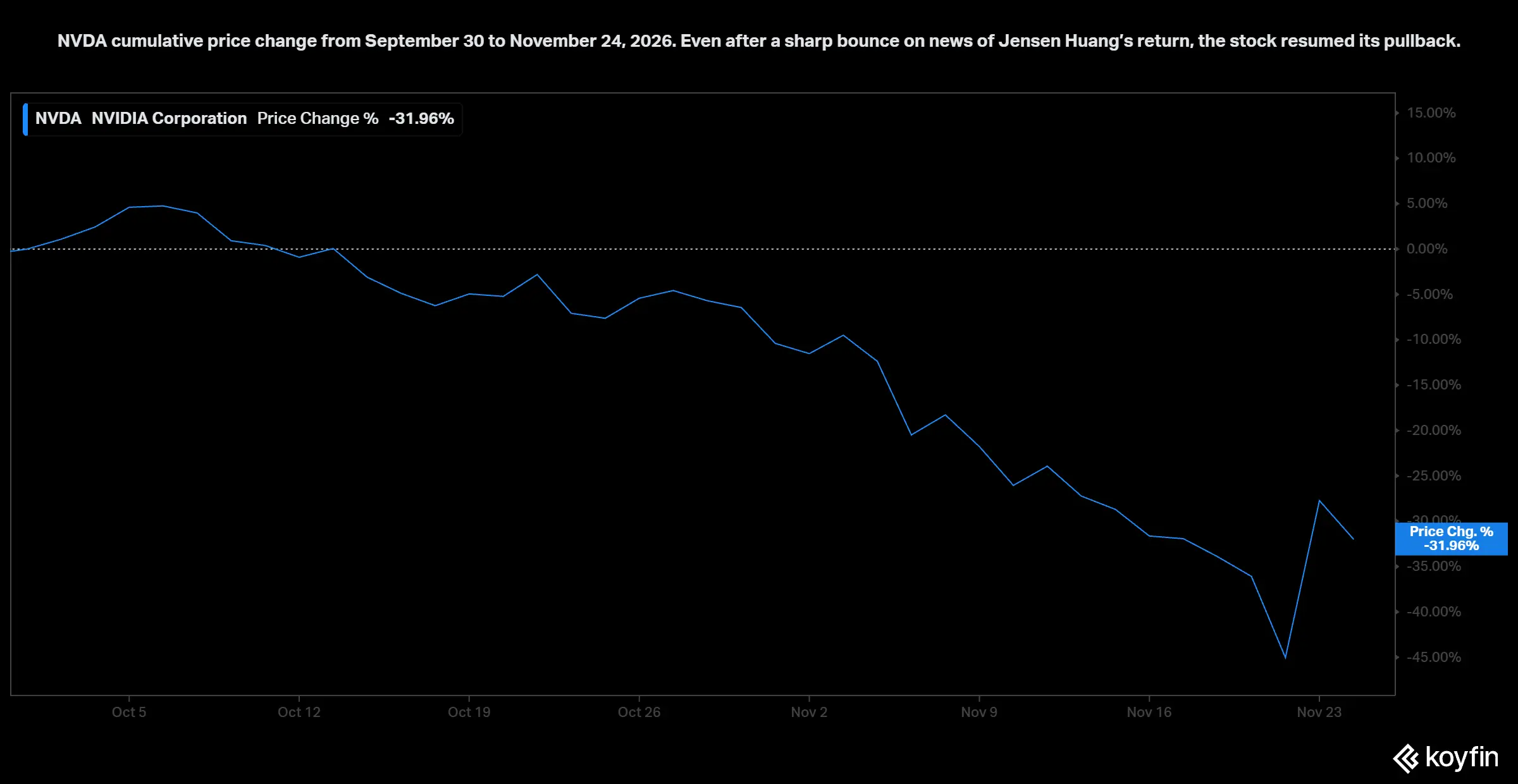
Despite the market welcoming Huang's return, there are significant reasons why some institutional investors may never return to these shares, at least not on the same terms as before.
A board of directors that initially removes its CEO over compliance and national security concerns, only to reinstate him 11 days later under pressure from the stock market and the White House, sends a clear signal. Nvidia practically has no internal mechanisms or people capable of stopping or overseeing its leader's decisions if he makes a mistake.
Direct intervention by the White House and lobbying from the upper ranks of Silicon Valley raise uncomfortable questions about potential favoritism and the blurring of boundaries between government authority and corporate interests. For conservative global funds, political protection is a double-edged sword, especially when political winds can change overnight. Some sources have even claimed that Trump made approximately $15 million in paper gains following the stock movement. Whether this is true or not is difficult to establish, as no investigation has yet taken place. However, Democratic Senator Ruben Gallego has already called for an investigation. For now, this remains a theoretical estimate of unrealized paper profits.
This entire story has confirmed my initial thesis. Nvidia remains critically dependent on a single individual. Huang's return removes short-term panic, but only highlights the structural vulnerability of a flat management model in which dozens of top executives report directly to one leader.
Right now, in my opinion, nobody can responsibly predict whether Nvidia is ready to return to its previous period of uninterrupted growth.
Both Nvidia's investors and its own employees need time to adapt to this new reality. Yes, Huang is back, but now he will be working under the supervision of a new National Security and Export Controls Committee and a dedicated compliance director. Maintaining employee morale internally after weeks of public scandals and behind-the-scenes power struggles will not be easy.
Even more importantly, the external chaos is far from over. On December 1, Huang is expected to face a closed-door briefing with House lawmakers, while public hearings are scheduled for December 3 before the Senate regarding export controls and how billions of dollars worth of Nvidia chips may have reached China through intermediaries such as Megaspeed. Meanwhile, Democratic lawmakers, who are set to take control of the House of Representatives in January, have made it clear that they view this entire situation as a textbook example of corporate and political corruption that requires an in-depth investigation.
As for the company's future adaptation and its impact on the market, I lean toward the view that Nvidia is not going anywhere as a technology giant. Its fundamentals and demand for AI infrastructure remain enormous. However, until the dust settles in Washington and the company proves that it can operate under genuine oversight, it is still too early to expect its shares to rise steadily and without complications.
For those interested in the company and the situation surrounding it, I can only recommend patience and keeping an eye on what happens in Congress next week. For now, that is the only rational position.
As for Huang himself, I wish him endurance, because after everything that has happened, looking his colleagues in the eye must feel extremely awkward.
Thank you for reading.