In my previous article, How Republicans Lost Capitol Hill, I wrote that Wall Street's reaction to the Democrats' victory had turned out to be surprisingly optimistic. The Dow Jones Industrial Average surged by more than 1,500 points. I also explained the reasoning behind this phenomenon: investors felt relieved by the prospect of a divided government, which typically acts as a safeguard against sweeping unilateral decisions and, in turn, provides greater economic stability.
However, just a few days later, particularly yesterday, a flood of articles and red stock market heatmaps began appearing across the internet, showing declining share prices among some of the world's largest companies. Their authors framed these developments with headlines and narratives such as "Welcome back, Democrats" and "The market isn't happy with Democrats." There has been an enormous amount of such content, particularly videos circulating across various social media platforms. Almost all of it implies that Democrats have somehow broken the American economy.
I wanted to let this story settle for a little while before addressing a simple question: does a red stock market screen really mean that companies are heading for collapse?
These viral accusations against Democrats are being actively promoted by the Republican camp, whose narrative increasingly suggests that the "blues" (meaning the Democrats) are bad news for business. Even Donald Trump himself took to Truth Social following the election results, blaming his political opponents for the market decline. Various commentators and influencers quickly picked up the story, using fresh screenshots from stock market trackers in which major market players such as NVIDIA, Microsoft, and Tesla were highlighted in dark red.
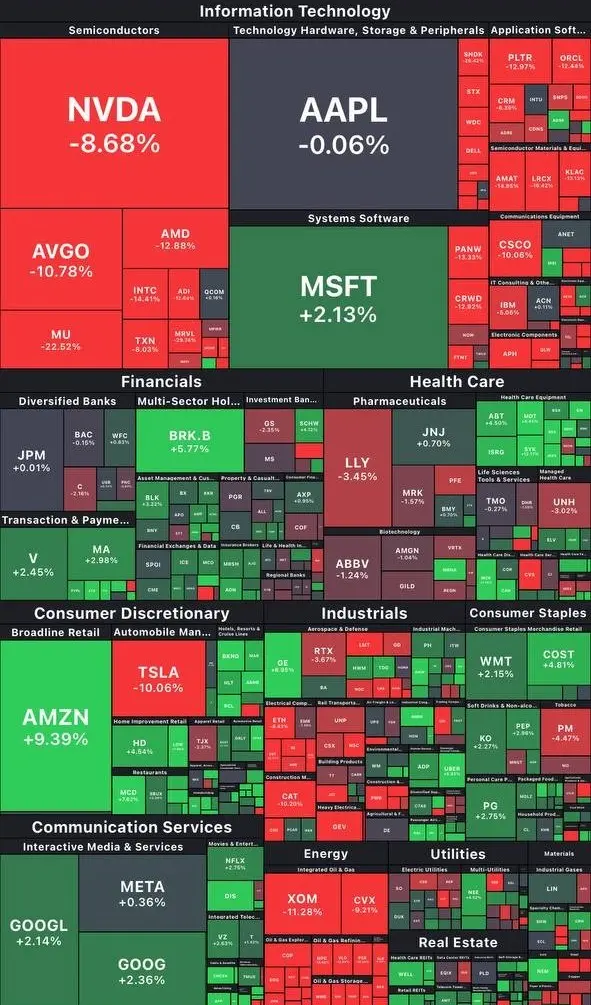
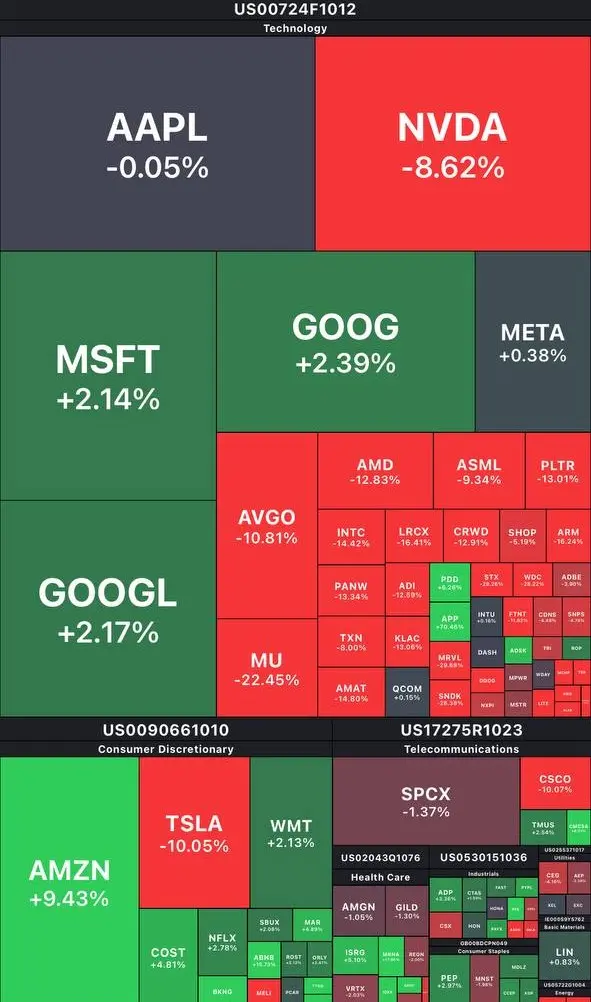
*The weekly stock market heatmap displaying a sharp correction in the technology sector right after the elections.
For an average reader or viewer, this kind of visual evidence can indeed create the impression of an economic collapse caused by the Democrats.
In reality, a sell-off of this scale does not necessarily indicate that the economy is falling apart. Rather, it can represent a short-term emotional reaction among large institutional investors. And I should add that this kind of market behavior is hardly unpredictable.
I think it is no secret that much of America's economic growth in recent years has been driven by the hype surrounding artificial intelligence. When Democrats regained control of the House of Representatives and the Senate, major hedge funds began factoring the possibility of a shift in political direction into their risk assessments.
Democrats generally favor stricter oversight of AI safety and the ethical use of algorithms. They have also traditionally taken a tougher stance on the monopolistic practices of major technology companies. Moreover, they could potentially introduce new restrictions on data centers' electricity consumption.
Fearing a possible change in regulatory policy, funds began selling off expensive shares in technology and semiconductor companies on a large scale. As a result, the IT sector experienced a temporary decline in market value.
Ultimately, I would argue that blaming a single political party for immediate fluctuations in stock prices is a mistake from a macroeconomic perspective. Historical data suggests that the US stock market has performed strongly under divided government and during Democratic presidencies. One possible explanation is that a divided Congress makes it more difficult to introduce unpredictable tariffs or spend public money without sufficient oversight. Consider, for example, the conflict in Iran and the unstable situation surrounding the Strait of Hormuz.
Red stock market heatmaps are useful tools, but they are also frequently exploited for political propaganda. It is important to understand that they reflect traders' short-term anxiety rather than necessarily indicating the long-term failure of economic policy - at least when we are discussing the short time frames that are so often used to manipulate public perception.
Over the next two years, the government will have to constantly seek compromises. The market should eventually stabilize once businesses understand the new rules of the game.
Returning to the point I made at the beginning of this article about allowing the situation to settle before drawing conclusions, I would like to invite you to look at the latest charts, compiled today. I want you to examine the data and draw your own conclusions: did the short-term decline in Big Tech stocks really signal an economic collapse, especially when, just 24 hours later, overall market capitalization had already begun recovering rapidly and individual companies - including AMD - had recorded gains of more than 8%?
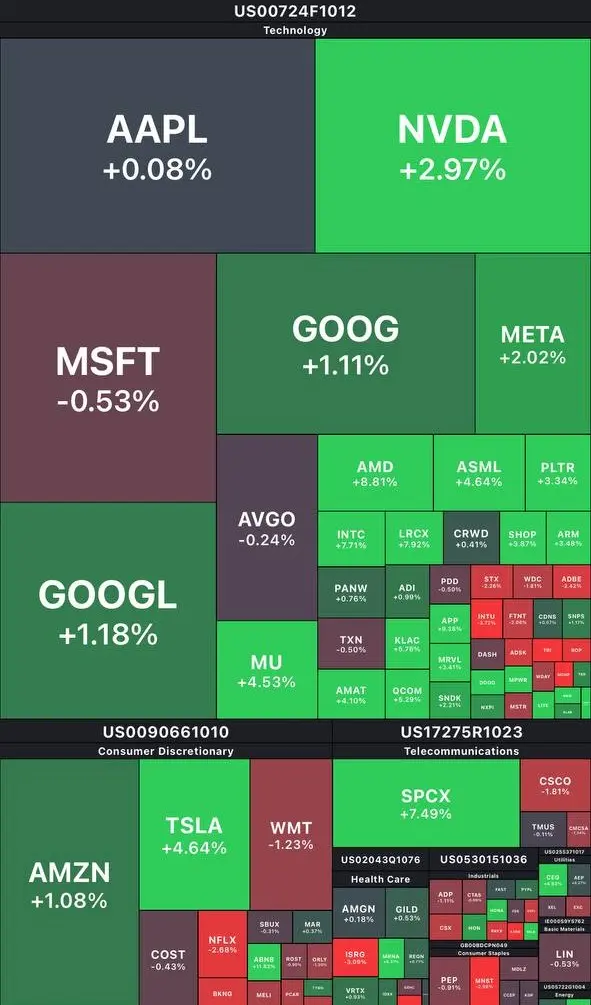
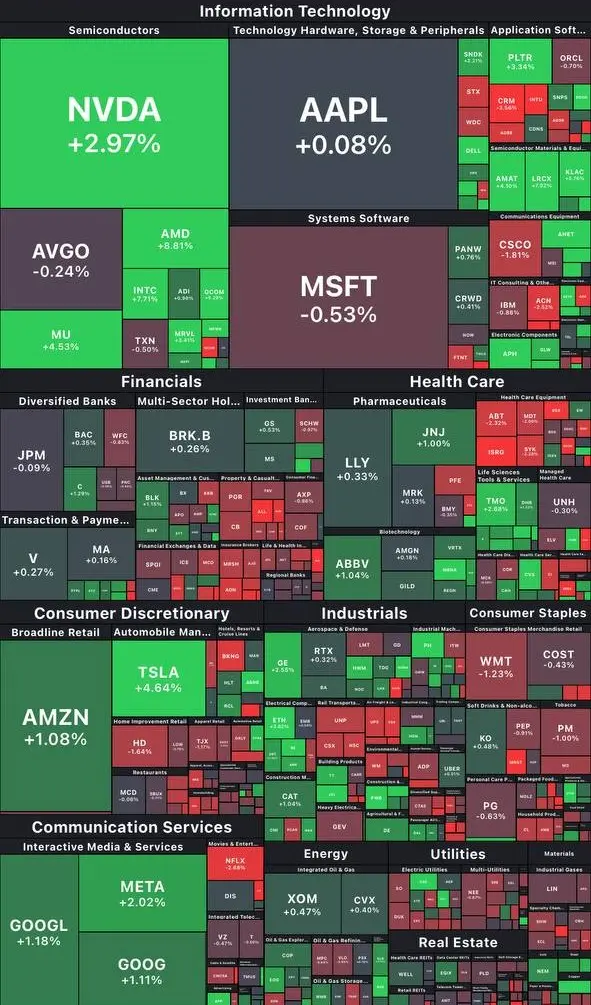
*The immediate 24-hour market reversal showing rapid recovery and tech stocks turning green