The Republican Party has lost control of Capitol Hill - these were the results of the US midterm elections held on November 3. For the administration and Donald Trump personally, a new era of forced compromises and confrontation with a reshaped Congress has begun.
The legislative branch of the federal government, along with the leadership of several key states, is shifting into Democratic hands. According to analysts, the main factors behind voter dissatisfaction were the high cost of living, inflation, and the prolonged war in Iran. Let's take a closer look at the causes and consequences of this domestic political shift.
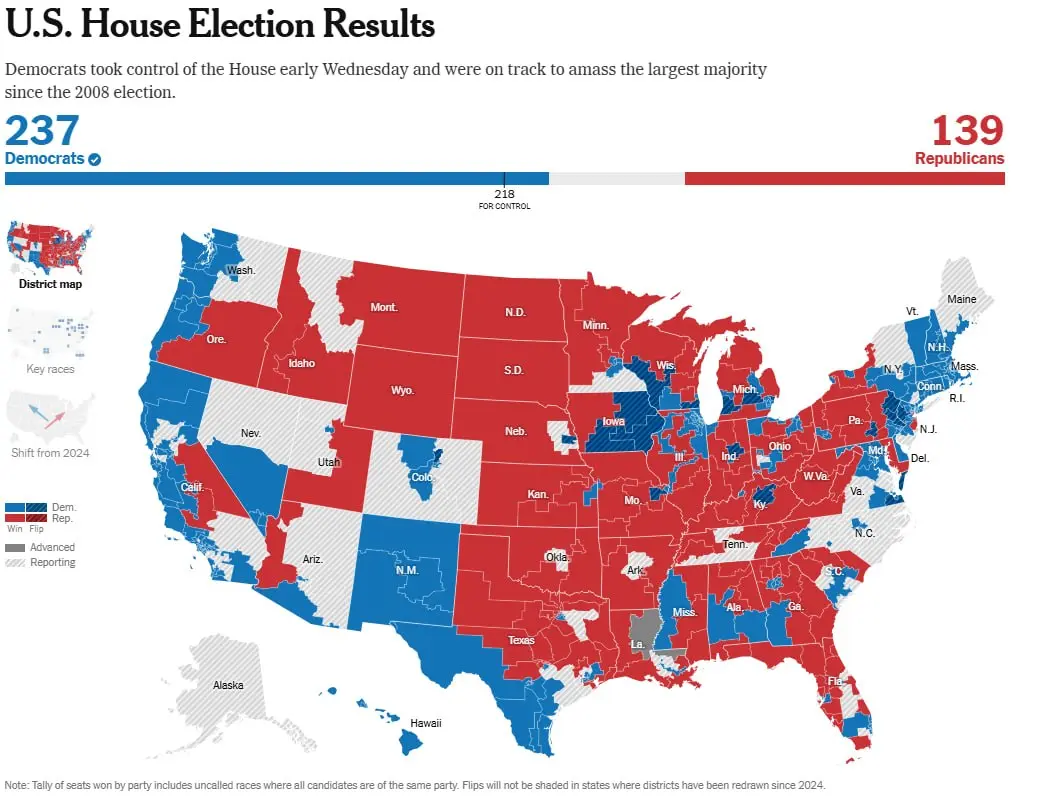
It is important to understand that the main purpose of midterm elections is to renew the composition of Congress and various local governing bodies. The Democratic victory means that the party has regained control of the House of Representatives, the lower chamber of Congress, which plays a key role in drafting federal legislation and shaping the national budget. Democrats secured more than 240 seats, giving them a majority.
In the Senate, the upper chamber of Congress, Democrats also made a significant breakthrough. According to preliminary results, they gained seven additional seats and regained control of the chamber. This significantly changes the balance of political power in Washington.
In recent years, Republicans have actively relied on gerrymandering - the manipulation of electoral district boundaries for political advantage. Put simply, this is when politicians effectively choose their voters instead of allowing voters to choose their politicians. Imagine a football match in which one team is allowed to move the goalposts wherever it finds it easier to score. That is roughly how this mechanism works.
However, amid declining Republican approval ratings, this strategy failed to deliver the expected results. Democrats managed to win several districts where Republicans had counted on stable support. These included districts in Pennsylvania, California, Ohio, Virginia, and North Carolina. At the same time, it is worth remembering that district boundaries and voter sentiment are not the only factors determining election outcomes.
The biggest surprises, however, came at the state level, where Democrats managed to win key positions in regions that had long been considered Republican strongholds.
The most striking example was Texas. No Democrat has held the state's governorship since 1995, when Ann Richards left office. Her defeat in the 1994 election to Republican George W. Bush was an important milestone in his political rise, which eventually led him to the White House. Democrats had not won a US Senate seat in Texas since 1988.
It is also important to look at the candidates who emerged victorious. In the Senate race, Democrat James Talarico defeated Republican Ken Paxton, the state's attorney general, by 55% to 43%. Meanwhile, the gubernatorial race ended with Democrat Gina Hinojosa defeating incumbent Republican Governor Greg Abbott.
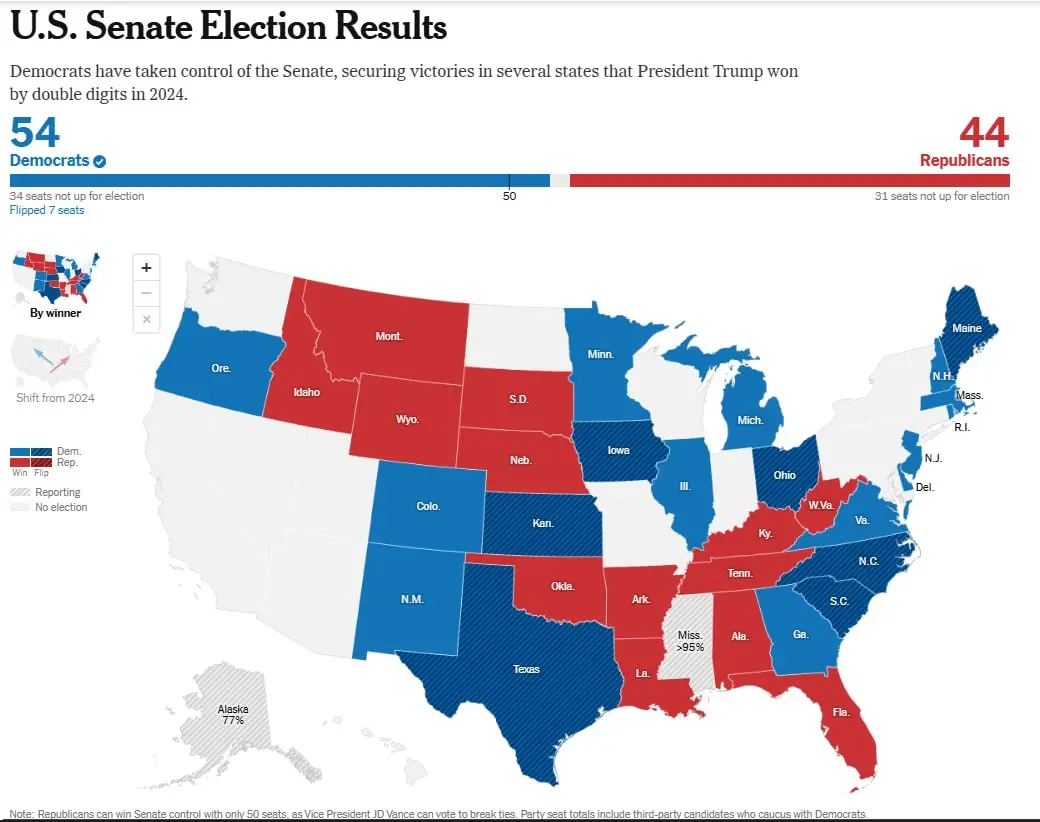
Republicans also lost governorships in Ohio, Iowa, and Georgia. Meanwhile, in Michigan, Minnesota, Nevada, Pennsylvania, and Wisconsin, Democrats achieved what is known as a trifecta. This occurs when one party controls all three key branches of state government: the governorship and both chambers of the state legislature. In simple terms, this gives a party significantly more power to implement its policies, from taxation and healthcare to education. However, it does not mean absolute power, as constitutional limits, judicial oversight, and other checks and balances remain in place.
The Republican defeat affected not only the overall balance of power but also intensified internal divisions within the party itself. Republican Congressman Thomas Massie plans to pursue impeachment proceedings against US Defense Secretary Pete Hegseth. He has stated that he will not abandon the initiative unless the secretary resigns voluntarily.
There is an important detail here: criticism of Hegseth is not coming exclusively from Democrats. Some Republicans are also prepared to support the initiative. The reason is the war in Iran. Lawmakers have criticized the lack of a clear plan to end the conflict and what they see as strategic miscalculations that have contributed to a prolonged confrontation in the Middle East. In particular, Hegseth has been accused of convincing Trump to launch the military operation while overestimating the United States' ability to secure a swift victory.
The Pentagon dismissed these accusations as an attempt by politicians to score partisan points and launch politically motivated investigations.
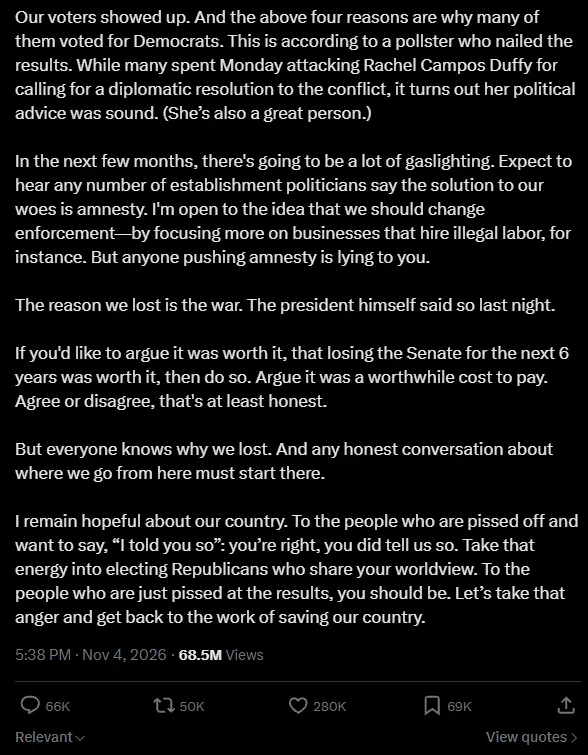
Even Vice President JD Vance has publicly distanced himself from Trump's position on the war. In a post on X, he stated directly"The reason we lost is the war." Moreover, Vance stressed that Americans should honestly consider whether the war was worth losing control of the Senate for the next six years.
Despite the criticism, Trump continues to publicly defend Hegseth and has stated that he has no plans to fire him.
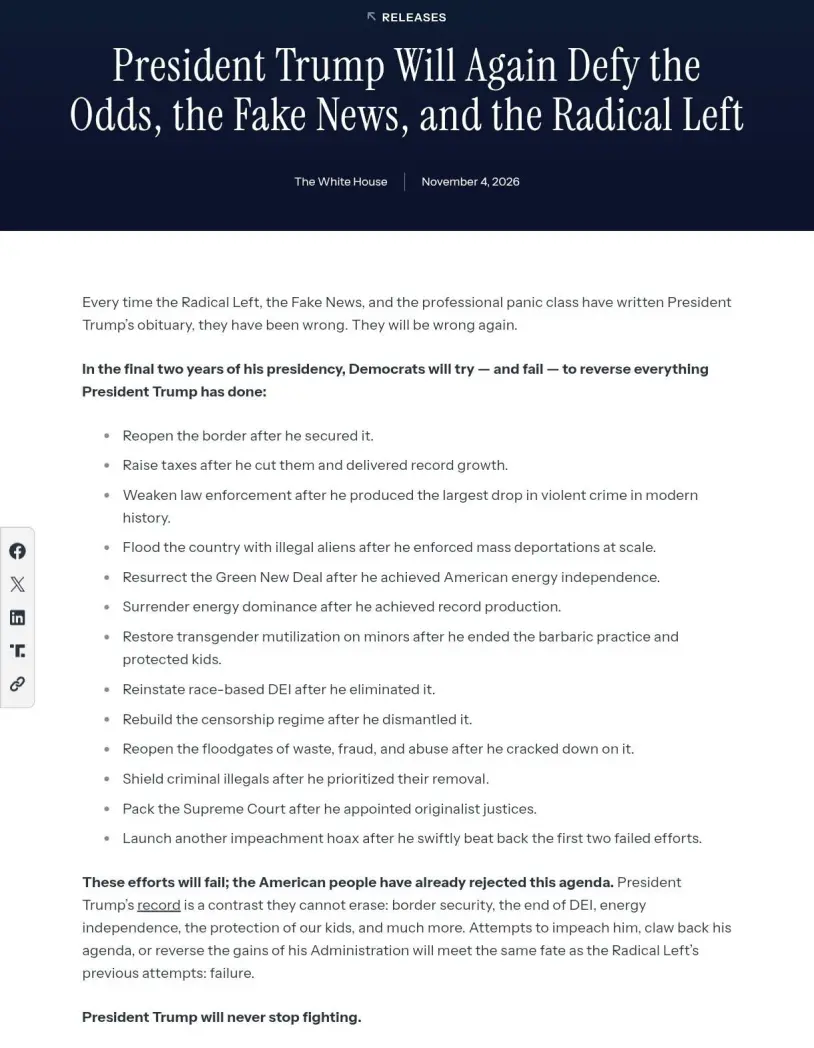
Following the Republican defeat, the White House made it clear that it had no intention of abandoning the key elements of the president's agenda. The administration's priorities include a tough immigration policy, stronger border controls, maintaining low taxes, supporting the oil and gas industry, eliminating DEI policies, and restricting medical gender-transition procedures for minors.
At the same time, Trump indicated in an interview with CNBC that he was willing to seek common ground with Democrats on certain issues. In particular, he expressed openness to cooperation on financial initiatives that could be mutually beneficial to both parties.
It is also worth examining the reaction of the stock market. Despite the Republican defeat, the US stock market recorded notable gains. The Dow Jones Industrial Average surged by more than 1,500 points, or approximately 3%.
Wall Street investors may have welcomed the election results with a sense of relief. The division of power between the White House and Congress is seen by some market participants as an additional safeguard against sudden unilateral political decisions, large increases in government spending, and new tariffs that could negatively affect the US economy.
Global Brent crude oil prices also fell significantly, dropping by approximately 8%. One possible explanation was growing optimism about a diplomatic resolution to the conflict with Iran and a reduction in geopolitical risks. However, it would be premature to attribute the entire decline in oil prices solely to the election results.
To sum up, the United States faces two years of intense political battles, during which Democrats and Republicans will be forced to demonstrate pragmatism, negotiate, and seek compromises. At the same time, this does not mean Washington will avoid confrontation. On the contrary, Democratic control of Congress creates the conditions for a serious political conflict with the White House.
Ultimately, whether both parties can move beyond mutual accusations and reach meaningful agreements will affect not only US domestic policy but also the economic situation and international stability.