
AI could revolutionize not only everyday life and the way we work, but also technologies we once considered secure. The big problem is that until a few years ago, the criminal had to study the code line by line and then attempt the attack. AI can work 24/7 without vacation, without getting tired, without eating and analyzing millions of codes in a short time. In some ways, it's a bit like trying to find a password by trial and error, or brute-force software that tries tens of millions of combinations per second. What makes these discoveries remarkable is not just their severity, but their age: many of the vulnerabilities had survived years of audits, fuzzing campaigns, static analysis tools, and multiple generations of maintainers before being uncovered by AI-assisted security research.
AI HAS FOUND BUGS OVER 20 YEARS OLD
This is a short list of bugs found by AI in recent times. If you think about it, it's monstrous to think that these errors were present in software but no auditor had ever found them. AI found them in a short time.
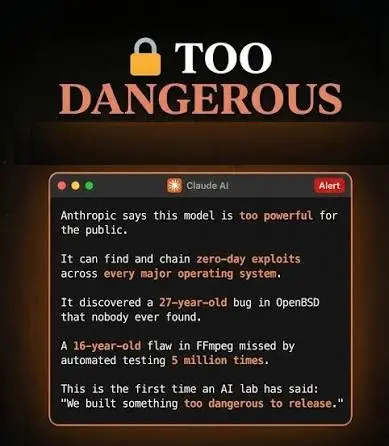
- Anthropic's Mythos uncovered a 27-year-old vulnerability in OpenBSD's TCP stack, hidden since the late 1990s despite decades of security auditing.
- Mythos found a 17-year-old remote code execution bug in FreeBSD's NFS implementation (CVE-2026-4747), allowing complete takeover of vulnerable servers. Anthropic stated the discovery and exploit generation were performed autonomously.
- Mythos identified a 16-year-old vulnerability in FFmpeg's H.264 decoder, code that had survived years of fuzzing and review while remaining embedded in countless video-processing pipelines.
- Anthropic reported a flaw in wolfSSL (CVE-2026-5194) that could enable certificate forgery by bypassing important cryptographic verification checks.
- Researchers at Vidoc Security later showed that public frontier models such as GPT and Claude could independently rediscover several of the vulnerabilities highlighted by Mythos, including bugs in FreeBSD and Botan, suggesting that advanced AI-driven vulnerability discovery is no longer limited to specialized internal systems.
- Mozilla researchers previously reported that AI-assisted auditing uncovered a 15-year-old bug in Firefox's HTML parsing logic, a flaw that had remained unnoticed through years of testing and code review.
- Anthropic disclosed that Mythos also found previously unknown vulnerabilities across major operating systems, browsers, cryptographic libraries, and Linux kernel components, with many of the findings still under coordinated disclosure.
- Two serious bugs have been found in Zcash in the last four months (one four years old).
- Octane (an AI auditing company) reported a bug in Nethermind, one of the clients running about 40% of Ethereum validators: a malformed transaction was enough to bring them down.
- Anthropic's AI agents (powered by Claude Sonnet 4.5 and GPT-5) have found several bugs in smart contracts on the BNB Chain.
- Over the last four years, approximately $13-15B has been drained from DeFi.
DIFFERENCES WITH BITCOIN
The big problem these days is that hackers don't get tired, they don't sleep, they work on tens of thousands of contracts in parallel, and they get better over time precisely because they're not humans but AI agents. Bitcoin has a different philosophy: the fewer things the language can do, the fewer ways to break it. After a bug in 2010 that allowed $184 billion BTC to be created via a fork, Bitcoin was made "Forth-like, stack-based" rather than Turing-complete (out of fears it might contain other bugs). This is the main reason why AI will be unlikely to "hack" Bitcoin.
Article always updated with all the possibilities of on-chain farming (airdrop): Some Sites To Earn Crypto Bonus (Old & New)





