This article outlines various computational and mathematical problems solved by AI. However, some context often omitted in sensationalist reporting is necessary, as these achievements include both the resolution of long-standing conjectures and the development of entirely new proofs.
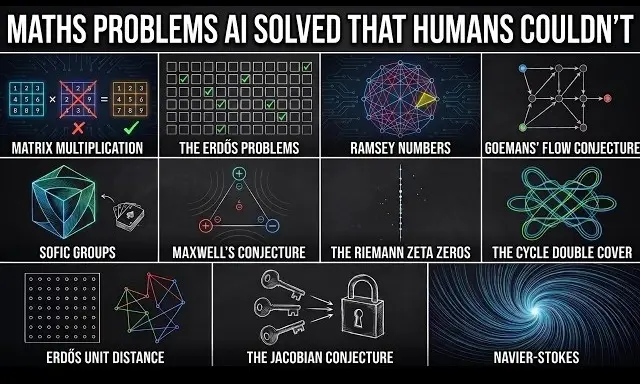
Problems solved by AI between 2025 and 2026:
- Exponential Time Hypothesis (ETH).
- Complex matrix multiplication.
- Closest Vector Problem (CVP).
- Complexity of arithmetic circuits.
- Parallel repetition in quantum games.
- Efficiency improvements for data center and hardware algorithms.
- Erdős unit distance conjecture.
- Erdős problems 728 and 729.
- Erdős problems 652 and 1051.
- Kissing number problem.
- Sphere-packing bounds.
- Binary codes and spherical codes.
- Maxwell's conjecture.
- Conjecture on Ehrhart volume.
- Multicolor Ramsey numbers.
- Existence of non-sofic groups.
- Compactness and degeneration conjecture.
The following two items while not fully "solved" relate to cryptography; I will therefore examine them in greater detail.
- HAWK Post-Quantum Cryptography: proposed by Anthropic, July 2026. A cryptographic attack has been demonstrated. Type: Asymmetric cryptography and post-quantum digital signatures. Problem: HAWK is a digital signature scheme designed to withstand attacks from future quantum computers. AI Solution: Claude Mythos Preview identified a previously unexploited mathematical symmetry in the lattice used by HAWK, improving a private key recovery attack. Consequence: for HAWK-256, the estimated cost of the attack dropped from (2^64) to (2^38). RSA, ECDSA and the entire post-quantum sector have not been broken.
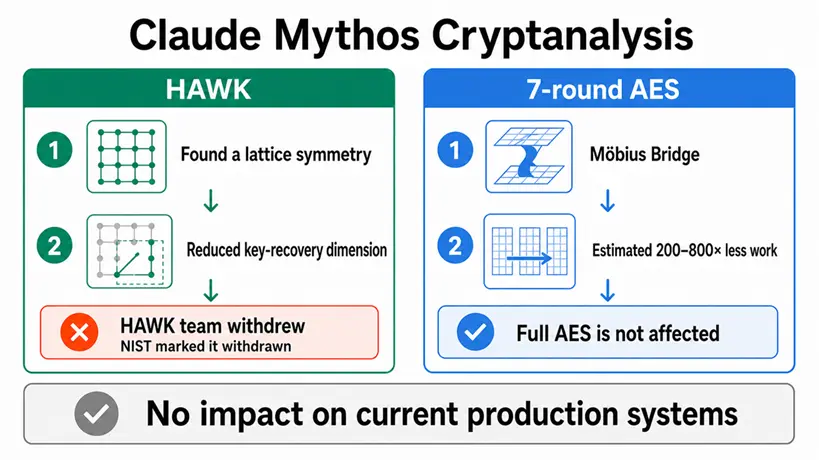
- Advanced Encryption Standard: presented by Anthropic, July 2026. Type: Symmetric encryption. Problem: AES-128 is one of the most widely used encryption algorithms in the world; it employs 10 rounds of mathematical transformations. AI Solution: Claude Mythos Preview improved a cryptanalytic attack against a reduced version of AES that uses only 7 of the 10 rounds. Consequence: An advancement in research into cryptographic vulnerabilities; however, the full version of AES-128 has not been compromised.
Can I compromise asymetric cryptography? This is the most significant aspect for the internet, banking systems, blockchain, Bitcoin, and Web3. It should be noted, however, that discovering a mathematical attack does not necessarily mean successfully breaking the encryption or recovering a private key. The asymmetric cryptography used by Bitcoin, Ethereum, the internet, and virtually the entire global financial system relies on mathematical problems that are extremely difficult to solve:
- RSA (Factorization of large integers).
- ECDSA (Discrete logarithm problem on elliptic curves).
- EdDSA (Discrete logarithm on elliptic curves).
- Diffie-Hellman (discrete logarithm).
- Post-quantum cryptography (problems based on lattices, codes and other mathematical structures).
AI has already demonstrated an ability to improve cryptographic attacks, as seen in the case of HAWK but it has not yet shown that it can efficiently solve the mathematical problems underlying RSA or elliptic curves.
Article always updated with all the possibilities of on-chain farming (airdrop): Some Sites To Earn Crypto Bonus (Old & New)