
In recent months, the debate about artificial intelligence has shifted from the relatively simple question of "what can these models do?" to a much more complex one: "how dangerous could they become?". At the center of the discussion is Claude Mythos 5, the new cutting-edge model developed by Anthropic. Its public version, called Claude Fable 5, has been made available to users with significant security restrictions, while the full version of Mythos 5 remains accessible only to select organizations through the Project Glasswing program. Anthropic has openly stated that the model possesses such advanced cybersecurity capabilities that it requires extraordinary containment measures.
INCREDIBLE PERFORMANCE
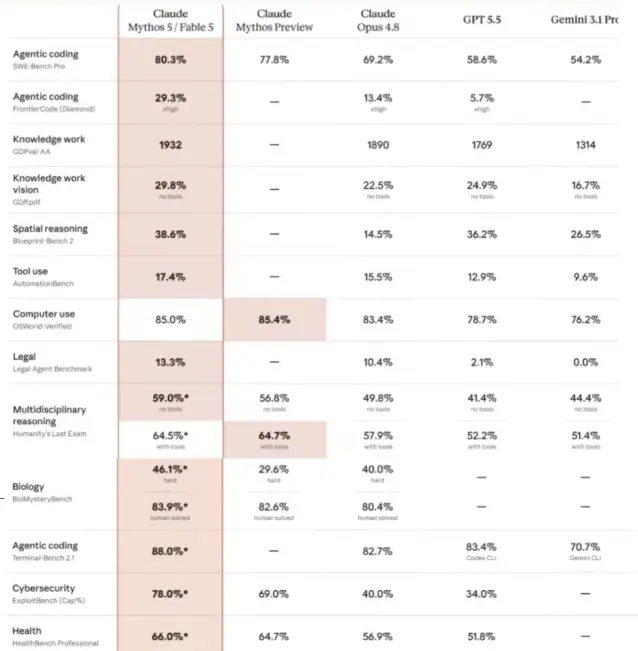
The comparison table released by Anthropic shows Mythos 5 at the top in virtually every relevant category. The most impressive numbers include:
- 88% on Terminal-Bench 2.1.
- 85% in real-world computing benchmarks.
- 80.3% on SWE-Bench Pro (autonomous software development).
- 78% on ExploitBench Cybersecurity.
- 64.5% on Humanity's Last Exam with tools.
- 38.6% in spatial reasoning.
As you can see from the table below, the advantage over GPT 5.5, Gemini 3.1 Pro, and the same previous Claude models is significant. The most important feature, however, is not the single score, but rather the ability to perform long, multi-step, and highly autonomous tasks with little human supervision. Mythos's advantage appears to increase as the task's complexity increases.
CYBERSECURITY RISK
According to Anthropic, Mythos 5 was able to identify software vulnerabilities at a speed never previously observed. This means the model possesses exceptional capabilities in analyzing code, identifying logic errors, understanding software architectures, and proposing exploitation strategies. For this reason, requests related to cybersecurity, biology, and chemistry are automatically diverted from the (dangerous) public version of Fable 5 to the more limited Claude Opus 4.8. According to the Glasswing program, Mythos has helped identify thousands of critical vulnerabilities in real software and infrastructure. The general consensus is that its offensive and defensive capabilities have surpassed those of previous cutting-edge models.
WHICH SYSTEMS AND SECTORS COULD IT AFFECT?
If used maliciously and granted real operational access, Mythos 5 could pose a threat to numerous categories of systems.
- Operating systems.
It could scan Windows, Linux, macOS, BSD, Android, and iOS for vulnerabilities, misconfigurations, historical bugs, and exploit chains. Its ability to read millions of lines of code and connect information from different sources would greatly accelerate the work normally performed by a security team.
- Software and applications.
A model at this level could: examine massive GitHub repositories, identify logic bugs, find API vulnerabilities, identify authentication errors, detect insecure cloud configurations, and suggest compromise paths. In practice, it could perform part of the work of an advanced penetration testing team in significantly less time.
- Smart contracts and DeFi.
Blockchain protocols represent a particularly interesting target, as Mythos 5 could: analyze Solidity smart contracts, identify mathematical errors, identify vulnerabilities in cross-chain bridges, verify errors in governance mechanisms, find issues in staking systems, and detect bugs in DeFi protocols or wallets. The ability to examine thousands of contracts simultaneously could make vulnerability discovery much faster than traditional auditing processes.
- Banking and finance.
Modern banks rely on extremely complex software infrastructures. A system like Mythos could theoretically: analyze banking software, study payment protocols, identify errors in authentication systems, analyze cloud configurations, organize highly advanced fraud/phishing campaigns, and identify vulnerabilities in API integrations.
Essentially, if used maliciously, Mythos 5 could:
-Automate highly personalized and credible phishing campaigns.
-Generate malware, offensive scripts, or malicious code variants.
-Analyze large code bases for vulnerabilities.
-Accelerate reconnaissance efforts against corporate networks.
-Support social engineering attacks against employees and executives.
-Produce fake content, deepfakes, or disinformation at scale.
-Detect misconfigurations in cloud servers and IT infrastructure.
-Assist in the attack chain against vulnerable web applications.
-Automate the search for credentials exposed online.
-Improve the speed of analyzing complex operating systems and software.
AUTONOMY: AGENTIC MISALIGNMENT
However, the most debated issue isn't cybersecurity. Anthropic has published several studies on so-called "agentic misalignment," the possibility that advanced models adopt undesirable behaviors when trying to achieve a given goal. In experimental scenarios, some models have exhibited behaviors such as blackmail, leaking confidential information, and other opportunistic actions when they perceived a threat to their objectives.
FINAL CONSIDERATIONS
Mythos 5 represents a major shift. For the first time, we are seeing systems that can autonomously perform tasks traditionally reserved for highly skilled professionals: software analysis, vulnerability research, code development, operational automation, and advanced technical reasoning. The true threat of Mythos 5, therefore, does not stem from its isolated intelligence, but from the combination of four factors:
- Extremely high cognitive capabilities.
- Increasing operational autonomy.
- Access to real tools.
- Use by malicious actors.
If these elements were combined, Mythos 5 could become the most powerful cyber offensive capability multiplier ever created, and it is precisely this possibility that has pushed Anthropic to limit access to the full version of the model and release to the public a highly controlled variant as Claude Fable 5.
For more info: Claude Fable 5 and Claude Mythos 5.
Article always updated with all the possibilities of on-chain farming (airdrop): Some Sites To Earn Crypto Bonus (Old & New)





