
For such a comparatively small part of the world, the Greeks had so far colonised far and wide, produced great writing and epic poetry, and founded democracy. Entanglement in the affairs of those larger and more powerful than themselves had landed them in the crosshairs of the King of Asia himself, Xerxes. Hordes of hundreds of thousands of Persians were now bearing down on the tiny Greek world. However, what should have been a walkover for the King of Kings became anything but that; for all their disunity, internal quarrelling and general unpreparedness for such foreign affairs, a small band of between five and seven-thousand Greek soldiers had mustered a loose coalition together to hold off Xerxes' armada at the narrow pass of Thermopylae, ready for battle. Meanwhile, Athens would set their stage at sea, mustering a small force of warships to defend against the oncoming Persian armada just off the coast, protecting the land forces.
Heading the land force was King Leonidas, and his three-hundred elite Spartan warriors.
Check out my previous blog on Themistocles and Leonidas's preparations for the war
"Thermopylae 480 BC - Epic Symphony" by "Farya Faraji"
(I do NOT own this video)
THE PRE-BATTLE
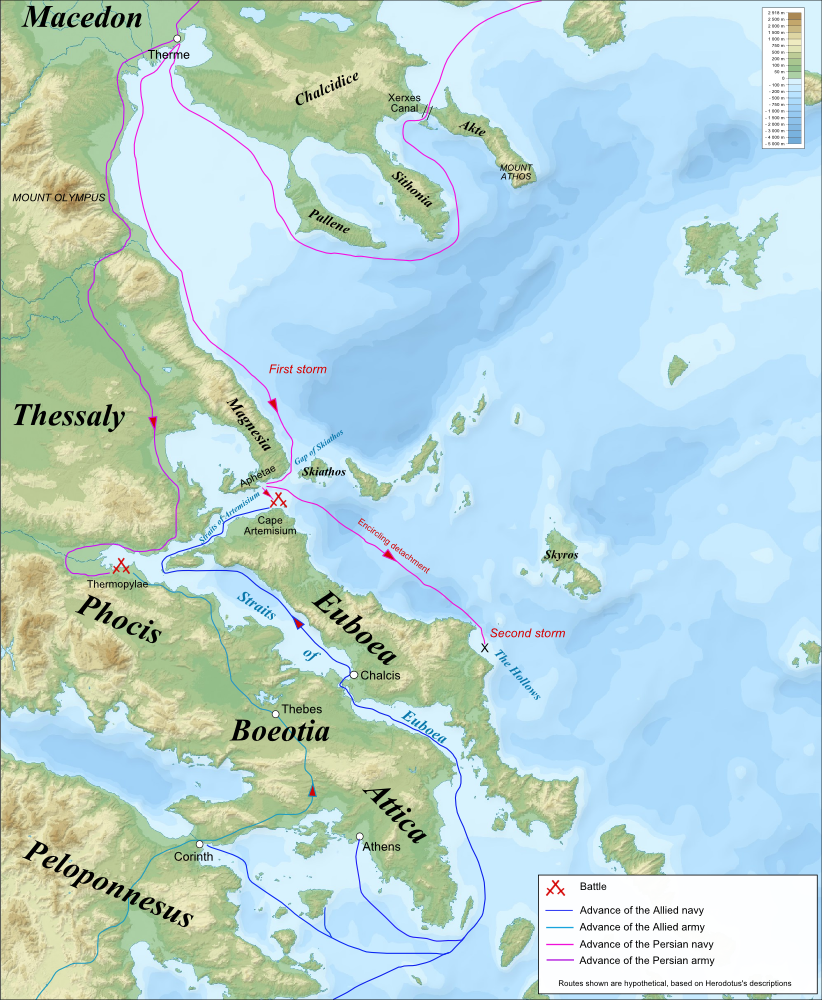
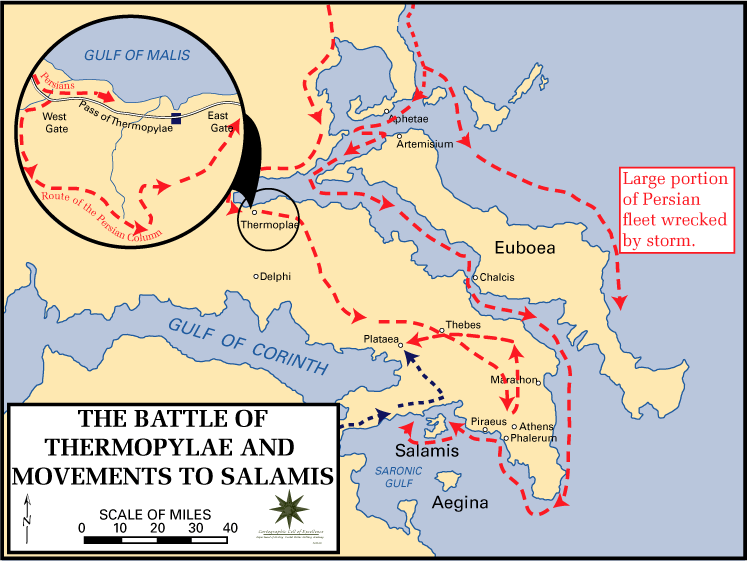
[ABOVE: The sites of Artemisium and Thermopylae, central Greece]
Xerxes set up camp at Malis in Trachis, All Greek land north of the Hot Gates was currently under Persian command, while the south remained free.
The Kallidromos mountain range hugged the Malian Gulf coast, coming extremely close to the sea at three points: the East, West and Middle Gates. Leonidas stationed his men at the Middle Gate, barely 15 metres wide. Mountains to his left would have towered a kilometre over him, while the Phocian Wall guarded his rear. The Anopaia Pass flanked the entire army at this position, so Leonidas ordered the 1,000 Phocian soldiers there to guard the pass.
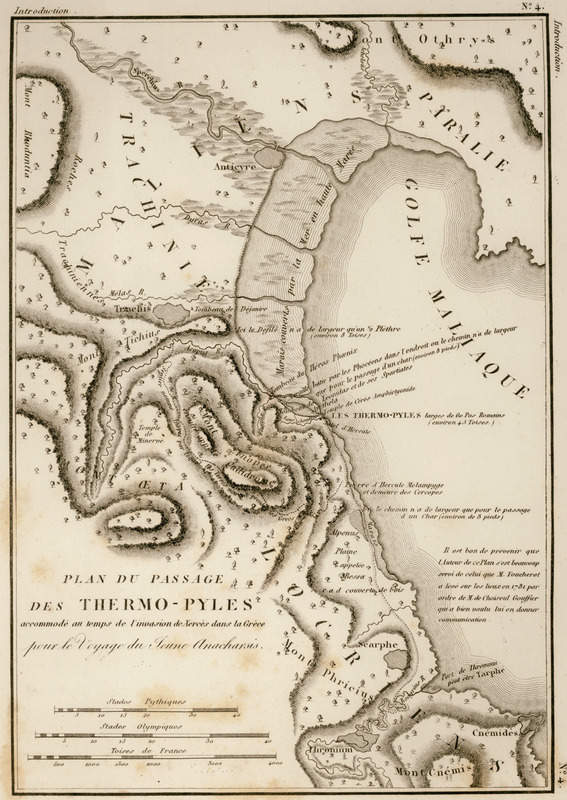
[ABOVE: Reconstructed shorelines of Thermopylae, 480 BC]
Prior to the battle, Xerxes sent a rider to spy on the Greeks. He could not see the entire force, since the local Phocian Wall, where they set up their defence, had been repaired. The few soldiers he could see, however, were the Spartans; they were posted outside at the time the Persian scout was looking, and at this time their armour was left in front of the wall as they exercised naked, and combed their hair. Being a man from the East where public nudity would have been abhorrent, the sight perplexed the scout, but he took notes of how many there were and made his way back to Xerxes.Early fifth-century BC Spartan figurines, Spartans can be seen with four locks of hair falling to the front, two on each shoulder and a further four to the back. Beards can be seen to be short and pointed, and the upper lip can be seen to be shaven. The king simply laughed, not believe what he’d been told. What he didn’t understand was that the Spartans were preparing their bodies to kill to the best of their abilities, and ultimately to die. Xerxes called for Demaratus, son of Ariston, to ask him about everything the scout had told him:
I told you about these men before, when we were setting out for Greece. You laughed at me then, and found my ideas about what would happen in this war absurd, just because I take pride in nothing so much as in trying to be honest with you, my lord. But listen to me now. These men have come to fight us for the pass and they are getting ready to do just that. It is their custom to do their hair when they are about to risk their lives. But you can rest assured that if you defeat these men and the force that awaits you in Sparta, there is no other race on earth which will take up arms and stand up to you, my lord, because you are now up against the noblest and most royal city in Greece, and the bravest men… My lord, if things do not turn out as I say, you can treat me as you would any other liar.

[ABOVE: "Leonidas and his Companions Devoting Themselves to Death", by Ward, 1881]
Before the battle, with his army encamping on the River Spercheius, Xerxes sent messengers to Thermopylae to ask the Greeks how they felt about war with him, commanding his messengers to give the following message:
King Xerxes orders all to give up their arms, to depart unharmed to their native lands, and to be allies to the Persians; and to all the Greeks who do this he will give more and better lands than they now possess.
Leonidas replied:
If we should be allies of the king we should be more useful if we kept our arms, and if we should have to wage war against him we should fight the better for our freedom if we kept them; and as for the lands which he promises to give, the Greeks have learned from their fathers to gain lands, not by cowardice, but by valour.
When the messengers warned the Greeks that Xerxes had so many archers that their arrows would block out the sun, Dieneces, a Spartan noted for his extreme bravery, replied:
All to the good, my friend from Trachis. If the Persians hide the sun, the battle will be in shade rather than sunlight.
As well as Leonidas and Dianeces, other names of Greeks who fought at Thermopylae have survived: Alpheus and Maron were brothers, and Dithyrambus was the bravest Thespian. Eurytus, Aristodamis and Pantites were three more Spartans who fought, but their fates would be different from the rest.
ARTEMISIUM
Meanwhile, off the coast of Euboea, Greek naval contingents were as follows: 127 Athenian ships (with boarded Plataean troops), 40 Corinthian ships, 20 Megarian ships, 20 Chalcian ships (provided to them by the Athenians), 18 Aeginetan ships, 12 Sicyonian ships, 10 Spartan ships, 8 Epidaurian ships, 7 Eretrian ships, 5 Troezenian ships, 2 Styrian ships, 4 Can ships and 7 Locrian ships. In total, that’s 280 Greek ships. In overall command was the Spartan Eurybiades, since the allies refused to follow Athens when a Spartan commander was present.
Artemisium was roughly 40 nautical miles from Thermopylae, an eight hour row. Because of this, direct communication wasn’t possible between the fleet and Leonidas. While stationing the fleet closer to Thermopylae may seem like a more logical thing to have done, it was the precise positioning of the fleet that put them in the narrowest point of the strait, much like the land force. Closer to Thermopylae, the straits could have been as wide as fourteen kilometres. It was also a possibility that Euboea could have fallen to the Persians entirely were it not guarded at its northern coast, since the Persians would have been able to land there.
BRIBING THE COMMANDERS
Once the Greeks caught sight of the vast Persian navy, still huge even after loosing some of their ships to storms, a retreat back south was considered. Realising what was happening, the Euboeans asked Eurybiades to remain until they had moved their children and homes to a safer place. Eurybiades refused, so the Euboeans turned to Themistocles, who they bribed to ensure the allies would stay at Artemisium and fight. Themistocles would give some of this money to Eurybiades to bribe him to stay, after which he promised the Corinthian commander, who was also considering fleeing, that he would reward him with more gold if he stayed than Xerxes would do if he left. No one knew Themistocles kept the rest of the money.
THE PERSIAN DEFECTOR
Seeing the Greek fleet assembled, the Persians sent a detachment of two-hundred vessels to sail around the entire isle of Euboea, to surround the Greek navy. In the mean time, the main body of the Persian navy would wait for the detachment to arrive, so that the Greeks could be surrounded. Meanwhile, a Persian man, Scyllias, defected to the Greeks, provinding Eurybiades and Themistocles with details of the wrecked Persian fleet, and the detachment being sent around Euboea. Meeting to discuss this new information, most commanders agreed to stay put and pitch camp ashore in the night, but then set out post-midnight and attack the Persian fleet that was attempting to outflank them. Later though, since no one attacked them, the Greek fleet rowed forward to meet the main Persian armada.

[ABOVE: "Disaster to the Persian Fleet", bu Jacob Abbott, 1803 - 1879, published in 1900]
DAY 1
ARTEMISIUM
The Greeks were led by Eurybiades, while Themistocles supervised the affairs of the fleet. Themistocles, however, enjoyed great favour from the troops, and Eurybiades himself, as all would often turn to him eagerly the most. While all commanders gathered to discuss how to engage the Persians, most would suggest waiting where they were, but Themistocles said it would be advantageous to charge them as one, taking the Persians by surprise and causing dismay in their ranks. With the Persians docked at several harbours strung out far along the coast, they were not prepared as one singular fleet when Themistocles’s fleet met them.
Upon seeing the comparatively small fleet charging towards them, Xerxes’s troops thought the Greeks had gone insane. The Persians attempted to encircle the Greeks, but the Greeks formed into an outward-facing circle. At a signal, they charged forward at the Persians, engaging head-on. It was a huge success; thirty Persian ships were captured. Among the captured was the brother of the king of Salamis. As the fight continued, nighttime came, and ceased hostilities between the navies as they went back their separate ways. As the Persians rowed back to Aphetae in defeat, another Greek defected from the Persians, and he was rewarded with a plot of land on Salamis for this by the Greeks. That night, a storm broke out, sinking even more Persian ships and mangling some of Persian corpses in the oar blades of their allies ships, terrifying the rowers and soldiers on board who feared it was a bad omen. This same storm also claimed the Persian detachment sailing around Euboea, wrecking the fleet entirely. These blessed occurrences for the Greeks lowered the Persian ship numbers to around the same as their own.
THERMOPYLAE
Xerxes would wait four days before engaging the Greek defence, simply not believing that so few would stand against the Persian Empire. What started out as amused bewilderment turned to anger, as Xerxes’ patience ran out by day five. Xerxes sent his Median and Cissian soldiers forth, with orders to bring back some prisoners. Among their ranks were relatives of Persian soldiers who had fallen at Marathon the years prior. An order from the Persians was given for Leonidas and his forces to lay down their arms. Leonidas laconically replied:
Come and take them!
Fighting began, and Persian soldiers dropped dead in vast numbers, fleeing away from the Greek defensive line. The battle continued throughout the entire day, and the Greeks made it clear to Xerxes that while he had many men, he also had very few soldiers.
Stood at the narrowest part of the pass, the Greeks stood shoulder to shoulder in a tight formation. In such close quarters, the early fighting remained fairly even for both sides, however the superior valour and armour of the Greeks soon started to push back the Persian line, suffering heavy casualties along the way. The Medes were thus swapped round for the Cissians and Sacae. Fresh in the fight against the now tired Greek forces, Leonidas pulled back the Greek forces and marched forward with his elite guard - the fight soon became a one-way slaughter, as the Cissians and Sacae were forced back. Persian soldiers were far more lightly armoured, designed to fight in the open plains of Asia, and here in the narrow mountain valleys against dense formations of elite troops, they stood little chance.
When the Medes failed to break the Greeks, Xerxes decided to send in his personal guard - ten thousand soldiers known to the Greeks as the Immortals, commanded by Hydarnes. The Greeks called them so because every time an Immortal fell in battle, it was said that, immediately, there was a reserved Immortal waiting to take his place in battle, so they never seemed to drop below ten-thousand in number. Xerxes believed his crack force would defeat the Greeks, yet they too suffered heavy casualties, fleeing back to Xerxes as quickly as the Medes had. Thermopylae’s restricted area to fight in made it matter not how many soldiers Xerxes flung at Leonidas’s forces - Greek discipline, and their effective arms and armour, made Persian numbers meaningless. The best fighters among the Greeks, of course, were Leonidas’s three-hundred personal guard themselves, something they made more apparent whenever they would feign a retreat, exposing their weak backs and causing Persian soldiers to break formation and chase after them, only for the Spartans to turn on the spot, regroup with great speed and discipline, and cut down the Persians. This was still a risky move to pull, and some Spartans did fall during these manoeuvres. During the fighting, Xerxes could be seen from his hilltop jumping to his feet every so often, like a spectator at a sports game, eager to see his men gain any ground. A second day of fighting saw Xerxes utilise the same tactic; believing so few wouldn’t have the endurance to keep up the fight. But much like Xerxes’ own forces, the Greeks organised themselves into groups based on nationality and took turns to fight, keeping up their endurance.
DAY 2
ARTEMISIUM
The following morning, Xerxes’s fleet felt content staying where they were instead of fighting the Greek fleet again. Fifty-three reinforcing Attic ships also came to the Greek fleet, telling them of the destroyed Persian fleet off of Euboea. That afternoon, just like yesterday, the Greeks sailed for the Persian fleet, met them head-on and sunk several Persian ships before returning to Artemisium.
THERMOPYLAE
On the second day, before battle resumed, Xerxes told his men that those who breached the Greek lines would be handsomely rewarded personally. However he also told them that failure to do so would result in their deaths by his own hand. Xerxes’s army thus hurled itself at the Greek line, but Leonidas formed his Spartans up once more, and locked in formation, they again repelled another attack with relative ease. After two days of fighting, potentially twenty-thousand Persians were lost at Thermopylae, and no footway had been gained. To break the Greeks, Xerxes would need a miracle, and he eventually got one…
EPHIALTES
On the night of the second day of fighting, while Xerxes sat in his tent not knowing how to deal with the Greeks, a Malian named Ephialtes arranged to meet the king, wanting to help him in exchange for a handsome reward; Ephialtes told him of a narrow goat path that wound around the mountain pass. This would allow Xerxes's army to encircle the Greek army and cut off their line of retreat.
The word “ephialtes” today has entered the Greek language, meaning “nightmare”.

[ABOVE: The flanking path exposed to Xerxes by Ephialtes]
MARCHING ON THE PHOCIANS
Feeling blessed with this information, Xerxes wasted no time and appointed Hydarnes to set off at dusk, accompanied by Ephialtes. Persian soldiers made their way through the pass through the night. By dawn, they had reached the peak of the narrow pass, where they encountered the one-thousand Phocian soldiers that had accompanied Leonidas to Thermopylae, who had voluntarily stationed themselves there in case this path was found out. At first, the Phocians didn’t notice the oncoming soldiers, since they were shrouded by an oak forest that covered the mountain slopes, but so many soldiers marching at once atop of fallen leaves woke the Phocians to their presence. Worried these soldiers might be Spartans, Hydarnes consulted Ephialtes, who reassured him that these were not elite fighters, at which Hydarnes’ men reached the bewildered Phocians before the Greeks even had time to don their arms and armour. Hydarnes’ archers rained arrows on the unarmored Greeks, forcing them to pull back to the top of the mountain; they were certain that Xerxes’ entire army was upon them, and so were ready to fight to the death, however the Persians ignored them and descended down the mountain.
PREPARING FOR DEATH
That night, a diviner accompanying Leonidas’s army named Megistias inspected a sacrificed animal’s entrails, predicting that death would come for the Spartan king’s forces in the day. Soon after, look-outs approached Leonidas, informing him of the Persian’s advance through the goat path. Among them was a Persian deserter, Tyrrhastiades, who fled Xerxes’s camp in the middle of the night to inform Leonidas of the betrayal by Ephialtes. The Greeks quickly discussed what they should do, but couldn’t agree; some argued that all should abandon their position and pull back, while others argued for the opposite. Once the meeting had broken though, some Greeks had already snuck away to pull back to their homes. Others prepared to stay with Leonidas, and fight to the death.
THE REMAINING GREEKS
It’s said that Leonidas had told most of the Greeks to retreat - an honourable discharge, if you will - in order to spare their lives, while he would stay with his three-hundred Spartans, not wishing to abandon the post they had set out for in the first place. It may be likely that Leonidas was also keen to live up to the words he had previously heard from Delphi before arriving at Thermopylae, which predicted that a Spartan king would have to fall if victory were to be attained, or else all of Sparta itself would fall. There may have also been some Spartan valour inside of him, keen to leave a mark on history, that convinced him to stay and make a final stand. In the end, the only men that stayed to fight were Leonidas, his three-hundred Spartans, the seven-hundred Thespians commanded by Demophilus who refused to abandon Leonidas, and the four-hundred Thebans, commanded by Leontiades, who Leonidas forced to stay with him, given Thebes’s past deal-makings with Persia, as well as Megistias, the diviner.
SURVIVING SPARTANS
Eurytus and Aristodamus were two Spartans that actually survived, but they sustained eye infections during the fight. They were both released by Leonidas once he had learnt that his forces would be surrounded, offering them the choice to either stay and fight or return to Sparta. Eurytus chose to stay and fight, ordering his personal slaves to direct him to the fight, where those slaves fled at the sight of danger, leaving Eurytus to die in the melee. Aristodamus, however, returned to Sparta. Had he been the only one who had the opportunity to leave Thermopylae before the last stand, or had they both made the return journey together, it’s likely the Spartans back home would not have been so angry with him; he was abused on his return, being nicknamed “Aristodamus the Coward”.
Pantites was one more Spartan that survived, having been tasked to send a message to Thessaly. When he returned to Sparta, he was met with such scorn and hate that he later hung himself.
Aristodamus would go on to redeem himself in a large battle to come.
DAY 3
ARTEMISIUM
A third day at Cape Artemisium came. Angry at the damage done to their fleet already, and fearing how Xerxes would punish their losses, the Persian commanders wasted no time in preparing to sail out and meet the Greeks themselves. While the Greeks barely reacted to the oncoming enemy, the Persian ships took up a crescent formation, attempting once again to encircle the Greeks. The Greeks sailed out to meet them again. With Persia now using their entire fleet, the engagement was much more evenly matched, and several more ships on both sides were lost while colliding with one another. Both sides fought hard and lost several ships, but the Persians still came off worse in the engagement, and both sides withdrew once again. Five Greek ships had been captured in total, but the Greeks themselves were still able to keep ahold of most of their injured and dead. The fleet overall though was badly damaged; half of the Athenian ships, the biggest Greek attachment, had been mauled.

[ABOVE: Egyptian soldiers who fought bravely against the Greeks, depicted on a stele in Deir-el-Bahri, Egypt]
Meanwhile, Themistocles believed that detaching the Ionian and Carian (Greek) contingents of the Persian fleet would allow them to overwhelm the rest of Xerxes’s fleet. Meeting with the other commanders, Themistocles also discussed sacrificing the local Euboean flock animals, mainly to deprive the Persians of having them. He suggested that every commander should tell their own men to light a watch-fire, and told them that he would decide on the exact timing of their withdrawal; Themistocles promised these men that they would get back to Greece safely. Agreeing to the plan, watch-fires were lit and many goats and sheep were slaughtered. This all happened because of an oracle the Euboeans, who had failed to prepare provisions or take their property to a safe place before sailing for battle at Artemisium, had received, which they deemed as nonsense:
When a man without Greek casts on the sea his yoke of papyrus,
Be sure to remove your bleating goats from Euboea.
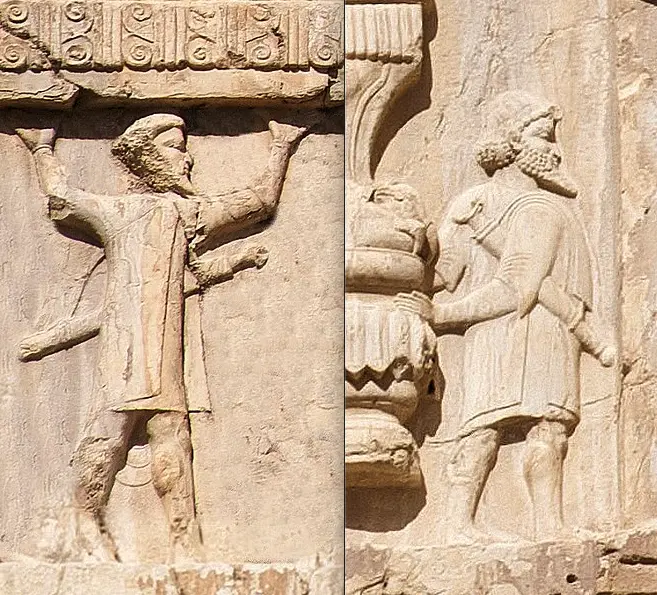
[ABOVE: Ionian (left) and Carian (right) soldiers in the Persian army, c.480 BC, depicted on Xerxes's tomb]
THERMOPYLAE: THE LAST STAND
Once Leonidas was surrounded, he and what was left of his army - now only some 500 men strong - sacrificed all thoughts of safety. The Greeks ate breakfast very early, still late into the night, as the Thespians voiced their eagerness for Leonidas to lead them into one final charge, to which the Spartan king, joining them in eating, told them to prepare their breakfasts quickly, for they were to dine in Hades. When all were ready, Leonidas lead the Greek force to attack the nearby Persian camp, heading straight for Xerxes’s personal pavilion and cutting down all in their way.
Leonidas’s forces attacked in a tight phalanx formation, with the Spartan King personally leading from the front. The Persians in disarray hastily ran out of their tents to meet the Greeks, under the impression that Ephialtes’s contingent had been cut down and that all 7,000 Greek soldiers were upon them. As this fight took place at night, the Persians were in a state of panic and confusion, and suffered many casualties, many of which were self-inflicted in the confusion. Disappointingly to the Greeks, however, Xerxes was nowhere to be seen, as his soldiers had withdrawn him to a place of safety upon being attacked so suddenly. When the sun rose, the Persians could see that only a few hundred Greeks actually remained. Yet still fearing their skill and valour, they moved to the flanks of Leonidas’s forces and shot them down with arrows and javelins, forcing the Greeks to pull back.
Come sunrise, Xerxes performed libations, and launched his final attack during the mid-morning. As the Persian soldiers advanced further, so did the Greeks, further than the days prior in fact, marching out into the wider parts of the Hot Gates, keen to take to the field properly this time, since death neared.
Persian casualties on this third day of fighting were even higher, as Xerxes had ordered for whip wielders to lash at every available man to charge into the fight, while the Spartans fought with nothing left to loose, taking no prisoners.. So many Persians were forced into the fight that several fell from the cliffs into the sea below, where they drowned, and more still died while being trampled by their fellow men. In this fight, where Spartan spears broke, swords were drawn, and where swords were lost, fists and teeth were used. Leonidas himself fought to the death with the utmost bravery, and two of Xerxes’s own brothers died in the fight. It was halfway through the fight that Leonidas fell. Each side fought vigorously over his body, one side keen to mangle his corpse and the other keen to preserve it. Four times the Persians were forced back, until Leonidas’s body was recovered.
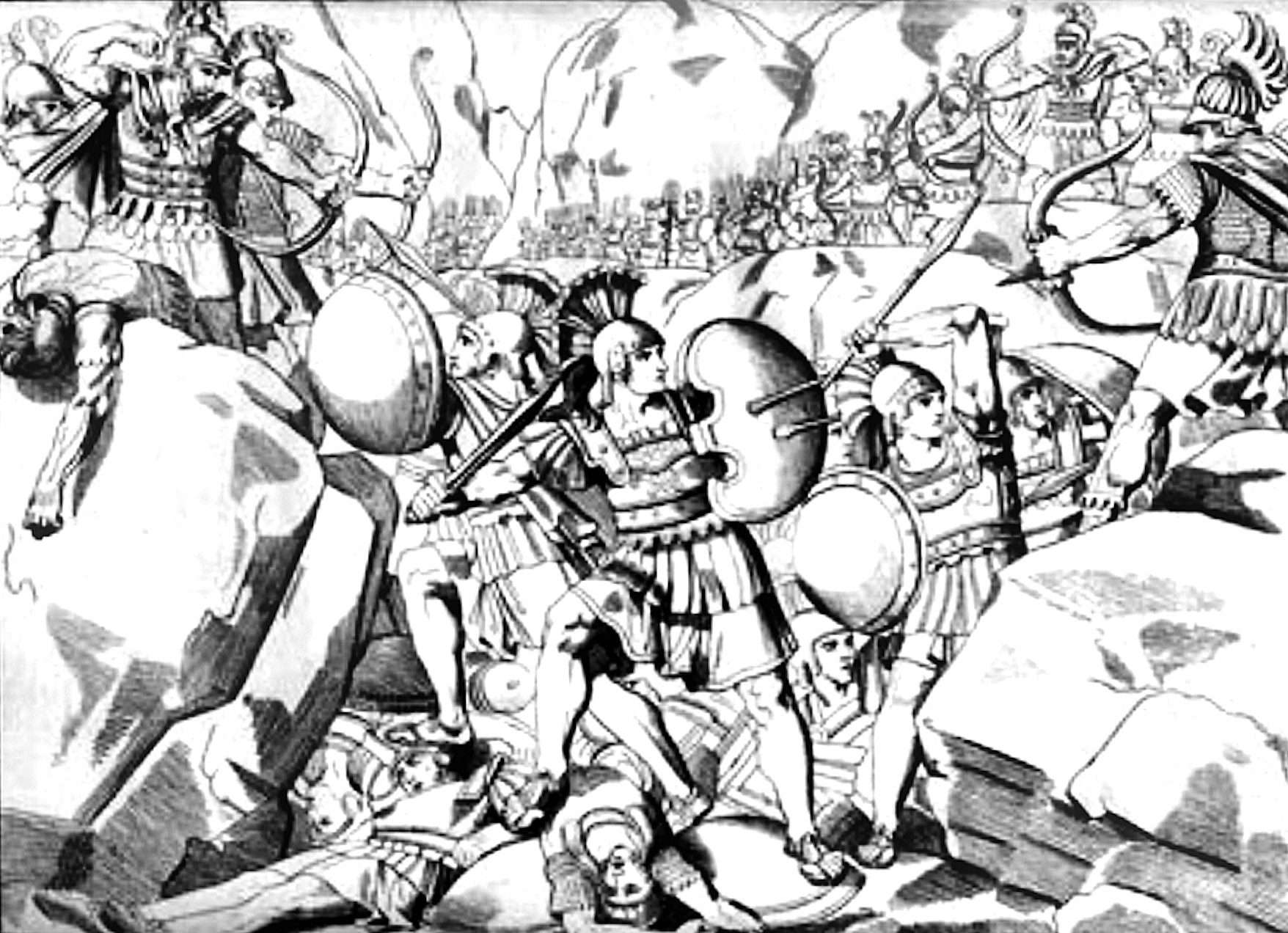
[ABOVE: Spartans surrounded by Persians. Drawing first published in 1832]
It was here that Ephialtes and Hydarnes arrived with their forces, now fully surrounding the remaining Greeks. Here, the tides of the battle completely tilted in favour of Persia; all remaining Greeks regrouped to behind the wall, in the narrowest point of the pass. The Thebans, meanwhile, having not wanted to stay in the first place, seized the opportunity while the Spartans and Thespians pulled back to surrender in open arms to Persia, declaring their allegiance to Persia. While some were killed while they approached the Persians, the rest were branded with the king’s mark, including Leontiades. A last stand was made by the Spartans, in which what was left of the wall was torn down, before Xerxes pulled back his remaining forces and finished off the last of the Greeks with arrow fire.
Leonidas and his three-hundred Spartans had fallen. Around twenty-thousand Persians had also fallen, several prominent men among them, including two of Xerxes’ brothers, and an entire week had been bought for the rest of Greece to the south to regroup and prepare for the rest of the war to come.
AFTERMATH
Once the Persians had won, Xerxes summoned Demaratus. He was keen to ask how many more Spartans were left in Greece, and if all would fight as well as the three-hundred. Demaratus confirmed that there were around eight-thousand in Sparta, and that all were of similarly exceptional fighting standards. Xerxes wished to know if there was a way to beat the remaining Spartans with as little trouble as possible. Demaratus advised on sending three-hundred warships to Cythera, the island just south of Laconia, and use it as a base of operations to attack Sparta, thinking this would haunt any Spartan reinforcements aiding the rest of the Greeks to the north. Demaratus also said that should Xerxes follow this advice, any resistance that would otherwise inevitably form at the Isthmus of Corinth would surrender beforehand.
Achaemenes, Xerxes’ brother and commander of the Persian fleet who was present at this conversation, was worried that Demaratus, being Greek, may be attempting to sabotage Xerxes’ campaign, advising that Xerxes should keep the much larger fleet together, to support the army and stop their own fleet being outnumbered. While not believing Demaratus was out to sabotage him, Xerxes followed Achaemenes’ advice instead.
LEONIDAS'S CORPSE
Xerxes scanned the battlefield for the body of Leonidas. Upon finding him, he ordered him to be decapitated, and have his head stuck on a pole. It’s this abnormal level of violence that tells us that the three-hundred were a particular hindrance to Xerxes, especially as the Persians did tend to respect valiant war-time enemies.

[ABOVE: An Achaemenid King killing a Greek hoplite. Dated to the reign of Xerxes and sculpted c.500-475 BC, this may be depicting Xerxes himself killing Leonidas]
THEMISTOCLES LEARNING OF DEFEAT
It was here that the messenger from Thermopylae arrived at Artemisium, telling the Greeks of the fall of Leonidas. The fleet immediately withdrew south in an orderly fashion, abandoning Athens altogether, fearing what Xerxes was to do to the city, and ordering all to retreat to the isle of Salamis. Before setting off, Themistocles took one of the fastest ships available, setting sail for any land that the Persians could stop off at for fresh water on their way south, where he carved a message into the rocks for the Greeks under Xerxes’s fleet to read:
Men of Ionia, it is wrong of you to fight against your ancestral line and to enslave Greece. Ideally, you should join us; failing that, even now adopt a position of neutrality, and ask the Carians to do the same. If neither of these courses of action is feasible, and the Persians have too great a hold on you for you to revolt, in the battle you can remember that you are descended from our stock and that you were the original cause of the enmity between us and Persia, and deliberately fight below your best.
This was a clever move by Themistocles; either the Ionians would be convinced to defect back to the Greeks, or Xerxes would become distrusting of his Greek followers and would keep them out of any future fights against their fellow Greeks. The Persian fleet, meanwhile, got word of the Greek’s withdrawal from Artemisium, setting sail for there themselves and reaching the cape by midday.
Meanwhile, a Persian messenger from Xerxes at Thermopylae reached the Persian navy; Xerxes had made prior arrangements for any of his soldiers who fell in battle, of which there were around twenty-thousand at Thermopylae. One-thousand were left as they were, while the rest were buried. He did this so that his fleet, who would pass by soon, would not see a huge amount of their dead allies and be disheartened by it. A large contingent of Persians from the navy were convinced to go and see the dead at Thermopylae for themselves, so much so that ships actually became scarce. This whole event was used to boost the morale of Xerxes’s men; while they were staring at what they thought were thousands of dead Spartans and Thespians, they were in fact starting as just a small section of the tens of thousands of their own fellow men who fell at the hands of so few. Some local Arcadians at this time defected to Persia, and told them of the Olympic festival that was currently taking place. The Persian navy then set sail for Euboea, storming the island.
SIMONIDES
In the years after the war, a commemorative epitaph, attributed to the lyric poet Simonides, was engraved on a commemorative stone, which lay at the hill that the last of the three-hundred Spartans fought on. While the original stone hasn’t survived, the epitaph was engraved on a second stone. Several translations exist, but it reads:
Stranger, tell the people of Lacedaemon
That we who lie here obeyed their commands.
An encomium of his also reads:
Of those who perished at Thermopylae
All glorious is the fortune, fair the doom;
their grave's an altar, ceaseless memory’s theirs
Instead of lamentation, and their fate
Is chant of praise. Such winding-sheet as this
Nor mould nor all-consuming time shall waste.
Their sepulchre of valiant men has taken
The fair renown of Hellas for its inmate.
And witness is Leonidas, once king
Of Sparta, who hath left behind a crown
Of valour mighty and undying fame.

[ABOVE: Leonidas shown atop the monument of Felice Cavallotti, Milan, created by Ernesto Bazzaro, 1906]
High praise should be given to those who refused to flee Thermopylae. They gladly offered up their own lives for the preservation of the rest of Greek civilization, in preference of dying nobly than living shamefully. No doubt can be had that the Persians were in total dismay that so few could have pulled off so much in so little time; they had only held the pass for seven days, only three of which were spent fighting. While a Persian victory, Leonidas’s men mustn’t be judged for the outcome of their actions, but rather for the intent of them. Future victories to come would be inspired by the knowledge that Leonidas and his Spartans chose to lay down their lives.
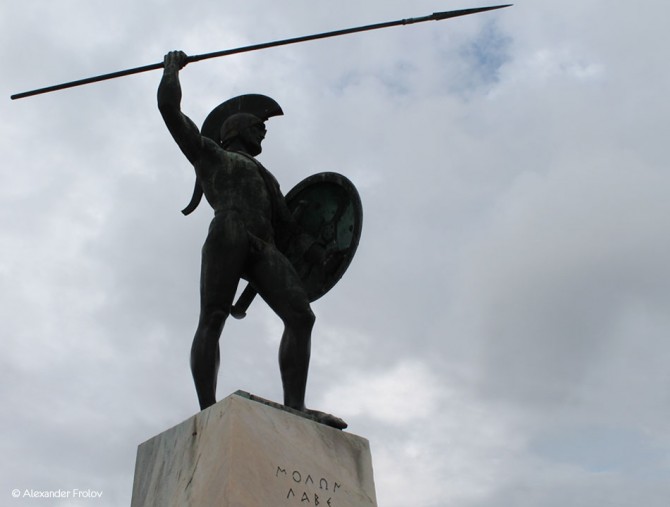
[ABOVE: A modern statue stands at Thermopylae, with the engraving "ΜΟΛΩΝ 𝝠ΑΒΕ", "MOLON LABE", "COME AND TAKE THEM!"]
Leonidas may have lost this fight and fallen, and the way to Athens was now indeed completely open, but the sacrifice at Thermopylae would serve as a rallying cry for the rest of the Greeks, that the few could, and indeed should, stand up to the many. To the Greeks, and even to us today two and a half thousand years later, their sacrifice would never be forgotten. It’s this lasting act of suicidal bravery against all the odds that has carried on to inspire people to this day. Famous words like Leonidas’s “Come and get them” and Dianeces’s “We will fight in the shade” are still well known to us today.
NEXT BLOG: THE SACK OF ATHENS, 480 BC: The Conquest of Central Greece
SOURCES
- Herodotus, "Histories"
- Diodorus Siculus, "Library of History"
- Plutarch, "Greek Lives: Themistocles"
- Oswyn Murray, "Early Greece"
- Robin Osborne, "Greece in the Making 1200 - 479 BC"
- Nic Fields, "Thermopylae 480 BC, Last Stand of the 300"
YOUTUBE LINKS
(I do NOT own these videos)
"Decisive Battles - Thermopylae (Greece vs Persia)" uploaded by "Zakerias Rowland-Jones"
"Leonidas of Sparta: Warrior king of the Greek city-state of Sparta" by "Biographics"
"300 Spartans (Part2/2) (3D Animated Documentary) Battle of Thermopylae 490-480 BCE" by "Hoc Est Bellum"
"Spartan Poems: Dramatic Readings!" by "OverlySarcasticProductions"
"History Today: How Accurate is Hoplite Warfare in the Movie 300?" by "Invicta"
MY ANCIENT GREEK HISTORY BLOG PAGE
MY ANCIENT PERSIAN HISTORY BLOG PAGE
MY TWITTER
All feedback - positive and/or critical - is appreciated!
All images used are copyright-free
Don't forget to rate this post and leave a tip if you enjoyed it
Thanks for reading :)






