
Leonidas and his three-hundred Spartans had fallen, with the rest of the Greek troops either dead or withdrawn. With no reason to remain where they were, Themistocles pulled his navy back South towards Athens to stage a desperate last defence at sea. The gateway to the rest of Greece was now open to Xerxes and his Persian army.
Check out my previous posts on the Greek preparations for the Second Persian Invasion, and the Battles of Thermopylae and Artemisium
MARCH THROUGH BOEOTIA
After the victory at Thermopylae, Xerxes now marched through Boeotia towards Athens. Meanwhile, the Thessalians sent heralds to Phocis; Thessaly and Phocis had been fighting for centuries, but given now that Thessaly had sided with Persia and that Phocia, the only non-Persian ally in the region, had sided with the resistance, tensions were now raised. Thessaly’s message warned the Phocians of how powerful and influential Thessaly now was under Persia, telling them that they would divert Persia’s advance towards them as long as they paid up. Phocia refused to pay, and, angered, the Thessalians personally guided Xerxes’s army towards their territory themselves before reaching Athens. Upon reaching Phocis, many of the locals had fled to the nearby hills and to other settlements. Regardless, the Persians torched the entire settlement, as well as over a dozen other local settlements. Among them was Abae, which housed a sanctuary to Apollo and a large treasury, and an oracle. The loot was taken, the shrines were torched and the locals were killed and raped.
ATTACK ON DELPHI

[ABOVE: The Athena Temple Complex at Delphi, situated on a cliffside]
Xerxes’s army would split into two soon after, with Xerxes leading the largest contingent and heading for Athens, entering Boeotia, while the other contingent headed for Delphi. Devastating the rest of the region along the way, their goal was to loot the entire city and its sacred oracle and bring it before Xerxes. Getting word of the oncoming army, the Delphic people consulted their Oracle, asking if they should bury the sacred property or flee with it. In response, the oracle told them that it would be safe, so their attention turned to their own safety. The women and children were sent across the Isthmus of Corinth to Achaea, while the majority of the men made their way up the mountains, and others to other nearby settlements. Only sixty men would stay at Delphi.
As the Persian army approached, the god’s prophet, Aceratus, noticed that the weapons, were not in the temple they belonged, but rather were laid out on the ground in front of it. As these were not meant to be touched by anyone, he assumed that it was a miracle, and told the Delphians about it, as the Persians moved on the sanctuary of Athena. It was at that moment we’re told that thunder directly hit the Persian forces, breaking two crags off of the cliffside that Delphi overlooked from, crushing more Persian soldiers. Combined with war cries from the Delphians, the Persians fled, with several being killed in the pursuit. Delphian survivors then fled to Boeotia. Following this lucky thunderstorm at Delphi, the Delphians built a trophy besides the sanctuary to Athena, on which was inscribed:
To serve as a memorial to war,
The warder-off of men, and as a witness
To victory the Delphians set me up,
Rendering thanks to Zeus and Phoebus who
Thrust back the city-sacking ranks of Medes
And threw their guard about the bronze-crowned shrine.
THE SACK
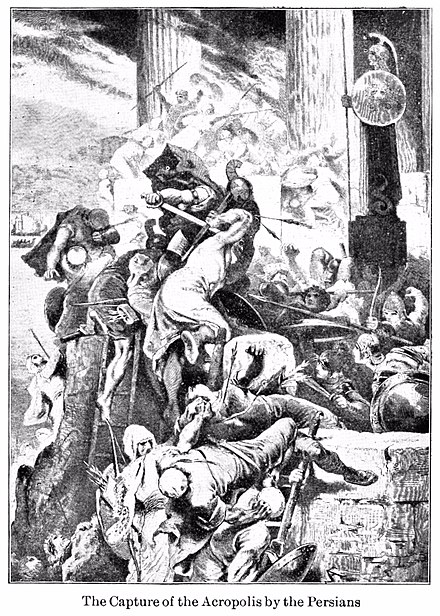
[ABOVE: "The Capture of the Acropolis by the Persians", illustration in Jacob Abbott's "History of Xerxes", published c.1900]
Xerxes, however, was in Attica, having just plundered and burnt Boeotia, Thespia, and Plataea. Only a few Athenians remained in the city, blocking off the Acropolis with make-shift wooden barricades; they thought that the Oracle’s words of a “Wooden Wall” meant to defeat the Persians could refer to this barricade defending the Acropolis. Stationed opposite on the Areopagus, the Persians besieged what was left of Athens, using fire-tipped bows and arrows to burn down the wooden fortification. When a head-on attack was ordered by Xerxes, the defenders, being among the more impoverished citizens and not professionally trained soldiers, still put up a good fight, and Xerxes was left in familiar territory: being held off in a narrow space with seemingly only one way through. Eventually, his soldiers would locate the more undefended sides of the Acropolis, but these were only accessible at the time by climbing up the sheer slopes of the rock face itself. With ropes, some Persians did eventually ascend the cliff, and upon seeing this, the Athenian defenders either withdrew to the temple itself, or flung themselves to their deaths. The Persian climbers reached the temple first, and eventually killed off the defenders. From there, the Acropolis was looted and set ablaze. Athens had fallen to Xerxes.

[ABOVE: The foundations of the Athenian Acropolis, photographed in 1909]
Sending messages back to Persia to boast the fall of his primary target, Xerxes then demanded all Athenian exiles among his forces to ascend the Acropolis as his soldiers had done, and to sacrifice each other by jumping off, which they did. When news of this reached the Athenian fleet at Salamis, some commanders were so fear-stricken that they made straight for their ships and intended to flee to who-knows-where. The remaining men decided to stand and fight to defend the Peloponnese.
PERSERSCHUTT: "PERSIAN RUBBLE"
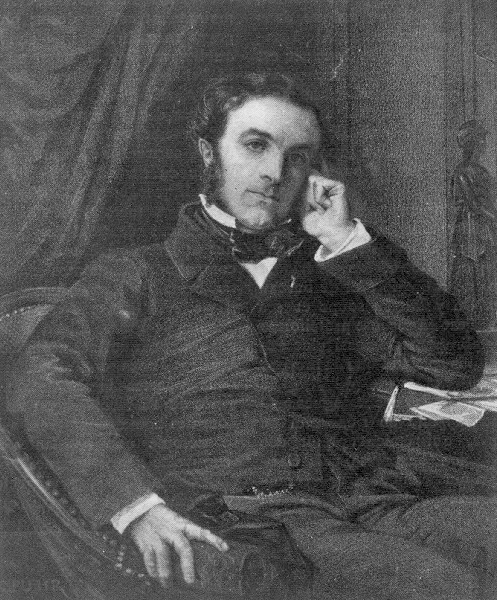
[ABOVE: 1862 painting of Charles Ernest Beulé]
Remains of the destruction of Athens were preserved after being excavated between 1863 - 66 by French archaeologist Charles Ernest Beulé, with the remainder being found in further excavations in 1885 - 90 by the archaeologist Panagiotis Kavvadias. Below is a selection of images showing some of the recovered pieces of art, first published in 1906:

[ABOVE: The Angelitos Athena, depicting Athena armed for war, photographed in 1866]
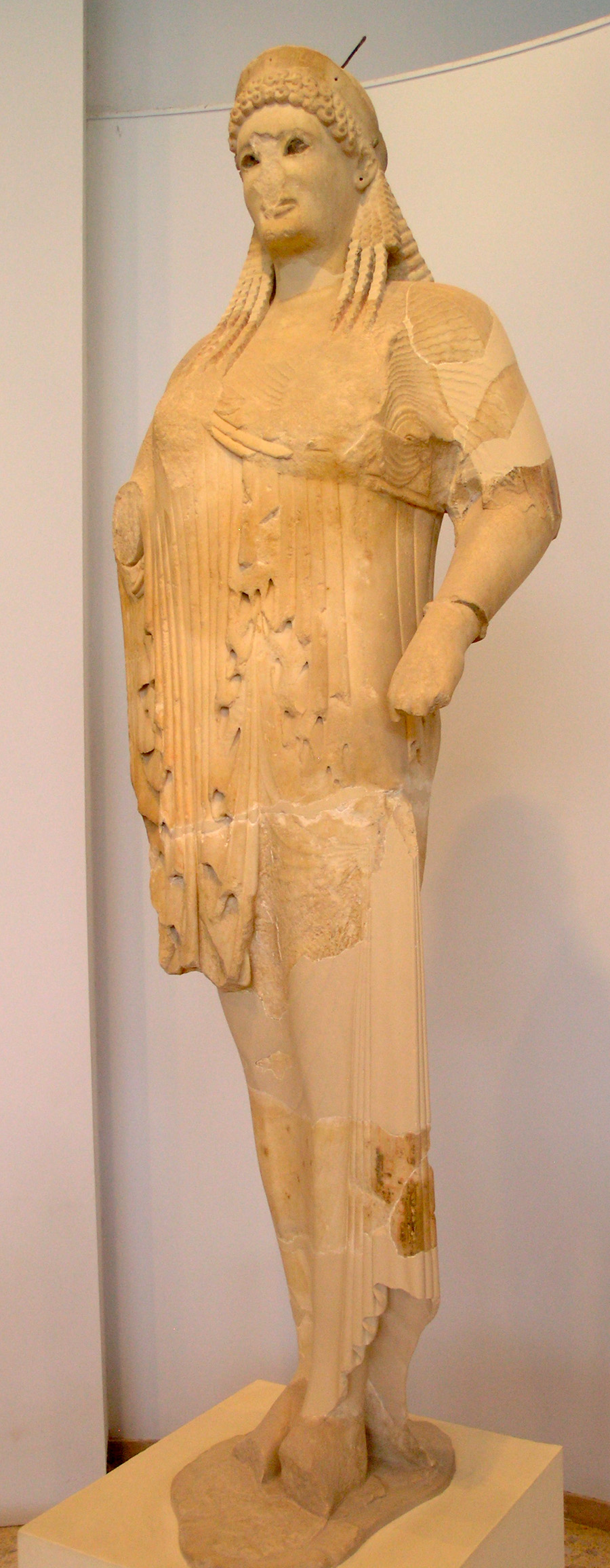
[ABOVE: The Antenor Kore, "Kore" being Greek for "girl"]

[ABOVE: The Three-Bodied Daemon, a section of the damaged Hekatompedon pediment]

[ABOVE: The Moschophoros, "Calf-bearer", a man carrying a sacrificial animal]

[ABOVE: The Peplos Kore, "peplos" being the robe worn here]

[ABOVE: The Rampin Rider]

[ABOVE: The Euthydikos Kore, enscribed: "Euthydikos son of Thaliarchos dedicated [me]."]

[ABOVE: A sculpture of a woman]
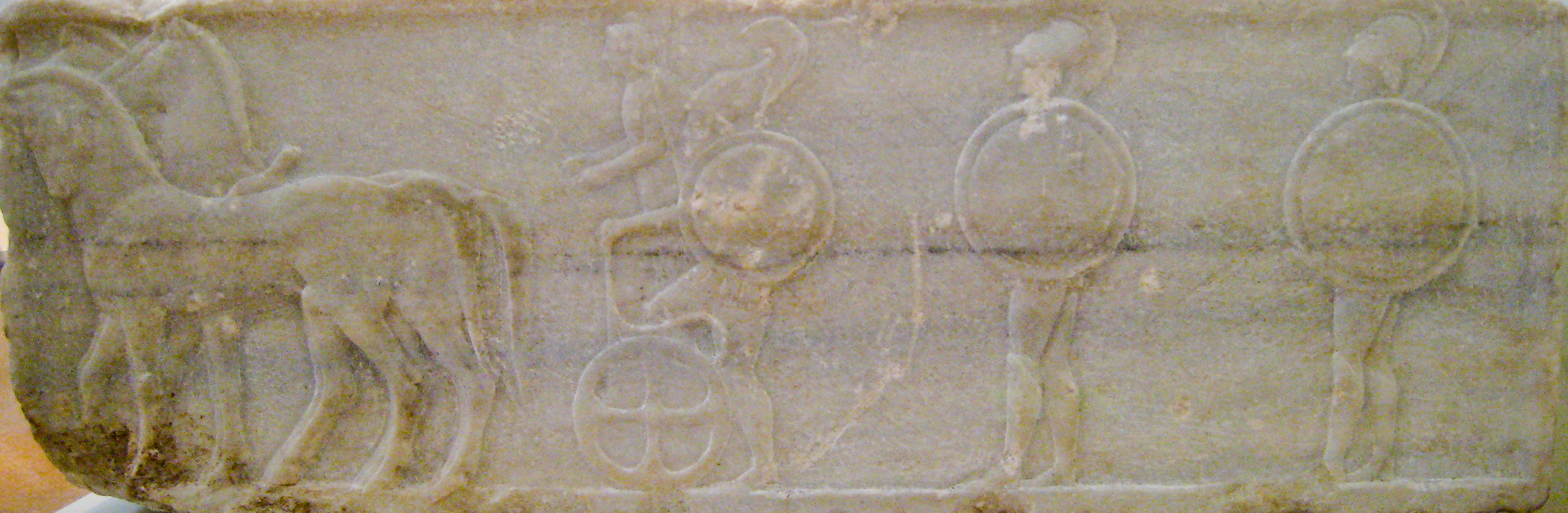
[ABOVE: A chariot and hoplites depicted on a funerary monument, later built into the Themistoclean Wall]
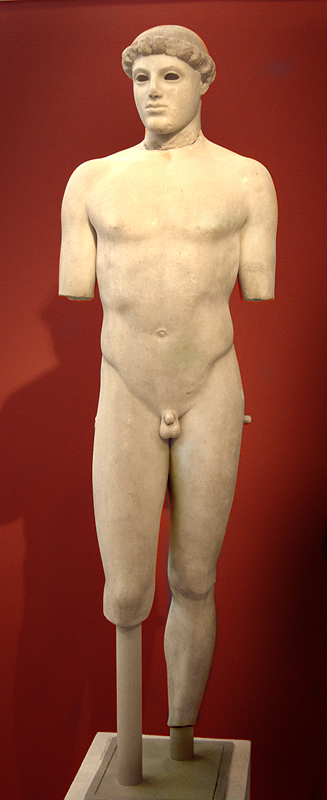
[ABOVE: The Kritios Boy, the first known Classical Greek statue to use contrapposto", a figure with most of their weight on one foot. Named after Kritios, who aided in rebuilding Athens and its Acropolis years later]
THE GREEKS CONVENE
While Athens was being sacked, Xerxes fleet sailed from Euboea to Attica, looting and burning the coastline as they went. Themistocles’s fleet, meanwhile, had fled from Artemisium, docking at the isle of Salamis where the women and children of Athens waited. The nature of the direness of the situation left the survivors, curious as to what to do next, feeling like they made a bad decision abandoning their post and their city. It wasn’t long until word reached them that the Peloponnesian were building a wall along the Isthmus of Corinth, completely blocking off the Peloponnese from the north. Soon, however, more ships stationed at the harbour of Troezen joined the fleet at Salamis, making the combined fleet now larger than the one that first sailed for Artemisium. Eurybiades of Sparta was still in overall command, and the Athenian contingent was still the largest.
That night, Themistocles was approached by a fellow Athenian, who asked him what decision had been made. Themistocles told him that he intended to sail for the isthmus and fight, to which the Athenian told him that leaving Salamis would leave him with no nation left to fight for, at which point all Greeks would flee back home, even saying that Eurybiades, in overall command, would not be able to keep the fleet together. Convening with Eurybiades, Themistocles was able to persuade him to stay at Salamis. Eurybiades ordered for the commanders of the fleet to convene, and before the session had even begun, a Corinthian, Adeimantus, interrupted:
At the games, Themistocles, those who are too quick off the mark earn themselves a flogging.
Themistocles responded straight away:
Those who get left behind win no prizes.
Themistocles continued. He argued to Eurybiades that fighting in the Isthmus would put the outnumbered Greeks in the open waters, putting them at a disadvantage, and that going to the Isthmus would put the Peloponnese at greater risk, since the Persian army would be following the Persian navy, and fighting there would draw them further south. Themistocles also knew that withdrawing from Athens was a good move, since it not only kept them out of the inevitable reach of Xerxes, but also withdrawing to the Peloponnese would have left the Athenians voiceless under the Spartans. Adeimantus again interrupted, claiming that since Themistocles was a man with no home, he had no right to speak. Themistocles responded with insults to the man and his nation, claiming that as long as the Athenian people and their navy survived, then so did Athens. Continuing, Themistocles said that should Eurybiades travel to the Isthmus, he would take his people to Siris, in Italy, since an oracle had once told the Athenians that it was their destiny to one day colonise it.
Either convinced by Themistocles’s logic or by his threat to take the largest contingent of the navy away from him, Eurybiades was won over; the fleet would stand and fight at Salamis. This was among the last forces left to defend Greece. Everything was on the line, and the fate of Greece would be decided in the straits of Salamis.
NEXT BLOG: THE BATTLE OF SALAMIS, 480 BC: The Battle to Save Greece
SOURCES
- Herodotus, "Histories"
- Diodorus Siculus, "Library of History"
- Oswyn Murray, "Early Greece"
YOUTUBE LINK
(I do NOT own this video)
"The Burning of Athens 480 BC (3D Animated Documentary) King Xerxes Invades Attica" by "Hoc Est Bellum"
MY ANCIENT GREEK HISTORY BLOG PAGE
MY ANCIENT PERSIAN HISTORY BLOG PAGE
MY TWITTER
All feedback - positive and/or critical - is appreciated!
All images used are copyright-free
Don't forget to rate this post and leave a tip if you enjoyed it
Thanks for reading :)






