
What a mess these last days!
We have seen scenes of massive panic from a few tweets by the Emperor of Mars who remembered a little late that Bitcoin was using a lot of energy. But oh, Mike Novogratz, CEO of Galaxy Digital published a work in which it is shown that the banking industry, the one that has been robbing us for more than 200 years through the spurious issuance of money, creating inflation and using our money for their business without sharing a penny with us of what they earn, spends more than double that of Bitcoin mining!
Ark Invest also defended the environmental impact of Bitcoin, saying that Elon Musk’s view on Bitcoin is ‘misguided’.
Mr. Musk, did you have any hidden interests in posting your famous tweets?
It makes me laugh to see the flock of manipulated journalists from the mass media repeating like parrots “carbon-free”, “carbon-free”, the new discourse that the banks want to impose. And it turns out that banks spend more than Bitcoin.
But let's not be very critical only of the Tesla man and his space rockets. There is also the Binance episode being investigated by the SEC.
Result of the explosive recipe: a lot of terrified people selling their small positions of cryptocurrencies, a situation widely used by the mainstream bought by banks and corporations to show once again that all this cryptocurrency is a bubble, that cryptocurrencies have no endorsement and that everyone who buys any cryptocurrency will lose all their money. It is the bankers' speech at its finest. And a lot of charlatans saying stupid things, demonstrating a supine ignorance about the technology that is revolutionizing the culture and the transfer of value of humanity.
For example, I read a report comparing Bitcoin to AOL. The ignorance that emerges from this article regarding what blockchain technology really is, is so great that it is not worth wasting a minute arguing it. Just one more time, before writing, you have to study, otherwise, you can look like an idiot.
When you don't know, you have to shut up. The newspapers and the media flood weak minds with their ignorance and biased actions and the results are used by politicians and corporate officials, especially bankers, to persuade us to deposit in their arks the promissory notes that central banks print so that they keep using our effort for their business.
Image by OpenClipart-Vectors from Pixabay
As long as this is not understood, there will not be mass adoption of assets such as cryptocurrencies that reside in the network of interconnected computers and do not depend on any authority or any central power.
In the absence of mass adoption, in reality, being still very far from it, there will continue to be instability and violent movements in the market. But if one understands that this ecosystem is about a revolution of stark magnitude for humanity, then one would not have to flinch before the roller coaster of the crypto markets. Sadly, most of the people who buy some crypto assets, are doing it to get rich next week. That lacks logic and is a show of total ignorance. However, this last week showed us fully how a new technology behaves in the hands of the ignorant. The famous figure of the “monkey with a razor blade”.

Image by MasterTux from Pixabay
The biggest danger right now is that even the most believing people in the crypto ecosystem, are asking for "some regulation," which runs counter to the spirit of decentralization. If you want regulation, then stick with fiat money issued as debt by a central bank. Or is it that you are not prepared for decentralization? Does it give you a bit of vertigo to be very free? Do you want regulators? So do me a favor, stay out of this now, because you're like a monkey with a razor blade. If you are afraid of the normal corrections of assets in nascent markets, please do not bother here with your doubts and go study a little before giving your opinion. Especially if you are a journalist for mass disinformation media.
What? That Central Banks are going to issue their own cryptocurrencies?
Ah well ... I thought we were going to be serious ...

Image by Manfred Richter from Pixabay
Please, let's look at the forest we are planting together to eliminate centralized authoritarian and dictatorial systems, let's push decentralization together and stop worrying about the price of bitcoin!

Image by FelixMittermeier from Pixabay
With that said, let's move on to today's two tokens.
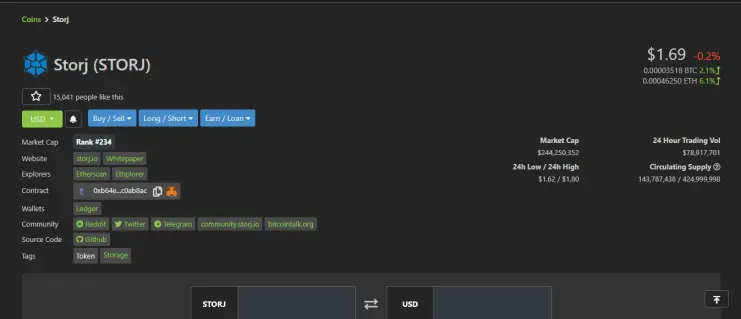
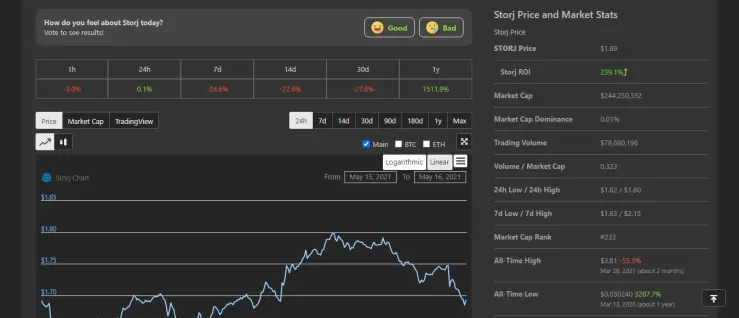
STORJ
https://www.storj.io/
ranking CoinGecko #234
The basic principle of decentralized storage systems consists of the creation of a network of distributed computers capable of working together to house and retrieve previously fragmented and encrypted information so that the different users of the network have the certainty that their information will be available when required in the place where they are and protected from selfish interests and malicious attackers. The IPFS (InterPlanetary File System) project, a P2P protocol capable of dispensing with the controls and limitations of central services that currently predominate on the Internet, is representative of this type of system.
Storj (pronounced “storage”) is a software project seeking to develop a cloud storage solution that improves upon existing cloud storage providers.
STORJ is an Ethereum-based token (ERC-20) that powers a cloud storage platform called Tardigrade, which in turn uses a decentralized network of nodes to securely host user data using advanced encryption. This process enables secure file storage without the need to rely on a centralized data center such as Amazon Web Services or Google Cloud. Network users who contribute their resources such as unused hard drive space and bandwidth to Tardigrade get STORJ tokens as a reward.
Recently, Storj's team announced that they have developed a method to upload data to the Tardigrade network through the IPFS system.
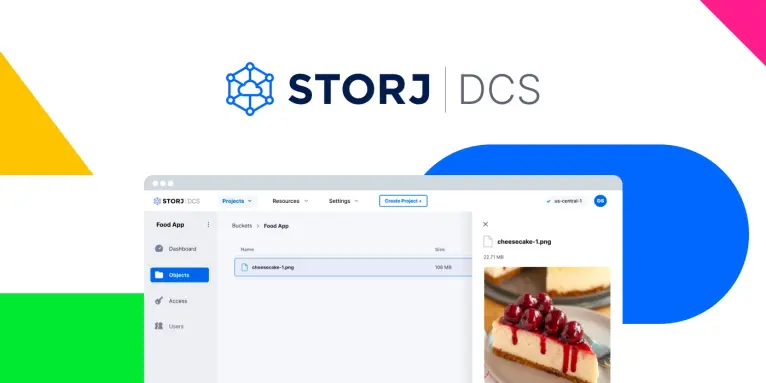
STORJ completed a $ 30 million ICO they made in an ERC-20 token sale in 2017. At the time, it received the blessings of Vitalik Buterin, having contributed himself to the STORJ whitepaper.
If you have free storage inside your hard drives, you can create storage nodes and rent them to get payments in STORJ. The maximum size for a single node is 8 TB. When users upload files to Tardigrade, parts of each file are distributed to the global network of independent nodes that store the data until someone requests a specific file, at which point it is safely recompiled and made available for use. You do not need to have video cards or GPU, STORJ can be mined on a hard drive.
The big difference with the rest of decentralized clouds such as Google Drive, Azure, or Dropbox, is that the files are not stored in a large Datacenter, but that STORJ stores the files in a large network of nodes created by users through the computers themselves. The files are indexed to later be stored in different nodes around the world.
STORJ uses a technology that saves 3 copies of each file in the different nodes, this is called 3X Redundancy. In the event that a node is shut down, a copy will be made from an active node to a file on a new node.
The STORJ ecosystem is very interesting. STORJ is just a utility token, but its function allows a user to be a provider of bandwidth, of space on his hard disk, and to store at the same time. The token is used as a form of exchange, between those who demand digital space online and those who offer it. In the Tardigrade network, users can demand space to store their data.
When a file is uploaded to this network, its data is encrypted on the space-demanding user side. After they have been encrypted, these data are protected and they are divided into small fragments that are distributed in the different nodes that make up the entire network. This modality makes it practically impossible for the data to be violated.
Any blockchain runs on different devices. The STORJ cryptocurrency network does the same. This distribution of the nodes that run this "blockchain" makes it very secure.
Recently, STORJ announced the inclusion in its protocol of zkSync, a Layer 2 (L2) scaling solution for Ethereum based on zk-Rollups technology.
The plan is that hosts (STORJ network storage node operators) who want to subscribe can take advantage of L2 payments on the Ethereum blockchain.
As for the STORJ Labs team, the CEO is Ben Golub, a renowned Start-up CEO and entrepreneur, with multiple, successful M&A exits, and Shawn Wilkinson, Founder & CSO
Conclusion. When we say that blockchain is much more than cryptocurrencies we specifically mean things like STORJ. In this case, STORJ is nothing more than a utility token to validate the operations of the blockchain itself. But what can really be an extraordinary revolution is the fact of being able to store all the contents of humanity in thousands of distributed computers, without depending on centralized servers or powerful companies that claim the fact of being the providers of all existing information. This is the spirit of decentralization. Google, Amazon, Facebook, or Microsoft have begun to concentrate on their respective data processing platforms everything that we share or develop. The race to grow, to encompass, and devour does not stop within these companies, which, in this way, cease to be operators of capitalism to become centers of political power.
The violation of personal data has raised doubts in digital communities, especially regarding the manipulation and trade of personal information on private platforms such as Facebook, Google, Amazon, or Microsoft. The fact that in many cases we transfer ownership of our personal data worsens this perspective, which is also linked to the increasingly questionable practice of censorship and surveillance of the information that we transmit through centralized Internet servers.
This context has driven for years a set of efforts to create decentralized data storage systems, a key element for greater security, privacy, and freedom on the Internet.
People lose confidence in large, centralized systems day by day, and especially in companies that gobble up other companies to get bigger and bigger. But the question is: Can a project like STORJ compete with giant, centralized companies like Google Drive or Dropbox? The truth is that the STORJ ecosystem is in full growth since its birth, it currently has 150,000 storage nodes in more than 200 countries, and can store more than 150 PB.
STORJ is undoubtedly one of the most attractive projects today, and it is managed by a large and very competent team. The use case is very concrete: users want a safe place to store their important data, and at the same time they want to earn extra money for their idle storage capacity. STORJ is going to face stiff competition, as there are similar projects that are also very attractive. But let's not forget that this one has Vitalik Buterin’s blessing ...
XTZ
https://tezos.com/
ranking CoinGecko #39
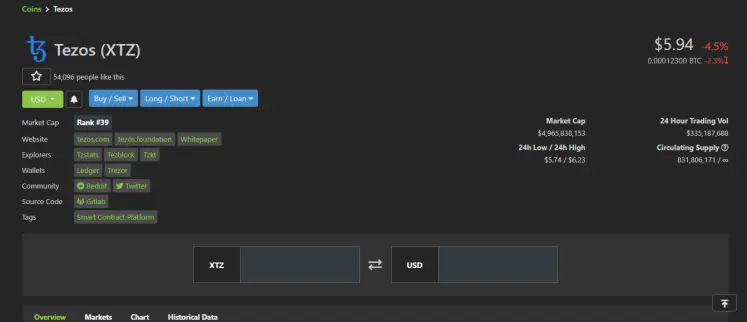
Tezos is a blockchain designed to offer scalable, secure, and powerful infrastructure for smart contracts. It uses a token for its internal operations, the Tezos (XTZ) token. XTZ has an existence limited to 10 billion coins. However, in its genesis block, about 700 million coins were released to the ecosystem at a total of 32 thousand Tezos addresses, respecting the agreements of the ICO that financed this cryptocurrency.
The rest of the coins are released to the ecosystem through a system of adjustment to the emission that takes place within the protocol. Currently, such emission per block is set at 40 XTZ per block. However, at no time can this inflation exceed 5% per year, in accordance with the provisions of the Tezos Seed Protocol. The XTZ tokens of an account that are not mobilized for more than a year, are burned, in order to keep the system economically active.
The potential of the XTZ token is focused on the control and interaction with smart contracts, the governance of the blockchain, and its block generation process. In fact, the use of this token on the blockchain is very similar to what ETH has within Ethereum. Each interaction in Tezos generates a cost in "gas", which is then translated into its respective commission in XTZ tokens.
Tezos has a modular infrastructure, easily upgradeable, and uses a consensus protocol called Liquid Proof of Stake (LPoS). Your smart contracts can be programmed both in its native language, Michelson, as well as in other languages, which gives it enormous flexibility.
The LPoS protocol is designed to allow validators to extract a block, and then need a set of signatures to offer validity to said block, all at random. That is, a group of validators generate a block, but only the block that manages to reach the set of necessary signatures in the first place will be the one chosen to be part of the blockchain. The rest of the generated blocks are rejected, and the process is restarted. This block generation process is the one that earns the 40 XTZ reward, and those who sign also earn a small reward. LPoS includes some protections against so-called double signing, which is an event in which a validator tries to sign and vouch for two different blocks at the same time, in a race to earn commissions at any rate. In this case, LPoS penalizes these actions with the loss of the profits of said block.
The process of creating a block in Tezos is called Baking (the validators are called “bakers”). The Bakers' job is to have the computational power and staking of XTZ tokens, which gives them the right to produce blocks according to their participation in the system. To become a Baker in Tezos you must have a minimum staking of 8000 XTZ, but the greater your participation, the greater your probability of generating a block. In addition to this, to generate a block, one Baker must make a security deposit (his "Proof of Stake") of 512 XTZ per block.

Image by Pexels from Pixabay
Another important part of how Tezos works are its smart contracts. In fact, in this sense, smart contracts are controlled in a very similar way to Ethereum smart contracts. That is to say, the actions and programming of the same have a certain cost in gas, which must be paid in XTZ tokens so that they can be executed. Tezos smart contracts are programmed in the Michelson language, instead of Solidity as in Ethereum. Michelson is the domain-specific language used to write smart contracts on the Tezos blockchain, based on stacks and without variables. Stack-oriented languages operate on one or more stacks, each of which can serve a different purpose. This allows enormous versatility at the cost of being much more complex to handle.
The existence of smart contracts enables this platform to create fungible and non-fungible tokens (NFT). At this point, Tezos fungible tokens are compliant with Ethereum's ERC-20 standard and are specified in TZIP-7. The same goes for non-fungible tokens (NFTs), which follow Ethereum's ERC-721 and ERC-1155 standards, and are specified in Tezos's TZIP-12. In this way, Tezos can create communication bridges between Ethereum tokens and its blockchain very easily.
The governance of Tezos relies on an on-chain structure that allows its participants to propose, select, test, and activate protocol updates without the need for a hard fork. In practice, this is similar to the structure of a corporation, where shareholders can vote on the direction of the company.
Many other blockchains do not have this type of formal governance structure, so the direction of these projects is often decided by a small group of developers or a foundation, who may or may not represent all stakeholders fairly.
There are no visible faces in Tezos, as in Bitcoin. It is very difficult to find members of a Tezos managerial team. Ethereum and Cardano are kinds of cult projects with a guru, and the existence of a roadmap presupposes that a group took decisions of a path to be followed. Instead, Tezos is highly decentralized and grows organically with thousands of initiatives around the world from developers and users.
Conclusion. Tezos is a project focused on offering a much friendlier system for managing smart contracts, instead of being a P2P payment project. This somewhat limits the scope of such a project, but also provides better conditions for those who want to build decentralized applications on this platform. It is designed as a blockchain to offer scalable, secure, and powerful infrastructure for smart contracts. This is an objective that, thanks to its Michelson language, the way in which its operation is structured, and the security of the LPoS protocol, are easily achieved. With infrastructures and tokens similar to ERC-20, DApps, and integrations with technology such as IPFS, Tezos offers everything necessary for the deployment of these tools very easily.
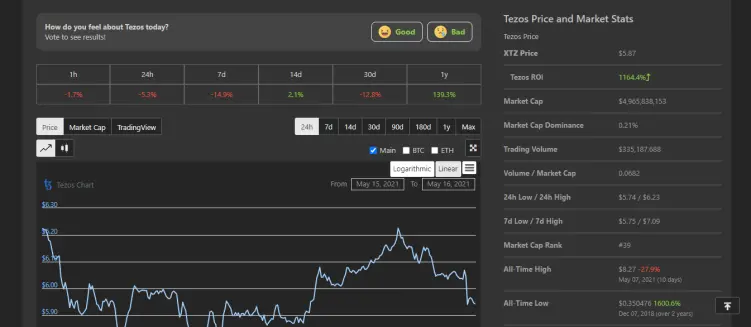
Tezos has made a strong place for himself in the crypto community with the potential to keep improving thanks to its vision and its strong community. However, the competition it faces is fabulous, as today there are many great projects competing with Ethereum and its famous EVM. It is necessary to closely follow the evolution of XTZ during the next months to know its probability of success.
As usual, none of the things written in this post are financial advice and are not intended to replace personal research.
Thank you for reading!
If you have any questions or comments, please feel free to leave them down below
You can also contact me at [email protected]






