
A USDT transfer can settle quickly, but the exact time depends on the network, fee settings and the receiving service. The transfer itself is only a few fields and a confirmation; most avoidable losses come from choosing the wrong network or address. Here is the procedure, the cost of each step, and what to check before you send.
Updated: September 14, 2026
Reviewed by: Rick Cramer, Head of Analytics at SimpleSwap
Short answer
To send USDT, open your wallet, choose USDT on a network the recipient supports, paste the recipient's address, enter the amount, review the fee, and confirm. Most self-custody wallets require the network's native asset or resources to cover transaction fees: TRX or Energy/Bandwidth on TRON, ETH on Ethereum, SOL on Solana, and GRAM on TON. Wallet-to-wallet transfers may appear within seconds on fast chains, while Ethereum inclusion and exchange crediting can take longer. The key rule is that the network must be supported by the recipient. A wrong-network transfer may be recoverable in some self-custody EVM cases, but recovery from custodial services is often difficult, discretionary, or impossible.
Before you send: the four things to check
1. The recipient's network. USDT exists on TRON (TRC20), Ethereum (ERC20), Solana, TON, and other chains. Ask which network the recipient supports, or read the network label on the exchange deposit page. On EVM-compatible chains, the same 0x address can exist across several networks, so a valid-looking address does not mean the receiving service supports the chain you selected.
2. The address. TRON addresses start with 'T' and are 34 characters long. Ethereum addresses start with 0x and are 42 characters. Solana addresses are 32 to 44 characters long and have no fixed prefix. A valid format is not proof that it is the right address, only that it is an address.
3. The fee balance or network resources. USDT is a token, so an on-chain transfer consumes the underlying network's resources. On Ethereum and Solana, the sender typically needs ETH or SOL, respectively. On TRON, staked or delegated Energy/Bandwidth can cover some or all of the resource cost; otherwise, TRX is burned. Some wallets or services can sponsor fees, so check the wallet's confirmation screen rather than assuming the same rule everywhere.
4. The amount. Exchanges can set minimum deposits or minimum crediting amounts. On Solana, a first receipt of a token may also require the creation of an associated token account (ATA), which carries a rent-exempt balance paid by the account creator. Check the receiving service's deposit rules before sending.
How to send USDT: step by step
-
Open your wallet and select USDT. If the wallet supports multiple networks, pick the one that matches the recipient's network. The wallet usually shows the network name next to the asset.
-
Tap Send and paste the recipient's address. Never type it by hand.
-
Verify the address against a trusted source. Do not rely only on the first and last characters: address-poisoning attacks can imitate both ends. For a new or high-value destination, compare the full address on a trusted display or verify several sections, including the middle, and consider an address book/allowlist or a small test transfer.
-
Enter the amount. Leave enough of the native coin in the wallet for the fee.
-
Review the confirmation screen. It shows the network, address, amount, and fee. Read all four.
-
Confirm. The wallet broadcasts the transaction and shows a transaction hash (TXID).
-
Send the recipient the TXID. It lets them track the transfer on a block explorer without asking you whether it went through.
What does a USDT transfer cost
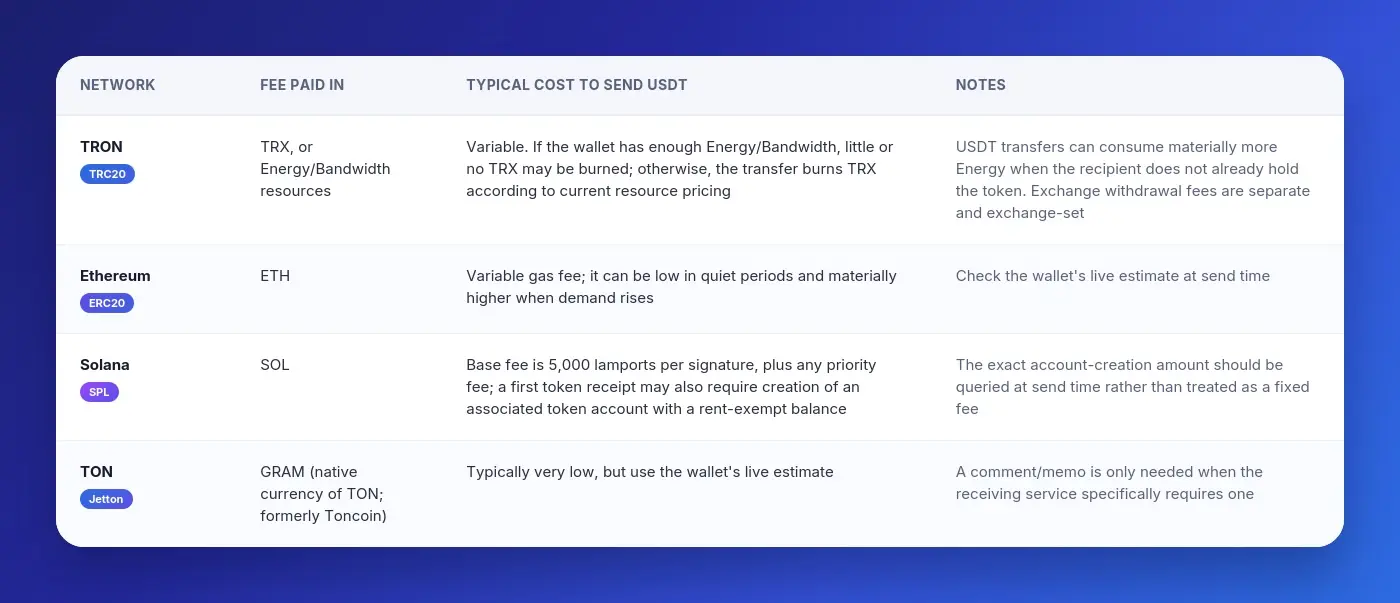
Fees move with network conditions and governance decisions. The number on your wallet's confirmation screen is the one that applies.
How long does a USDT transfer take?
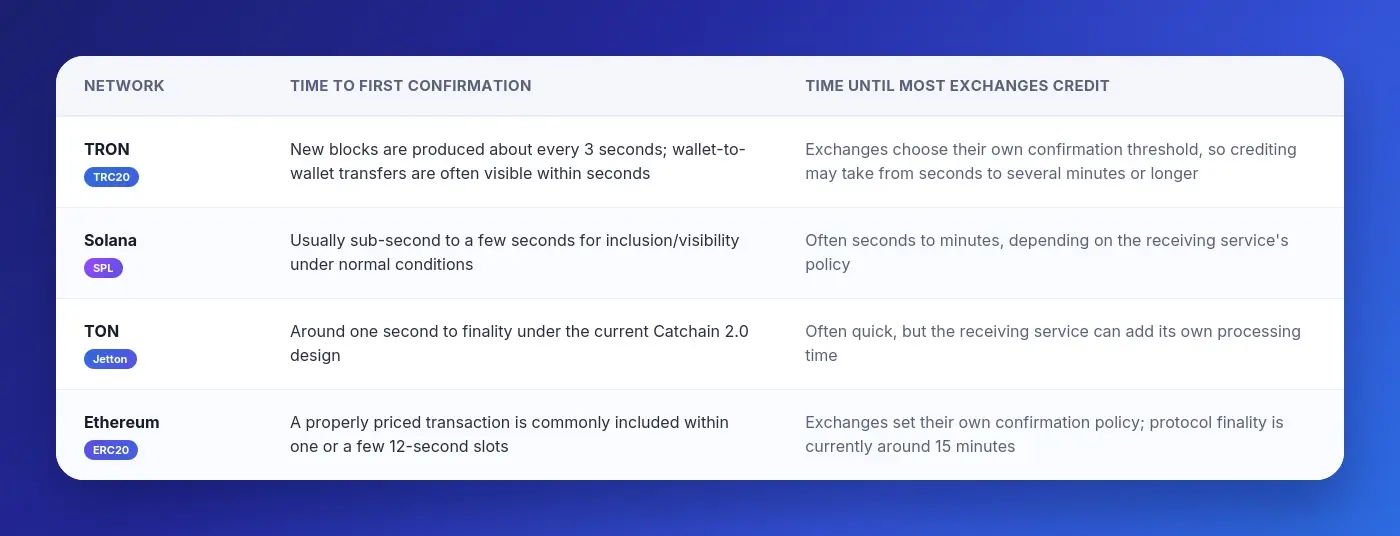
Wallets can show a transfer as soon as it is included or observed by the network, but custodial services apply their own confirmation and risk policies before crediting a deposit. That is why an explorer can show a successful transfer while an exchange still shows the deposit as pending.
Wrong-network transfers and other ways to lose USDT
Sending on a network the recipient did not enable.If an exchange supports USDT on one EVM network and you send it on another, the exchange may not credit it automatically even though the address format is valid. Recovery, if offered, is usually discretionary and may carry a fee. In a self-custody EVM wallet, a wrong-EVM-network transfer can sometimes be recovered because the same private key controls the corresponding address on multiple EVM chains.
Picking a lookalike network. Ethereum, BNB Chain, Polygon, Arbitrum, and other EVM chains all use 0x-style addresses. A wallet may therefore accept the address without warning even when the recipient does not support that chain. TRON uses a different address format, so a TRON/Ethereum mismatch is more likely to be caught by address validation.
Missing a required memo/comment on a custodial deposit. Some services use a shared deposit address plus a memo, tag or comment to identify the customer. If the deposit page requires one, omitting it can prevent automatic crediting. Wallet-to-wallet USDT transfers do not normally need this extra identifier.
Address poisoning. Attackers can create lookalike addresses that share the beginning and ending characters with a legitimate address, then place them in your transaction history. Copy the address from the original trusted source and verify more than just the first and last characters.
Sending the fee coin instead of USDT. In wallets that list assets side by side, it is possible to send TRX or ETH when you meant USDT. Check the asset name on the confirmation screen.
Trusting unsolicited "help." If a transfer seems stuck, contact support through the wallet or exchange's official channels. Accounts that message you first on Telegram or X are not support.
If the transfer looks stuck
Search the TXID on the explorer for that network: Tronscan for TRON, Etherscan for Ethereum, Solscan for Solana. Three outcomes are possible.
-
Confirmed on-chain, not credited by the recipient. The transfer worked. The delay is on the receiving side. Give them the TXID.
-
Pending or not yet finalized. On Ethereum, an underpriced transaction can remain pending, and many wallets offer a speed-up/replacement option. On other networks, check the explorer and wallet status rather than assuming the cause is insufficient gas. If a TRON transaction fails due to insufficient resources, the explorer should indicate a failure; fix the resource/fee issue before creating a new transfer.
-
Not found. The transaction may not have been broadcast, or you may be checking the wrong network/explorer. Confirm the network, wallet status, and fee/resources before trying again.
Sending USDT across networks with SimpleSwap
A wallet sends USDT on a single chain to an address on that same chain. It cannot convert your USDT ERC-20 to the USDT TRC-20 your recipient requested. That conversion is what SimpleSwap does.
SimpleSwap describes its service as a self-custodial, wallet-to-wallet swap aggregator and lists USDT on supported networks as separate assets. To pay someone in USDT TRC20 when you hold USDT on Ethereum or any other asset:
-
Select what you are sending and USDT on the recipient's network as the asset to receive.
-
Enter the recipient's address as the receiving address, and confirm the network matches what they gave you.
-
Choose a fixed rate, which is normally locked for 20 minutes if the deposit arrives and receives the required confirmation within the window, or a floating rate whose final output can change with the market.
-
Send your asset to the deposit address generated for the order.
-
SimpleSwap says it routes swaps across 20+ liquidity providers and sends the resulting asset to the receiving wallet. Track the order by its ID.
SimpleSwap uses an all-in-one rate rather than adding a separate percentage trading fee on top. Its fee is dynamic, and the company says some assets may start at 0.2%. With a floating rate, the final received amount can change; with a fixed rate, the quote remains valid only if the order conditions and timing are met. Your wallet pays the network fee for the initial deposit separately, while SimpleSwap's payout-side network cost is reflected in its calculation. Most crypto-to-crypto swaps do not require account creation, but SimpleSwap may request KYC or additional information for certain transactions. It does not keep long-term user balances. Its official domain is simpleswap.io.
FAQ: How to send USDT
How do I send USDT to another wallet?
Select USDT on the network your recipient uses, paste their address, enter the amount, and confirm. Keep enough native asset or network resources to cover the transfer: for example, ETH on Ethereum, SOL on Solana, or TRX/Energy on TRON.
How much does it cost to send USDT?
It depends on the network and current conditions. TRON cost depends heavily on available Energy/Bandwidth and current resource pricing; Ethereum gas varies with demand; Solana has a 5,000-lamport base fee per signature plus any priority fee, and a first token receipt may require creation of an associated token account. Always use the live quote shown by your wallet.
How long does it take to send USDT?
Wallet-to-wallet transfers can appear within seconds on TRON, Solana, and TON under normal conditions. Ethereum inclusion is commonly tens of seconds when properly priced, while protocol finality is around 15 minutes. Exchanges can wait longer because they set their own confirmation and risk policies.
Can I send USDT without paying gas?
Every on-chain transfer consumes network resources, but the user does not always pay with the native asset. On TRON, staked or delegated Energy/Bandwidth can cover resource use and reduce or eliminate TRX burned for a transfer; some wallets or services on other networks may also sponsor fees.
What happens if I send USDT to the wrong network?
The funds may land on a chain the recipient does not support. If the recipient is an exchange or other custodian, contact support with the TXID; recovery may be unavailable or fee-based. If it is a self-custody EVM wallet and the same key controls the address on the chain you used, recovery may be possible by switching/adding that network. Non-EVM mismatches can be much harder to recover.
Do I need a memo to send USDT?
For ordinary wallet-to-wallet transfers, no. Some custodial services require a memo, tag or comment for specific deposit routes. Follow the receiving service's deposit page exactly.
Can I send USDT from one network to another?
Not with a plain wallet transfer. Use a swap service such as SimpleSwap that accepts USDT on one network and pays out on another, wallet-to-wallet.
What is Address Check? Address Check is a Customer Account tool that screens a wallet address for association with sanctioned entities and other risk categories. Enter the address and its network to receive a risk level and the connections identified. Screening is performed by third-party services and may not identify all potential issues. The number of checks available per month depends on your Loyalty Program level.
This article is for educational purposes only and is not financial or investment advice. Fees and confirmation times vary with network conditions. SimpleSwap's only official domain is simpleswap.io.
Sources (fact-checked 14 September 2026)
-
Tether — Supported Protocols: https://tether.to/en/supported-protocols/
-
TRON Developer Hub — Account model and address format: https://developers.tron.network/docs/account
-
TRON Developer Hub — Blocks: https://developers.tron.network/docs/block
-
Ethereum.org — Accounts: https://ethereum.org/developers/docs/accounts/
-
Ethereum.org — Blocks: https://ethereum.org/developers/docs/blocks/
-
Ethereum.org — Single-slot finality roadmap / current finality context: https://ethereum.org/roadmap/single-slot-finality/
-
Solana Docs — Transaction fees: https://solana.com/docs/core/fees
-
Solana Docs — Tokens and associated token accounts: https://solana.com/docs/tokens
-
TON Docs — Subsecond block times and finality: https://docs.ton.org/subsecond
-
TON Docs — native currency renamed to Gram (GRAM): https://docs.ton.org/foundations/whitepapers/overview
-
MetaMask Support — Funds sent on the wrong network: https://support.metamask.io/manage-crypto/move-crypto/send/funds-sent-on-wrong-network
-
SimpleSwap — FAQ (rates, fixed/floating swaps, fees): https://simpleswap.io/faq
-
SimpleSwap — About: https://simpleswap.io/about
-
SimpleSwap — AML/KYC policy: https://simpleswap.io/aml-kyc
-
SimpleSwap — Address poisoning safety guidance: https://simpleswap.io/safety/address-poisoning
-
SimpleSwap — Verify official SimpleSwap resources: https://simpleswap.io/safety/verify-simpleswap





