A crypto swap quote is one number with four things inside it. This guide takes the number apart, explains what “locked” means on a fixed rate and what moves on a floating one, and shows why nothing is deducted after you send. Co-published by SimpleSwap and BetaExchanger.
Short answer. A fixed rate holds the quoted amount for a set window (20 minutes on SimpleSwap) in exchange for a slightly wider spread. A floating rate is set at execution, so the delivered amount can be above or below the estimate. In both cases, the quote already includes the service fee, routing costs, and provider spread before you send anything. The only cost that sits apart is the blockchain network fee, which goes to the network, not to the swap service.
What a quote is made of
When a swap service shows you “1 ETH → 2,431.18 USDT”, that number is not a market price. It is an executable amount: what the service expects to deliver to your wallet if you send 1 ETH now. Four things are folded into it.
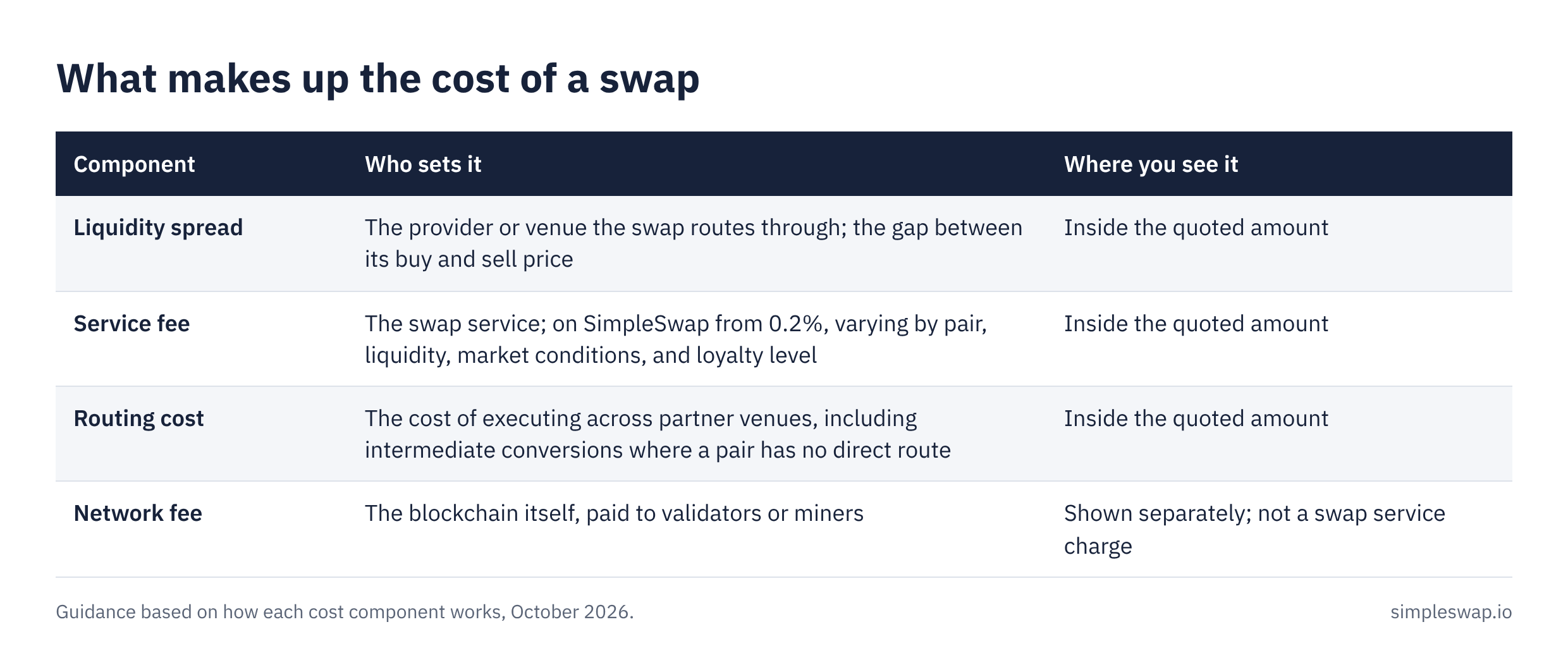 The spread varies the most. Deep pairs (BTC/USDT, ETH/USDT) run tight; long-tail or low-liquidity pairs run wide because whoever fills the other side of the trade takes on more risk. The service fee is the swap service’s margin. On SimpleSwap, it starts at 0.2% and can be reduced through the Loyalty Program. Routing cost is the piece users rarely think about: if you swap an asset on one chain for an asset on another, the route may pass through an intermediate token, and each hop has a cost that is factored into the quote before you see it.
The network fee is of a different kind. You pay it to the blockchain; it changes with congestion, and no swap service controls it. Typical ranges at the time of writing: Bitcoin $1–10, Ethereum $2–20 or more depending on gas, Solana under $0.01, Polygon and BNB Chain under $0.10.
Fixed rate: what “locked” actually means
A fixed rate freezes the quoted amount for a window that starts when you create the order. On SimpleSwap, that window is 20 minutes. If your deposit arrives within that window, the amount on the order page is what lands in your wallet, regardless of what the market did in between.
That certainty has a price, and it’s visible: fixed-rate quotes carry a slightly wider spread than floating ones. You are paying for the service to absorb market risk during the time between your deposit and confirmation.
Two things decide whether a fixed rate does its job. The deposit must arrive within the window, which, for slow networks, means sending it promptly rather than at minute 18. The deposit must also match the order amount, since a fixed quote is tied to the specific amount you entered.
Floating rate: what moves between quote and delivery
A floating rate shows an estimate and settles at execution. Between those two moments, the market keeps moving, and so does the estimate.
The path of a floating swap: you see the estimate; you send the deposit; the network confirms it (seconds on Solana, tens of minutes on Bitcoin under load); the aggregator executes the conversion; the output is delivered. The delivered amount reflects the market at execution. If the market moved in your favor, you receive more than the estimate. If it moved against you, less.
This is where the phrase “hidden fee” usually comes up, and it is worth being exact about what happened. A floating estimate that landed 0.3% lower than shown is not a deduction. No new charge was added. The asset’s price changed while your transaction was confirming, and you had chosen the rate type that follows the price. On SimpleSwap, estimate accuracy on most floating swaps reaches 99.998%, meaning the delivered amount is almost always within a fraction of a percent of the number shown.
Nothing is deducted after the fact
The contract of a quote is simple, and it applies to both rate types: everything the swap service charges is inside the number you see before you send. There is no second screen, no settlement statement with new lines, no fee taken from the output on arrival.
What can still make the delivered amount differ from your expectation, and none of these is a hidden charge:
Comparing the quote to a spot price. A CEX order-book price is not an all-in executable amount. It excludes the spread you would pay filling the order, the withdrawal fee, and the network fee on the way out. Compare a quote with another quote, not with a chart.
Forgetting the network fee is separate. It is displayed, but you pay it to the blockchain and it’s not part of the swap service’s margin.
Choosing to float and watch the market move. That is the rate type working as designed, not a cost added by the service.
Sending a different amount than the order specified. Underpayments and overpayments change the outcome, especially for fixed-rate orders.
A useful comparison is not just about the number—it is about knowing which conditions come with it. BetaExchanger distinguishes floating estimates from fixed-rate offers, helping users compare like with like. Quote validity depends on the provider, route, and rate type; expired offers must be refreshed before an order is created. Once the transaction is created within BetaExchanger, the focus shifts from comparing to sending correctly: users should verify the asset, network, amount, deposit address, any required memo or tag, and any provider-supplied deposit deadline. That deadline governs the transaction’s deposit window, not the earlier comparison quote.
Which rate fits which situation
This is a fit table, not a recommendation. The right choice depends on the swap you are making.
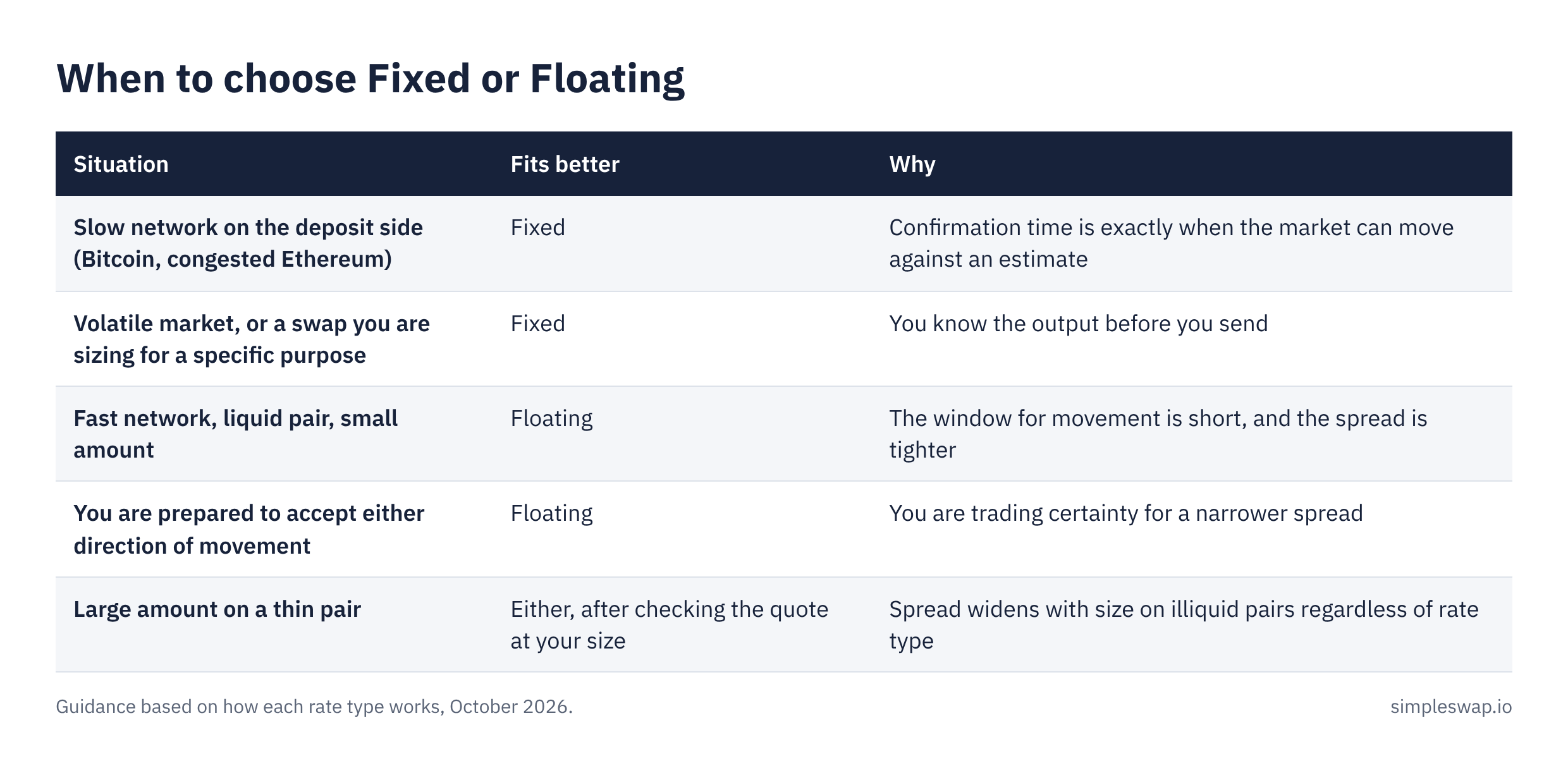 For most standard conversions, the gap between fixed and floating is small enough that the choice comes down to what you value: a known number, or a slightly better number that is not yet known.
From the infrastructure side
“The number a user should read is the amount that lands in the wallet, not the rate. Everything we charge is inside that amount before the user sends anything. What we cannot fold into it is the market itself, which is why the floating rate exists as a choice and not a default.”
Stefan Lauer, Head of Infrastructure, SimpleSwap
“A clear quote tells you what you could receive. A useful comparison shows you what your options could deliver. BetaExchanger brings those choices together across providers, helping users compare the same assets, networks, and rate types — or work backwards from a target receive amount. The goal is simple: make providers compete for your choice, and make every swap decision better informed.”
Alex Oto, Head of Strategy & Partnerships at BetaExchanger
FAQ
Does SimpleSwap charge hidden fees?
All service costs (spread, service fee, routing) are included in the quoted amount you see before confirming. The network fee is shown separately and goes to the blockchain. Nothing is deducted from the output after delivery.
Is a fixed or floating rate better for a crypto swap?
Neither is better in general. Fixed suits slow networks and volatile conditions, where confirmation time is long enough for the market to move. Floating suits fast networks and liquid pairs, where spreads are tighter, and the window for movement is short.
Why did I receive less than the estimate on a floating swap?
The market moved between your quote and execution. A floating rate follows the price by design; no additional charge was applied. If you need a known output, choose a fixed rate next time.
Are network fees included in the SimpleSwap rate?
No. Network fees are paid to the blockchain, vary with congestion, and are displayed separately from the quoted amount.
Does comparing routes on BetaExchanger add a cost?
Comparing routes on BetaExchanger is free. We earn revenue through provider commissions and, where applicable, platform fees reflected in the quoted receive amount. This lets users review the available routes and their expected outcome before deciding whether to proceed.
About SimpleSwap
SimpleSwap is a self-custodial, multi-source swap aggregator that helps users exchange crypto with greater privacy and control, without having to compare providers and routes themselves. It supports direct wallet-to-wallet swaps across 20+ liquidity providers and 2,800+ swappable assets, combining liquidity from well-known CEX and DEX sources under the hood. Operating since 2018, the exchange infrastructure is integrated into 6,000+ partner products, including Exodus, Tangem, Ellipal, Cake Wallet, and Tonkeeper.
About BetaExchanger
BetaExchanger is built around a simple idea: users should have providers competing for their swap, not settle for the first quote they find. Operated by BetaExchange LLC, a Delaware-registered company, the platform brings multiple exchange providers into one comparison experience. Users can start with an amount to send or a target to receive, explore supported floating and fixed rates, and compare expected outcomes alongside available fee and timing information. Transactions are created and tracked within BetaExchanger, while the selected provider handles the exchange. BetaExchanger does not hold customer funds. Its ambition is to make informed choices — not guesswork — the starting point for every cryptocurrency swap.
This article is for educational purposes only and is not financial or investment advice. Products, frameworks, and tools named here are examples, not endorsements, and none replace your own judgment. SimpleSwap’s only official domain is simpleswap.io.