
For over two decades, Silicon Valley giants tried to convince us that their sole purpose was to "connect people" and make the world a better place. While this was rarely true, the narrative sounded light, fluffy, and safe. However, modern geopolitical and technological realities are completely redefining these rules. The masks have fallen. Today, the CEO of one of the most influential software companies in the world can openly and without a hint of embarrassment admit to an audience: "Our product is sometimes used to kill people."
The man speaking is Alex Karp, and the company is Palantir TechnologiesHere is the complete, high-quality English translation of the article, formatted for optimal readability and impact.
The Seeing-Stone Empire: How Palantir is Building a Digital Operating System for Power and a New Form of Technofascism

For over two decades, Silicon Valley giants tried to convince us that their sole purpose was to "connect people" and make the world a better place. While this was rarely true, the narrative sounded light, fluffy, and safe. However, modern geopolitical and technological realities are completely redefining these rules. The masks have fallen. Today, the CEO of one of the most influential software companies in the world can openly and without a hint of embarrassment admit to an audience: "Our product is sometimes used to kill people."
The man speaking is Alex Karp, and the company is Palantir Technologies-a corporation that has stopped hiding in the shadows and has begun openly striving to become the digital and military bedrock of Western civilization. What truly motivates this multi-hundred-billion-dollar company, which after years of secrecy is transforming into a lifestyle brand promoting hard military dominance?
Genesis: From PayPal to the CIA

Palantir was founded in 2003 by controversial billionaire Peter Thiel (the PayPal co-founder who believes that freedom and democracy are incompatible) and his Stanford law school classmate, Alex Karp. Their first external investor was In-Q-Tel-the venture capital arm of the CIA, which provided $2 million in seed funding.
The founders' vision was to adapt PayPal’s anti-fraud algorithms to fight terrorism and crime in a post-9/11 world. The company's very name refers to the magical, seeing stones from J.R.R. Tolkien’s The Lord of the Rings-crystals that allowed one to see events from afar, but which could corrupt and distort reality in the wrong hands. This metaphor perfectly captures the nature of their operations today.
The Heart of the System: Foundry, Gotham, and the Magic of "Ontology"
To understand Palantir's power, one must stop thinking of it as a mere database. The company's business relies on two main platforms, bound together by a unique engineering solution:
· Palantir Foundry: Utilized in the private sector by global corporations (including Ferrari, Airbus, Nike, BP, and United Airlines) to manage supply chains and operational processes. This is the gentler face of the company, which also helps institutions like the British National Health Service (NHS) optimize hospital workflows and diagnose cancer faster.
· Palantir Gotham: A purely governmental, intelligence, and military tool. It functions as a central "operating system for global decision-making."
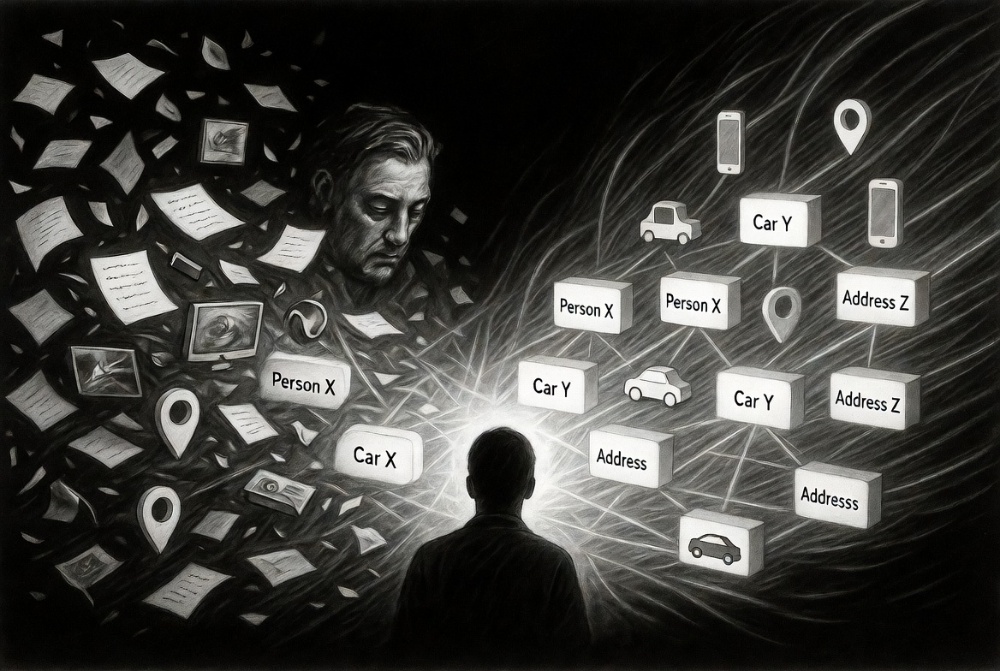
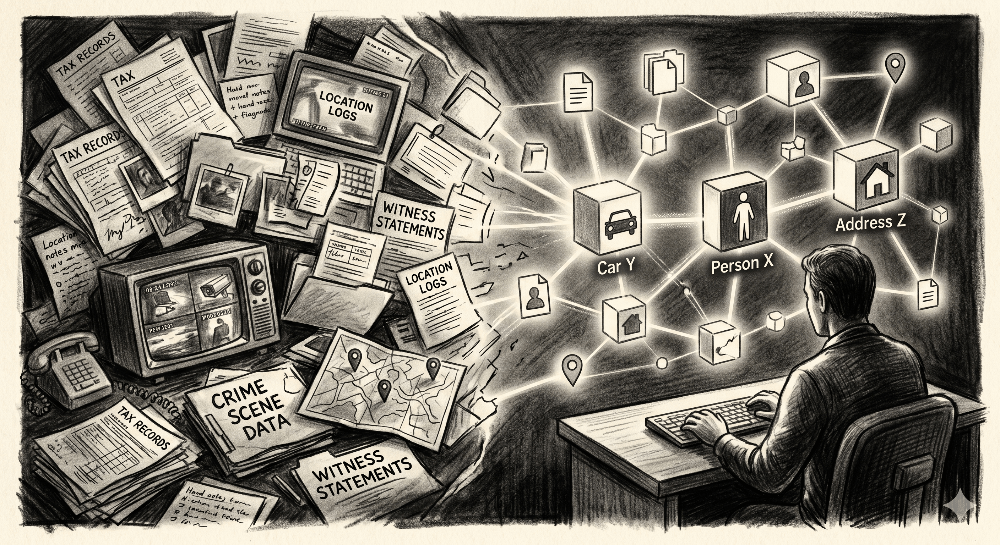
The key to the effectiveness of both tools is the so-called Ontology Layer. Traditional analytical systems force users to search through complex, siloed SQL tables. Palantir does something entirely different: it ingests gigantic amounts of previously scattered, disparate data (ranging from medical histories, IRS tax databases, and social security registries, to data from over 80,000 ALPR cameras scanning license plates and phone location histories) and maps them onto digital objects from the real world.
For a police or intelligence analyst, data ceases to be a string of characters. It becomes objects like "Person X," "Car Y," or "Address Z," connected by visible relationships.
This enables mass surveillance (known as pattern-of-life surveillance) on an unprecedented scale. What once required the East German Stasi to deploy 20% of their GDP and an army of informants is now achieved through Palantir’s algorithms, smartphones, and AI cameras at a fraction of the cost.
Once a state or corporation deploys this architecture, a phenomenon known as vendor lock-in occurs. Palantir becomes the sole interpreter of that institution's data-removing it and replacing it with a competitor's offering (such as Snowflake or Databricks) becomes an open-heart surgery that few can afford.
The Algorithmic Kill Chain
Palantir's most controversial face manifests on modern battlefields, where the corporation's systems have been integrated directly with autonomous weaponry. Palantir provides core intelligence data analysis systems for the war in Ukraine. These algorithms support unmanned aerial vehicles during takeoff, automated target location, and autonomous elimination (the so-called terminal strike). This has led to groundbreaking and terrifying moments in military history, where enemy positions were captured entirely by combat robots without direct infantry involvement or friendly casualties.
Karp is personally involved in the company's military expansion. Among other deals, he signed a contract with the Israel Defense Forces (IDF) to provide automated target-generation systems in the Gaza Strip conflict. Furthermore, in collaboration with Anthropic, Palantir serves as a pillar of Project Maven-a military AI system that drastically reduces the time required to identify, decide on, and destroy an enemy. Karp himself bluntly refers to these

At the helm of this technological monster stands Alex Karp-a man full of contradictions. He holds a PhD in neoclassical social theory from Frankfurt, speaks fluent German, has dyslexia, and has never held a driver's license. Instead, he travels between his numerous, modest ski chalets around the world and keeps his phone in a Faraday cage out of fear of Chinese intelligence. Although his mother was an African-American civil rights activist, Karp manages technology that poses the greatest threat to those very rights. In 2024, his compensation reached an astronomical $6.8 billion (the highest leadership package in US history), and thanks to a special Class F stock structure, he and Thiel hold absolute, unremovable voting control over the company.
Karp has completely abandoned past, conciliatory rhetoric in favor of the language of hard power and civilizational clash. In his book The Technological Republic and in an official, 22-point "Palantir Manifesto" (which caused a dip in the company's stock price due to its radicalism), he laid his cards on the table. Palantir openly rejects the idea of "empty and academic pluralism." The company argues that Western defense institutions require technological ruthlessness, engineers have a moral obligation to build weapons, and the US should consider reinstating mandatory military service.
Belgian philosopher Mark Coeckelbergh unequivocally assessed these declarations as "blatant technofascism," while other economists point to the birth of an era of "technofeudalism," where tech lords control the sovereignty of entire nations.
Crucially, the Palantir Manifesto clearly declares loyalty only to the United States and its direct allies. This poses a massive risk for third-party states that buy this software, effectively surrendering control over their intelligence data to a private corporation pursuing Washington's political agenda.
Dystopia in a Trendy Wrapper

The most bizarre and novel element of Palantir's strategy is its attempt to domesticate this threat using soft power. A company that promotes automated killing is trying to become... a lifestyle brand for young people. Palantir launched an online store featuring trendy apparel (including $200 jackets) printed with slogans like "ontology," "velocity," or "dominance." Their hired "Head of Vibes" openly admitted in interviews with fashion magazines that he wants the brand to be associated with a desirable lifestyle. Cultural analysts sum it up briefly: it is as if someone tried to turn the controversial post-9/11 Patriot Act into a trendy TikTok movement.
The Impending Threat and the Point of No Return

What, ultimately, does Palantir want? It wants to become the default, indispensable digital nervous system for the power structures of the entire West. The goal is a reality where no government, immigration office, police department, hospital, or army can function without their software.
However, the greatest danger does not lie in the efficiency of the algorithms themselves, but in the massive moral and systemic hazard. Even if the current state administration uses these tools for noble purposes, once deployed, an infrastructure of total control will inevitably pass into the hands of future ruling regimes.
In a system steered by Gotham, suspicion of a crime or terrorism no longer needs to stem from hard forensic evidence or witness testimony. It can be generated automatically because a proprietary, classified algorithm of a private company deemed an individual's behavioral pattern to be "deviant." By the time a citizen realizes they have become a target, the state machinery-driven by digital precision-will have already cut them off from public services, passports, or bank accounts.
Are we witnessing Palantir building a vital immune system for the free world in an era of new global conflict, or are we seeing the birth of the most terrifying surveillance system in human history? To prevent the worst-case scenario, international organizations (including the UN) are calling for treaties banning autonomous weapons, while experts demand the urgent implementation of independent code audits, rigid expiration clauses on government contracts, and the education of lawmakers. If governments hand the keys to their operating systems over to Palantir, it will be too late for any resistance.
A corporation that has stopped hiding in the shadows and has begun openly striving to become the digital and military bedrock of Western civilization. What truly motivates this multi-hundred-billion-dollar company, which after years of secrecy is transforming into a lifestyle brand promoting hard military dominance?





