
Why I wrote The 0.1 Bitcoin Family Plan — and why it's now available on Amazon.
Every time Bitcoin makes headlines, the conversation seems to follow the same script.
How high will it go?
Is it too late to buy?
Will the next cycle make people rich?
Should you buy now or wait for another crash?
These are understandable questions. Bitcoin is volatile, and its price can dominate the news for weeks at a time.
But after years of following Bitcoin, I have become increasingly interested in a different question.
What does Bitcoin actually look like in the life of an ordinary family?
Not a millionaire.
Not a professional trader.
Not someone who spends six hours a day watching charts.
Just a family with a mortgage, bills, children, everyday responsibilities, and perhaps a little money left over at the end of the month.
For those people, Bitcoin is a very different conversation.
And I think it is a conversation worth having.
The Problem With the Way We Talk About Bitcoin
Imagine someone who has never owned Bitcoin.
They are curious. They have heard about its limited supply, its independence from traditional banking systems, and its potential role as a long-term asset.
So they start researching.
Within an hour, they encounter discussions about private keys, cold storage, market cycles, institutional adoption, monetary policy, and predictions about Bitcoin reaching extraordinary prices.
Some of that information is valuable.
But where does an ordinary person actually begin?
How much should they consider buying?
How do they avoid making emotional decisions?
What happens if Bitcoin loses half its value?
How do they store it safely?
And if they are building something for their children, how will those children eventually receive it?
These questions are less exciting than a million-dollar Bitcoin prediction.
But they are much closer to real life.
Why I Chose 0.1 Bitcoin
I have written before about my personal goal of accumulating 0.1 BTC for my family.
In an earlier article, My Children Will Either Thank Me or Never Know This Existed, I explained why that particular number had become meaningful to me.
One-tenth of a Bitcoin.
It is large enough to represent a meaningful long-term ambition for some households, yet far less intimidating than the idea of owning an entire Bitcoin.
That does not make it affordable for everyone. At some prices, even 0.1 BTC can represent a substantial financial commitment.
Nor is there anything magical about the number.
It is a goal, not a guarantee.
I chose it because I wanted something measurable. Something I could work toward gradually, without pretending to know what Bitcoin will be worth in ten or twenty years.
Bitcoin has a maximum supply of 21 million coins.
That scarcity is one reason I find it interesting.
But scarcity alone does not guarantee future demand, price appreciation, or investment success.
Bitcoin could perform extremely well over the coming decades.
It could also disappoint investors badly.
Both possibilities deserve a place in any serious family plan.
A strategy that only works if Bitcoin goes up is not much of a strategy.
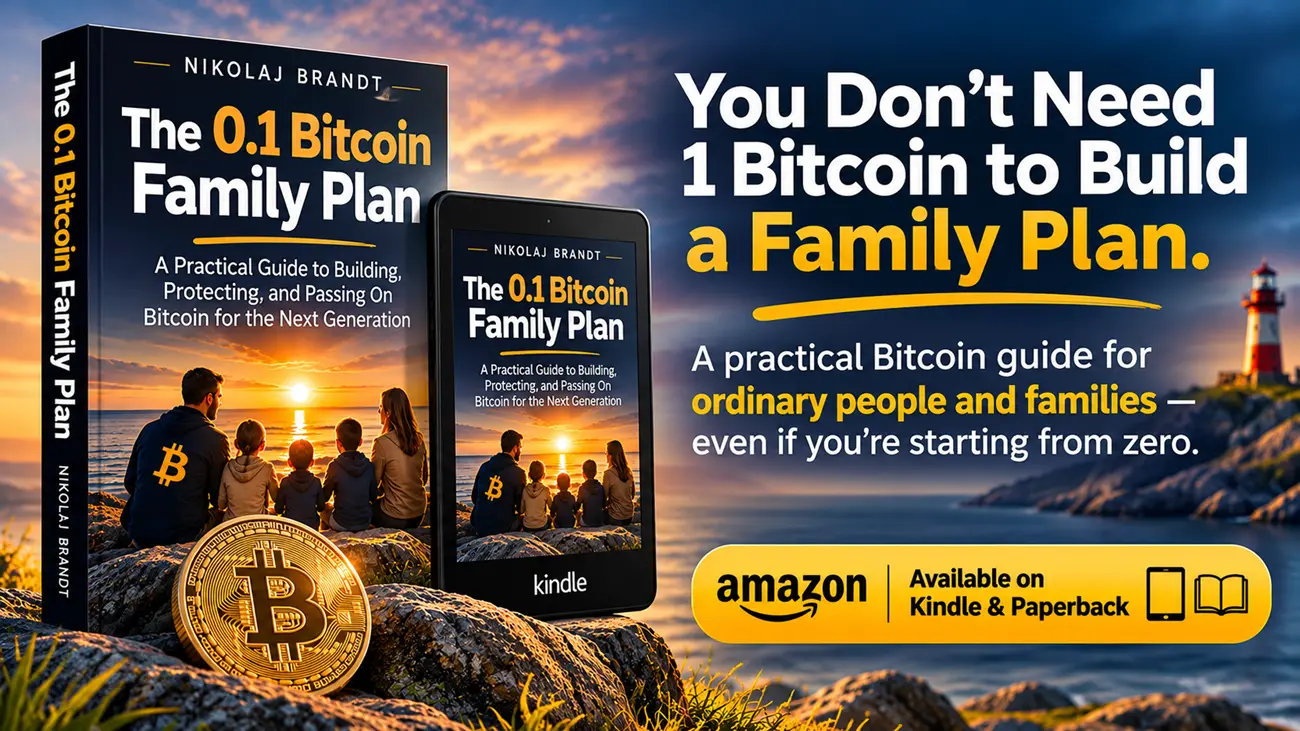
My new Bitcoin book is officially available on Amazon.
The 0.1 Bitcoin Family Plan is written for ordinary people and everyday families who want to understand Bitcoin and build a thoughtful, long-term strategy — even if they're starting from zero.
No complicated financial jargon. No get-rich-quick promises. Just a practical approach to accumulating, protecting, and potentially passing on Bitcoin to the next generation.
📘 Explore The 0.1 Bitcoin Family Plan on Amazon — Kindle & Paperback
What Happens After You Buy?
This is where I think the Bitcoin conversation becomes genuinely interesting.
Buying Bitcoin is relatively straightforward.
Living with the decision for twenty years is something else entirely.
Imagine buying your first Bitcoin today.
Six months later, the price has fallen 40%.
Your investment is worth considerably less.
Social media is full of people declaring that Bitcoin is finished.
Do you sell?
Buy more?
Stop looking at the price?
What if the opposite happens?
Bitcoin doubles, and suddenly your small position has become a meaningful part of your savings.
Do you take profits?
Continue accumulating?
Rebalance?
There is no universal answer.
But these are questions that can be considered before the emotions arrive.
I've experienced several cryptocurrency market cycles since entering the market in 2017. In Here's What Bitcoin Taught Me About Surviving Cycles, I reflected on how those experiences changed my approach to buying, selling, and managing uncertainty.
For an ordinary family, that preparation matters far more than correctly guessing next month's Bitcoin price.
A long-term plan should account for position size, financial priorities, volatility, security, and the possibility of needing money at an inconvenient time.
Bitcoin should not require a family to gamble its emergency savings or sacrifice essential expenses.
If the plan creates financial stress at home, something is wrong with the plan.
The Part That Changed My Thinking
At first, my own Bitcoin goal was mainly about accumulation.
I wanted to build a position over time.
But gradually, I realized that buying Bitcoin was only one part of the challenge.
The bigger question was what I was actually trying to accomplish.
Was I trying to outperform other investments?
Build a reserve for the future?
Create something my children might inherit?
Or simply participate in a monetary technology I believe could become increasingly important?
Those are different motivations.
And they lead to different decisions.
If my goal involves my children, for example, then custody, recordkeeping, and inheritance become just as important as the purchase price.
That realization led me to write If I Died Tomorrow, Would My Children Ever Find My Bitcoin?.
It is an uncomfortable question, but one that deserves attention.
Because owning Bitcoin and making sure your family can eventually access it are two very different things.
If my goal is long-term financial resilience, Bitcoin cannot be considered in isolation from the rest of my finances.
And if I want to hold through difficult markets, I need a position size I can realistically tolerate.
The more I thought about these questions, the less interested I became in predicting Bitcoin's next big move.
I wanted a framework I could actually use.
Why I Decided to Write a Book
Over time, my notes, questions, calculations, and personal reflections began to form something larger.
I realized that the approach I was developing might also be useful to other people.
Not because I had discovered a secret investment formula.
I haven't.
And certainly not because I know where Bitcoin is going.
I don't.
But because I believe there is room for a different kind of Bitcoin book.
One that starts with the ordinary person rather than the professional investor.
One that acknowledges uncertainty rather than hiding it behind impressive price targets.
And one that treats Bitcoin as part of a family's financial life, not as an isolated bet on the future.
That became the foundation of my new book:
And I'm pleased to say that it is now officially available on Amazon.
A Bitcoin Book for People Who Don't Speak Crypto
I wrote this book for people who are interested in Bitcoin but do not necessarily understand all the terminology.
You do not need to own Bitcoin already.
You do not need to understand blockchain technology.
You do not need to be wealthy.
And you certainly do not need to believe that Bitcoin will make everyone rich.
The book explores how to build a realistic accumulation strategy, think about risk, understand custody, keep useful records, make decisions about selling, and prepare for the possibility of passing Bitcoin to the next generation.
It also examines situations that are easy to overlook when markets are rising: financial emergencies, serious illness, changing family circumstances, and the practical challenges of inheritance.
The objective is not to convince everyone to buy Bitcoin.
It is to help readers understand what a thoughtful Bitcoin plan could involve — and decide whether such a plan makes sense for them.
Because sometimes the most useful investment decision is deciding not to invest more than you can afford to lose.
The Book Is Out. But the Bigger Conversation Is Just Beginning.
Publishing this book feels like an important milestone for me.
What began as a personal goal of building toward 0.1 Bitcoin has developed into a much broader exploration of money, risk, responsibility, and family.
I still believe Bitcoin is worth taking seriously.
But I also believe it deserves better conversations than endless price predictions.
We need more discussions about realistic expectations.
About the people who are curious but intimidated.
About the difference between owning an asset and having a plan for it.
And about what it means to make financial decisions today that could affect the people we care about decades from now.
That is the conversation I hope this book contributes to.
Not everyone needs 0.1 Bitcoin.
Not everyone needs Bitcoin at all.
But anyone considering Bitcoin deserves a plan they can understand, question, and realistically follow.
If this approach resonates with you, The 0.1 Bitcoin Family Plan is now available on Amazon in Kindle and paperback formats.
Disclaimer: This article reflects my personal views and experience. It is not financial, investment, legal, or tax advice. Bitcoin is volatile, and investing involves the risk of losing money.






