
As a community, Tezos has followed a well though-out strategy: launch main-net, lay out the fundamentals and fine-tune the basic functions like staking and battle proving the network. The second phase has been to provide more languages and tools for developing smart contracts, while simultaneously building a developers community by providing a ton of free courses, resulting in close to 1,500 developers that have completed courses and workshops. The third phase is to launch more hackathons (had a few successful ones so far), while combining these with more free workshops and continuing to provide courses and building out more tools for developing on Tezos (For example, Ganache has just become available for Tezos).
So a clear path has been followed so far on the way to adoption. But how does that look on-chain? We've seen some reports of smart-contract growth and growth of the amount of XTZ held in smart contracts. (26 Million XTZ lately) But lets take a closer look to some on-chain statistics. Lets head over to Better-call.dev.
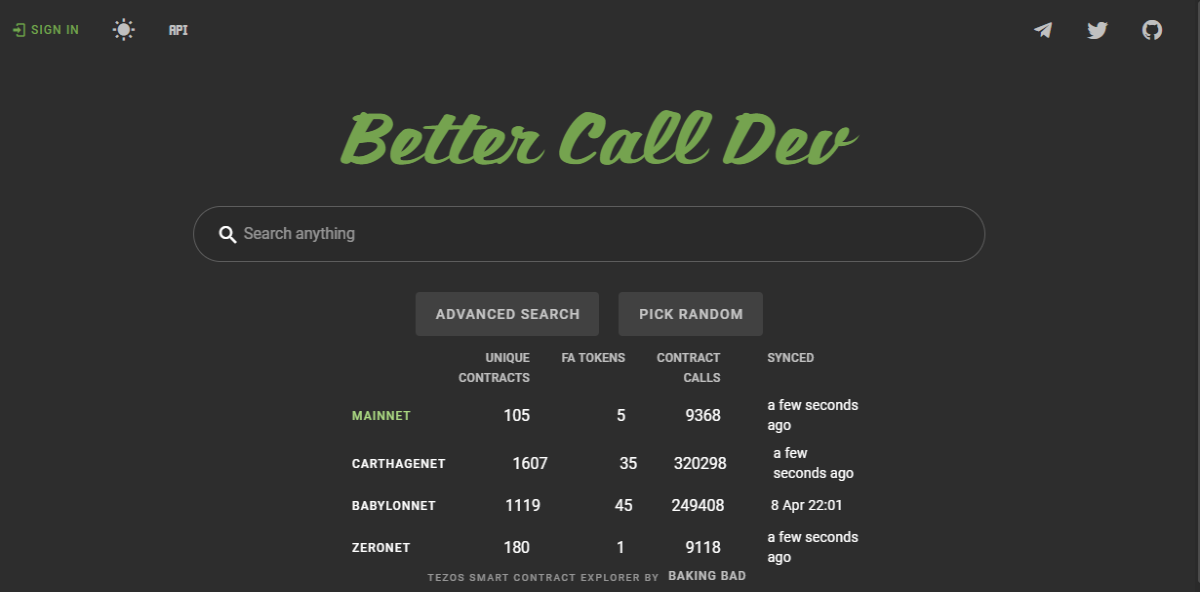
We can see the amount of "unique contracts" that are deployed. Currently 105 on main-net, 1,607 on "Carthagenet", which is the current testnet for main-net development, 1,119 on Babylonnet which was the testnet of the previous version of main-net. (Remember, Tezos is built to evolve fast and smooth. Current main-net is the third upgraded version of Tezos.) The majority of the contracts deployed on Babylonnet are likely try-outs and contracts made during workshops and courses. But some might still be in development and be migrated at a later stage.
And last but not least, 180 contracts are deployed on Zeronet, which is another testnet, but with a lower blocktime (20 sec) and a lower cycle size (128 cycles). This makes it easier and faster for testing certain features.
 - Source
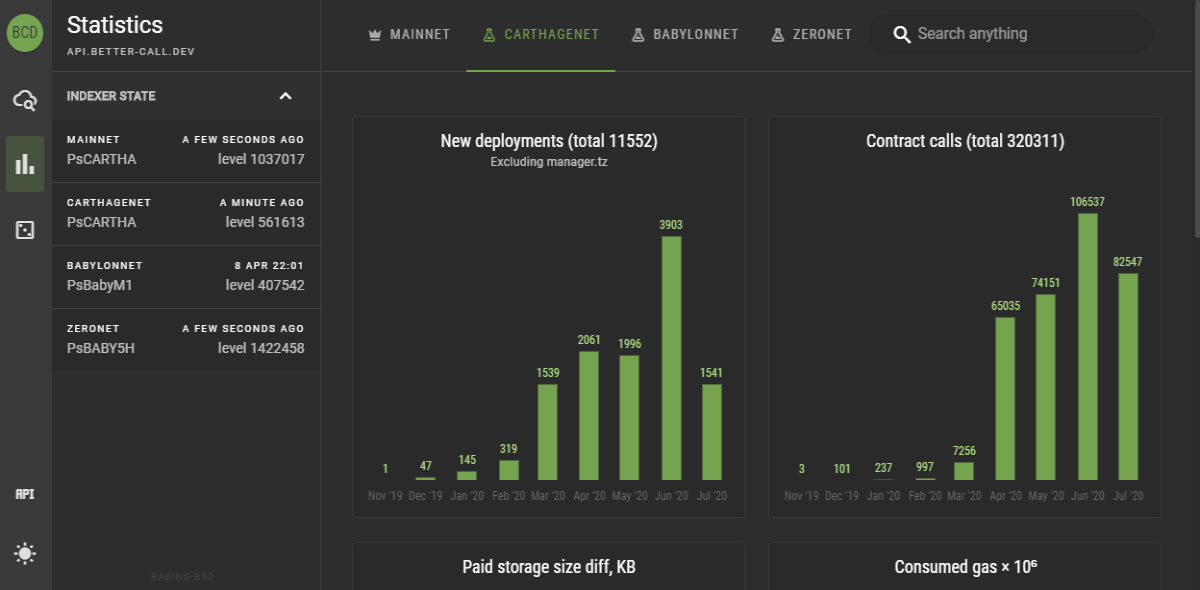
So a total of 3,011 unique contracts that have been deployed on Tezos so far. But that is the tip of the iceberg: the term unique contracts is a composition of all contracts deployed on Tezos. It represents a part of the total. Certain similar and simple contracts have been compiled and displayed as 1 unique contract. The actual amount of developer interaction with Tezos is way higher. Which is important to notice if we want to make an estimate of its potential growth in functional contracts and the amount of developers and the frequency they interact with Tezos to get more familiar with building on Tezos. It is a numbers game, and the more developers try to learn and develop on Tezos, the higher the probability will be that we keep seeing the increase in actual growth that has been initiated so far. So if we go to the statistics page on better-call.dev, we see different numbers. 225 deployments on main-net, 11,552 on Carthagenet, 10,379 on Babylonnet and 804 on Zeronet.
 - Source
Now we're talking about 22,960 contract deployments on Tezos in total in tha past 2 years. That is an average of over 31 deployments every single day. What we see happening today on Tezos is an enormous interest of people wanting to learn and build on Tezos. If we read the signs, we can only conclude that eventually, this thing is going to blow in a positive direction of development and adoption. Sow and you will reap. And with a Foundation that carries over $600 million of funds, there is a ton of sowing being done now, and in the future.
------------------
New to Tezos? Read this full introduction to Tezos.
New to Publish0x? Create an account here and you will be able to tip articles and earn some crypto rewards yourself while doing so.