
Zen blog post in Russian
https://dzen.ru/a/adDT2naXdQvVFZDH
Why is Telegram blocked?
The Russian authorities require Telegram to remove prohibited content, open an office in Russia and transfer data to the special services. Telegram doesn't do this, so it's being slowed down and restricted.
Why not switch to MAX?
MAX was created with the participation of the state and Rostelecom. There is no end—to-end encryption in it - all correspondence is available to the authorities. It requests redundant rights and is already being used to monitor and block unwanted channels. This is not a replacement for Telegram, but a control tool.
MAX is more dangerous than Telegram mainly because it usually has a higher risk of close integration with government requirements, a lower level of trust in data protection, and less independence in managing the platform.
Why is Telegram blocked?
The authorities cite several key reasons why the decision was made to limit the work of the messenger.
Refusal to remove prohibited content: The main formal reason is ignoring the requirements of Roskomnadzor. According to the Ministry of Digital Affairs, the administration of the messenger ignored more than 150,000 requests to delete information related to drugs, extremism, child pornography and calls for illegal actions. In total, Telegram blocked about 10 million communities in 2026, but this, according to the agency, is not enough.
Use for criminal purposes: The authorities note that Telegram has become the main platform for recruiting citizens to terrorist and extremist organizations. Since 2022, more than 153 thousand crimes have been committed using the messenger, of which 33 thousand are related to sabotage and terrorism.
Non-compliance with the law on "landing": Telegram refuses to open an official representative office in Russia and store personal data of Russian users on the territory of the Russian Federation, which is a direct violation of the law.
Access by foreign intelligence services: According to the Russian authorities, the administration of the messenger provides access to user correspondence to the intelligence services of Western countries, which is used against Russia's national security.
Back in April 2018, the Tagansky Court of Moscow decided to block Telegram due to the messenger's refusal to transfer encryption keys to the FSB to decrypt user correspondence. This requirement was based on the Yarovaya Law and anti-terrorism legislation. The real reasons for the block were that Telegram was used to coordinate protests (2017-2018 rallies). The platform allowed circumventing censorship and was a means of communication for the opposition. Encryption made it impossible for the security services to control it. The refusal to cooperate with law enforcement agencies was perceived as a challenge. In 2018, the blocking proved ineffective — Telegram continued to work through proxies and VPNs. Attempts at complete isolation failed due to the technical features of the Internet. Later, the pressure eased, and the messenger continued to work until the events of the present day in 2026.
Why Telegram is blocked in 2026.
The reasons are usually not one, but several at once:
1. Lack of control over the state
Telegram was originally built as a platform that is difficult to control:
there is no complete localization of servers for a specific country,
The authorities have limited access to correspondence,
and an independent moderation policy.
This is a problem for States with strict information control.
2. Dissemination of uncensored information
Telegram often becomes a platform for:
independent news,
leaks,
coordination of protests.
Because of this, it is perceived as a channel that cannot be filtered in the same way as TV or regular media.
3. Security and crime
The official argument in many countries:
extremism,
fraud,
illegal content.
This is partly true, but any major messenger has the same problems.
4. The political factor
Blockages often increase during periods of:
elections,
protests,
conflicts.
So it's not just about technology, but also about controlling the agenda. The site is poorly controlled by the authorities and does not make it so easy to manage the visibility of messages. Telegram is convenient for spreading news, coordinating people, and circumventing censorship. The government wants to move communication into a more manageable ecosystem. Access to data and technical control over the service are more important for the authorities than the freedom of convenient communication. That is, blocking or putting pressure on Telegram is primarily a matter of control, not a “technical necessity.”
The official reasons for blocking Telegram, which Roskomnadzor cites:
Non-compliance with Russian legislation. Telegram has not registered a legal entity in Russia and has not transferred user data to servers located in the country. This violates the requirements for data localization and registration of a legal entity.
Ignoring instructions to remove prohibited content. Roskomnadzor regularly requires the removal of materials that violate the laws of the Russian Federation (extremist content, drug information, child pornography, etc.). As of October 2025, more than 150,000 dangerous publications remained on Telegram, although more than 210,000 materials were deleted during the year. In March 2026, the Tagansky Court of Moscow fined the messenger 35 million rubles for refusing to remove prohibited content.
Lack of anti-fraud measures. Roskomnadzor claims that Telegram is not taking sufficient measures to combat phone fraud and the use of the messenger for criminal and terrorist purposes. In August 2025, voice calls to Telegram were blocked, which was explained by the fight against phone scams.
A criminal investigation into the founder of the platform Pavel Durov. At the end of February 2026, it became known that a criminal case had been opened against Durov on suspicion of facilitating terrorist activities.
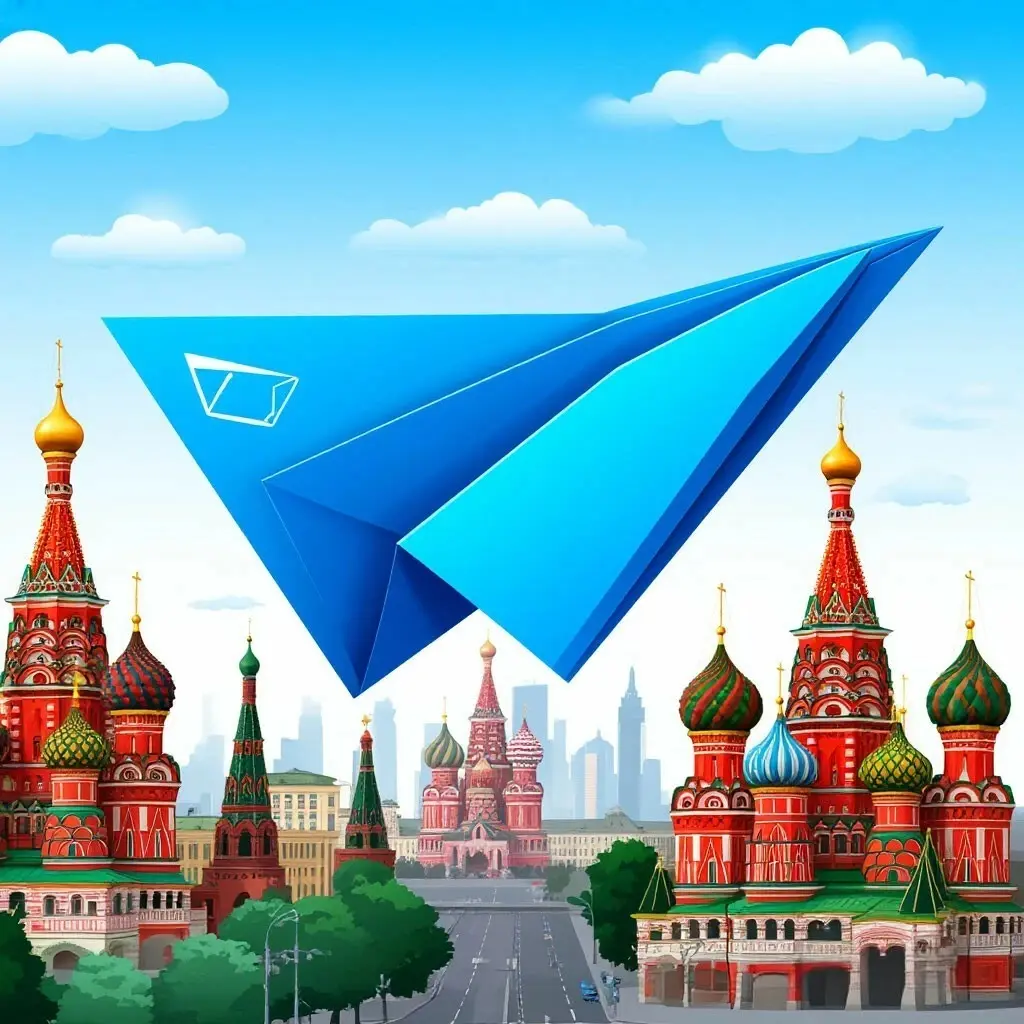
If Telegram is a relatively independent platform with an already established ecosystem, then MAX looks like a more risky option if privacy, autonomy and protection from external control are important to you. Telegram is usually blocked or restricted due to communications controls, pressure on an uncontrolled platform, data requirements, and the ability to quickly disseminate information. You should not switch to MAX if privacy, infrastructure independence, and minimizing the risk of unnecessary access to your correspondence are important to you.
Why you shouldn't switch to the Max messenger:
No end-to-end encryption (E2E). Unlike Telegram, where messages are encrypted so that only the sender and recipient have access to them, there is no public confirmation of end-to-end encryption in Max. This means that the messenger server can potentially have access to the contents of the chats, which reduces the level of privacy.
Private code. Part of the Telegram code is open for audit, which allows independent experts to verify security. The Max code is closed, so it is impossible to conduct an independent audit of the data protection level.
Integration with government services. Surveillance and control. Max is closely linked to public services and other government systems. This raises concerns that user data may be used for monitoring or shared with government agencies. The Max Privacy policy explicitly states that information can be shared at the request of authorized authorities.
Wide resolutions. Users note that Max requests a lot of permissions (access to contacts, photos, geolocation, microphone). There are complaints that the app uses data even when permissions are disabled. Critics call MAX a "spy messenger." The application requests wide access to phone functions, and, according to some reports, it can also analyze user reactions to content (for example, posts about military operations) and transmit this information to the FSB.
Obsession and commitment. Since September 2025, Max has been pre-installed on all new smartphones in Russia. This is perceived as a violation of freedom of choice and creates the impression that the messenger was imposed rather than chosen voluntarily.
Technical instability and distrust. The messenger is criticized for technical problems, the lack of some functions (for example, comments in channels) and the lack of maturity of the platform. There is a risk of encountering bugs or unstable operation.
Risks to sensitive information. Experts do not recommend using Max to discuss confidential topics (medical, legal, commercial data), as the level of protection does not meet the requirements for working with sensitive information.
Censorship and blocking: The MAX administration blocks user accounts without explanation. There are known cases of blocking the channels of deputies who were investigating topics that were inconvenient for local authorities.
Vulnerability to fraudsters: Contrary to security claims, MAX has already become a tool for fraudsters. The platform records cases of account hacking (including through the Mammoth virus), deception of elderly people and the offer of fake "investments". The attackers are actively using the trust in the new domestic service
If MAX is promoted as a “national” alternative, the main risk is that such a platform is usually more closely linked to local jurisdiction, regulators, and government requirements. For the user, this means more risks to privacy, more chances of moderation pressure, and less independence from the political environment.
Comparison table: Telegram vs MAX
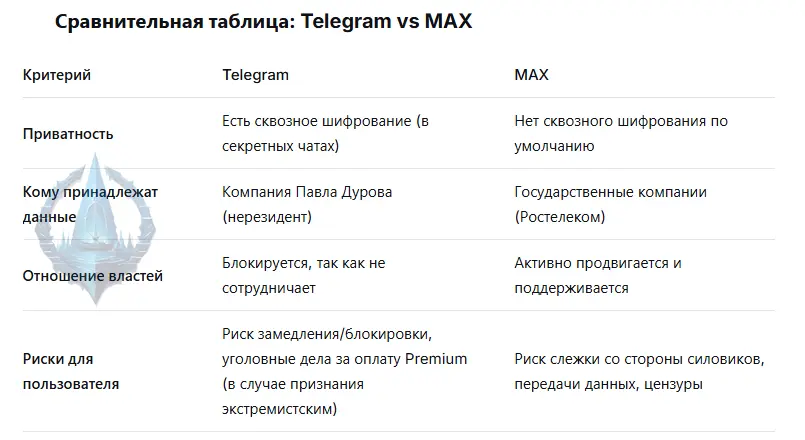
Switching to MAX is a necessary measure for those who want to stay in the legal field and use public services. However, in terms of protecting privacy and freedom from digital control, this messenger is inferior not only to Telegram, but also to other encrypted analogues.
Key risks of using MAX:
No end-to-end encryption by default — correspondence can be accessed.
Storing data on servers under the jurisdiction of the Russian Federation is an obligation under the Yarovaya Law.
Possible backdoors — the FSB's requirements for Russian software have been documented.
More control from the authorities. If the service is focused on a local jurisdiction and a “national” infrastructure, it is more difficult for the user to rely on neutrality.
Less reputation in matters of privacy. Telegram, despite all the disadvantages, already has a stable global usage practice. A new messenger or a government-promoted messenger usually has less trust.
The risk of forced moderation and access to data is higher. The stronger the platform's connection with the state, the more likely it is that correspondence, metadata, or contacts will be potentially available for pressure.
Independence from a political change of course is weaker. Today, the service can be “convenient”, and tomorrow it can become a tool for controlling, restricting, or transferring all communications to a managed environment.
Reasons to avoid MAX
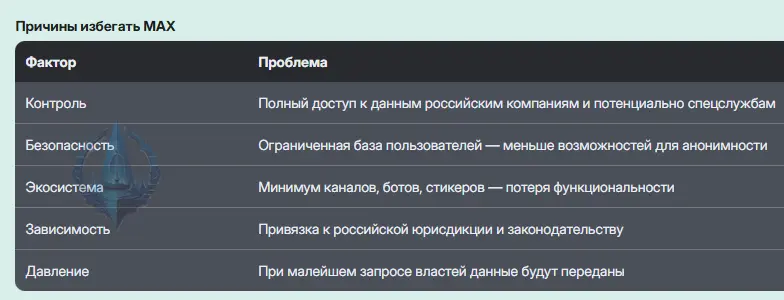
Why is this important?
For an ordinary person, the difference may not seem obvious, but it is critical for:
personal correspondence;
journalism;
activism;
work chats with sensitive information;
any conversations where excessive transparency for the state or the platform is undesirable.
Recommendations if confidentiality is required in Russian conditions:
Signal is an open source, strong encryption, independent development organization.
Session is a decentralized architecture with minimal metadata.
Element (Matrix) is a distributed network of servers, self—deployment.
For those who stay on Telegram: using secret chats, disabling cloud storage, VPN.
Conclusion: the transition to MAX means a voluntary abandonment of privacy and the transfer of communication under the control of structures directly related to the Russian authorities. Max can be convenient for everyday communication, calls, or using built-in services, but for tasks where privacy and data security are important, this messenger is not the optimal choice.
On the topic of the blog post:
Escalation of state control over citizens
https://www.publish0x.com/professional-videoproduction/escalation-of-state-control-over-citizens-xleeowv
What's the catch if Max is tied to Government Services?
https://www.publish0x.com/professional-videoproduction/whats-the-catch-if-max-is-tied-to-government-services-xokqjlk
Let's remember the Pandemic
https://www.publish0x.com/professional-videoproduction/lets-remember-the-pandemic-xgnnwek
Fines for searching for extremist materials
https://www.publish0x.com/professional-videoproduction/fines-for-searching-for-extremist-materials-xrpoldy
I write and shoot. Join me
Author's video content
https://www.youtube.com/c/ViolettaWennman
Political trash
https://www.youtube.com/@Ship-Shard
I invite you to the telegram channel
https://t.me/shipshard
Highly Social on Zen
https://dzen.ru/shipshard
To buy caramels to ruin your teeth
https://dzen.ru/shipshard?donate=true
My hobbies are history, philosophy, psychology, music, economics, politics, and sociology. I write about this and much more. Professional model. She has performed at international music festivals. I dance, I sing, I parody the voices of the performers. I am studying in the Netherlands at the Academy of Arts, Faculty of Film Industry and Arts. Co-owner of a video studio in St. Petersburg.
I am glad to see all of you in my blogs.


Please support us, like-minded people, join the telegram channel https://t.me/shipshard





