
Mayer Amschel Rothschild was starting to forge the greatest empire of all, not one of political power, but one of economic and monetary power. With the ability to control money and be a Money Changer, the Rothschilds would be able to control international economics, exchange rates, stock prices, media channels, territory, land, gold, information, and more. All while hiding in the shadows, letting the politicians take the blame for sending young children to war to fight their battles.
The next opportunity Mayer Rothschild saw to increase his wealth and power across the world was the French Revolution that lasted a decade from 1789 to 1799. When contrasted with the American revolution, these battles fought in Europe were much more bloody, wicked, and malicious than those fought in America. During the 18th century, the French citizens were subject to a stagnant economy, increasing prices, and large numbers of unemployed due to the considerable amounts of government debt and economic imbalance that was occurring throughout the nation due to their involvement in wars in the American Revolutionary war and elsewhere in Europe.
The French Parliament, which was responsible for generating revenue for the French government, implemented a regressive tax system, where you paid fewer taxes as you made more money. Today, in the United States, we have a progressive tax system, so when you make more money, you pay a larger percentage of your income in taxes. In this section, we’ll look at the start of the French revolution from the calling of the Estates-General in 1789 to the culmination of the historic and culture-shifting war that ended with the creation of the military dictatorship of the French Consulate in 1799.
The over-taxation of the lower and middle classes in France began the crisis and steadily overwhelmed the French people. While most of the lower and middle classes were getting a large portion of their income taxed, laws were enacted that made it legal for government officials, nobles, and clergy to be exempt from paying taxes which allowed them to hoard the wealth and property of the nation. The Money Changers and Nobels were hoarding wealth, while the lower and middle classes had no money to facilitate real movement of the economy. This stifled the economy and caused massive unemployment, which slowed down job creation and economic production even more.
The financial crisis France was experiencing was partially a result of their intervention in the American Revolutionary War when they were ill-prepared to afford it. In addition, Britain and France fought again in the Anglo-French war from 1778-1783 which deepened the money hole the French found themselves in even more. The only solution the French Government found to afford these major undertakings was to issue more debt, which compounds the issue. In 1788, the French found themselves in debt over 4.5 billion Livre Tournois, which was the French currency used at the time, inflated for today’s silver prices, which would be over $16,000,000,000 USD in debt.
Instead of attempting to take the issue head-on and propose a rational solution to the problem, the French finance minister decided to significantly devalue the French currency. That way, the government would owe less on their debt in real terms (Does that sound familiar. Hint: USA). Anyway, the result didn’t help the financial situation but actually worsened it with massive and rapid inflation that devasted the lower and middle classes even more, by ruining their employment status and production for the economy. Throughout the cities there were many people homeless, begging, and starving; while the Money Changers remained comfortable in their mansions.
After different sections of the government or Money Changers failed to propose a meaningful and positive change, King Louis XVI called on a sacred and powerful French body of government titled the Estates-General. This summoning of the Estates-General was monumental for the French Nation. This hasn’t been done in over 150 years, and the last time they were called was from 1560-1614 when the supply of money had made it difficult for the French economy to produce goods and services effectively.
We can think of the Estates-General as a last resort French government body that was used to come together in times of crisis. The body of government was made up of three different representatives or estates. The First Estate was the Nobles, the Second Estate was the clergy and the Third Estate was everyone else who didn’t fit into the first two categories; because the Estates-General was formulated this way, it made it so the First Estate, which had very little population by numbers had an equal vote to the Third Estate, that contained a vast plurality of the French Citizens. The Estates-General passed laws on a majority rules basis, therefore when two or more of the groups voted in favor of a proposal, the measure would become law.
This distinction allowed the Estates-General to give a misrepresentation of the population in France, even though it was considered a Super Parliament, by pretending the institution's law would be unbiased and an all-encompassing view. However, because the clergy and nobility were closer to each other in terms of wealth and ideas than the common people, it was easy for them to conspire and create policies that were in their favor, without taking into consideration the views of the common people. The meeting called by King Louis XVI in 1789 was the first calling in the last 150 years and after the common people elected Abbé Sieyès as their main representative and their grievances were unanswered, this meeting would end up being the Estates General’s last.
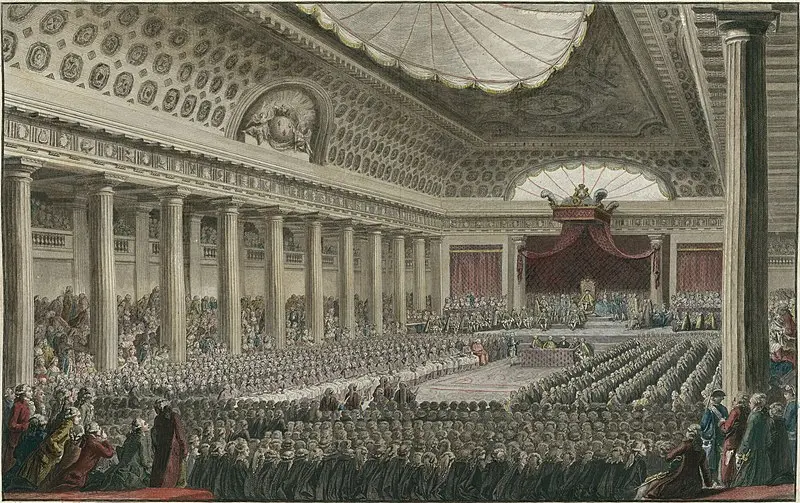
(Author: Isidore-Stanislaus Helman (1743-1806) and Charles Monnet (1732-1808. Painting of Estates General meeting in 1789.)
In June 1789, Sieyes believed that all three of the assemblies should be brought together as one, in order to ensure French citizens are properly represented by their government. After pushback by the Nobles, Sieyes brought some of the clergy and all of the common people together to create their own laws and elect their own representatives. After over 100 of the clergy joined the common people, they deemed themselves the National Assembly and planned on creating a new form of government, with or without the nobles helping them. King Louis XVI immediately fought back against the National Assembly and after years of fighting international wars, the king began to mobilize troops to shut down the rebellion that was occurring domestically.
The new National Assembly demanded a new and fair constitution put into place for the French people. The skirmishes and political debates between the nobles and the National Assembly continued, with the King attempting to dismantle the newly-formed revolutionary legislative body. The breaking point occurred when rumors circulated that the King was going to begin using soldiers to break up the meetings of the National Assembly. In response, on July 14th, 1789 the common people began to protest angrily in the streets and the soldiers, who the king ordered to disperse the protesters, actually joined their side in the demonstration. The large group made their way to a military prison, called the Bastille, that secured weapons, ammo, equipment, and a measly seven prisoners of the French crown. This began the bloody battle that became known as the famous Storming of the Bastille which sparked support of the rebellion across the nation. Although the complex wasn’t strategically important to the King or nobles, it served as a symbol of the liberty of the French people, and Bastille Day is still celebrated in France as the National holiday on July 14th every year.
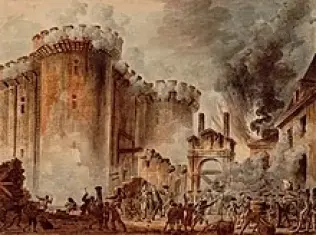
(Storming of Bastille Painting. Jean-Pierre Houël, 1735-1813)
Now the revolutionaries of the Third Estate were armed and motivated. With renewed confidence, widespread protests and demonstrations began to sweep across the nation. As the common people began to win battles, the nobles fled the country with all of the wealth they could hoard. Once the lower and middle classes felt that it was appropriate, they began passing what is now known as the August Decrees. These new laws outlawed many of the medieval practices that were plaguing the French economy up to this point such as;
feudalism, the hoarding of property, exemption from taxes, abolishment of royal land that was shut off from the rest of the public, offering more rights and privileges to common citizens, and taking away privileges from the nobles.
In less than 6 months, the lower and middle classes had destroyed all the remanence of the old regime and now had to create a new government from the ground up, and every nation starts with a constitution.
Lafayette, who was a French citizen who assisted the United States in the Revolutionary war began to draft the government document and with the editing and consultation from Thomas Jefferson, they produced the Declaration of the Rights of Man and of the Citizen (DORMAC), which highlights basic human and civil rights that were to be respected and carried out in the French nation. After rejection by the Money Changers and French Aristocrats, Montesquieu, a French Judge helped layout the final draft that would be put into effect. Although the Declaration of Independence and the DORMAC differ in intent, the document has a striking resemblance to the Declaration of Independence and Bill of Rights of the United States and is still used in the Preamble of the French Constitution that is active today.
All of these efforts were slowed down, however, because the National Assembly, made up mostly of the Third Estate, still believed that a King was necessary to bring society together, therefore striving for what’s called a Constitutional Monarchy. Once the new Constitution was created while still having a King, progress started to be made, however, the changes weren’t that clear to many of the French people. The entire reason the uprisings started in the first place was a lack of food, shelter, and adequate monetary activity in the economy that was driven by the hoarding and manipulation of the Money Changers, Nobels, and Clergy.
However, the laws that were written into the DORMAC were widely ignored and the economic state of France did not have any drastic differences. Citizens were considered males over the age of 25 who owned property and the economic conditions of the majority of the French continued to worsen. These inconsequential actions sparked a radical political group to emerge called the Jacobians, who instead of seeking a constitutional monarchy wanted to implement a republic that would be representative of the people.
This is where things can get a bit complex and much more devastating for France. The Jacobians began protesting their views in the public streets of Paris attempting to persuade different groups, including members of the National Assembly to join their cause to remove King Louis from power. After the debates escalated, the National Assembly, led and commanded by Lafayette, fired upon the Jacobians killing 50 members. The king saw this massacre as an opportunity to shut down the revolutionary efforts by instituting laws that would shut down newspapers, political forums, and other ways for information to disseminate.
Therefore, the National Assembly who had been the main artery of support for dismantling the destructive and discriminatory practices of the monarchy partook in those same practices they sought to destroy, by killing a group of people who had differing ideas. Not only that, this played right into the Money Changers and King Louis’ hands by allowing this event to be used as a weapon to portray the possible negative effects of radical changes in government.
Neighboring countries of France began to worry about the dismantling and dysfunction of the French nation. The Holy Roman Emperor, Leopold II, and King of Prussia, Frederick William II pledged their support to King Louis (Roman Empire was basically Austria at this point). The support was pledged because if Austria and Prussia's citizens understand the principles that caused the revolution in France, the radical view of having basic civil rights, then they would upthrow the kingship in Prussia and Austria and demand a republic for themselves. The money changer’s main goal is always to maintain their wealth for themselves and future generations, so they pledge their support to the French Kingdom with the Declaration of Pillnitz, which promises to restore power to the French king, in the hope their citizens won’t get any radical ideas to have basic rights.
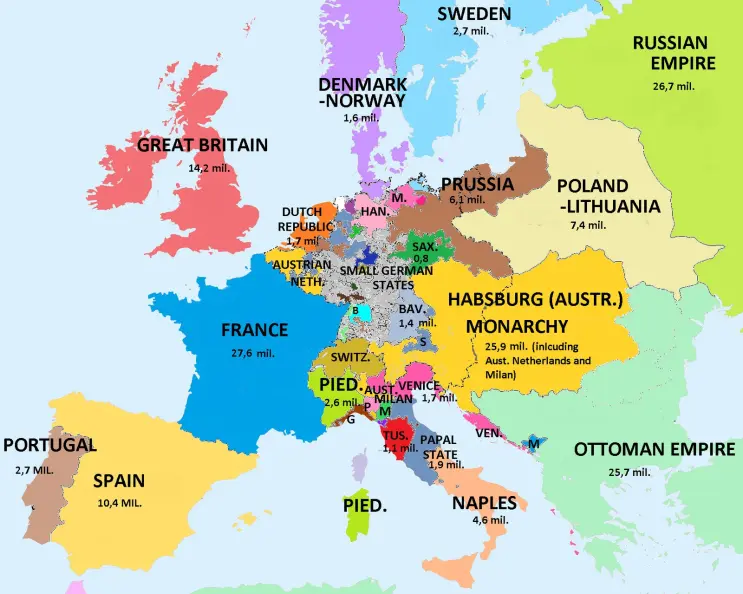
(Europe in 1789. https://vividmaps.com/europe-on-eve-of-french-revolution/)
The National Assembly of France viewed these alliances with foreign nations as a threat to their revolutionary efforts and began to invade Austria in hopes of finding food to spread through the French economy and to spread their own morale and spirit of revolt through Austria. Instead of successfully spreading their ideas, the French efforts were severely hurt when Prussia joined Austria to defend its monarchy because of the reasons cited earlier. When King Louis began to publicly support Prussia and Austria becoming an alliance to fight off the French, the National Assembly suspended the monarch status of King Louis in France and held new elections in September 1791 to create a Legislative Assembly. This would be the new formal law-making body in France for the time being and would be responsible for creating the French Constitution of 1791.
The DORMAC would go on to be the preamble of the constitution, but even after it was created, along with the Legislative Assembly, discrimination and prosecution were still very prevalent throughout France.
Still ongoing was the war between Austria and Prussia against France. In April 1792 when France officially declared war on Austria and began attacking Austrian and Prussian forces at their borders. The different political factions disagreed on many things, but one thing they agreed on was that war should unite the people under the revolutionary ideals and dismember the old systems. The French would enjoy small victories against enemy forces and with those small wins, the French people gained confidence in their ability to fight. However, large French defeats suffered at the hands of the Austrians and Prussians muffled the progress of the French and caused them to retreat back to their shell, with no real influence spreading to the people inside of Austria or Prussia, which was their goal from the onset, the war efforts had been a lost cause.
Later that year, concentrations of certain political factions inside of the Legislative Assembly were actively pursuing policies that went against the views of the lower and middle class. As a result, there were votes being held for a new law-making body called the National Convention. The National Convention would create a new body of laws without a king, marking a shift in government operation from a monarchy to a republic. I think when people read history shifts in government structures, they are often underappreciated for how significant they really are. Imagine if the United States today went from being a republic to having a King.
With France now being a republic, the National Convention felt inspired and encouraged by its victory of being officially recognized. The new republic created the Constitution of the Year I that would supersede the previous constitution that included a position for a monarchy. Consequently, the National Convention decided to put in new measures that would drastically affect the success of their new republic. One of the propositions was made by the Committee of Public Safety, headed by Maximilien Robespierre. The Committee agreed on changing the calendar that was being widely used around the world and renaming 1792 to year 1. Furthermore, the Convention changed numerous measurements of time including the names of all the months and made it so there were 10 hours in each day and 100 minutes in each hour. Thus, making the system very confusing domestically and internationally.
The most drastic measure the new French republic took was the vote to put King Louis XVI to death. Now that France was a republic, there was no need for a formal or symbolic king and on January 17th, 1793 when the balloting took place, one vote made the difference and the King was sentenced to death by a brand-new technology for death sentences called the guillotine. During this time, the guillotine was thought to be a more moral and painless way for death sentences and was used in France up until 1977.
With many of the surrounding monarchies in Europe stunned and disturbed by the acts of the French people, they began mobilizing troops to shut down domestic protests and to fight France directly. In response, France declared war on Great Britain and the Dutch who later allied with Spain, Portugal, Naples, and more in the War of the First Coalition that lasted from 1792-1797.
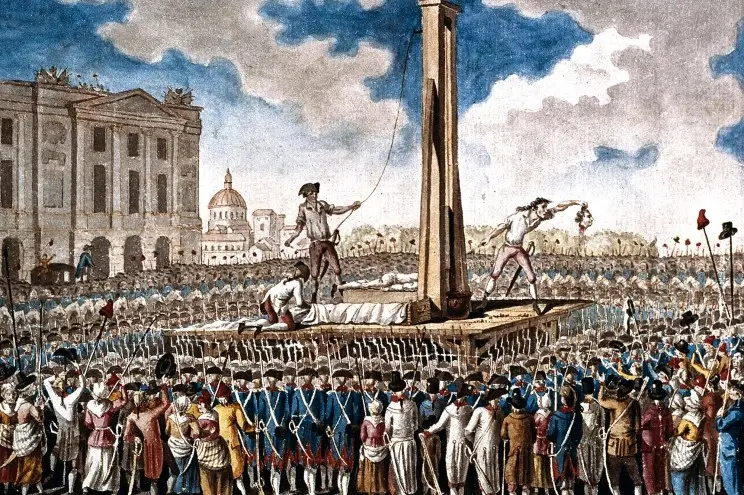
(The Execution of Louis XVI in the Place de la Revolution on January 21, 1793. In the collection of Musée Carnavalet, Paris.)
In addition to the international wars the French nation now found themselves in, they were also dealing with issues domestically. In France, the Committee of Public Safety was orchestrating the Reign of Terror, which marked the bloodiest and most infamous part of the French Revolution. Now that the National Convention had killed a king and created a new republic, the ability to kill anyone who went against their views quickly became law. Shortly after the death of the King, the National Convention named the Committee of Public Safety, headed by Robespierre, the official government of Revolutionary France
Robespierre instituted a number of laws that sought to benefit the lower and middle classes such as price control, hoarding rules, and the death penalty for anyone who didn’t follow those rules. However, as time went on the common people of the French Republic felt that the Committee of Public Safety was not holding up to the promises, they made prior to being in power. The strict zero-tolerance policy for having differing views and the accumulation of centralized control, which was the situation they had before, led the French people to become increasingly skeptical.
The laws that Robespierre instituted resulted in the direct public execution of nearly 17,000 people by guillotine with an additional 10,000 people dying in prison. The terror had concluded about a year later with Robespierre, the person who started the terror being guillotined himself. A new regime would be put into place the next day, with the executions of the previous regime continuing for many months. Some of the previous allies to Robespierre were able to stay because of their similar views to the lower and middle classes.
In the years following the Reign of Terror, France managed to earn peace with many of the foreign countries they found themselves in international war with. Mostly because of sensational and unpredictable victories led by a French Soldier named Napoleon Bonaparte, who was able to stay in France after the terror, despite his connections with Robespierre because of his dominance in battle.
However, their issues continued domestically with issues on deciding the economic and governance structure that should be embraced by France. In 1795 a new constitution was put into place, called Constitution of the Year III, that created a two-part legislature system similar to that of the United States, in addition, power was more broadly distributed with the hopes of making the legislative process slow so that volatile policy changes wouldn’t cause sudden economic failure. The most powerful government body though was the French Directory, where five members would be selected to take on executive decision making. The French Directory would hold massive influence and again be another form of centralized power the lower and middle classes had to deal with.
Government, politics, and the economy continued to be extremely fragile, making it so any sudden social change has the ability to lead to something drastic. The internal and international affairs made the French people tired and finally a draft was proposed by Sieyès, the one who proposed the first National Assembly and managed to survive the great travesties through the French Revolution suggested replacing the French Directory in 1799 with a French Consulate who would be run by Sieyes, Roger Ducos and the First Consul Napoleon Bonaparte, which finally brought the French Revolution to an end.
There were a series of other revolutions sparked by the effort in France that occurred in French colonies and other nations across the globe, because of its tremendous upheaval of government and bloody battles fought throughout the effort, the French revolution is still considered to be one of the most important and inspirational revolutions in world history.
Once the French Consulate was created, Napoleon Bonaparte was named First Consul, the most powerful position in France, because of his unbelievable military successes and leadership displayed during the crisis that was occurring during the French Revolution. Bonaparte was set on achieving glory for the French nation and one of the first things he did was create a “Bank of France” which would be a privately owned central bank that was owned by 16 of the wealthiest bankers in France at the time.
This was very controversial for the people of France because its first attempt at creating a Central bank during the early part of the 18th century led to the institution paying off the debts for the Kings for his war efforts during the War of Spanish Succession and ultimately led to a large economic bubble that burst and left the people of France in a great depression. From that point on, the word 'bank' was considered taboo in France, and another attempt at a Central Bank wouldn’t come until Napoleon in 1800. The 16 bankers that had control of the central bank had helped create Napoleon’s fame and narrative, in addition to financing his campaigns, therefore Napoleon granted them a monopoly on French finance in 1803 and that continued until 1998.
(16 original investors in the Bank of France)
- Jean-Frédéric Perregaux
- Guillaume Mallet
- Jean-Barthélémy Le Couteulx de Canteleu.
- Joseph Hugues-Lagarde
- Jacques-Rose Récamier
- Jean-Pierre Germain
- Carié-Bézard
- Pierre-Léon Basterrèche
- Jean-Auguste Sévène
- Alexandre Barrillon
- Georges-Antoine Ricard
- Georges-Victor Demautort
- Claude Perier
- Pierre-Nicolas Perrée-Duhamel
- Jacques-Florent Robillard
- Jean-Conrad Hottinguer
During these bloody battles, it’s easy to forget the financial powers we mentioned in the beginning of this section who regardless of the outcome of these battles and wars, continue to culminate massive amounts of financial gain, while their influence is being spread across the globe. After all, the main focus of writing all of this is to show you that regardless of the conditions domestically or internally in a country, a small group of people continue to benefit off of the struggles of everyday people, regardless of the outcomes of those events and it’s our turn to take back those powers.
Throughout the internal and international wars happening in France, whenever he saw the opportunity Mayer Rothschild would deploy German mercenaries to battle for many of the foreign countries that were partaking in the Wars of the First and Second Coalition. In addition, he would partake in money changing and loan dealing with the Nobels that were fleeing France and headed to Germany. During this time, Rothschild’s wealth grew tremendously because of the sharp volatility in markets, foreign currency speculation, and more. In addition, he became especially close to the King of Germany and began issuing his own international loans from the German treasury, allowing him to continue making profits off of money that wasn’t even his, but rather the taxes of the German people. While this was happening, Mayer Rothschild was having many children, and he planned to use those children as weapons for what would become the greatest international banking empire the world has ever seen.
In 1798 Nathan Rothschild, Mayer’s 3rd born son was sent to London, England to start his banking business with a large sum of capital created from the conflicts and was instructed to begin the practices his father had taught him and become a Money Changer.
Read more and come help grow a community at themoneychangers.org






