
Now that we have highlighted the prevailing themes from 1815 to 1848 of economic injustice, shifting political views, evolving technologies, and religious persecution that was allowing Money Changers to hoard unprecedented amounts of wealth inside of Europe, we can dive into the results of suppressing the rights of an entire continents population to impoverishment, starvation, and exhaustion in what historians consider the most widespread acts of an upheaval of the national government in world history that involved over 50 countries; the Revolutions of 1848.
In the years leading up to the Revolutions of 1848, small protests were transpiring around the continent because of the themes highlighted above, especially hunger. The 1840s are often described as the hungry ‘40s because of a large potato famine that occurred in Ireland as a result of practicing monoculture, a farming strategy that was adopted by slave plantations in the United States that focus on growing one type of crop. After a disease struck the most popular strain of potato, over 1,000,000 Irish citizens died and many more fled the country. The population still hasn’t fully recovered to this day (John Greene, Revolutions of 1848). This famine spread across Europe to the lower and middle classes, but because of the wealthy’s connections to vast international trade, they were left widely unharmed and without offering aid to their neighbors. These protests in the 1840s were put down shortly after they started by aristocrats, but they didn’t prepare anyone for what was about to come and seemed to be one of the last straws before the armed rebellion broke out.
The continent was never unified in its principles for being in battle, but the feelings of mistreatment and exploitation were being universally experienced across Europe. The main goals of the revolutionaries for most of the countries were to have many of the human rights granted in the United States, and other popular western constitutions: freedom of speech, freedom of the press, more political representation, increased standards of working and living conditions and equitable human rights. After these requests had been unanswered for too long, the people of Europe began to revolt. So where did it start?
Italian Revolutions of 1848
The Revolutions started in present-day Italy in January 1848 in what is now known as Italy’s First War for Independence. At this point, Italy did not exist and was broken up into many different territories that were split between different rulers. In the North, most of the territory was controlled by Austrian Foreign Minister Prince Metternich and Austrian Emperor Ferdinand. The areas to the south were mostly controlled by the Kingdom of Two Sicilies to the South.
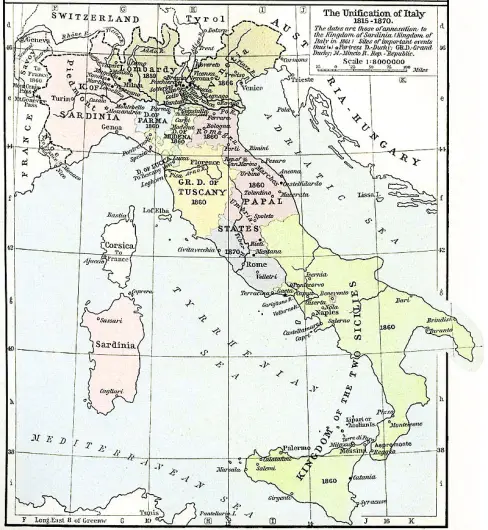
(An image of divided Italy from 1815-1870. Source: Shepherd, William. Historical Atlas. New York: Henry Holt and Company, 1911)
As a result of Italian's strong sense of national pride and the intolerable treatment they were experiencing by wealthy Money Changers, the citizens were forced to pick up arms and actively fight against Austrian Control. They were briefly successful in early battles; however, less than 6 months later Italian leaders realized their armies were no match for the large Habsburg empire and had to return to their familiar status of being servants to the Austrian King. A failed revolution.
During the midst of these unsuccessful attempts at revolution, perhaps one of the greatest generals in Italian history arose as a leader of the revolutionary efforts named Giuseppe Garibaldi who initially embraced republicanism and the ideals of political activist Giuseppe Mazzini.
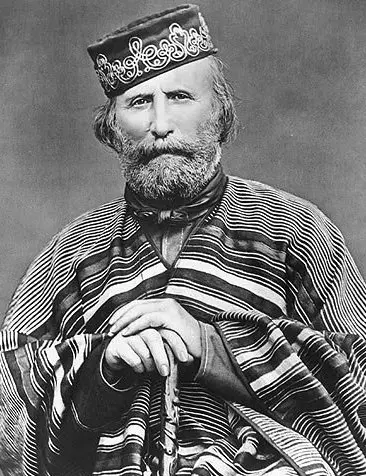
(Garibaldi in 1866)
In the meantime, the Austrians continued to maintain power and the Rothschild branch inside of Naples was able to preserve their financial prosperity for a brief time. In addition, Carl Rothschild, who managed the Naples branch was able to make close connections with Kings of Various Italian states, including the powerful Kingdom of Two Sicilies, which controlled a large territory in the region. This allowed Carl Rothschild to buy up valuable bonds and influence the various states that existed inside the southern provinces of Italy
However, the people of Italy wouldn’t give up easily and the lower and middle classes would continue to mount their efforts against Money Changers in their Second War for Independence in 1859 with Garibaldi now becoming the General of the military efforts leading the revolution. In the midst of becoming the general, Garibaldi changed his political view to believe a kingdom was necessary to run Italy, rather than a republic, after gaining support from another political faction that was more powerful. This allowed Garibaldi and the Italians to defeat the Austrians by capturing more land for the Unification of their country, including the two important states of Naples and Sicily and formally creating the Kingdom of Italy in 1861.
As a result of Garibaldi taking control of Naples, the Rothschild branch in Italy, which had been passed down from Carl Rothschild to his son Adolf Rothschild, was forced to shut down and consolidate its tremendous amount of assets with the Frankfurt branch in Austria in 1863. After Adolf died, their bloodline shortly died off and all of the documents pertaining to the Naples branch were destroyed by a family decision in 1901.
With most of Italy now unified under the Kingdom of Italy, the rebels sought to complete the union among the various Italian states by capturing more territory from Austria in the Third War for Independence. In 1866, longtime allies Austria and Prussia were undergoing war against themselves in the Austro-Prussian war. This important battle was being fought over the newly emerging German states who were longing for liberation themselves. To fight against Austria, Italy would partner with newly instated French Leader Napoleon III, who was a descendent of Napoleon Bonaparte, and allowed Italy to defeat the weakening Austrian empire and take control of more land, including Venetia, because of the Austrian’s lack of resources committed to the effort and their attention being focused elsewhere. The ultimate decision by the Austrians to give up Venetia came to a vote in the Treaty of Vienna. During the Treaty of Vienna, one of the contingencies for Venetia to become part of Italy was the approval by popular vote of Venetian citizens to see which country they wanted to belong to. After 642,000 ballots were taken, only 69 of the votes decided to remain with Austria, and Venetia was given to Italy.
After the Third War for Independence was over, most of Italy was unified. However, the complete unification of Italy wasn’t complete until 4 years later in 1870 with the capture of Rome, and 48 years after the capture of Rome in 1918 at the end of World War I, when Italy was granted more territory and some historians consider the Italians Fourth War for Independence.
The French Revolutions of 1848
France was the next country to experience massive uprisings because of the maltreatment of King Louis Phillipe during his reign. The events are now known as the February Revolution and exiled King Louis Phillipe and put Napoleon III in power, a descendent of Napoleon Bonaparte.
After the July Revolutions of 1830 King Charles X of France was overthrown by the people because of the mistreatment they were suffering at the hands of the elite and appointed his cousin Louis Phillipe. King Louis Phillipe had initially been popular because of his conservative government spending and ability to hide his close relationships with the financial banking elite. However, after the administration was in large debt with a new government, they were in desperate need of funding for building new infrastructure and paying off old loans during the industrial revolution. As a result, King Louis Phillipe turned to Jacob Rothschild in the Paris branch, who would extend two loans of undisclosed amounts to help the economy stabilize. In return for forwarding the loans, King Louis Phillipe gave Jacob Rothschild a noble rank called the Grand Officer of the Legion of Honour, where you can still find his name being represented under the French honor today.
King Louis Phillipe now had close relationships with the largest financial empire in the world and had ambitions to become wealthy himself, “Louis Philippe was an expert businessman and, by means of his businesses, he had become one of the richest men in France (Albert Guèrard, France: A Modern History p. 289). However, his wealth would come to his detriment when citizens became increasingly aware that the king was hoarding wealth for himself. Preceding the Revolutions of 1848 in France, the country would go through an economic crisis because of bad harvests and currency manipulation from Money Changers that resulted in around 1/3 of the French citizens relying on social welfare. Small rebellions and activists began promoting a new government and France’s system was undergoing major turmoil.
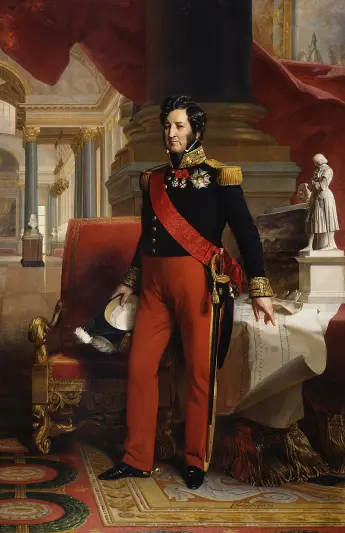
(Louis Philippe I, the last King of the French)
At the start of King Louis Phillipe’s reign, he had good intentions to run the country well. However, the money and wealth corrupted him, and bankers were now the ones running the country and are evident from a quote by a banker who helped Louis Phillipe rise to prominence in 1830 when Louis Philippe was named king, the banker said, “From now on, the bankers will rule" ("Class Struggles in France" in Collected Works of Karl Marx and Frederick Engels, Volume 10, p. 48).
With a Constitutional Monarchy being originally established in 1830, by 1848 when France was on the brink of revolution, citizens were being manipulated to believe the king, who was a figurehead for the financial empires, was responsible for their suffering. In 3 short days, France overthrew King Louis Phillipe who was exiled and replaced with a provisional government that created the Second French Republic. Napoleon III would be approved as the leader of France and after being comfortably in exile in Great Britain, he returned to fulfill his self-proclaimed destiny.
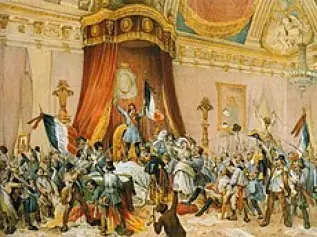
(The throne room of the Tuileries Palace was seized by a revolutionary mob)
Napoleon III would attempt to try and use many of the same tactics as Bonaparte by attempting to take over the continent of Europe. After moderate success in improving the economy and infrastructure, Napoleon III took part in creating laws that rendered French legislative bodies useless, concentrated authority in his hands, and proclaimed himself Emperor of France. Witnessing the potential for another vast and manipulative French Empire to sweep across Europe, Napoleon was left without the support of his citizens or powerful, advancing foreign nations. Therefore, he attempted to take reestablish French dominance in Europe during the 1870 Franco-Prussian War where Napoleon III would lose and was exiled. This event would surpass any chances for France to be the dominant European power, solidified German unification (preceding this war Germany was a major ethnic group inside of Prussia), and made countries realize the importance of having strong governing bodies.
For the Rothschild’s Paris Branch, the Revolutions of 1848 proved to be uneasy years for their business. However, the family managed to come out successful and still runs a multinational financial organization there today. After the Revolutions of 1830 in France and Belgium, the Rothschilds managed to gain the client of Belgium Emperor Leopold I, the newly appointed King of the Belgians. In addition, from 1845 to 1862 Jacob was able to take £55,000 (equivalent to £4 million in 2019) and turn it into £16,914,000 (equivalent to £1.81 billion in 2019) (The House of Rothschild (vol. 2): The World's Banker: 1849-1999, Niall Ferguson). With the money from his investments, Jacob bought one of the most spectacular wine vineyards in Europe that are still owned and controlled by the Rothschild family today.
Furthermore, during the Franco-Prussian War in 1870 Jacob Rothschild’s heirs Gustave and Alphonse Rothschild were managing the Paris branch. Therefore, when France lost the altercation and had to pay 5 billion Francs to the Prussians for war compensation, the Paris Rothschilds were the family that created a syndicate (and got paid handsomely to do so) to raise the 5 billion francs that would be transferred to the Prussian King, who would then have the Rothschilds manage it in the Prussian Kingdom. After the Franco-Prussian war, the Paris Rothschild branch took part in numerous purchases and funding of major commodities companies and government projects that had and still have enormous effects on world control today.
For instance, in 1845 the Nord company was created which was a government-appointed firm that allowed the Paris Rothschild branch to fund, build and maintain a cross-country rail transportation system. After years of reaping profits, the company would eventually be nationalized by the French government in 1937.
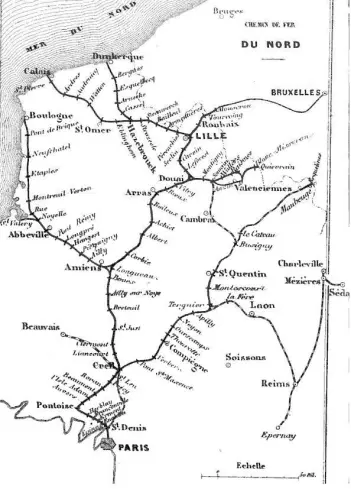
(The Nord network in 1853)
In addition, the Rio-Tinto copper mines and mining companies in Spain were bought out in 1873 at a tremendous discount due to Spain’s political and financial crisis during the time. The Rothschild installed new managers, techniques, and innovative equipment that would drive up future production (Harvey, Charles E. (1981).). From the 1880s onwards, the Rothschilds had full control of Rio Tinto and by 1903 the Rothschilds had a 30% stake in the company (The Rio Tinto Company: an economic history of a leading international mining concern, Charles E. Harvey (1981), page 188). This company will definitely have an impact on our journey as we move forward through history. As of 2021, the Rio-Tinto Group is the second-largest mining and metals company in the world and has total revenue of 63.495 billion$ and total assets of $102.896 billion.

(The open-pit Corta Atalaya mine was part of Rio Tinto's original operations in Spain.)

(Rio Tinto headquarters in Melbourne, Australia)
In 1880, the Rothschilds attempted to keep secret that the family was the largest funders of Eramet, a multinational mining and metal research company based in Paris, France. The family took full control over the company in 1890 (Cambridge University Press, 2004). As of 2017, the company has over 47 sites in five different continents, €3,652 billion in revenue and €3.269 million in total assets
Also, in 1880 a French-based multinational industrial mineral processing company called Imerys was funded by the Rothschilds. After acting as a stand-alone company for the next 90 years, the company would undergo mergers and management under new holding companies in 1970. As of 2020 Eramet is based in 40 countries on 3 different continents and has 230 industrial sites with revenue of €3.799 billion and total assets of €7.594 billion.
Another example includes how in 1887 the Paris branch of the Rothschilds teamed up with their family branches in Europe to become the largest shareholder in the De Beers diamond mines in South Africa after the African Diamond rush where an 83.5-carat diamond was found. Cecil Rhodes was the founder of De Beers and proved to be a very controversial figure in his lifetime and after. From this point on, the Rothschild dominated the diamond trade through De Beers who, “from its inception in 1888 until the start of the 21st century, De Beers controlled 80% to 85% of the rough diamond distribution and was considered a monopoly” (Fall 2002), The Global Diamond Industry). Today the De Beers Diamond company has a revenue of US$6.08 billion and an undisclosed amount of assets.
It’s fair to say the Rothschilds, especially the Paris branch, survived the insurrections of the Revolutions of 1848 just fine. As for France’s government structure, the Second Empire would come to an end and the Third Republic would be born in 1870 which would last until the Second World War.
Germanic Revolutions of 1848
Thinking back to the results of the Revolutions of 1848 in France, putting Napoleon III in power was widely perceived as the spark to set off the wildfire of resurrections across Europe. After years of mistreatment, these resurrections would lead to the eventual creation of many formal countries, territories, and borders. However, as previously mentioned the countries were not coordinated in their efforts to dismantle the current system. Another important development was the advance of differing and radical political views, mainly communism and socialism, that was articulated in 1848 in the Communist Manifesto by two German philosophers named Karl Marx and Friedrich Engels.
The most immediate spark of the French Revolutions was the effect on the exhausted Germanic and Austrian people who reached their tipping point in March of 1848. The maltreatment of the lower and middle classes drove the population to a very natural feeling, wanting to enjoy the fruits of their labor. After being opposed by the elite, the masses took part in the Revolutions of 1848 that lasted until the Summer of 1849 in Germany and Austria in a fight to unify their culture and take hold of their fortune.
When Napoleon Bonaparte defeated Austria during the initial French Revolutions in 1806, the dissolution of the Holy Roman Empire came with it. In an effort to have influence over the region, Napoleon I established the Confederation of the Rhine inside modern-day Prussia, Germany, and Austria to make up for the dissolution of the Holy Roman Empire. Therefore, after Napoleon I was defeated in 1815 at the Battle of Waterloo, the Confederation of the Rhine fell with him. At this time the Germanic states were a loosely defined area that differed in the language they spoke, politically, socially, and religiously creating a complicated and challenging situation regarding how to divide the Germanic States. This issue was set to be resolved at the Congress of Vienna in 1815, headed by Austrian Prince Metternich. In this meeting, he established nearly 40 independent states that would make up a German Coalition with loosely defined borders defining their territory and unofficial governance by Prussian King Fredrick William IV and Austrian King-Emperor Ferdinand I of Austria.
After continuing to go through mistreatment, seeing the success of other unified nations, and being inspired by the February Revolutions in France that put King Louis Philippe in exile; citizens began revolting across the region against Austrian, and German Monarchs to form a more equitable nation in 1848. Furthermore, the Communist Manifesto was being released by Karl Marx and Friedrich Engels which signals the changing political and social views of the lower and middle classes during the time of the insurrection.
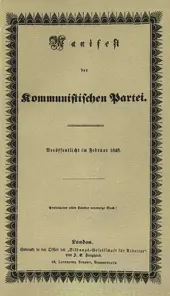
(The first edition of The Manifesto of the Communist Party, published in German in 1848)
An uprising in Vienna, an important Austrian city, sparked armed conflict in the region that eventually led to German and Austrian states erupting into pandemonium. During the early success of the lower and middle classes brawls, Germany attempted to offer King Frederick William IV of Prussia authority over its citizens because of the Prussian family’s tremendous influence in the region that would catapult Germany’s status to be among the top in the continent. Nevertheless, fear of losing domestic and foreign support from his allies forced King Frederick IV to decline the offer. In addition, a temporary Germanic congress named the Frankfurt Assembly had relevant, but diverse and uncoordinated, demands that left the institution, and unification effort, with little success. Without any harmonized leadership, goals or ideals and the Monarchies armies having better equipment and preparation, the political and military efforts of the German revolutionaries were met with failure and disappointment. The rebellious efforts of the lower and middle classes had failed once again.
Although Germany failed to capture the inspired spirits of the people during the Revolutions of 1848, the circumstance entrenched the Germanic people into the values of seeking more equitable opportunity and treatment. As a result, seeking patriotism and harmony for their country, Germany eventually became unified in 1870 after the Franco-Prussian War. Success in the Franco-Prussian war led to the Treaty of Frankfurt, which officially recognized the German Empire and named the now-deceased King Frederick William IV’s brother, William, the Emperor, making him William I of Germany.
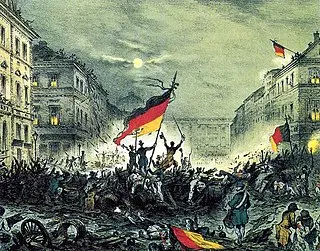
(Origin of the Flag of Germany: Cheering revolutionaries in Berlin, on March 19, 1848)
Let’s remember back to the Rothschilds for a second. Amschel Rothschild ran the Frankfurt Branch in Germany and survived the Germanic Revolutions of 1848 because of Austria’s ability to put down the revolt. However, Amschel passed away in 1855 and left control to his three nephews Anselm, Mayer Carl, and Wilhelm Carl Rothschild to see out the success of the family’s business. So how did they do?
Coincidently, Anselm’s father, Salomon, died in the same year as Amschel Rothschild, in 1855. Anselm married his first cousin and had 8 children together, mostly daughters. After Anselm’s father and uncle passed away, he created the Imperial and Royal, an intermediary government system that helped with the success of the Austrian-Hungary Dual Monarchy that ruled over south-eastern Europe from the middle of the 19th century to the first world war. The Imperial and Royal became the largest financer of government projects for Austria-Hungary and allowed for large amounts of success until their collapse. Furthermore, Anselm created the Creditanstalt AG, an Austrian bank that survived until it merged with the Bank Austria in 2002. Anselm gradually retired from the banking business after the 1860s when he started to work with and develop the Austrian Railway. As a result of his work with financing large projects and being a government aid, Anselm would be granted into the Austrian House of Lords in 1861. He died in 1871 in Austria.
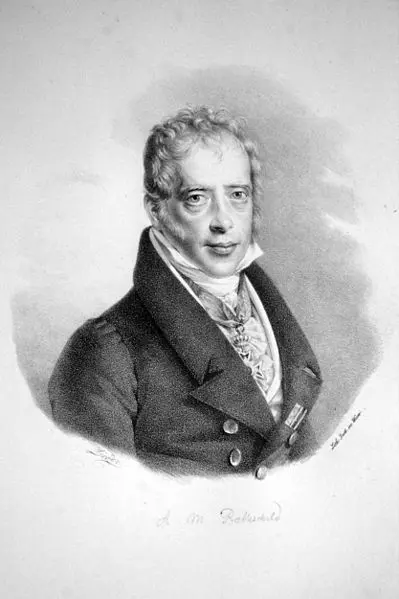
(Anselm Rothschild)
Mayer Carl Rothschild was more focused on Germany. In 1854 the Frankfurt branch was given the contract to become the sole banker for the Court of Prussia. In addition, he was appointed as a government representative in Frankfurt, Bavaria, and Austria. Finally, he became the first jew to ever be granted the status of House of Lords in Prussia in 1871. He also married his cousin and had 7 kids together. He died in 1886.
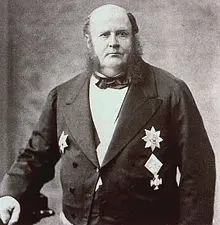
(Mayer Carl Rothschild, Date Unknown)
Wilhelm Carl Rothschild was an important figure in the Vienna and Frankfurt Rothschild branches. After Mayer Carl’s death in 1886, he came the sole decision-maker of the Frankfurt branch, and after Wilhelm Carl died in 1901 without any male heirs, the Frankfurt branch was shut down and their assets were spread to the London, Vienna, and Paris branches.
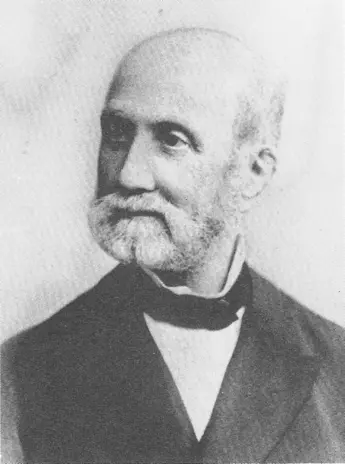
(Baron Wilhelm Carl)
Austrian Revolutions of 1848
Now we can discuss the changes that were occurring in Austria during the Revolutions of 1848. The common themes of mistreatment, oligarchs amassing never-before-seen wealth, and the lower and middle classes being impoverished are dominant in this region as well. In addition, many of the different social, religious and ethnic groups wanted to form new states with borders that would recognize their differences. At this time, Austria was among the largest empires in Europe, controlling important territories such as Vienna, and ethnicities like Germans, Hungarians, Slovenes, Poles, Czechs, Slovaks, Ruthenians (Ukrainians), Romanians, Croats, Venetians, Serbs, and plenty more. Prince Metternich was the largest influence in Austria during the time, he was the orchestrator of foreign, domestic, monetary, and military policy; and also had a tremendous connection with the Rothschild family.
This large amount of territory and influence gave Austria overwhelming military and political control over the region and resulted in the armed efforts of the revolutionaries being quickly squandered in many of these areas. Territory such as Germany would eventually be unified and other areas would see success down the road. However, the Hungarian region had deep connections with powerful Money Changers and demanded more political influence immediately, and they received it.
During the Revolutions of 1848 in Austria to stop the bleeding that was affecting the empire, Austrian Emperor Ferdinand appointed his nephew Franz Joseph to take over the throne, who took a more friendly stance with Hungarians. Ferdinand was getting old and his influence was being lost as quickly as his life.
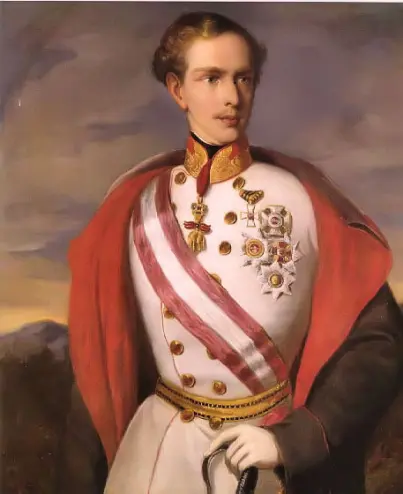
(A young Emperor Franz Joseph)
As a result of Franz Joseph being appointed leader of the region, the Austro-Hungarian Comprise of 1867 was agreed upon that dissolved Austria and created the dual monarchy of Austria-Hungary, the second-largest empire in Europe by land, only behind Russia. Hungary would be given equal status to Austria and Franz Joseph would be named the Emperor and King. Austria-Hungary would last until World War I when they would find themselves entering battle as a result of assassination attempts made on the family of Franz Joseph. We will discuss this later.
Notable countries that weren’t involved or did not have major uprisings during the Revolutions of 1848 include Great Britain, the Russian Empire, the Netherlands, and the Ottoman Empire. However, soon many European borders would be threatened due to more armed conflict in Europe and across the globe.
The story of common citizens fighting for their rights does not end after the revolutions or even after some of the countries unify. The cycle of Money Changers using their wealth to control the supply of money and goods that are necessary for human civilization to their benefit occurs throughout the globe, throughout history, throughout time; and especially today. In fact, it’s worse today than it ever has been. Without even realizing it, people sacrifice their labor, time and energy to get paid next to nothing compared to the wealth they are generating.
So, what did the Revolutions of 1848 teach us? It teaches us that an initial effort from almost every nation was met with failure. Melvin Kranzberg summarizes the Revolutions of 1848 in four parts. The first part is the Winter and Spring of 1848 when the revolutionaries had surprising success against the monarchies. Next in the summer of 1848 partisanship and disagreement were occurring among the commoners which led to turmoil and a halt in progress. In the fall of 1848, the monarchies began formulating plots to organize their counter-revolutionary attacks. Finally, from 1849 to 1851 the monarchies successfully overthrow the revolutionary regimes (“1848: A Turning Point?” 1962).
Even though the lower and middle classes battles were initially unsuccessful, the revolutions did lay the foundation for some countries to realize their independence and unify such as Germany in 1870, the Italian states after their capture of Rome, and Hungary becoming equal to the powerful Austrian Empire in 1867. Therefore, one lesson that should be taken away from reading this is that even though the initial effort is unsuccessful, after years of persistence and guiding principles that are coordinated among citizens, positive change can happen that puts new people at the table, and makes the table larger. That is until more war sparked in Europe. However, this war couldn’t be contained to a country, or even a continent; this war would span across the world.






