As the holiday season begins, Washington is pressing a pivotal debate over the future of U.S. digital asset policy.
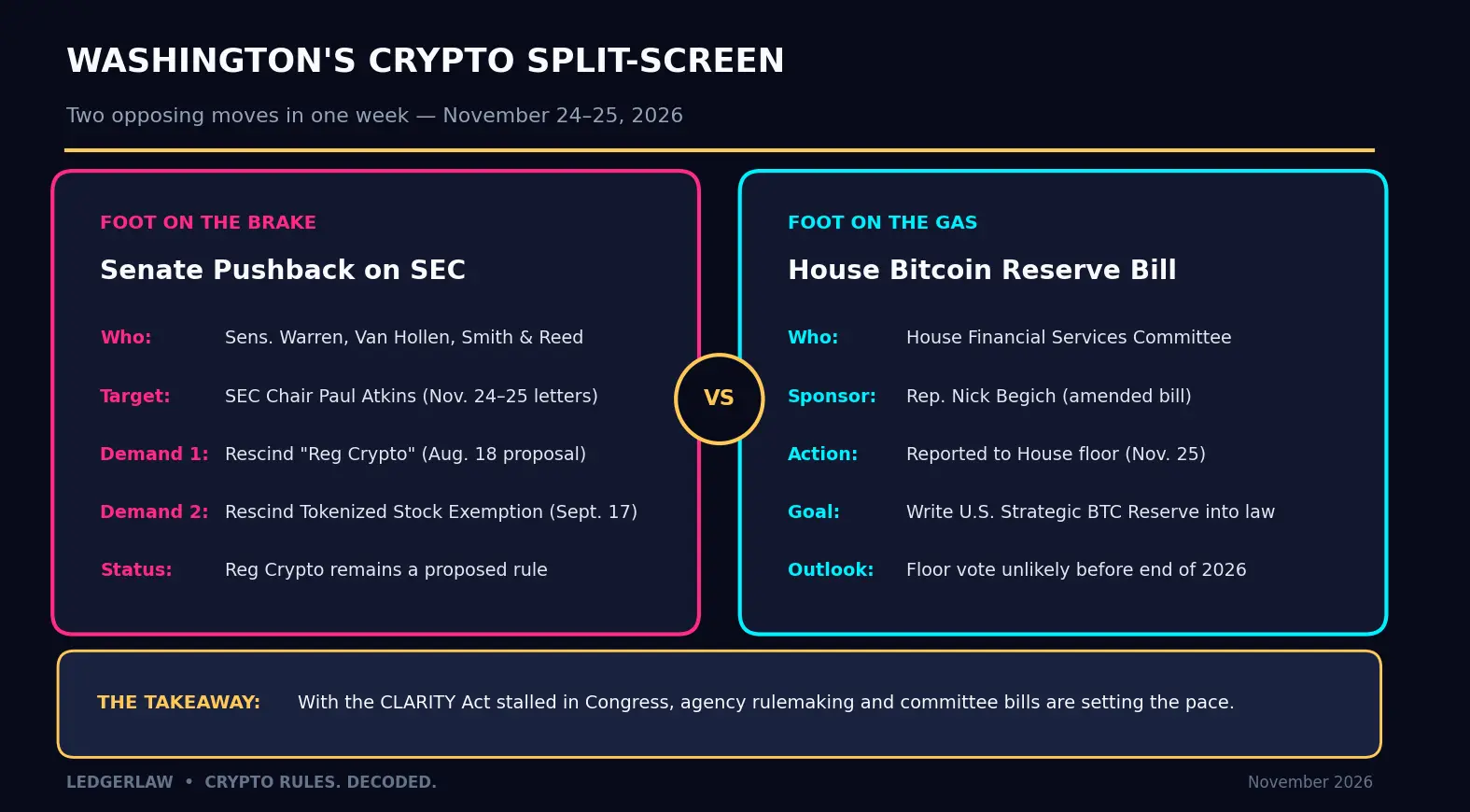
On November 25, opposing legislative and regulatory strategies collided on Capitol Hill. In the Senate, key Democratic leaders issued formal inquiries urging Securities and Exchange Commission (SEC) Chair Paul Atkins to rescind proposed regulatory exemptions for crypto assets. Simultaneously, the House Financial Services Committee advanced landmark legislation establishing a federal U.S. Strategic Bitcoin Reserve.
This continuing divergence over digital asset policy highlights the ongoing friction shaping the domestic oversight landscape between the two political parties.
Senate Oversight: Pushback Against Proposed SEC Exemptions
With comprehensive statutory legislation like the CLARITY Act delayed in the Senate, the SEC has sought to address market dynamics through administrative rulemaking. However, senior members of the Senate Banking Committee have raised significant concerns regarding this administrative approach. You can likely guess who at least one of the protagonists is.
Led by Senators Elizabeth Warren and Chris Van Hollen, alongside Senators Tina Smith and Jack Reed, lawmakers submitted formal correspondence urging Chair Atkins to reconsider two primary SEC initiatives:
Regulation Crypto Assets ("Reg Crypto"): Proposed in August 2026, this framework offers tailored capital-raising pathways for eligible digital asset issuers outside standard registration requirements. Critics argue the initiative dilutes standard disclosure requirements and undermines established investor protections.
Tokenized Equity Innovation Exemptions: Issued on September 17, 2026, this order provides conditional relief from select Regulation National Market System (NMS) provisions to enable secondary market trading of tokenized equities. The Senate pushback follows recent venue launches, including joint initiatives by OKX and Intercontinental Exchange (ICE).
Because Reg Crypto remains in the proposal stage, stakeholders expect active debate ahead of any final rule adoption. This also means, if you have an opinion, let pertinent policymakers know.
My goal is not to be partisan and I typically won’t make opinionated statements. However, I can’t ignore the consistent theme of the Democratic Party being the party of non-innovation dressed up in the guise of some form of “safety.” Of course, there are exceptions to any rule and if you would like to comment on any of these in the digital asset policy arena, I’d love to read it.
House Initiatives: Legislative Advancement of a National Bitcoin Reserve
At the same time, House leadership is pursuing formal statutory frameworks to institutionalize digital assets within national financial strategy.
The House Financial Services Committee officially reported Representative Nick Begich’s amended bill establishing a U.S. Strategic Bitcoin Reserve, positioning the measure for potential consideration by the full House chamber.
While scheduling constraints make a floor vote before year-end uncertain, committee approval marks a noticeable shift in federal policy discussions surrounding digital asset integration.
Strategic Implications
These simultaneous developments illustrate three key themes driving U.S. regulatory policy moving into 2027:
Legislative Delays Drive Executive Agency Action: Broad statutory consensus remains elusive, placing primary policy execution on Executive Branch regulatory bodies such as the SEC and CFTC.
Administrative Rulemaking Under Scrutiny: As agencies utilize exemptions to facilitate market integration for tokenized assets, Congressional oversight of administrative authority has intensified.
Policy Durability Depends on Legislation: Administrative directives and agency orders provide immediate flexibility, but clear statutory frameworks are necessary to establish long-term regulatory certainty.
As these competing approaches develop, the balance between fostering financial innovation and enforcing traditional market safeguards will define the regulatory landscape in 2027. Given the “Blue Wave” in the latest round of U.S. elections, it’s safe to say that the bicameral policy differences will be replaced by an increasingly wide chasm between the policy views of the Executive and Legislative Branches. For Chief Justice John Roberts, 2027 won’t likely be a boring year.
For informational purposes only. Not legal or investment advice.