
The most fascinating race on the cycling scene returns to the Olympics. It was eliminated from the Olympic program because only the men's category was scheduled, but from Tokyo 2020 there will also be a women's race.
It is a "prehistoric" race born more than 120 years ago. Now I will briefly explain why such a race was invented, then we will see the main rules. That way I hope you can fully enjoy the Olympic races coming up soon.
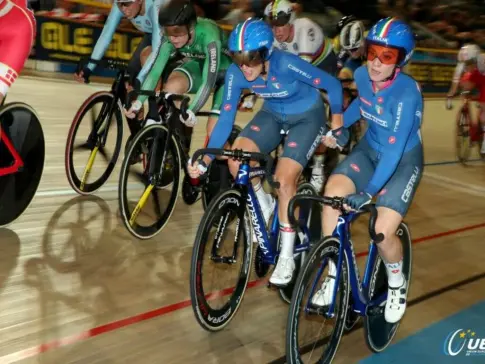
the modern female race
Madison THE HISTORY :
The Madison was created to circumvent laws passed in New York in the United States designed to limit the exhaustion of cyclists participating in six-day races. American spectators' passion for six-day races had led athletes to exceed their limits as competition promoters were willing to pay exorbitant amounts of money to sign up the best athletes. Often the cyclists literally came out in pieces from the six days.
To overcome these problems, in 1898, a limit was imposed: cyclists could not run more than 12 (TWELVE!) hours a day.
The promoter of the Madison Square Garden contrary to the limit imposed decided to give a partner to each cyclist so as to obtain 24-hour races; after all, 12 hours per cyclist for two cyclists equals 24 hours of racing! The idea became immediately successful because the introduction of two athletes increased the resistance of the individual and raised the speed and the show.
The name of the competition comes from Madison Square Garden, the place where the race was inaugurated.
Curosity: in italy the race is still called "Americana".
on video madison at the six days of berlin
OVERVIEW
In the Madison a series of teams (of two cyclists) compete in giving each other a touch or hand in hand. This test is very iconic of track cycling as it is the one that usually places the conclusion of the "six days".
The standings are determined by the number of laps completed by each pair and the points scored in the intermediate sprints placed during the race.
The Madison has come to the modern format of 200 laps of racing with both riders on the track at the same time. The first runs on the black line (called rope), this is in the race for all intents and purposes and can participate in the intermediate sprints. The other instead rests higher catching up until he is caught up, at which point the switch occurs and the cyclists reverse roles. A team wins by earning laps on the course or by accumulating the most points in the special sprints that are designated every 20 laps (250m track).
Ranking is based on the number of laps completed by the pair and the following points are awarded for each intermediate sprint:
- 5 points to the first place finisher,
- 3 points to the second classified
- 2 points to the third classified
- 1 point to the fourth classified
If there is a tie by adding the points to the number of laps, the winner is determined by the result of the final sprint.
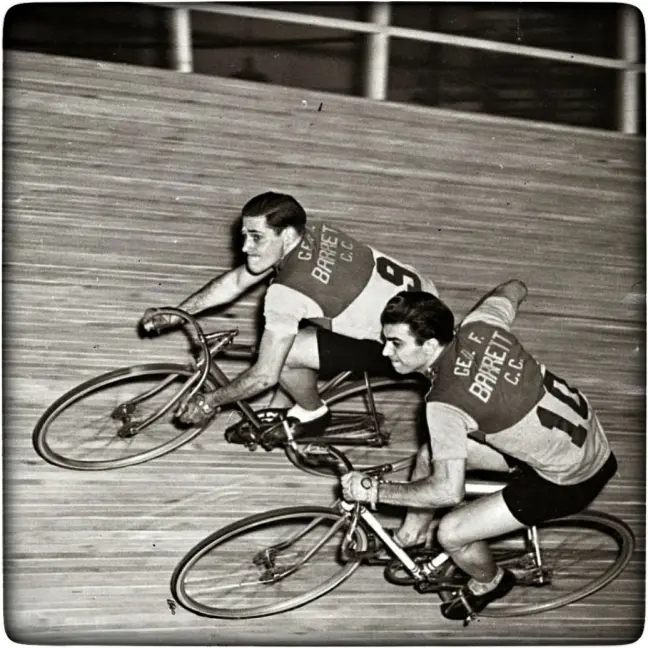
Ed Carfagnini and Bill Jacoby @ Chicago Coliseum Velodrome 1942
MADISON: The main rules
The official rules of the Madison are stated as follows by British Cycling (excerpt):
- Teams must be of two or three riders (two in the Olympics)
- There must always be one rider from each team in the race.
- Riders may take turns at any time during the race.
- The touch can be a push or a hand.
- The winner will be the team with the most laps.
- If two or more teams are on the same lap, the outcome will be determined by the team that won the most sprint points
- In the event of a tie in laps and points, the winning team will be the best team in the final sprint.
- A chime (of a bell) must be sounded to indicate a missing lap before a sprint.
- A bell will be rung at the start of the last lap.
With this brief overview, I hope that those who have not yet heard of this race can enjoy it in its spectacularity.
I leave the Olympic program below:
MADISON FINAL WOMEN 6 Aug 10:15 am (ROME); 4:15 am (NY); 17:15 (TOKYO)
MADISON FINAL MEN 7 Aug 9:55 am (ROME); 3:55 am (NY); 16:55 (TOKYO)
As usual I invite you to leave a LIKE and subscribe to all our communication channels to support the project. There will be good news and probably some gifts to those who follow us more assiduously.





