Beyond the Horizon: The Forgotten History of Global Slavery
Most modern discussions about slavery focus on the Transatlantic trade, but history reveals a much broader, global narrative. To understand the world today, we must look at how forced labor and human trafficking affected various populations across centuries and continents.
1. THE ETYMOLOGY OF "SLAVE":
The Slavic People
It is a little-known fact that the English word "slave" actually derives from the word "Slav." During the Middle Ages, millions of Slavic people from Eastern Europe (modern-day Ukraine, Russia, and Poland) were captured and sold into the Ottoman Empire and across the Mediterranean.
2. THE BARBARY SLAVE TRADE (15th – 19th Century)
While many focus on European colonial expansion, there was a massive reverse-flow of human trafficking. Pirates from the Barbary Coast of North Africa raided European shores, kidnapping people from as far as **Ireland and Iceland.
The Scale: An estimated 1 million to 1.25 million Europeans were captured and sold in North African markets.
The Impact: Entire coastal villages in Europe were abandoned for centuries due to the fear of these raids.
3. ANCIENT ROME: SLAVERY WITHOUT BORDERS
In the Roman Empire, slavery was not defined by race but by conquest. After Julius Caesar’s campaigns in Gaul (France) and Britain, millions of white Europeans were brought to Rome in chains. At the height of the Empire, the abundance of European captives caused the market price for human beings to plummet.
4. The Colonial Pattern: Australia and Beyond
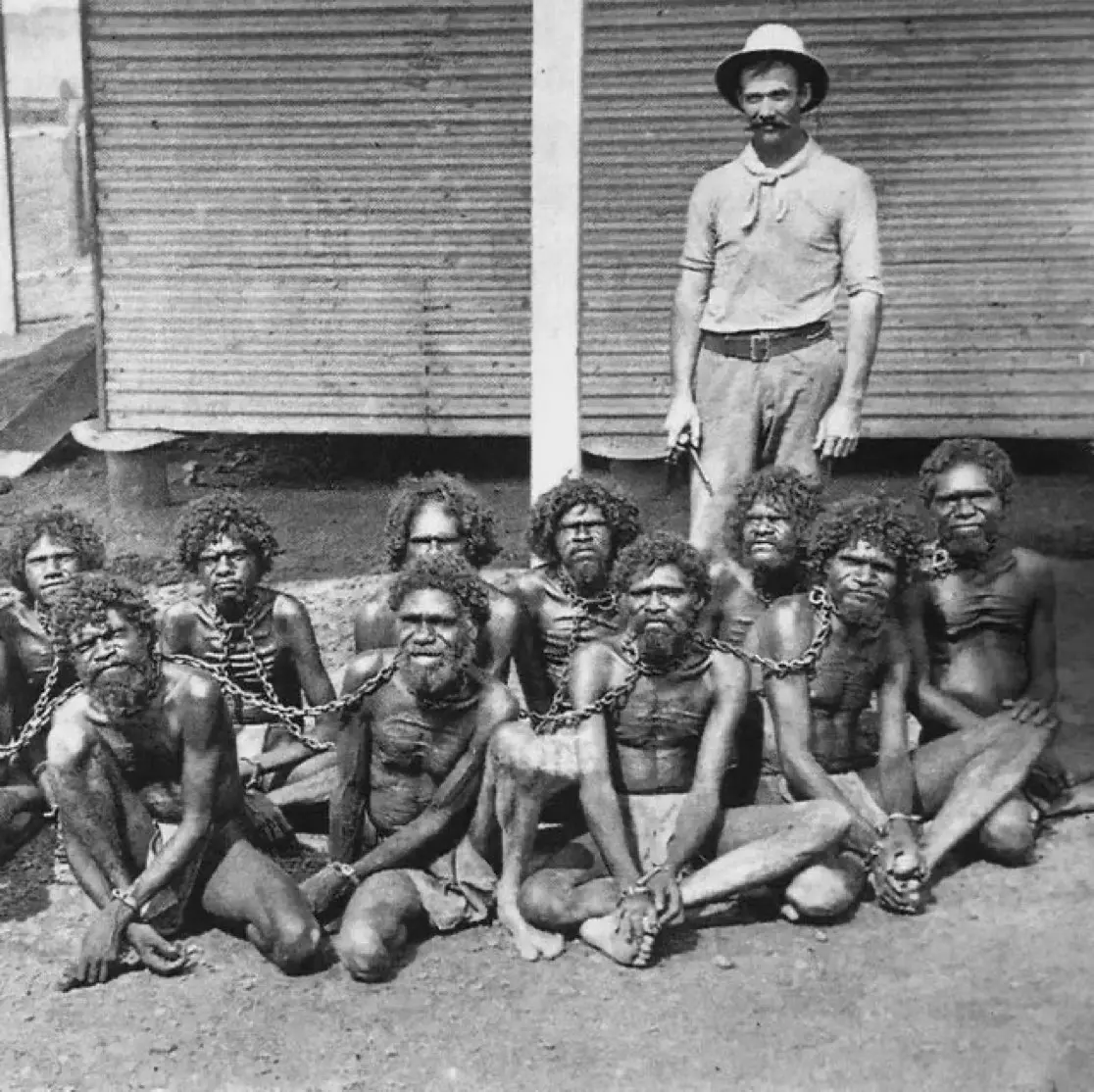
The methods of control used during the colonial era were strikingly similar across the globe. Whether in the Congo or the Australian Outback, the use of heavy iron neck chains was a standard tool for subjugating Indigenous and Black populations.
A famous 1901 photograph from Wyndham, Western Australia, serves as a haunting reminder of this reality. It depicts Aboriginal men in 2.4kg neck chains—a practice that persisted in parts of the world well into the 20th century.
Conclusion: A Shared Human Struggle
Slavery is a dark thread woven through the history of almost every nation. Recognizing that different races—including Europeans, Africans, and Indigenous Australians—have all faced the horror of the chain helps us understand that the struggle for human rights is a truly global story.
Looking at what is happening now In the world who should we blame?