If you read the Western business press over the past few months, or even the past few years, a fairly clear picture emerges. China is confidently dominating global trade, its industry is catching up with and, in some areas, overtaking Europe, while its automotive sector is putting serious pressure on American and European giants. And, to be honest, these claims are not without foundation. China's export figures and the pace of Beijing's technological expansion are genuinely impressive.
Almost a month ago, I already looked at how this very trade expansion forced the European Union to introduce countervailing duties on Chinese electric vehicles and prepare new protective barriers in my article Why Is Europe Starting to Restrict Chinese Imports?
But, as always, whenever I see something that looks so impressive and ideal, I want to look behind the scenes of these headlines and see how the country's domestic market is actually doing. And believe me, there is plenty to look at. Against the backdrop of all the talk about global dominance, the key blue-chip index, the CSI 300 ( which tracks the 300 largest companies listed in Shanghai and Shenzhen and, in terms of its economic influence and concentration in major companies, is somewhat similar to the S&P 500 and Dow Jones ), recorded 12 consecutive weeks of losses at the end of October 2026. This was the longest uninterrupted losing streak in the index's history, according to Reuters data.
Over those 12 weeks, the index fell by approximately 14%, while its total decline from the summer highs reached around 20%, officially pushing the market into bear territory. Although stock prices managed to break this streak with small technical rebounds in early November ( particularly during the weeks of November 2-6 and November 9-13 ), the decline resumed in the second half of the month.
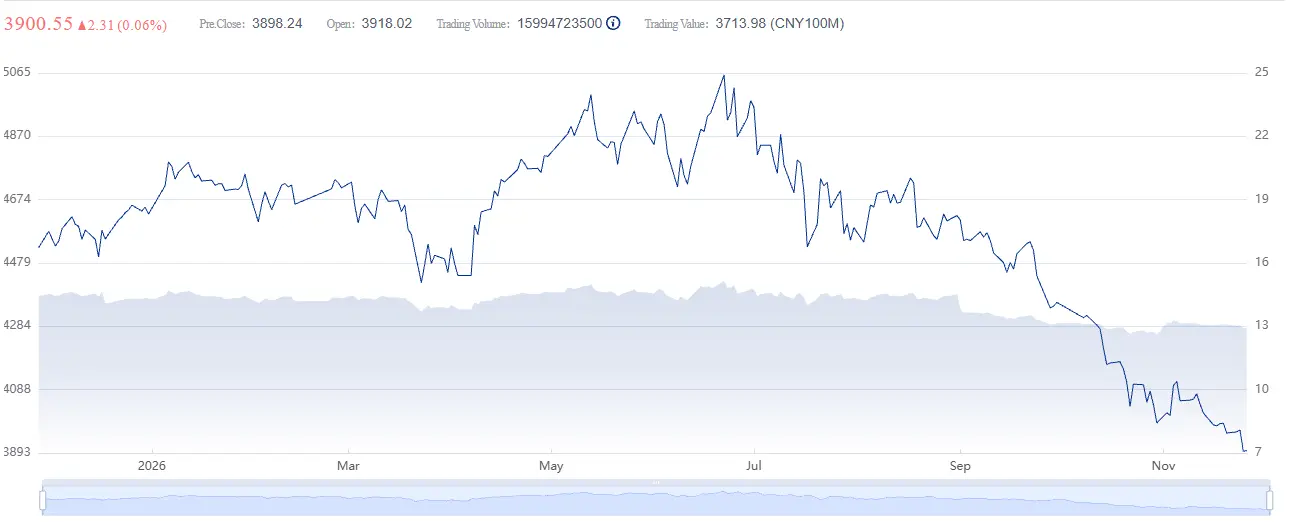
The Chinese government is trying to stabilize the situation through direct intervention by state investment funds ( the so-called "national team" ). However, capital outflows continue. When I started putting these figures together, it became clear that the problem was not an isolated stock market panic, but rather a combination of structural factors that had been building up in the Chinese economy over the past few years.
The first thing that caught my attention was the structure of the summer rally. According to analysts, including Goldman Sachs, companies linked to artificial intelligence and semiconductors became the main drivers of the market in the first half of the year, accounting for a significant share of market capitalization and trading volume in China and Hong Kong. In my view, such a concentration of capital in a single segment always creates dangerous fragility. Once one sector starts to weaken, it can drag the entire index down with it.
That is exactly what happened in the autumn. The Shanghai STAR 50 technology index plunged approximately 40% from its summer highs.
Here, I want to make a small remark about the valuation of these assets. According to Reuters, at its summer 2026 peak, the STAR 50 index was trading at an average P/E ratio of around 250. Even after the autumn crash, this figure had fallen only to approximately 100 ( for comparison, the US technology index NASDAQ 100 traditionally trades at around 30 ). In simple terms, the market was pricing in expectations that these companies were physically unable to meet over the next few quarters.
When third-quarter corporate earnings reports came out, it became clear that the profits of many technology giants and companies included in the MSCI China index had failed to meet expectations. A large-scale correction followed.
Shares of heavily hyped robotics manufacturers (such as Unitree) and chip developers ( MetaX and Moore Threads ) fell significantly.
Suppliers of optical components for data centers ( Eoptolink and Zhongji Innolight ) also suffered substantial losses after discussions intensified in the United States about new restrictions on the use of Chinese equipment in overseas server infrastructure.
The situation is further complicated by the composition of market participants. On mainland Chinese exchanges, individual retail investors play the dominant role. Unlike large funds, which tend to invest for the long term, ordinary investors are more prone to emotional decisions and tend to withdraw their money as soon as the market turns around.
And this is precisely the point I would like to emphasize.
Capital Migration
A natural question came to mind. How did the technology sector become so overheated so quickly in a country where ordinary families have traditionally been afraid of risky investments? I tend to believe that the answer lies not on the stock exchange, but in demographics and the prolonged real estate crisis.
For decades, real estate was the main store of wealth for Chinese families. The lion's share of household wealth was tied up in apartments. However, this model has hit a wall. According to official data, China's population has been declining for four consecutive years ( from 2022 to 2025 ). I would venture to suggest that this trend will not only continue in 2026 but may become even more pronounced. However, I should note that the final figures for the year are not yet available. Birth rates remain at historic lows, while real estate investment in 2026 continues to decline amid falling housing prices.
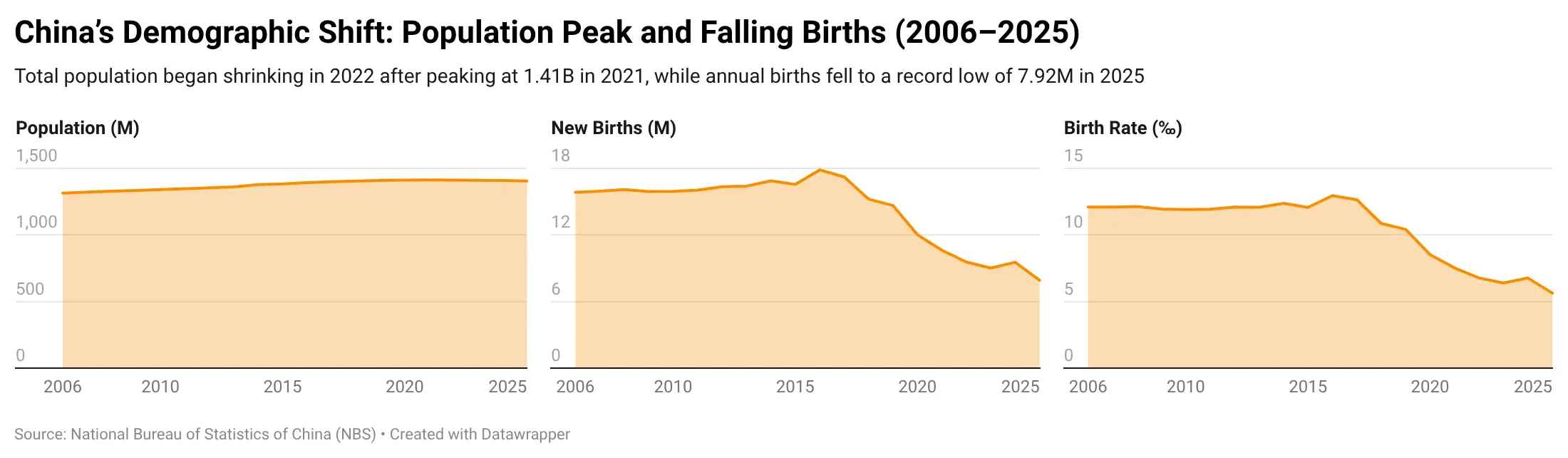
My hypothesis is that once real estate stopped generating the returns people were accustomed to, household savings and domestic investment capital began flowing into sectors prioritized by Beijing, particularly AI, microelectronics and robotics. However, China's technology market turned out to be too narrow to absorb such a large amount of money. Speculative demand pushed stock prices higher, even though the underlying fundamentals, in the form of rapid earnings growth, were not yet there.
To put it simply, shares of Chinese technology companies were not rising because these businesses were already making enormous amounts of money. They were rising because, following the real estate crisis, both ordinary Chinese citizens and major investors began looking for somewhere else to put their capital.
Looking at the bigger picture, the stock market crash is just one manifestation of an increasingly serious imbalance in the Chinese economy. From the outside, the country looks powerful thanks to its exports, but problems continue to accumulate within its domestic market.
On the surface, the figures look convincing. China's GDP grew by 4.5% year-on-year in the third quarter of 2026, while its trade surplus reached record levels thanks to strong exports of electric vehicles, batteries and semiconductors. ( However, as we have already seen from the EU's countervailing duties on electric vehicles and the tariff pressure from the United States, foreign markets are increasingly closing themselves off to this flow of goods. )
Inside the country, however, capital is behaving extremely cautiously. This is clearly reflected in several indicators.
Domestic consumption remains weak. Retail sales are growing at only slightly more than 1% per year. Chinese families traditionally save a significant portion of their income, and falling property prices make people feel poorer, making them even less willing to spend.
Chinese state-owned banks remain the largest in the world by total assets, but making money is becoming increasingly difficult for them. According to data from China's financial regulator, the NFRA, for the first nine months of 2026, the profitability of bank lending fell to a historic low of approximately 1.4%. The government is forcing banks to issue cheap loans to support the economy, while the number of non-performing loans that borrowers cannot repay continues to grow, particularly at smaller regional banks.
With stocks falling and real estate no longer generating returns, banks and investors are rushing to buy Chinese government bonds. In November 2026, this surge in demand pushed the yield on 10-year government bonds down to a historic low of around 1.60% annually. To me, this is one of the clearest indicators of market sentiment. Chinese market participants themselves are preparing for the possibility that the economy will continue to slow for a long time and that prices across the country will keep falling.
In addition, China's regional governments are running out of money. Local budgets relied for years on land sales to property developers, but those revenues have now collapsed, while provincial debt has reached enormous levels. As a result, local authorities lack sufficient funds for new infrastructure projects and even for supporting agriculture, which has traditionally provided a safety net for migrant workers who lose their jobs in cities.
Personally, I see this autumn downturn and the record 12-week losing streak as a natural reality check for the market. Yes, Beijing has enormous financial resources and a powerful industrial base. It is certainly capable of using state funds to slow a market collapse or periodically trigger short-term stock market rebounds, as happened in early November.
However, based on my experience observing financial markets, government cash injections work only as a painkiller. They do not cure the underlying disease. As long as domestic demand remains constrained by the housing crisis, and the technology sector struggles to recover from the collapse of inflated expectations surrounding AI and export restrictions, China's trade records do not guarantee the stability of its stock market.
A real recovery will not begin when state funds buy up yet another market dip. It will begin when Chinese investors themselves stop hiding their money in government bonds yielding 1.6% and start putting it back into the real economy.
Thank you for reading.