For years, one of the biggest challenges in cryptocurrency has been transforming digital assets from something people simply hold into something they can actively use. While many blockchain projects talk about utility, true utility emerges when assets become part of a functioning economy, creating opportunities for lending, borrowing, saving, and growth without sacrificing decentralization.
The concept of a lending and borrowing market built around DigiDollar (DD) represents an interesting step in that direction. By connecting DigiDollar holders with users seeking access to stable-value digital currency, such a system could create an entirely new layer of economic activity within the broader DigiByte ecosystem.
The Missing Piece of Digital Asset Utility
Most cryptocurrency users are familiar with a common dilemma. An individual may own a valuable asset such as DigiByte (DGB), believe strongly in its long-term future, and have no desire to sell it. At the same time, that individual may need liquidity for trading, spending, business activities, or participation in the wider digital economy.
Traditionally, the only options are to sell the asset, reducing future exposure, or simply leave it sitting idle in a wallet.
A DigiDollar lending market introduces another possibility.
Instead of selling DGB, users could potentially lock their DigiByte as collateral and borrow DigiDollar against it. This allows them to retain ownership of their DGB while still gaining access to a stable digital asset that can be used for transactions, payments, or other financial activities.
At the same time, DigiDollar holders could supply DD to lending pools and earn yield from borrowers who pay interest on their loans.
The result is a system where assets that might otherwise remain inactive can begin contributing to a productive ecosystem.
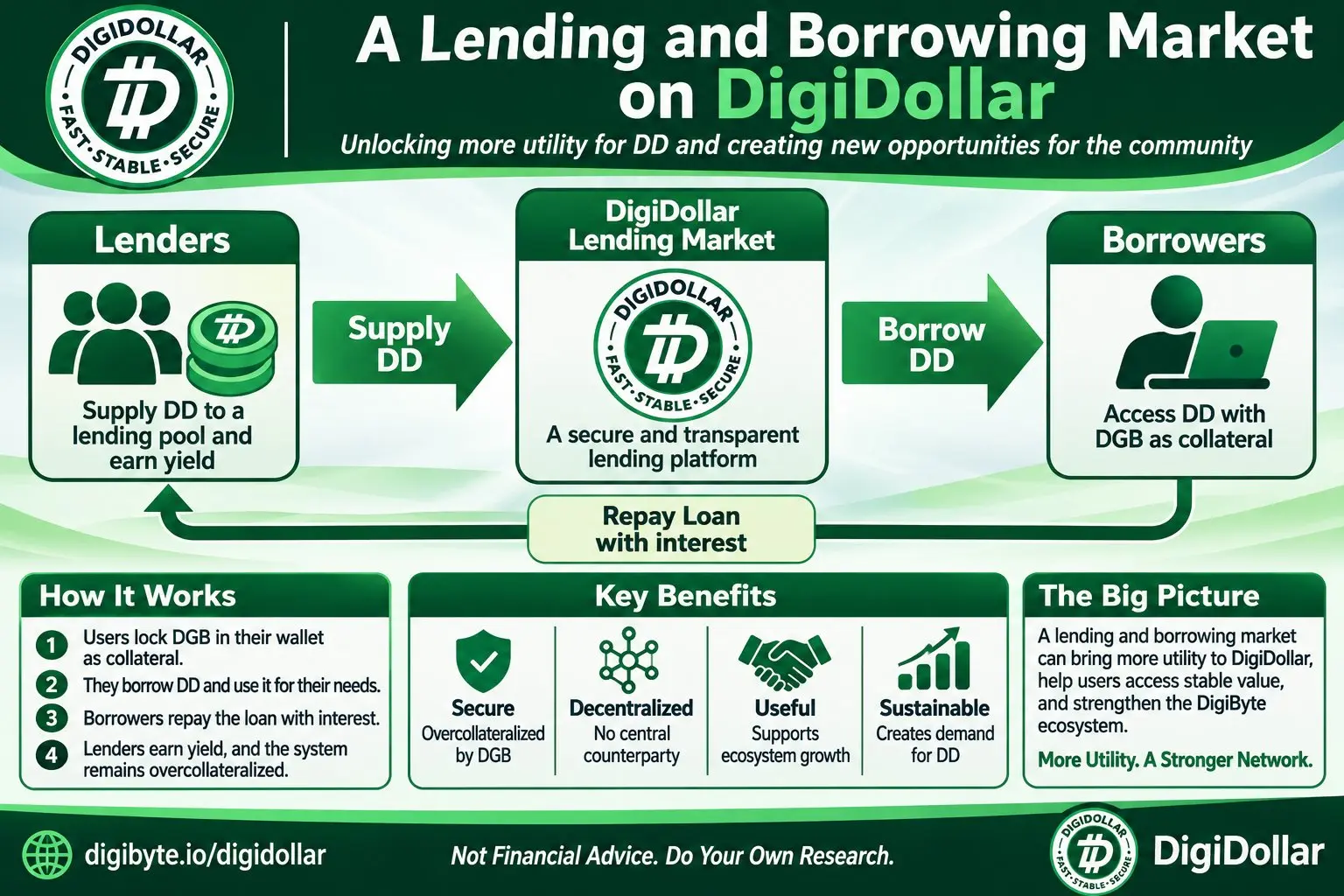
How the Model Works
At its core, the concept is straightforward.
Step 1: Lenders Supply DigiDollar
Users holding DigiDollar deposit their DD into a lending pool. These funds become available for borrowers.
In exchange for providing liquidity, lenders earn a share of the interest paid by borrowers.
Rather than keeping DigiDollar dormant in a wallet, participants gain an opportunity to put the asset to work.
Step 2: Borrowers Lock DGB as Collateral
Borrowers who need stable liquidity deposit DigiByte as collateral.
The collateral acts as security for the loan and helps ensure the system remains solvent.
Because DGB secures the borrowed amount, the protocol remains protected against default.
Step 3: DigiDollar Is Borrowed
Once collateral requirements are met, borrowers receive DigiDollar from the lending pool.
The borrowed DD can then be used for various purposes:
Trading
Payments
Business transactions
Ecosystem participation
Liquidity management
Stable value storage
Importantly, borrowers continue holding ownership rights to their underlying DigiByte collateral as long as loan obligations are maintained.
Step 4: Loan Repayment
When borrowers repay the DigiDollar loan plus any applicable interest, their locked DigiByte collateral is released back to them.
This creates a complete lending cycle in which lenders earn returns and borrowers gain access to liquidity without permanently selling their assets.
Why Over-Collateralization Matters
One of the most important aspects of any decentralized lending system is risk management.
The proposed DigiDollar model relies on over-collateralization.
In practical terms, this means a borrower may need to lock significantly more value in DigiByte than the amount of DigiDollar being borrowed.
For example, a user might lock $150 worth of DGB to borrow $100 worth of DigiDollar.
This additional collateral creates a safety buffer for the system.
Cryptocurrency markets are known for volatility. By requiring excess collateral, the lending market can better withstand price fluctuations while protecting lenders whose DigiDollar is supplied to the pool.
This approach has become a widely recognized mechanism in decentralized finance because it prioritizes solvency over excessive risk-taking.
Strengthening DigiDollar Through Utility
Stablecoins often face a simple problem.
If a stable asset has no meaningful use cases, demand can become limited.
A lending and borrowing market changes that dynamic by creating an organic reason for users to acquire and hold DigiDollar.
Borrowers need DD to access liquidity.
Lenders need DD to earn yield.
Traders may use DD as a stable pairing asset.
Businesses may prefer a stable medium of exchange.
As additional use cases emerge, DigiDollar transitions from simply being a digital representation of value into a functional economic tool.
Utility creates demand, and demand supports ecosystem growth.
Benefits for the DigiByte Ecosystem
Perhaps the most exciting aspect of a DigiDollar lending market is the effect it could have on the broader DigiByte economy.
Increased Demand for DGB
Because DigiByte serves as collateral, borrowing activity naturally creates demand for DGB ownership.
Participants must acquire DigiByte before they can access loans.
As adoption grows, the collateral layer itself becomes increasingly valuable.
Enhanced Ecosystem Activity
When users can lend, borrow, save, and transact without leaving the ecosystem, overall activity increases.
Instead of value continuously flowing outward toward external platforms, economic activity remains within DigiByte-related services.
New Opportunities for Holders
Long-term DGB supporters gain additional options.
Rather than choosing between selling or simply holding, users gain another path that allows them to leverage their holdings while maintaining exposure to DigiByte's future.
Greater Financial Flexibility
Access to stable, collateral-backed liquidity can provide users with tools that traditional cryptocurrency markets often lack.
This flexibility may encourage further innovation and adoption across DigiByte-focused applications and services.
Decentralization Matters
One concern frequently raised in the cryptocurrency industry is the growing dependence on centralized platforms.
Many lending services historically required users to surrender custody of assets to a company, trust a third party, and depend on centralized decision-making.
A properly decentralized lending model seeks to reduce these dependencies.
Rather than relying on a central counterparty, the system operates through transparent rules, collateral requirements, and blockchain-based verification mechanisms.
For supporters of decentralized networks such as DigiByte, this distinction is significant.
The original vision of cryptocurrency was not simply digital money. It was financial independence, self-custody, and open participation without requiring permission from centralized gatekeepers.
A DigiDollar lending market aligns closely with those principles when built around transparency and decentralized operation.
Looking Toward the Future
The cryptocurrency industry often focuses on hype, speculation, and the next big trend. Yet the projects that endure tend to be those that steadily build practical utility over time.
A DigiDollar lending and borrowing market has the potential to represent exactly that type of development.
By enabling users to earn yield on DigiDollar, borrow against DigiByte collateral, access stable liquidity, and participate in a self-sustaining economic system, the concept introduces functionality that extends beyond simple buying and holding.
Whether viewed from the perspective of lenders, borrowers, DigiDollar users, or long-term DigiByte supporters, the idea points toward a more active and interconnected ecosystem.
The ultimate goal is simple: create real reasons for people to use the network every day.
And in the world of blockchain, utility has always been the foundation upon which lasting ecosystems are built.