
Every day, the crypto industry debates scalability, affordability, and real-world utility. Many blockchains promise fast transactions and low costs, but few consistently deliver both while maintaining decentralization.
Recent on-chain data from DigiByte provides a powerful example of what an efficient blockchain network looks like in practice.
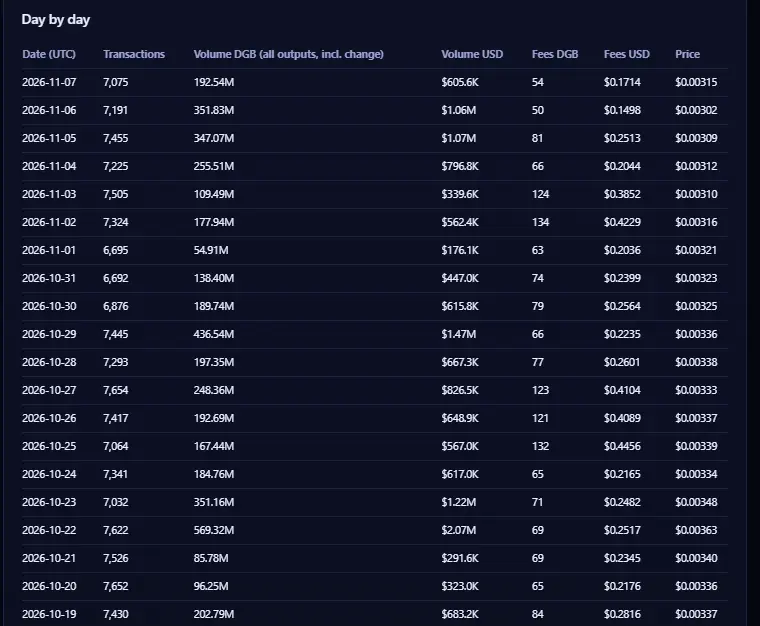
On November 7, 2026, the DigiByte network processed 7,075 transactions, transferred approximately 192.54 million DGB, representing about $605,600 USD in value, while collecting only 54 DGB in total network fees, worth roughly 17 cents USD.
Let that sink in.
More than half a million dollars in value moved across the network, secured by a decentralized blockchain, for less than the cost of a cup of coffee.
Efficiency at Scale
One of the biggest challenges facing blockchain adoption has always been transaction costs.
Many users have experienced networks where transaction fees rise dramatically during periods of heavy usage. In some ecosystems, sending a transaction during peak demand can cost several dollars, and sometimes even much more.
DigiByte demonstrates a different approach.
The network processed thousands of transactions while maintaining fees so low that the total cost paid by all users combined was only a few cents.
This is exactly how a payment network should work.
Users should be able to send value without worrying that fees will become larger than the transaction itself.
Real Utility, Not Just Speculation
The most impressive figure may not be the transaction count or even the fees.
It is the amount of value being transferred.
Daily network activity shows hundreds of thousands, and often more than a million dollars, moving across the blockchain. Looking at the recent statistics, multiple days exceeded $1 million USD in daily transfer volume, with some days surpassing $2 million USD.
This highlights an important fact:
People are actually using the network.
Value is moving. Transactions are being settled. The blockchain is performing its intended purpose.
While much of the cryptocurrency industry is focused on speculation, DigiByte continues to quietly function as a working decentralized network.
Decentralization Without the Cost
DigiByte's architecture was designed around speed, security, and decentralization.
Unlike many newer projects that sacrifice decentralization for higher throughput, DigiByte maintains a globally distributed blockchain secured by multiple mining algorithms while still delivering extremely low transaction costs.
The result is a network where users can:
Send payments quickly
Transfer large amounts of value
Avoid expensive fees
Retain control of their own assets
Operate without relying on centralized intermediaries
These characteristics become increasingly important as centralized exchanges and regulated platforms continue introducing additional compliance requirements, restrictions, and transaction monitoring.
Preparing for a Peer-to-Peer Future
The significance of low fees becomes even greater when considering DigiByte's upcoming peer-to-peer marketplace initiatives.
A functioning decentralized marketplace requires affordable transactions.
If buying and selling goods costs several dollars per transaction, widespread adoption becomes difficult.
However, when transaction costs are measured in fractions of a cent, entirely new economic possibilities emerge:
Peer-to-peer commerce
Direct digital payments
Global trading without intermediaries
Microtransactions
Community-driven marketplaces
Cross-border transactions with minimal cost
This is where DigiByte's blockchain infrastructure could become a major advantage.
The network was built not only to store value but also to facilitate the movement of value efficiently.
The Bigger Picture
Many people evaluate a blockchain based on price alone.
Yet price rarely tells the complete story.
Network activity, transaction volume, user participation, decentralization, and real-world utility often provide a much clearer picture of a blockchain's long-term strength.
The latest DigiByte statistics reveal a network that continues to process substantial amounts of value while keeping costs nearly invisible to users.
Hundreds of thousands of dollars move across the blockchain.
Thousands of transactions are settled.
The network remains decentralized.
And the cost to use it remains remarkably low.
In an industry constantly searching for scalable blockchain solutions, DigiByte continues to demonstrate that efficient, decentralized, low-cost transactions are not just a future goal.
They are happening today.






